 |
| Mangos grown in Málaga, Osteen variety, are in season now. |
My little mango tree again produced a single fruit. It was the best mango I’ve ever eaten, but it was soon gone. Happily, Málaga mangos are in season. I bought locally-grown ones from the couple who has a clothing shop that I pass on the way to the market. So, for a few weeks, I’m rolling in mangos. Besides breakfast, maybe a mango tart?
 |
| Luscious. no-bake mango tart has cuajada, cream cheese and whipped cream and is set with gelatin. An easy crumb crust doesn't need baking either. |
 |
| Diced fresh mango can be scattered on top of the tart before chilling or served alongside. Alternatively, cook the mango with sugar and ginger and spoon the fruit and syrup over the slices when serving. |
 |
| Whipped cream makes a very rich mango mousse, but low-fat products can be used instead. |
 |
| Option: instead of filling a tart shell with the mousse, spoon it into dessert coupes. They can be served chilled or frozen. |
 |
| Mix and match the dairy components of this tart. At the bottom left are small cartons, of cuajada, unsweetened milk custard. Clockwise, above, is mascarpone, a cream cheese that can be substituted for the "original" cream cheese at the bottom. "Estilo griego" is thick Greek-style yogurt, much tangier than cuajada. On the upper right is "queso fresco batido," a no-fat, whipped fresh cheese, somewhat like cottage cheese in taste. On the right is "nata para montar," whipping cream. In the center is no-fat plain yogurt. Other ingredients, not shown, that could be used to make the mousse are requesón, which is similar to ricotta, and cottage cheese. |
This week someone brought a lovely no-bake cheesecake with a fruit topping to a friend’s birthday party. The cheesecake wasn’t set with gelatin, but with cuajada. I was intrigued.
 |
| Cuajada, unmolded. |
Cuajada is a sort of “custard” with no eggs. Cuajo, an enzyme (rennet or junket), sets the custard. Cuajada is, basically, the first step in cheese making. But, instead of cutting the curds and draining off the whey, the thickened milk is poured into cups and allowed to cuajar, set. Cuajada is served with honey, fruit and nuts, an old-fashioned traditional dessert in Euskadi (Basque Land).
In Spain, supermarkets sell packets of powdered ready-mix cuajada, similar to junket pudding mix in the U.S. This is what is used to make the no-bake cheesecake. The cuajada powder contains sugar, which I don’t use. Instead, I bought cups of prepared, ready-to-eat. unsweetened cuajada in the dairy section. However, as the prepared cuajada was already coagulated, it wouldn’t work for setting the cheesecake. I used it as if it were yogurt or whipped cottage cheese to make a creamy, airy mango mousse with gelatin to fill the tart shell.
You can mix and match the dairy components. Use yogurt, cottage cheese or ricotta to replace the cuajada. Use more cream cheese and less yogurt and call the tart a “cheesecake.” Use non-fat yogurt and reduced-fat sour “cream” for a less rich version. Or, up the quantity of fruit and decrease the dairy component. Total volume of ingredients, fruit plus dairy, should be about 5 ½ cups for the given amount of gelatin.

Mangos (also figs) are so sweet that they hardly need added sugar in this dessert. Lemon juice points up their sweetness but isn’t needed to prevent oxidation, as mangos don’t darken with exposure to air. Most varieties of mango are somewhat fibrous. If you want an absolutely smooth mousse, after pureeing the fruit with the yogurt or cuajada and cream cheese, press the mixture through a sieve to remove fibrous bits.
If you prefer a soft-set mango mousse, decrease the gelatin and place the cream in dessert cups instead of the tart shell. Serve it with a spoon.
Use any favorite crumb crust, store bought, baked or no-bake. A 10-inch fluted flan ring with removable bottom is perfect for this tart, but it can also be made in a pie pan, springform mold or individual tart molds. (My tart, pictured, is smaller because I made the crumb crust first and then realized I had more than enough mango cream to fill it. The remainder filled four dessert cups.) Both the tart and dessert cups can be frozen.
No-Bake Mango Tart
Tarta de Mango sin Horno
How many mangos? Depends on their size. A one-pounder will make enough chopped fruit for this recipe. Smaller ones, you'll need two or three.
 |
| Easy way to cut a mango. |
You can peel whole mangos, then slice the flesh from the flattened center pit. Or, place a whole mango upright on the cutting board and slice downwards on both sides of the pit. Instead of peeling, score the pulp with a sharp knife, then gently bend the mango half so that it opens up into segments. Cut them away from the skin.
Serves 10.
1 ½ cups chopped mango (12-14 ounces peeled and pitted)
4 tablespoons cold water
2 tablespoons unflavored gelatin
2 cups plain (unsweetened) cuajada or yogurt
½ cup (4 ounces) cream cheese, softened
Zest of a small lemon
3 tablespoons lemon juice
½ teaspoon grated ginger
4 tablespoons sugar OR ½ teaspoon liquid stevia (optional)
1 ½ cups whipping cream, chilled
Crumb crust for a 10-inch pan (recipe follows)
Chopped fresh mango or mango in syrup, to serve
Peel and chop mangos to make 1 ½ cups.
Place the water in a small bowl and sprinkle the gelatin into it. Allow to soak for at least 5 minutes.
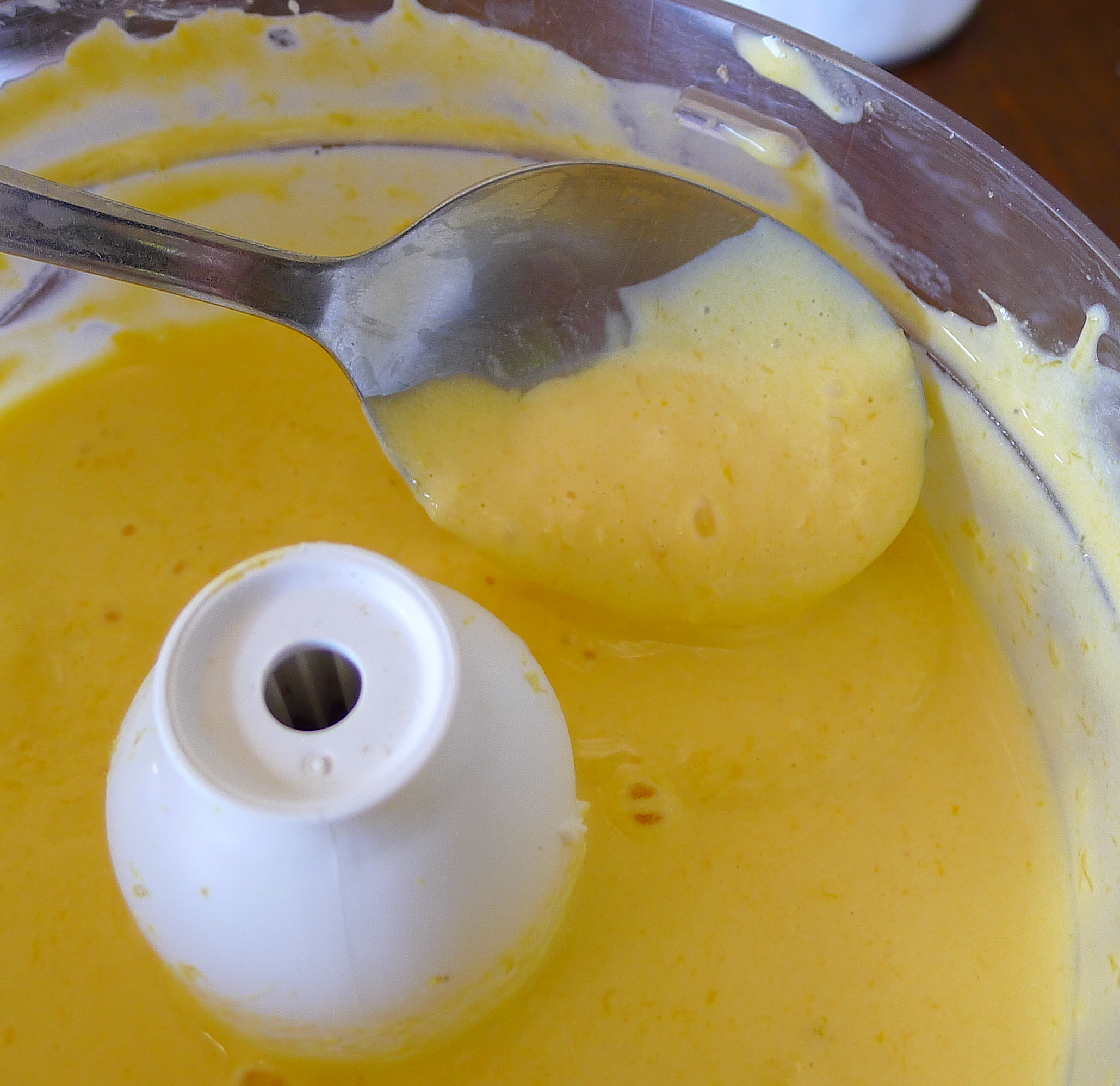 |
| Puree mango with yogurt. |
Combine the cuajada or yogurt, cream cheese and chopped mango in a food processor or blender. Process until smooth. Add the lemon zest and juice and ginger. Taste the mango cream mixture. If it needs sweetening, add 2 tablespoons of the sugar OR ¼ teaspoon of the stevia.
Add the softened gelatin to the processor and blend again until smooth.
Place the whipping cream in a large chilled bowl and, using chilled beaters, whip it until it holds soft peaks. Beat in remaining 2 tablespoons of sugar OR ¼ teaspoon of stevia.
 |
| Fold mango into cream. |
Fold the mango mixture into the whipped cream until thoroughly combined. Spread the filling evenly in the crumb crust. Chill the tart at least 8 hours before serving.
Serve slices of the tart with chopped fresh mango or mango that has been cooked in sugar syrup with a piece of ginger.
No-Bake Crumb Crust
Pastel de Galletas sin Horno
This crumb crust is not baked. It needs to be chilled before filling with the mango mousse, so make it first. Mix melted butter with cookie crumbs and press into a tart pan. Chill the crust or, if you’re in a hurry, place the tart pan in the freezer.
In Spain, use galletas María, plain, not-too-sweet, cookies, to make the crumbs. Graham crackers or any cookie or cracker can be used. Grind them to crumbs in a food processor or place the cookies in a plastic bag and crush them with a rolling pin. Add crushed almonds or walnuts, if you like. If using cracker crumbs, you may want to add a spoonful of sugar to the crumbs.
Flavor the crust any way you like. I added crushed aniseed, but cinnamon would also be good.
This crust can also be baked to make a crisper shell for the tart. (See below for more crust options.)

1 ½ cups cookie or cracker crumbs
Sugar (optional)
1/8 teaspoon aniseed, crushed
3 ounces unsalted butter, melted
Combine crumbs, sugar, if using, aniseed and melted butter. Mix thoroughly. Spread the mixture in the tart pan. Using hands or a flat utensil (bottom of a cup, for instance), press the crumb mixture firmly and evenly in the pan. Refrigerate at least 2 hours so the butter solidifies.

More recipes with mangos:
More recipes for tart crusts;


