 |
| Lots of lemons! |
We had to prune back the lemon tree this year, resulting in many fruit-laden branches being cut down. I´ve got lemons galore, a crate full of them, and plenty more on the tree.
Lemons are essential in my kitchen. A squeeze of their tangy, fragrant juice adds sparkle to many foods. Fish, absolutely, but also pork chop, roast chicken, lentils, artichoke, avocado and much more. Lemon juice is a boon for low-salt cooking. It helps bring up the flavor of many foods without added sodium. Grated lemon zest adds zing to everything from pasta to veal cutlets. In Spanish repostería, lemon zest is, along with cinnamon, the basic flavoring for puddings and custards.
I´ve still got more lemons than I can use! I don´t use more than a couple Moroccan preserved lemons in a whole year, so I won´t be making those. I don´t consume anything with sugar, so no lemon marmalade. Maybe I´ll try Indian-style lemon pickle.
Meanwhile, here´s an easy lemon marinade typically used for fresh anchovies. After a brief (one hour) time in the marinade, the small fish are floured and fried. This preparation is traditional in Málaga, where both anchovies and lemons are always available.
 |
| Fried fresh anchovies are marinated in lemon juice with garlic and parsley. This is a good plate for shared tapas. |
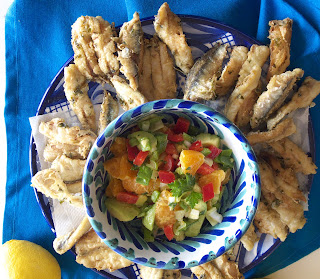 |
| A bright chopped salad to go with the boquerones. This is a winter version of pipirrana, with clementines and avocados in place of tomatoes. |
 |
| A terrific lunch--boneless fried anchovies and a citrusy salad. |


Lemon Marinated Fried Fresh Anchovies
Boquerones al Limón
 |
| Filleted anchovies, before soaking. |
I bought 500 grams (about 1 pound 2 ounces) of fresh anchovies (boquerones). That’s about 20-24 small fish. I was all set to clean and de-bone them myself, but the vendor quickly did it without my even asking. It´s totally easy, but messy. Use a knife to cut off the head and pull out the guts. With the knife tip, lift the spine and gently pull it down across the fish’s belly. Cut off the spine (with knife or scissors) at the tail, leaving the two fillets attached at the tail.
After they have been filleted, the anchovies are soaked in salted water from two to 24 hours (refrigerated) to clean them of residual blood and whiten the flesh. Soaking is an optional step, useful if you don´t wish to cook them the same day as purchase.
The small anchovies need only 45 minutes to an hour in the lemon marinade to acquire flavor. Much longer and the acid of the lemon juice will “cook” the delicate flesh. The same marinade can be used with larger fish fillets, but they can be marinated for two hours or more.
Serves 4-6 as a shared tapa or 2 as a main dish.
2 dozen fresh anchovies
Cold water
1 teaspoon salt
Lemon juice
½ teaspoon coarse salt
1 clove garlic
3 tablespoons chopped parsley
Flour
Olive oil for frying
 |
| Lift and pull out the spine. |
Clean the anchovies by removing the heads and pulling out the innards. Pull out the spine and cut it off above the tail, leaving the two fillets attached at the tail. Place the filleted fish in a bowl and cover with cold water (about 2 cups). Add 1 teaspoon salt and a few drops of lemon juice. Cover the bowl and refrigerate at least 2 hours and up to 24 hours.
Crush the garlic in a mortar with the coarse salt. Add the parsley and crush to a paste. Stir in ¼ cup of lemon juice. (If preferred, this can be done in a mini food processor.)
 |
| After soaking, layer anchovies with marinade. |
Drain the soaking anchovies. Rinse them in cold water. Layer the anchovy fillets skin side down, in a non-reactive container. Spread the garlic-parsley-lemon marinade over each layer. Cover tightly and refrigerate 45 to 60 minutes.
Drain off the lemon marinade but do not rinse the anchovies. Pick up a fillet by the tail and pull it between the fingers to remove most of the parsley and garlic. Place the fillets on a paper towel and pat them dry.
 |
| Dredge fillets in flour, pat off excess. |
Place flour in a shallow container. Heat the oil (360ºF)in a frying pan. Dredge the anchovies in flour and either pat off excess flour or shake the floured anchovies in a sieve to remove excess flour. Place them in the hot oil without crowding the pan. Fry until they are beginning to brown on the bottom. Carefully turn them and fry the reverse sides. They need less than 1 minute per side.
Skim the anchovies out of the oil and let them drain on paper towels. Serve hot.
Chopped Salad with Clementines and Avocado
Pipirrana de Clementinas y Aguacate

Pipirrana is a summer chopped salad with tomatoes that is a splendid accompaniment to fried fish. This version, with clementines taking the place of the tomatoes, is perfect for end-of-winter meals.
3 clementines or tangerines
1 tablespoon chopped scallions
1 tablespoon chopped green pepper
1 tablespoon chopped red bell pepper
1 small avocado, chopped
Salt
Red pepper flakes
3 tablespoons olive oil
2 teaspoons Sherry vinegar
Chopped parsley or cilantro
Peel the clementines, cut them in half and cut into segments. Place them in a bowl. Add the scallions, green and red pepper and avocado. Season with salt and red pepper flakes to taste. Add oil and vinegar. Mix gently. Stir in chopped parsley. Serve the salad immediately or refrigerate, covered, up to 24 hours.
More recipes using lemons:
More recipes with fresh anchovies:
Salad to accompany fried fish: Chopped Tomato Salad (Pipirrana)


