Showing posts with label tomatoes. Show all posts

Saturday, June 15, 2024

THE OREGANO HARVEST


Oregano soon to be harvested.

"Wait till it starts to flower," Reme told me. "Then cut off the stems and dry them." She had given me a small potted oregano plant last winter that I set out in the garden. It's budding now, soon to be harvested.

Reme, my aerobics teacher and also author of a cookbook about traditional pueblo cooking, said she uses the pungent herb in any kind of guisocazuela de arroz or fideos (rice or noodle casserole), pisto (medley of summer vegetables), adobo (marinade for pork or fish). 

She also adds oregano to chopped raw tomatoes and keeps them in a jar ready for slathering on breakfast toast. Now that's a great idea, I thought. Must try that.

How to use the tomato sauce? Spread it on toasted bread, drizzle with extra virgin olive oil, and top with sliced ibérico ham or your favorite cheese. Use it in place of cooked tomato sauce for pizza, pasta, eggplant parmigiana. 


Raw tomatoes chopped with oregano and garlic, perfect for spreading on breakfast toast with extra virgin olive oil.


Tomato-oregano spread, toasted molletes (buns) with extra virgin olive oil, ibérico ham, anchovies, olives, queso fresco (fresh goat cheese) add up to brunch.  


My dream breakfast--toast, olive oil, and superb ibérico ham.


Same uncooked tomato-oregano sauce, spread on molletes, with pizza toppings. (From top right to bottom right; sliced chorizo and mozzarella; artichokes from a jar, diced serrano ham, and mozzarella; and anchovies, black olives, and mozzarella.) Split molletes, spread with tomato sauce, add toppings, drizzle with extra virgin olive oil, bake in fan-oven at 400ºF. until cheese is melted and edges of crusts beginning to brown, 10 minutes.

The tomato-oregano spread is quickly made in a food processor or blender. The tomatoes needn’t be peeled. The more thoroughly you process the tomatoes, the fewer bits of tomato skin remain in the sauce. But if you like it chunky, process less. 

A tablespoon of chopped fresh oregano for two pounds of tomatoes seems about right—noticeable flavor without dominating. If you use dried oregano, reduce to one teaspoon. Use a minimum of salt in the mix and serve the tomato spread at the table with flaky salt. 

Don’t blend in the oil or you’ll end up with an emulsion, like gazpacho. Once the tomatoes are placed in a clean jar, add enough oil to completely cover the surface so the tomatoes are sealed from exposure to the air. Store capped and refrigerated. Use a clean spoon to dip the sauce. Tomato sauce keeps 4 to 5 days. 

Uncooked Tomato Sauce with Oregano
Salsa Cruda de Tomate con Oregano


It's early in tomato season, but these big plum tomatoes (tomate pera) are super flavorful. 

2 pounds ripe tomatoes 
1 clove garlic
1 tablespoon chopped fresh oregano or 1 teaspoon dried
½ teaspoon salt
2-3 tablespoons extra virgin olive oil
To serve
Toasted molletes, sliced bread or crusty rolls
Extra virgin olive oil
Flaky salt
Freshly ground black pepper
Sliced ibérico ham, cheese, anchovies, etc

Remove the stems and cores of the tomatoes and cut them up (makes 5 to 6 cups cut-up tomatoes). Place them in a food processor or blender with the garlic, salt, and chopped oregano. Process until fairly smooth. 

Place in a clean glass jar. Add enough oil to cover the surface of the tomatoes. Cap the jar and refrigerate. 


To dry oregano:  Cut the stems when the buds begin to flower. Tie them together and hang the bunch upside down in a dry place away from direct light. Place a tray underneath to catch bits of leaves that fall off or enclose the bundle loosely in a paper bag. When completely dry the leaves can be stripped off the stems and stored in a jar. (In humid weather, dry herbs in an oven with the “dehydrator” setting.) 

Gastronomía Tradicional Mijeña by Remedios Valenzuela.

About those toasted buns called molletes.


With my oregano spread I am sampling a very exclusive ham, Raza & Oro,  100% ibérico of the rubio-dorado (golden-blond) breed from Dehesa de los Monteros in the Serranía de Ronda. 


Saturday, August 13, 2022

SWEET ON TOMATOES

Luscious tomato jam, a sweet way to use summer's tomatoes.

 When I began collecting Spanish recipes, besides jotting down notes on visits to neighbors’ kitchens, I borrowed their hand-written recipe collections and copied them to my notebooks. Some were sketchy directions, written with many misspellings, passed down from a madre or tía-abuela (great-aunt). Others were transcribed from notebooks put out by the Sección Femenina, the women’s section of the Falange party. (This was 1966, under the Franco dictatorship.)


Amongst those recipes was one for mermelada  de tomates, tomato jam. Revelling in a glut of locally-grown tomatoes, I needed to stretch beyond gazpacho and sofrito, so, outlandish as it seemed to me at the time, I made tomato jam.

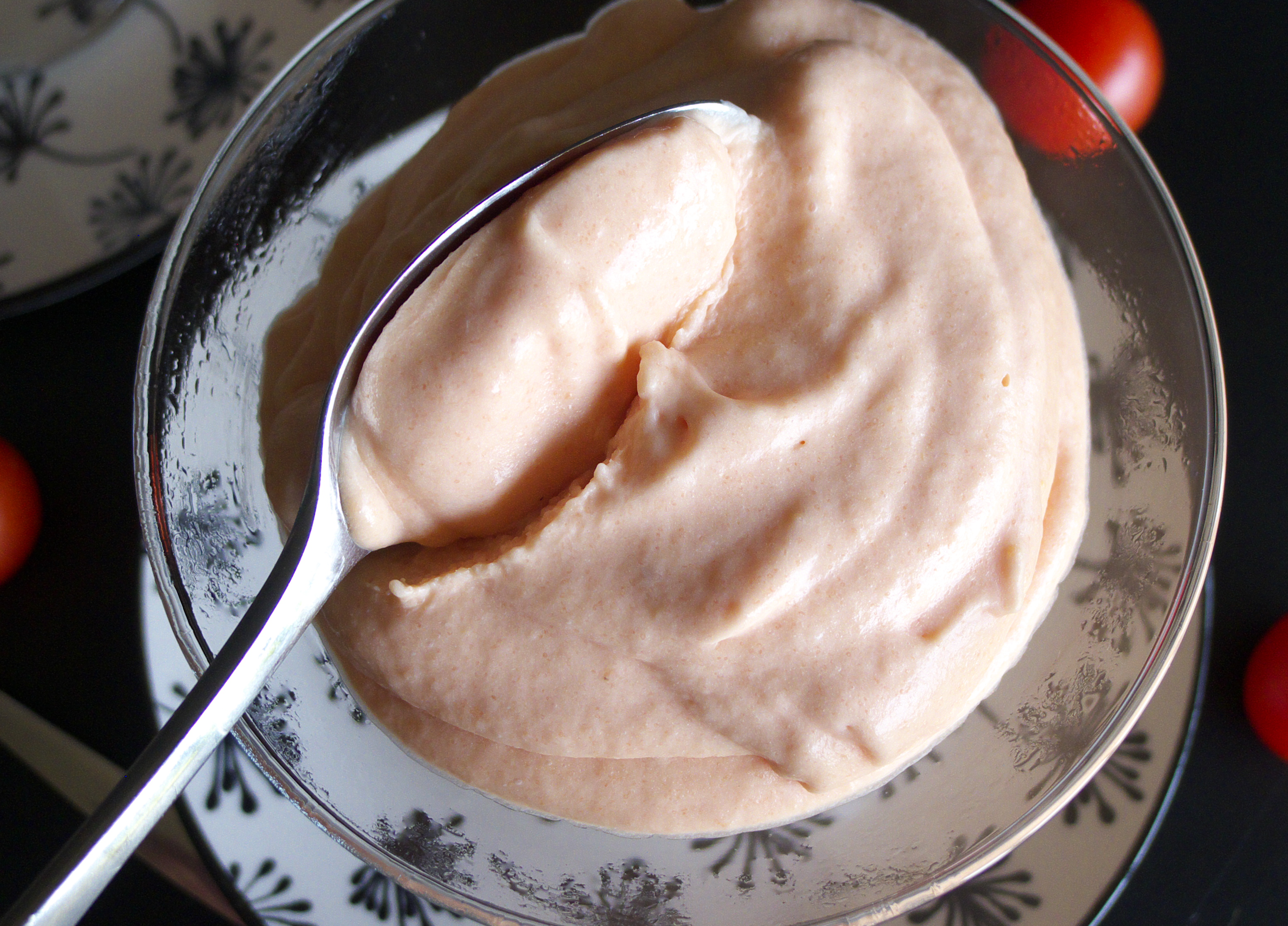
The original tomato jam recipe called for tomatoes, sugar, cinnamon and cloves. I made it several times and enjoyed it on breakfast toast. I later changed the spicing—cardamom or ginger, basil or mint. Then I added cream and froze the mixture, creating an ice cream so mysterious that my guests couldn't identify it.

Tomato jam is a good accompaniment to a cheese board. Here it's served with Brie, a smoked sheep's milk cheese and cream cheese.


Add cream and turn the jam into ice cream. Your guests might not guess the flavor.


Interesting combo: sweet tomato ice cream and a garnish of salty serrano ham.

Tomato Jam
Mermelada de Tomate

This is not a true preserve, which requires processing in a boiling water bath. Keep it refrigerated and use within four weeks.

Use a blender or food processor to puree the seeded tomatoes to desired consistency—completely smooth or, my preference, with some lumps of tomato for texture.


Serve the jam on toast that has been “buttered” with olive oil. Serve it as an accompaniment to a cheese board, with muffins or plain cake, spooned over fresh fruit or alongside ham croquettes.

Pictured, toast with olive oil, spread with tomato jam and topped with cream cheese and seed crackers with Brie cheese and a dollop of tomato jam.


Blanch and skin tomates.


Makes about 2 ½ cups.

4 pounds ripe tomatoes (14-15 tomatoes)
¼ teaspoon ground cardamom
2 cups sugar
1/8 teaspoon salt
2 tablespoons lemon juice

Bring a pot of water to a boil. Cut an X in the blossom end of the tomatoes. Add them to the boiling water just until the skins begin to loosen, about 1 minute. Drain and refresh with cold water. 

Separate seeds.

When the tomatoes are cool enough to handle, slip off the skins and cut out the stem and hard core. Cut the tomatoes in half and scoop the gelatinous seed cells into a strainer placed over a bowl. Place the seeded tomatoes in a large bowl. Press on the seeds to extract as much of the juice as possible. Pour the juice in with the tomatoes. Discard the seeds. 

With a blender or food processor, puree the tomatoes to desired consistency. Place the puree in a heavy pan and add the cardamom, sugar, salt and lemon juice. 

Place the pan on moderate-high heat, stirring, until the mixture begins to bubble. Lower heat so the tomatoes don’t splatter. Cook, stirring occasionally, until the tomatoes are thick, about 45 minutes. As the mixture thickens, stir frequently to prevent the jam from scorching on the bottom. 

Remove from heat and ladle into clean jars. Store the jam refrigerated.


Tomato Ice Cream
Helado de Tomates

I made the ice cream using the tomato jam as described above and decided it was much too sweet. Rather than increase the quantity of cream, I decided it was better to make the jam--or sweetened tomato puree--with less sugar.

Make the tomato jam, as described above, REDUCING THE SUGAR TO 1 CUP.

If desired, the soft-set ice cream can be spooned into individual dessert cups to freeze. You will need freezer space for the cups. 

I garnished the tomato ice cream cups with mint sprigs, but basil or tarragon would be good also. 

Serves 6.

2 cups tomato jam (reduced sugar)
1 teaspoon vanilla extract
2 tablespoons medium Sherry
3 cups heavy cream
Mint, to garnish


Beat together the jam, vanilla, Sherry and cream. Freeze the mixture in an ice cream maker or in a metal container in the freezer. If freezer-frozen, remove when soft-set and beat it with an immersion blender until creamy and smooth. Return the cream to the freezer to harden.

The cream needs to soften a few minutes before serving. Garnish with mint sprigs.


Tomato ice cream poolside. (Photo by Marina Caviese.)

More tomato recipes: Fifty Ways to Use Your Tomatoes.


Saturday, July 31, 2021

SEARCHING FOR THE BEST TOMATO


Nine local varieties of tomato, in search of the best.

A friend complained that she couldn’t find good tomatoes—right now, at the height of tomato season! I took up the challenge—to find the best tomato. I bought a lot of tomatoes at my local, village market and set up a cata, a tasting. 


Top row, from left: Daniela, Castellano, Ensalada, Rama. Second row, Canario, Roma, Raf, Kumato and Corazon de Buey. The cherry tomatoes are just for pretty; I didn't include them in the tasting. 


I had nine different varieties (plus cherry tomatoes). Using local (Málaga, Andalusia) nomenclature they were Daniela, Ensalada, Kumato, Canario, Castellano, Corazon de Buey, Raf, Rama and Roma. 

I soon discovered that the local names are not all actual varietals. “Rama” just refers to tomatoes “on the vine.” “Ensalada” just means “salad tomato;” it may or may not be the same as Valenciano, which may or may not be a Rutgers tomato.  Nor do the names correspond to American names. Buying locally, I did not have access to varieties from other regions of Spain.


The Castellano variety was the largest specimen (between 14 and 16 ounces). In spite of the name, it is grown locally, is quite similar to the famed tomato, Huevo de Toro (bull's ball), which I was unable to find in my market. The Castellano is sweet/tart, fruity, soft and juicy, thin-skinned. It is easily damaged in handling, so is not widely distributed.

This Corazon de Buey--"ox heart"-- is a puny specimen. It comes from my garden, where the plants were twice dug up by rooting wild boar and stressed by tomato rot. Like the Castellano, this variety doesn't travel well. It has leathery skin, but peels easily. It's juicy and very sweet.
 
The Daniela variety, widely commercialized. Large, round, red, it is gorgeous. It will keep a couple weeks without deteriorating. 

Where I live, this variety is called Ensalada. It's large and frequently comes to market while still quite green. Local cooks like the green fruit, cut into gajos, wedges, dressed with olive oil and lots of salt. I pick out the ripest (reddest) of these tomatoes and let them mature a couple days more. They are juicy, sweet/acid balanced. This was the second largest tomato, weighing from 8 to 12 ounces.

The Kumato is a protected cultivar, developed in Spain, unusual for its darkened red color. It is tough skinned (best peeled) and has a winey, tart flavor, very firm texture. 

Deeply ridged, the bright red Raf tomato is very pretty. It has an intense flavor and is quite firm. Developed in Almería, the name stands for resistance to Fusarium, a disease that affects tomato plants.  

Rama tomatoes come to market dangling from the vine. They are medium-sized, very red and long lasting. The rama, or branch, is useful for hanging the tomatoes, the best way to keep them.

Two varieties here, on the left is the Canario, a small round tomato extensively grown in the Canary Islands. On the right is the Roma, or tomate pera, "pear" tomato, known in English as the plum tomato. It's grown year-round under plastic and, besides being a fine cooking tomato, is a reasonably good salad tomato in the winter when other tomatoes fare poorly.  

The tasting plate--nine varieties, no salt, no oil, plain toast to nibble between tastes.


Was this beauty the best tomato we tasted? It's probably the variety that so disappointed my tomato-loving friend. With its smooth red skin, no lumps or blemishes, it looks like the perfect tomato. 

Maybe somewhere it's as good as it gets. The Daniela is bred to stand up to industrialized picking, packing and shipping. Besides looking good, it has a long shelf life. 

No, along with Rama and Canario, the Daniela was the least good tomato we tasted. They are insipid in flavor, mealy in texture. Not what you want to make a great gazpacho.

And the winner is--- This wasn't a fair fight. The best tasting tomato was not one purchased at the municipal market. It was the stunted Corazon de Buey from my own garden. Of the market tomatoes, I liked best the Castellano (bigger than Beefsteak!), the Ensalada and, surprising to me, the Kumato. All three had the most intense flavors, best sweet/acid balance. The Ensalada, in fact, is my go-to tomato for salads, gazpacho, sandwiches. 

Tomato Salad with Cheese
Ensalada de Tomate con Queso


This salad is best if the tomatoes are sliced and dressed with vinaigrette shortly before serving. The longer they stand with salt, the more juices they give off. Of course, the juicy version of tomato salad is pretty delicious too; served with bread for dunking.
 
Tomatoes with especially tough skins are best peeled. Your choice. Slice the tomatoes not too thick, not too thin—3/8 inch is about right. 

I like queso fresco de cabra, a fresh, soft, white goat cheese, for this salad. It’s very mild in flavor and not very salty. Feta or fresh mozzarella could be used instead. 

3-4 tomatoes
4 ounces fresh white goat cheese
Vinaigrette for Tomato Salad (recipe follows)
Croutons (optional)
Maldon salt flakes

Use very sharp knife to slice tomatoes.


If desired, peel the tomatoes. Cut away the stems and slice the tomatoes crosswise. Cut large slices in half. Spread the sliced tomatoes on a platter or divide between 4 individual plates.

Slice the cheese and cut it into 1 ½ -inch pieces. Tuck the slices between the sliced tomatoes. Spoon the vinaigrette over the tomatoes. Sprinkle with croutons, if desired. Sprinkle generously with salt flakes.

Vinaigrette for Tomato Salad
Vinagreta para Tomates

For this vinaigrette, I used Picual, a single varietal extra virgin olive oil, instead of my usual blended oil. It’s pungent, with a bite that complements the sweetness of fresh tomatoes. I added vinegar in moderation. Tomatoes are good with no vinegar at all, but a small quantity of vinegar helps to emphasize their sweetness. There’s not much salt in the dressing, but be sure to sprinkle the tomatoes liberally with flaky salt to serve. Garlic is optional; you may prefer to leave it out.

The vinaigrette can be made in advance. Keep it, covered, at room temperature up to 8 hours. Add the parsley immediately before using the vinaigrette.

1 small clove garlic, minced or crushed
¼ teaspoon salt
2-3 teaspoons Sherry vinegar
3 tablespoons extra virgin olive oil
1 tablespoon finely chopped parsley

In a small bowl combine the garlic, salt and vinegar. Whisk in the oil. Stir in the parsley immediately before using the vinaigrette.

Toasts with Tomato
Pan con Tomate

Spread grated fresh tomato pulp on toasted bread. Add olive oil and sliced ham.

For pan amb tomàquet in Cataluña, you rub toasted bread with tomato, but in Andalusia, for pan tumaca, you spread the toast with lots of grated tomato pulp. Drizzle generously with extra virgin olive oil, sprinkle with salt and you’ve got a perfect breakfast or snack. Add thinly sliced serrano or ibérico ham (omit the salt) and it’s sensational.

Sliced bread or rolls, split open
Tomatoes
Extra virgin olive oil
Salt, if needed
Sliced serrano or ibérico ham

Use thickly sliced country bread, baguette, split bollos (crusty rolls) or molletes (soft buns). Toast the bread slices or split rolls in a toaster, on a ridged grill pan or under the broiler. 
Grate tomato, discard skin.

Grate the tomatoes coarsely, discarding the skins. (Approximately 1 medium tomato for a 7-inch bread roll.)  Spread the tomato pulp on the toasted bread. Drizzle generously with oil. Sprinkle with salt. Lay sliced ham on top. Serve rolls open-faced or as sandwiches. 


Lots more ideas for how to use tomatoes here.

The festival of the Tomate Huevo de Toro (Guadalhorce, Málaga) runs all through the month of August. See a list of restaurants featuring special menus with this outstanding tomato here.


Saturday, July 18, 2020

A 3-INGREDIENT RECIPE FROM MARÍA’S KITCHEN

My garden tomatoes this year are small, but intensely flavored.

I learned to speak and cook Spanish in María’s kitchen in my early years in an Andalusian village.  María and her mother did all the cooking for the tapas bar the family ran. Every day of the year these women put out an assortment of tapas, ten or more different dishes, both hot and cold, that changed with the seasons and with what ingredients María had from the family’s huerta, vegetable garden, in the nearby campo, countryside. 


I would sit at the table in María’s kitchen several evenings a week. In the beginning I just watched and chatted, my vocabulary growing by leaps and bounds. Soon, I was asking questions and taking notes (where my recipe collection began). Eventually, I began to help peel and chop and even lend a hand at the stove.

In the summer, one of my favorite tapas was pollo con tomate, chicken with tomatoes. María’s husband, Paco, would come back from irrigating the fields with a basket of dead-ripe, fragrant tomatoes. María peeled them and added them to a pan with chunks of chicken browned in olive oil. She added salt and a bay leaf. Ya está. Nothing more.

The tomatoes cooked down to a thick sauce, savory with chicken juices. The dish was served in small tapa portions with chunks of bread for mopping up the sauce or as a ración, a larger serving, with patatas fritas, fries, as well as bread.

Not counting olive oil, salt and pepper, this dish can be made with only three ingredients. Over the years, I have gussied it up with Sherry, mushrooms and herbs, but, honestly, the intense flavor of vine-ripened tomatoes is all that’s needed to make a delicious dish.

Pollo con tomate--chicken with tomatoes--an easy summertime dish.

Fresh tomatoes cook up to a sauce the consistency of jam.

As a tapa, pollo con tomate is served with bread to mop up the sauce. How about some torn fresh basil on top?

Mix the savory tomato sauce with pasta. Add fresh rucula leaves on top.

Tender chicken legs in tomato served with rice--a whole meal.


Top the chicken with a 1-2-3 sauté of diced zucchini, red pepper, garlic and pine nuts. 

Chicken with Tomato
Pollo con Tomate

This recipe is pretty close to María’s original—three ingredients, chicken, tomatoes and bay leaf—except that I’m using legs and thighs instead of hacked-up chicken. Instead of bay, you could swap a different third ingredient (onion, garlic, red or green peppers, chile, pimentón, Sherry, brandy, mushrooms, ham, olives---). Add some fresh and flavorful herbs to the finished dish. Serve the chicken with bread, with pasta or rice or even with fries.

The tomatoes need to be skinned and the easiest way to do this is to blanch them in boiling water. You may also wish to remove seeds. To do this, cut each tomato in half crosswise and either scoop out seeds with a spoon or gently squeeze the seeds out. Cut the tomatoes roughly into pieces. After skinning and chopping, there should be about 4 cups of pulp and juice.

Serves 6.

3 basic ingredients
2 ½ pound chicken legs and thighs
4 pounds fresh tomatoes
2 bay leaves (or choice of another ingredient)
Free ingredients
Salt
Freshly ground black pepper
¼ cup olive oil

Sprinkle chicken pieces with salt and pepper. Allow to come to room temperature.

Bring a large pot of water to a boil. Cut a slit in the skin of the blossom end of the tomatoes. Drop them in the boiling water for 2 minutes. Drain them into a colander and rinse in cold water so they do not continue to cook.

Tomatoes, peeled and chopped.
When the tomatoes are cool enough to handle, slip off the skins, cut out the cores and break or cut the tomatoes into pieces.  (Remove seeds, if desired. I didn't.)

Tomatoes cook until jammy.

Heat oil in a large skillet. Slowly brown the pieces of chicken. Add the cut-up tomatoes, bay leaves and 1 teaspoon salt. Raise heat until tomatoes begin to bubble. Lower heat and cover the pan. Cook 15 minutes.

Turn the pieces of chicken in the sauce. Continue cooking, uncovered, until chicken is very tender and tomatoes are reduced to a thick, jammy sauce, about 25 minutes more.

Another version of pollo con tomate: Chicken Sautéed with Tomatoes.
Similar: Pork with Tomatoes (Magro con Tomate).

Tomato picking and Country Gazpacho.


Picking tomatoes in the huerta (1968).