
Municipal elections across Spain are only a week away, but the only campaign slogan I’m signing on with is “Ni un solo día sin alcachofa”. Not a single day without artichokes. I endorse this platform, the promotional campaign of Alcachofa de España. I could eat artichokes every day.
Although the season for fresh-cut artichokes, which begins before Christmas, is coming to an end, it’s a vegetable readily available in jars and frozen all year round.
The English name, artichoke, comes from the Spanish, alcachofa, which, in turn, derives from the Arabic, al-kharshûf, meaning a thistle. The artichoke plant, a mutation of another thistle, the cardoon (cardo), probably originated in Egypt/North Africa.
Spain is the second largest producer of artichokes in Europe. Murcia (eastern Mediterranean coast) is the largest growing region for this delectable vegetable.
 |
| Discard outer leaves and top half of the artichoke. |
Prepping artichokes can be complicated—remove outer leaves, pare the stem, cut the leaves off down to the heart, extract the fuzzy choke. Or, simple—just cook them in boiling water until a leaf pulls off easily and let each person dismantle his/her own. Either way, an artichoke produces a lot of debris, good for the compost bin.
Don’t worry too much about artichokes’ tendency to oxidize and darken. Definitely don’t soak them in acidulated water, as that takes away their very special flavor. Prep them as close as possible to when you’re ready to cook them. If possible, drop them into the cooking water or oil as they are trimmed. If cutting up the artichokes stains your fingers, rub them with a cut lemon, not the artichokes.
Here’s a recipe for artichokes as they are prepared in Córdoba. They are first sautéed, then braised in the wine of the region, fino from the Montilla-Moriles wine region of Córdoba. Montilla is a fortified wine much like Sherry, another Andalusian wine that is made in Jerez, for which it can be used interchangeably. The artichokes are even better cooked in amontillado, which is more full-bodied and mellow than fino. Although artichokes are famously difficult to pair with wine, they go just fine with fino.
This is a vegetarian version of this dish. However, if you order it in a Córdoba tavern, it will probably include slivers of serrano or ibérico ham (from the Córdoba region of los Pedroches) as a garnish with the finished artichokes. In this case, they may be braised in a ham or chicken stock instead of plain water.
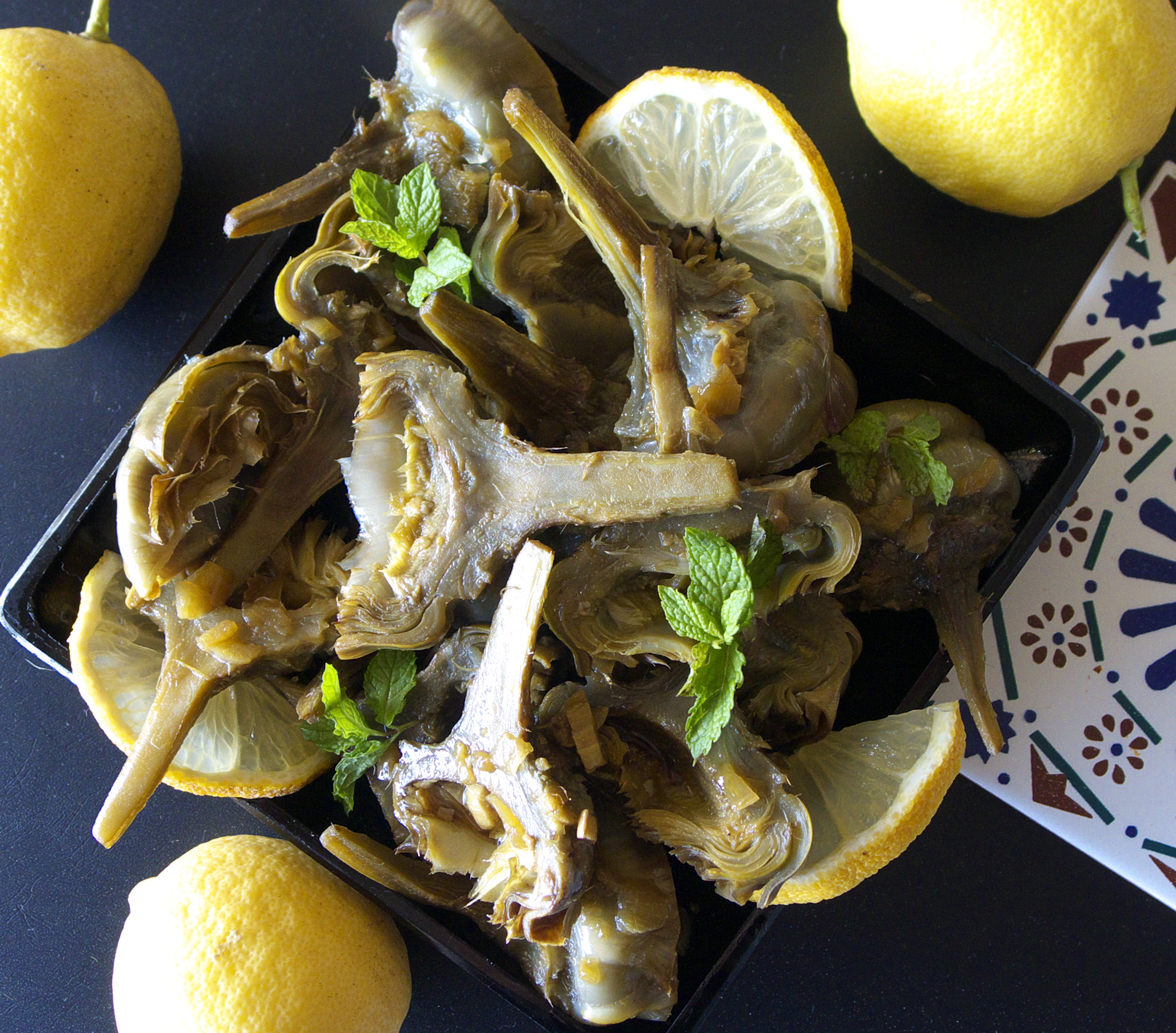 |
| Artichokes braise in a sauce with garlic, saffron and fino wine from Montilla-Moriles (Córdoba). |

Artichokes, Córdoba Style
Alcachofas a la Cordobesa
 |
Serves 6 as a starter.
8-10 medium artichokes (2 ½ pounds)
Water
Parsley
1 slice lemon
¼ teaspoon saffron threads
3 tablespoons hot water
1/3 cup olive oil
¼ cup chopped onion
4 cloves chopped garlic
1 teaspoon flour
½ cup fino Montilla or Sherry wine
1 cup water
1 teaspoon salt
Freshly ground black pepper
Sprigs of fresh mint
 |
| Scoop out fuzzy choke. |
Trim the artichokes. Pare the stem. Remove two or three layers of outer leaves. Cut the artichoke crosswise about a third from the bottom. Discard upper leaves. Use a melon baller to scoop out the fuzzy choke in the center. Drop the artichoke bottom as prepared into a bowl filled with water to which a a few stems of parsley and lemon slice have been added.
Crush the saffron in a mortar. Dissolve in the hot water. Reserve.
 |
| Sauté artichokes with garlic, onions. |
Heat the oil in a cazuela or wide pan. Sauté the onion and garlic on medium heat until softened, 4 minutes. Drain the artichokes. Cut each one in half (or quarters, if they are very large). Add the artichokes to the pan and turn them in the oil for 1 minute. Sprinkle with the flour. Stir in the wine and allow the alcohol to cook off, 1 minute. Add the saffron water, 1 cup of water, salt, pepper and one sprig of mint. Cover and cook until artichokes are very tender, 20-25 minutes. Add additional water, if needed, so there is always some sauce in the pan. Discard the cooked mint.
Serve the artichokes hot, room temperature or cold with the sauce in which they cooked. Garnish with sprigs of fresh mint.
 |
| The white fluff is an artichoke flower bearing seeds. |
 |
| Optional version of Córdoba-style artichokes is finished with serrano or ibérico ham. |
More recipes with artichokes:


