Showing posts with label chestnuts. Show all posts

Saturday, November 2, 2024

AUTUMN IN A BASKET

 
Create an autumnal meal with these fruits, nuts and vegetables.

Roasted chestnuts and sweet potatoes; huesos de santo (saints’ bones, a sweet made of almond paste); pine-nutty panellets from Catalonia, and buñuelos, puffy fritters—all are symbols of the autumn holidays of Todos los Santos (All Saints, Nov. 1) and Fieles Difuntos (Day of the Dead, Nov. 2). 


It’s also the season of the saffron harvest in La Mancha and of newly pressed extra virgin olive oil from my local mill. Coming Nov. 4-10 is International Sherry Week. Also in my autumnal basket are pretty pomegranates, knobbly quince and mushrooms. I’m going to put them all in a pot to celebrate the season.

A slow-cooked stew of pork cheeks with mushrooms and chestnuts in a savory sauce of pomegranate and Sherry with sweet potato fries on the side.


Pork Cheeks with Chestnuts
Carrilladas de Cerdo con Castañas

Pork cheeks are perfect for slow-cooked stews but you could substitute any stew meat in this recipe. 

Pink pomegranate is sweet.

Not all pomegranates have ruby-red kernels. You may have ripe fruit with pale pink arils. They are wonderfully sweet but a disappointment to a food stylist looking for that pop of color to finish a dish. Red pomegranate juice, by the way, cooks to a brownish color. 

A small pomegranate will yield about ¼ cup of juice. If pomegranate is not available substitute grated tomato pulp.

Slit chestnuts and microwave.
A microwave works fine for “roasting” the chestnuts in order to peel them. Cut a slit in the shells across the pointy end of each. Place them, about 6 at a time, on a microwave-safe plate. Microwave on High until the chestnuts begin to hiss as they release steam, 1 to 2 minutes. The slits should open slightly. Wrap the very hot chestnuts in a clean towel. While they are still warm, remove the shells, keeping them whole, if possible. The brown inner skins should come off with the shells. If necessary, scrape off the skins. 

By all means use autumn wild mushrooms such as boletus and níscalo (saffron milk cap) if available. Otherwise meaty portobellos or shitakes are a good stand-in.

Chocolate in a meat sauce? Yes, it’s typical in some Galician and Catalan recipes. And, besides, this week is the first international Chocolate and Cacao Week (Guadalcao) which is being celebrated in Sevilla. Add chocolate to the autumnal basket.

Serves 2

8 ounces (12-14) chestnuts (to make 1 cup chestnut meats)
1 small pomegranate
4 pork cheeks (about 4 ounces each)
Salt
Freshly ground black pepper
Flour for dusting the meat
3 tablespoons olive oil + more to fry the sweet potatoes
1 cup chopped onion
1 clove chopped garlic
½ cup diced carrot
3 tablespoons chopped apple or quince
4 large mushrooms, cut in half
3 tablespoons Brandy de Jerez
¼ cup pomegranate juice
1/3 cup fino or oloroso seco Sherry
1 cup water or meat stock + more as needed
Sprig rosemary + more to garnish
Sprig of fennel
Pinch of saffron (optional)
½ ounce dark chocolate, chopped (optional)
2 medium sweet potatoes (14-16 ounces)

Microwave the chestnuts and remove their shells as described above. 

Peel the pomegranate and separate the arils (kernels) from the membrane. Set aside a few of the kernels for garnish. Place the rest in a blender and grind them. Sieve the pulp, pressing on the seeds to extract all the juice. 

Trim pork cheeks.
Use the tip of a knife to remove most of the membrane that covers one side of the pork cheeks. Sprinkle the cheeks with salt and pepper and dust them lightly with flour. Heat the oil in a heavy pan and brown them on both sides. Remove the meat.

Add the onion, garlic, carrot and apple to the oil and sauté them on medium until lightly browned, 5 minutes. Add the mushrooms. Add the brandy and cook off the alcohol, 1 minute. Add the pomegranate juice and Sherry and cook them 1 minute. Add the water. Return the pork cheeks to the pan. Season with salt, pepper, rosemary, fennel and saffron, if desired. When liquid begins to simmer, cover the pan and cook 30 minutes.

Turn the pork cheeks and add the chestnuts to the pan. Cover and cook 30 minutes more. 
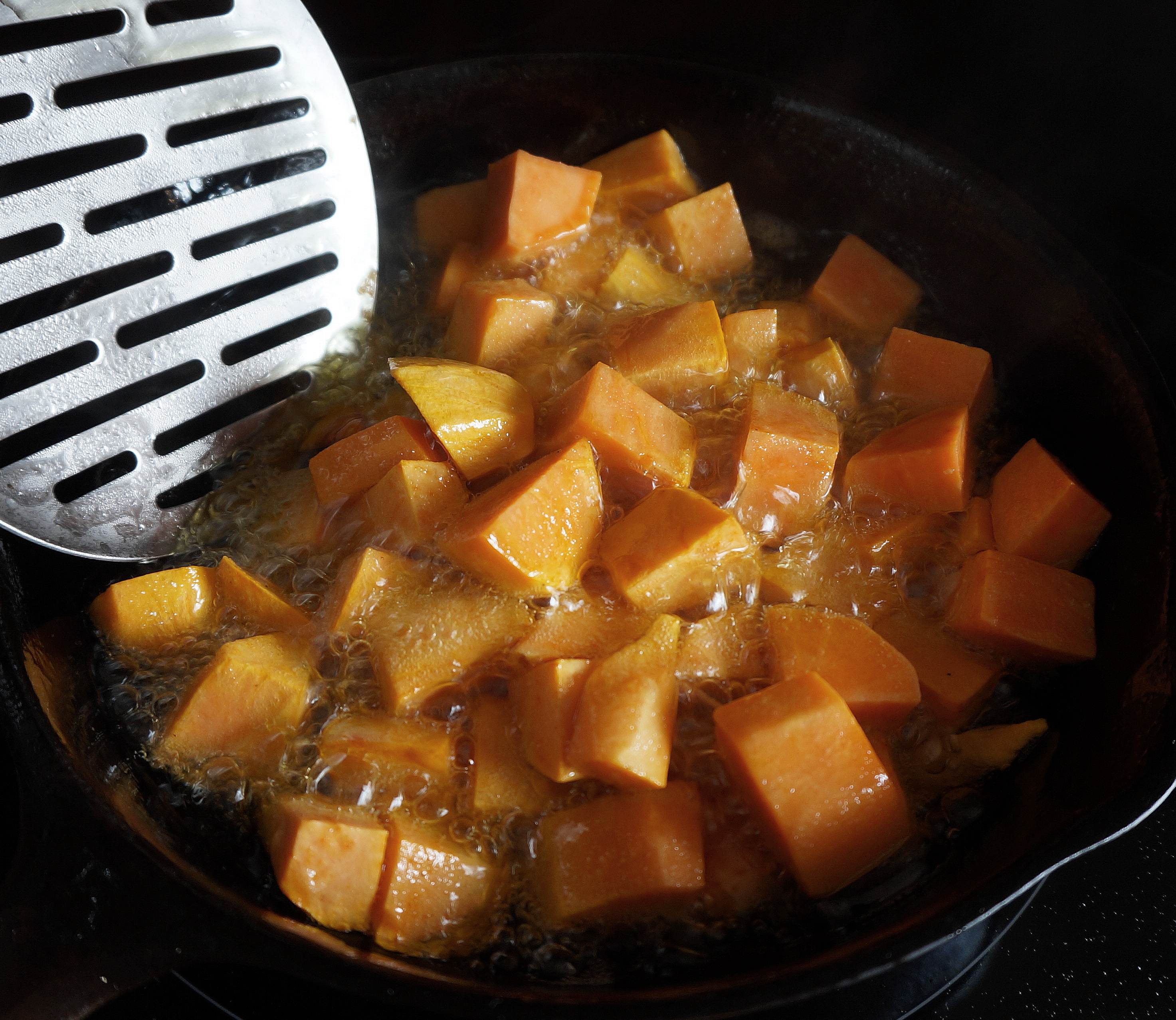
Fry cubed sweet potatoes in olive oil.


While the meat is cooking, prepare the sweet potatoes. Peel and cut them into ¾-inch cubes. Place oil to a depth of ½ inch in a small skillet and heat. Add the sweet potatoes and fry them on medium-high until they are lightly browned and tender, about 5 minutes. Remove them with a slotted spoon and drain on paper towels. Sprinkle the sweet potatoes with salt.
Sauce after blending.

Test the meat for doneness. If not completely tender, cook it 30 minutes longer. When it is fork-tender, remove the pan from the heat. Remove the meat, whole chestnuts (leave any crumbled chestnuts in the pan) and mushrooms. Discard the sprigs of herbs. Scrape the cooking liquid and vegetables into a blender container. Add the chocolate, if using. Blend until the sauce is smooth. Return the sauce to the pan with additional water or stock as needed to make a pouring gravy. Return the meat to the pan to reheat.

Serve the pork cheeks, sauce and fried sweet potatoes garnished with sprigs of rosemary and reserved pomegranate kernels.

A bouquet of fall flowers and a hearty red wine to accompany the autumn flavors.

More recipes with autumn flavor:


Saturday, December 3, 2022

A MAKE-BELIEVE MEAL

 I am fantasizing: the Pied Piper of Pigs leads the horde of wild boar off a cliff. Or, over the edge into the deep end of the swimming pool. I select a small, dead boar, butcher it and cook it for dinner. Boar out of the way, I once again cultivate a vegetable garden and fruit trees that the wild beasts have destroyed in the past several years.


I’ve got just the recipe for that dead pig—I will marinate the meat in red wine and stew it with mushrooms and chestnuts. 

But the dead boar is make-believe. I can make the stew with pork. But I won’t be planting a garden.

Pork stew with herbs, mushrooms and chestnuts.


Red wine makes a deeply flavorful gravy.


Chestnuts add texture and a subtly sweet flavor to the stew.


Pork shoulder is tender in an hour of cooking; wild boar would need two hours.


Pork Stew with Mushrooms and Chestnuts
Cerdo Guisado con Setas y Castañas

The recipe is suitable for wild boar (jabalí), venison (carne de venado), beef or pork. Only the cooking time changes, as game meat (carne de caza) is generally tougher and requires longer cooking than butcher’s meat.

Use dried mushrooms such as boletus or shitake in the stew. Soak them in hot water and use the soaking water in the stew. Add fresh mushrooms, wild or cultivated, to the stew once the meat is tender. 

Serve the pork stew with potatoes, noodles, spaetzle, polenta or Galician cornbread. 


To prepare chestnuts:
First roast the chestnuts. Then peel outer shell and inner skin. Finally, cook the chestnuts until soft, either by simmering in salted water or by adding to the stew. 

Chestnuts can be roasted in the oven, on a grate over coals or in the microwave. Whichever method you choose, first cut a slit in the shells. This provides an escape for steam, so the chestnuts don’t explode in the oven. 

Slit chestnut shell before roasting.
Slitting the shells is the hardest part of the operation. To avoid possible injury, I found the best way was to place the chestnut, flattened side down, on a cutting board and, using the tip of a knife, cut a slit in the tip, rather than trying to cut an X in the side of the shell, as most instructions direct. 
Microwaved chestnuts.
Oven-roast the chestnuts (375ºF), turning them once, until the shell begins to open up where it has been cut, about 15 minutes. To microwave, place the chestnuts on a microwave-safe plate in a single layer and microwave on High until the shell begins to open, from 1 ½ to 3 minutes, depending on size of chestnuts and microwave watts.

Peel shell and inner skin.


Remove the chestnuts from oven or microwave and cover them in a kitchen towel. While they are still hot, peel off the shells and the inner skins (use gloves to protect hands from heat). Keep them whole, if possible. 


Meat marinates with herbs, red wine.
1 ½ cups roasted and peeled chestnuts
Salt
½ ounce dried mushrooms
Hot water
2 pounds boneless pork shoulder
Freshly ground black pepper
3 cloves garlic
¼ onion, sliced
2 bay leaves
Sprigs of fresh thyme
Sprigs of fresh rosemary
2 cloves
½ teaspoon peppercorns
5 juniper berries (optional)
1 ½ cups red wine
Flour for dusting meat
5 tablespoons rendered pork fat and/or olive oil
2 carrots, diced
1 cup chopped onion
1 stalk celery, chopped
1 tablespoon sun-dried tomato flakes or 1 tablespoon tomato sauce
1 ½ cups water or stock
4 ounces fresh mushrooms, quartered or sliced
1 apple, peeled and chopped (optional)
Parsley, to garnish

Cook the peeled chestnuts in salted water until soft, 15 minutes. Drain, saving the cooking liquid. Reserve the chestnuts. 

Soak the dried mushrooms in hot water to cover for 30 minutes. Drain them, adding the soaking water to the chestnut water. Chop the hydrated mushrooms.

Cut the meat into pieces. Sprinkle them generously with salt and pepper. Place the meat in a non-reactive container. Sliver one clove of garlic and tuck the slivers in the meat with the sliced onion. Add one of the bay leaves, sprigs of thyme and rosemary, cloves, peppercorns and juniper, if using. Pour over the wine and mix into the meat. Marinate the meat 1 hour at room temperature or, covered and refrigerated, up to 24 hours. 

When ready to cook the pork, set a strainer over a bowl and carefully pour the marinade through the strainer. Save the marinade liquid. Discard the sprigs of herbs and juniper berries. Any peppercorns or slivers of garlic clinging to the meat can cook with the stew. Dust the pieces of meat with flour.

Heat 2 tablespoons of the fat in a heavy skillet on medium-high. Brown the meat, turning the pieces to brown all sides. Transfer the meat to a stew pan. Scrape up browned bits on the bottom of the skillet so that they don’t burn. Add 1 tablespoon more fat to the skillet. Sauté the carrots, chopped onion and celery. Chop the remaining 2 cloves of garlic and add them to the skillet. Sauté 5 minutes. Add the tomato. Combine the mushroom-soaking water, the chestnut water and enough additional water or stock to make 1 ½ cups. Stir it into the skillet and scrape up the browned bits on the bottom. Add the vegetables and liquid from the skillet to the meat in the stew pan. Add the reserved marinade. Add salt to taste. (If stock is used, salt may not be necessary.) Add remaining bay leaf and additional sprigs of thyme and rosemary.

Bring the liquid to a boil. Cover the pan, reduce heat and cook 30 minutes. Stir the meat, cover and continue cooking until it is very tender, 30 to 40 minutes. 

Add the remaining 1 tablespoon of fat or oil to the skillet and sauté the quartered mushrooms until they are very browned. Add the mushrooms to the stew with the reserved chestnuts and apples, if using. Cover and cook 10 minutes longer. 

Serve the stew immediately or refrigerate for another day. Garnish with chopped parsley.


Another chestnut recipe: Roast Pork Ribs with Chestnuts.

To serve with the Pork Stew: Galician Cornbread.

Saturday, November 3, 2012

CHESTNUT SEASON


Chestnuts on the tree. (Photo by Kenton Smith at http://www.imagenary.co.uk/ )
Such a cheery sight on a dreary evening—the guy in the plaza roasting chestnuts over hot coals. When a batch is ready, he scoops the fragrant nuts into paper cones and hands them to you. You pick up a chestnut and warm your hands, before peeling and eating the toasty nut.

Chestnuts are a seasonal pleasure. Appearing just in time for the November 1 holiday of Todos Los Santos, when families visit cemeteries to pay respect to the dead, chestnuts are sold by vendors outside the cemetery gates.

Chestnut trees grow in northern Spain and in mountainous regions of the south, such as the Serranía de Ronda, Sierra de Aracena and the Alpujarra.

I heard from my friend Ann Larson in Yunquera, in the Serranía de Ronda,  that it has been a bad year for chestnuts in southern Spain. “The chestnut crop in our whole area was awful!” she wrote. “We are harvesting ours this week, but only expect to get 50 kilos or so, if we're lucky. Due to the lack of rain at critical growing times, the chestnuts are few, and small. Of course, as the crop is poor, the price is high! Ah, the life of the farmer.” (Read more about Ann’s farm here.)

Chestnuts.
On the tree, chestnuts are encased in a prickly outer husk. Each chestnut has a smooth brown shell and an inner light brown skin. The nut meat is an ivory color. For roasting on an open fire, cut a slit into the shell of each and place them on a grill over coals. In Spain, they use a cooking pot with holes punched in its bottom to set over coals. To eat them, use your fingers to pull away the shell and the skin.

Looking for a different way to prepare chestnuts, I went to a Galician cookbook, as Galicia (northwest Spain) is real chestnut country. The classic book, Cocina Gallega, by Álvaro Cunqueiro (I mistakenly bought the book in the Galego language, different enough from castellano, Castillian Spanish, that I had to buy a dictionary in order to use it), lists 17 different chestnut recipes, about half sweet and half savory.

In this recipe for pork ribs, the chestnuts take the place of potatoes alongside the meat.

Juicy ribs and toasty chestnuts for a warming fall meal.

Roast Pork Ribs with Chestnuts
Costelar de Porco con Castañas


Raw chestnuts, shells removed.
Shelling chestnuts is more like peeling an orange than cracking a nut. Cut into the outer shell then peel it away in strips. The chestnuts are cooked, then the inner skin peeled off while they are still warm.

This adobo is an aromatic rub for the pork ribs.


Serves 4.

Herb-rubbed ribs roast until tender.
2 ½ pounds pork spareribs
1 teaspoon salt
4 cloves garlic
2-3 crushed bay leaves
½ teaspoon dried thyme
¼ teaspoon freshly ground black pepper
½ teaspoon sweet pimentón (paprika), preferably smoked
 Pinch of fennel seeds
5 tablespoons olive oil
½ cup white wine
Water
1 ½ pounds fresh chestnuts
Butter and/or olive oil


Place the ribs in a pan large enough to hold them. In a mortar or blender, grind together the salt, garlic, bay, thyme, pepper, pimentón and fennel. If using a blender, add the olive oil with the spices. If using a mortar, stir the oil into the spice blend.

Spread this mixture on all sides of the ribs. Allow to stand at room temperature for 1 hour or, covered and refrigerated, up to 8 hours. Bring to room temperature before proceeding.

Preheat oven to 350ºF. Place the ribs on a rack in a roasting pan or on a broiler pan. Mix the wine with ½ cup of water and pour into the bottom of the roaster. While meat is roasting, add more water from time to time so that there is always enough liquid to cover the bottom of the roasting pan. Roast until ribs are tender, about 1 ½ hours.

While meat is roasting, shell the chestnuts. Cook them in boiling water for 30 minutes. Drain. While still warm, remove the brown skin. Shortly before serving, heat the butter and/or oil in a skillet and brown the chestnuts.

Remove ribs to a cutting board and slice them. Serve on a platter with the browned chestnuts. Pour over any pan juices.

Tender ribs and chestnuts.
Browned chestnuts substitute for potatoes alongside roast meat.