Showing posts with label ibérico ham. Show all posts

Saturday, December 28, 2024

A MERRY LITTLE CHRISTMAS


Christmas morning. My grandson, Leo Searl, home from university, is spending a few days at my house. He makes breakfast on Christmas morning--smoked salmon on toast with cream cheese and scrambled eggs. What a pleasure to catch up with what's going on in his life.


What's in this strangely-shaped present under the tree for Ben?


Oh, wow! Look what's in my Christmas box! It's a sampler of ibérico ham, a selection of sliced ham, shoulder-ham, chorizo and cured fat from Dehesa Monteros, made from ibérico pigs of the Rubio Dorado breed. They start out eating chestnuts in the forests of Ronda and are finished on bellotas, wild acorns. 


Christmas lunch for three. On a sunny afternoon we started with sopa de galets, a rich chicken broth with giant pasta shells stuffed with pâté. Marinated "standing rib roast" of ibérico pork centered the main course, accompanied by potatoes and squash roasted with onions and apples. 

The pork loin has been boned to facilitate carving, but the rack of ribs tied back on for roasting to keep the meat moist. Ibérico pork with its marbling of fat is especially juicy. Ibérico pork is usually cooked medium-rare to medium--still pink in the center. (The recipe for the pork marinade is here.)


A side dish of chard sautéd with garlic, raisins and pine nuts was served in a colorful hand-made ceramic bowl by Tara Chapman, Leo's mum. 


I bought a kilo of locally-grown pecans, called nueces americanas, from a chica in my aerobics class. The pecans, which I adore, inspired me to make a nut torte just for me! It was sugar-free and gluten free as well. (I used this recipe for walnut torte, swapping King Arthur baking sugar substitute and gluten-free bread crumbs.) For the guys there were also fig brownies with real sugar, sweet figs and lots of nuts. Both desserts are good served with a dollop of rich Greek yogurt or whipped cream.
Pecan torte with a dollop of rich Greek yogurt.


From my kitchen to yours, MERRY CHRISTMAS TO ALL.

Saturday, January 7, 2023

HAM FINALE: DOWN TO THE BARE BONES

Chicken-noodle soup with a difference--the broth is made with a ham bone as well as chicken and bits of ibérico ham garnish the soup.

 My gorgeous ibérico ham has finally come to an end. Ben sliced me a last plateful—one last mollete with tomato, olive oil and ham. Then he carved out some thicker strips and dismembered the bones. 


Diced ham for cooking.


Those strips, cut into taquitos, dice, I’ll use in cooking and for garnishes. The ham dice is terrific in omelets, with scrambled eggs, in croquettes. The ham should never be fried, like you fry bacon, or it hardens and becomes stringy. Fold in the ham at the end of cooking time. 

By the way, although the ham has darkened in the month or more since it was broached, the flesh is still juicy, as ibérico ham has a lot of fat marbling that keeps it from drying out. 

Nothing left but the pata negra, black hoof.

With some of the bones, I’m making ham stock to stash in the freezer. It’s the perfect addition to split pea soup and lentils and for soups such as picadillo, rich broth with garnishes (that recipe is below).

To make ham stock
Use 2 to 3 pounds of bones from cured ham, ibérico or serrano (preferably sawed into pieces). Place them in a large stock pot and cover with 3 to 4 quarts of water. Add a sliced onion, 2 carrots, 2 stalks of celery, 2 bay leaves and additional aromatics, as desired (pepper, cloves, thyme, etc.) Add 2 teaspoons salt. Bring the water to a boil. Keep skimming off all the foam that rises to the top. Reduce heat so the water bubbles gently. Cook the stock, covered, 90 minutes. 

Discard the bones. Raise the heat and boil the stock 10 minutes. Strain the stock through a colander. Once cool, strain the stock through a fine sieve or cheesecloth. Divide it into portions. Refrigerate or freeze.


Pictured at left are cubes of frozen ham stock, ready to add to soups. The background for the photo is a new apron (thanks Marina) that depicts bellotas, the acorns that ibérico pigs eat.


Should you be so lucky as to have the remnants of a ham, here are some ideas for how to use them.

A literary dish--Duelos y Quebrantos are what Don Quixote ate on Saturdays. Basically, eggs scrambled with ham fat, chorizo and diced ham.


A rice dish typical of the dehesa, the woodlands in western Spain where ibérico pigs are raised. Chunks of fresh ibérico pork go into the rice which is finished with a scattering of slivered ham.


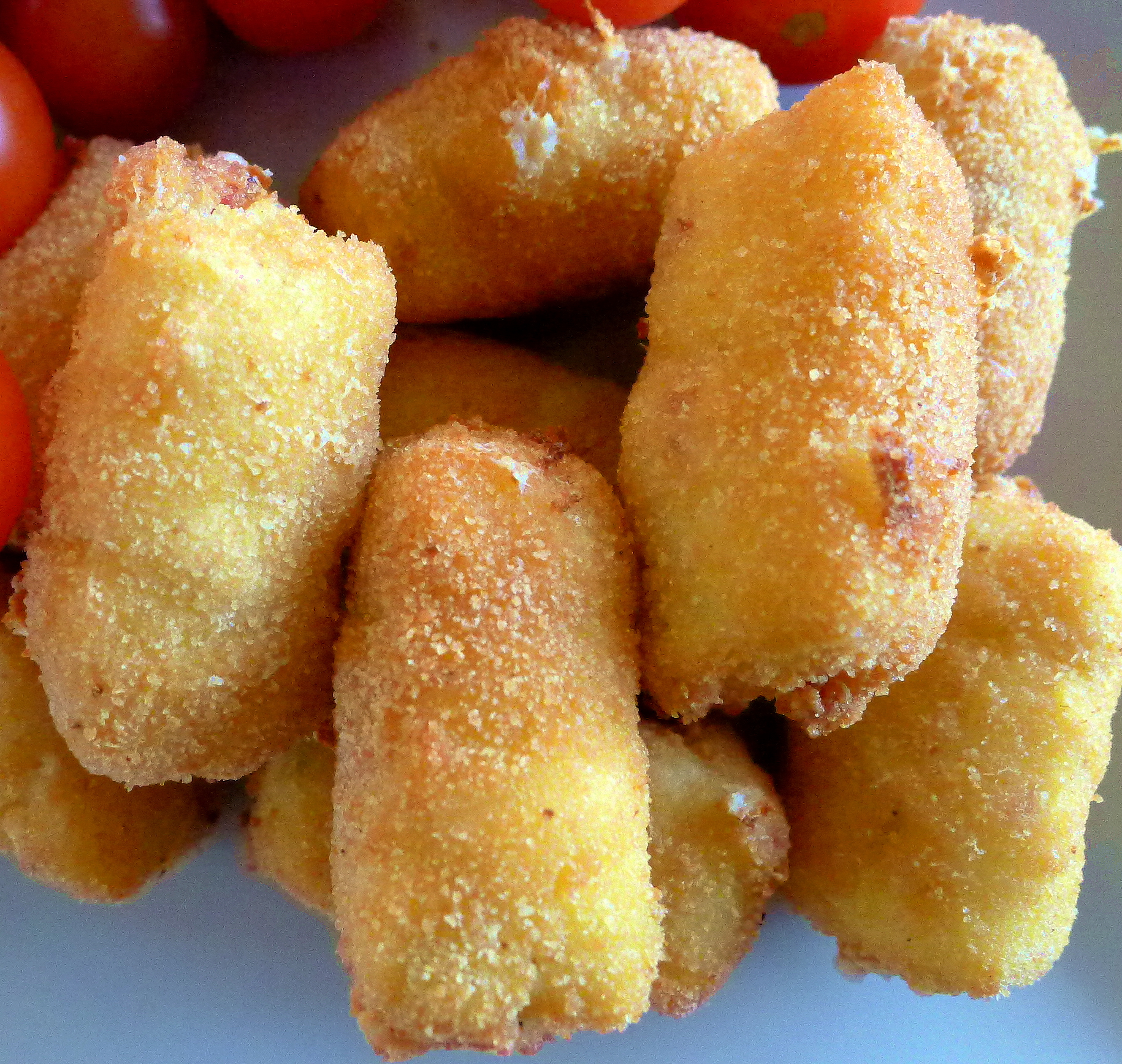
Ham Croquettes
Croquetas de Jamón

Mince the ham scraps to incorporate in the thick bechamel for forming croquettes. Use some ham fat with the oil for the bechamel and infuse the milk with a piece of ham bone. The full recipe for ham croquettes is here.


In Andalusia, sopa de picadillo might be served as the first course of a special dinner or it might make an easy supper for the family, using broth leftover from the puchero pot.

Garnished Chicken Soup with Ham
Sopa de Picadillo

This Andalusian soup traditionally is made with the caldo, broth, from a puchero, a boiled dinner containing chicken, beef, ham bone and vegetables. Or, the broth can be quickly made with store-bought chicken consommé simmered 30 minutes with a chunk of ibérico or serrano ham bone. In my case, I added the frozen ham stock to a chicken carcass along with the usual aromatics. Be sure to skim the broth as it comes to a boil. After cooking, ladle the soup through a fine sieve so that it’s as clear as possible. The broth can be made in advance and refrigerated. Skim off any fat that congeals on the surface before reheating it. 

Be sure to taste the broth and add salt if necessary before cooking the noodles. Thin fideos—angel hair pasta—is the usual type of noodle cooked with this soup. But, any size vermicelli or other soup noodle can be used. Adjust cooking time as needed. Rice can be cooked in the broth instead of fideos.

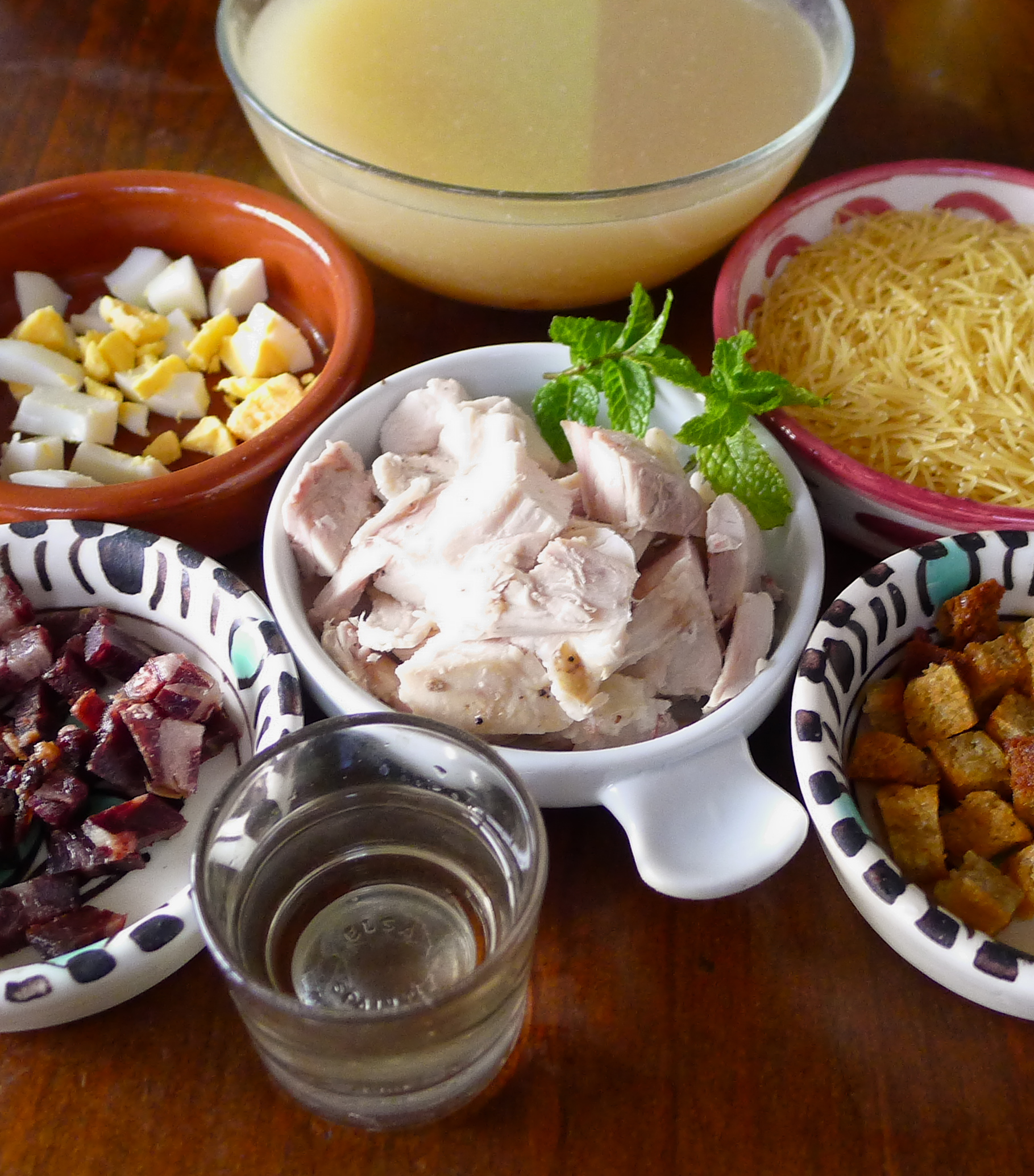
Have all the additions to the soup—cooked chicken, carrots, egg and ham—at room temperature or warm before heating the broth and cooking the noodles. The additions can be added to the soup pot or tureen or dished into individual bowls.

Make a rich broth, add garnishes.

Serves 4 

6 cups chicken-ham broth
Salt, if needed
1 cup angel hair soup noodles (4 ounces)
1 tablespoon dry Sherry (optional)
5-6 ounces diced cooked chicken 
Cooked and sliced carrots 
1 hard-boiled egg, chopped
2 ounces ibérico or serrano ham, cut in dice or thin strips
1 cup croutons of fried bread
Sprigs of fresh mint

Place the broth in a pan, bring to a boil and add the noodles. Cook the noodles al dente, 3 minutes. Add the Sherry, if using. Remove the pan from the heat and divide the soup between four shallow soup bowls.

Add the chicken, carrots, egg, ham and croutons to the hot soup. Garnish each bowl with a mint sprig. Serve immediately.

The scent of fresh mint complements the savory aromas of this soup.


Eggs Scrambled with Ham
Duelos y Quebrantos


Duelos y Quebrantos is a very old La Mancha dish—what Don Quixote ate on Saturdays, you will recall. A simple dish of eggs scrambled with fatty bits of ham and, sometimes with the addition of lambs’ brains. Unconscionably delicious, though it might require increasing the cholesterol medication. 

Cook the eggs in rendered pork fat or in a combination of olive oil and fat. If you’ve got the remnants of an ibérico or serrano ham, dice some of the fat (tocino) as well as the lean. If no ham is to hand, use bacon for both fat and ham. Should you have reason to use lambs’ brains, blanch them in salted water, cut into small pieces and sauté them with the chorizo. 

With salty chorizo and ham scrambled with the eggs, salt is probably not needed. 

The following recipe, using two eggs, makes one serving or, if served as a tapa, two servings. If making a larger batch, instead of breaking the eggs right into the skillet, place them in a bowl and beat them lightly before adding to the skillet.

1 ounce chorizo
1 ounce ham fat, pancetta or bacon
1 ounce ibérico or serrano ham
1 tablespoon olive oil
2 large eggs
Freshly ground black pepper
Salt (optional)
Chopped scallions or parsley to garnish
Fried bread to accompany

Remove chorizo from its casing and dice it. Cut the fat in dice. Cut the ham in dice or thin strips.  

Break eggs right into the skillet.


Heat the oil in a skillet on medium heat. Add the diced chorizo and fat. Fry them gently, turning, until the fat is rendered and they are lightly browned, 4 minutes. 

Break the eggs into the skillet. Keep the heat on medium. Use a wooden spoon to stir the eggs, breaking up the yolks. As the eggs begin to set, fold in the ham. Remove the eggs when they reach the desired consistency, creamy-soft or completely set. Sprinkle with pepper and salt, if desired. Garnish with scallions. Serve immediately accompanied by triangles or croutons of fried bread.


Rice with Ibérico Pork and Ham
Arroz con Ibérico


This rice dish is layered with porky flavor—fresh pork, pork fat, ham stock and strips of ibérico ham. Fresh ibérico pork is widely available in Spain. Most hams and fresh ibérico meat are from cross-breed pigs that are fed pig feed. From specialty butchers, you might find fresh pork that is 100 percent ibérico de bellota—meat from all-ibérico pigs that have been finished on bellotas—acorns. 

Any of the usual cuts—lagarto, pluma, secreto, presa, solomillo—are fine for this recipe. For my version, I cut the bone away from a thick-cut loin chop and trimmed the excess fat to use for browning the meat. 

Ibérico pork is best cooked to medium-rare, still pink on the inside. The meat retains some of the fat, which keeps it juicy. It will be sufficiently cooked after the browning process. Remove the pieces of meat from the pan while the rice cooks and return them at the end of the cooking time.

Use medium-short-grained (round) rice, the same kind used for paella. Bomba is the best rice variety for this dish, which cooks with enough liquid to finish meloso, or a little soupy. 

The best liquid for cooking the rice is caldo de puchero—the strained soup made with chicken, beef and ham bone. If not available use ham stock plus chicken stock. Have the chicken stock hot when ready to add to the rice. If the ham and chicken stock are well-flavored, the rice will probably not need additional salt. 

Use a paella pan, perol (deep, two-handled frying pan), cazuela, flat-bottomed wok or skillet to cook the rice. I used a cast-iron skillet. 

Cut fresh pork in large chunks and brown them first.
Serves 2-3.

8-10 ounces boneless ibérico pork
Salt
Freshly ground black pepper
Olive oil
2 ounces mushrooms, sliced
1 cup chopped onions
¼ cup chopped carrot
2 tablespoons Sherry
2 cloves garlic
1/3 cup chopped green pepper
1 teaspoon pimentón de la Vera (smoked paprika)
½ cup crushed tomatoes
1 cup ham stock
½ teaspoon miso (optional)
1 cup medium-short-grained rice
3 cups hot chicken stock
Salt, as needed
Sprigs rosemary
6 asparagus stalks (optional)
1 ounce slivered ibérico ham

Browned pork and mushrooms.
Trim off excess fat from the meat. Dice the fat. Cut the meat into 1 ½-inch chunks Sprinkle with salt and pepper. 

Heat 1 tablespoon of oil in the pan. Add diced pork fat and cook on medium heat until the fat is rendered out, 2 minutes. Add the chunks of meat and brown them slowly on all sides, 6 to 8 minutes. Skim out the meat and reserve. Add the mushrooms to the pan with 1 tablespoon more of oil. Fry the mushrooms until browned and skim them out.

Keep the heat on medium. Add the onions and carrot to the pan and cook, stirring frequently, until they begin to brown, 5 minutes. Add 1 tablespoon of the Sherry and cook until liquid evaporates. Add remaining Sherry and cook it off. Add the garlic and green pepper and continue sautéing the mixture until peppers are softened, 3 minutes. 

Stir in the pimentón. Immediately add the tomatoes. Cook them 5 minutes until tomatoes are thickened and beginning to brown. Add the contents of the skillet to a blender with the miso, if using, and the ham stock. Blend to make a smooth puree.

Add 1 tablespoon of oil to the pan and add the mixture from the blender. Stir in the rice. Add the hot chicken stock, saving ½ cup to be added at the end of the cooking time. Taste the liquid and add salt if necessary. Add the fried mushrooms. Add a sprig of rosemary. Add the asparagus, if using. Stir to combine. Bring the liquid to a boil, then reduce heat slightly so that the rice bubbles. Cook, uncovered, 10 minutes. 

Use a wooden paddle to stir gently. Lower heat and cook the rice 5 minutes more. Add remaining ½ cup of the chicken stock. Do not stir. Place the chunks of meat in the rice. Cook 3 minutes more or until the rice is cooked al dente. 

Discard cooked rosemary. Scatter the slivers of ham on top of the rice and tent the pan with foil. Allow to set 10 minutes. Serve the rice in the same pan in which it cooked with a fresh sprig of rosemary on top. 


After browning, the ibérico pork is cooked medium-rare and still juicy. Return it to the pan after the rice is cooked.

If you're starting from scratch, here is the authentic recipe for Andalusian puchero, incorporating chicken, beef and ham bones, chickpeas and vegetables.

Sunday, January 2, 2022

HOLIDAY FINALE

Almost down to the bone. Daniel slices the last of a Spanish ibérico ham, ordered in the United States from La Tienda, importers of Spanish products. Daniel orders his ham right before Thanksgiving and packs it along to gatherings during the holiday season. 


I brought Spanish turrón (almond nougat, both soft Jijona and crunchy Alicante) and little figures of marzipan from Spain. Just a few pieces left to finish out the holidays.


On New Year's Eve we put out the last of the pimentón-rubbed goat cheese that I brought from Spain and imported Spanish chorizo picante, Palacios brand, bought locally at World Market in Atlanta, GA. 


For our family gift exchange we had "white elephant" baskets, each  packed with themed goodies. Can you believe, I drew the Spanish foods basket? Extra virgin olive oil, a packet of serrano ham, anchovies, wine and more. I later swapped a few items from my grandson's Italian basket and contributed the oil to the family kitchen.

Among the contents of the Spain basket, a Tempranillo wine from Valdepeñas, perfect with our roast leg of lamb on New Year's Eve.


For New Year's day I'm making black-eyed peas, a Spanish recipe with a southern tradition in the U.S. Will it be chorizo or smoked southern sausage? I definitely would have added collard greens, but they didn't turn up on the grocery order. I cooked the black-eyed peas with some of the ibérico ham fat.


Black-eyed peas--good luck for the New Year. It's 75 degrees F. in Atlanta, Ga., warmer than where I live in southern Spain. 


Black-Eyed Peas with Tomato Sofrito
Potaje de Carillas con Sofrito

Serves 4.

2 cups dried black-eyed peas (14 ounces), soaked in water 8 to12 hours
½ cup sliced leek
1 cup sliced carrots or pumpkin
2 bay leaves
1 head garlic, char-roasted (see instructions below)
Pork, pork belly or ham hocks
2 tablespoons olive oil
1 cup chopped onion
1 cup chopped green bell pepper
Red pepper flakes
½ teaspoon pimentón de la Vera (smoked paprika)
1 cup peeled, seeded, and chopped tomato
1 teaspoon salt
¼ teaspoon cumin
¼ teaspoon dried oregano
1 tablespoon chopped parsley
Pinch of ground cloves
Freshly ground black pepper
1 tablespoon wine vinegar

Drain the soaked black-eyed peas and place them in a pot with 6 cups of fresh water. Bring to a boil and skim off the froth. Add the leek, carrots, bay leaves, cloves of char-roasted garlic and pork or ham hocks. Cover and simmer the peas 30 minutes.

Heat the oil in a skillet and sauté the onion and pepper 5 minutes. Stir in the red pepper flakes and pimentón and immediately add the tomato. Season with salt, cumin, oregano, parsley, cloves, and pepper. Cook the sofrito 8 minutes.

Add ½ cup cold water to the black-eyed peas. Bring again to a boil and stir in the sofrito. Cover and simmer until peas are very tender, 60 to 90 minutes.

Stir in the vinegar and cook 5 minutes longer.


This is an Andalusian cooking technique, used especially for potajes with legumes. Char-roasting garlic makes it easy to peel a whole head of garlic and mellows the bite of raw garlic. 

Spear the whole head of garlic on a kitchen fork (use a hot-pad to protect your hands) or grip it with tongs and roast over an open flame on a gas stove or barbecue until charred on all sides. Once cool enough to handle, rub off all the charred skin and add the cloves of garlic to the pot of black-eyed peas.

Monday, December 31, 2012

PARTY TIME!


Look what I’ve got! An ibérico ham. Time to invite some friends over to share this deliciousness.


 Using the lavishly illustrated book, Slicing Spanish Ham by Pilar Esteban, as reference, my son, Benjamin Searl, broaches the ham, a pure ibérico de bellota (acorn-fed) from Los Pedroches (Córdoba) with more than 36 months curing time.

The ham is sweet and nutty; the fat is soft and melting.

For my Sunday afternoon Open-House-with-Ham party I made a pot of black-eyed peas to get a jump on good luck for the New Year. That recipe is in my January 1 blog last year. And, hot from the oven, a cazuela of patatas a lo pobre, potatoes cooked with onions, peppers and tomatoes in wine (recipe).


Also on the buffet table, a bright winter salad of cauliflower with capers instead of the olives shown in the photo (recipe),


I also made olivada, a garlicky olive paste, good with quail eggs or bread sticks for dipping. I bought a heap of empanadillas de batata, little fried pies filled with sweetened sweet potato paste, and made a batch of carrot-raisin-apricot-fig cupcakes to serve with mandarins from my trees.

How many guys to turn a ham?


With good ham, I love fino Sherry. I also served red and white wine and beer. Most guests seemed to favor beer for an afternoon gathering. The sun was shining and we all sat on the terrace until sunset. Glorious winter day.


Olivada is a garlicky olive dip.
Olivada
Olive Spread


My home-cured and pitted manzanilla olives lost their crisp texture, so I turned them into this tasty spread. Serve it as a dip, sandwich spread or sauce to accompany hard-cooked eggs, roast lamb, fried fish or sliced tomatoes.

Makes  ¾ cup.

1 cup drained and pitted olives, black or green
½ cup fresh breadcrumbs
1 clove garlic, chopped
1 shallot, chopped
1 tablespoon chopped parsley
1 tablespoon lemon juice
2 tablespoons dry Sherry
2 tablespoons extra virgin olive oil
Salt and pepper


Combine all the ingredients in a blender or food processor. Blend until smoothly pureed. Serve cold or room temperature.

New Year's luck--black-eyed peas.


¡FELIZ AÑO NUEVO!    HAPPY NEW YEAR!


Friday, December 17, 2010

HAM, THE BOOK

Whole Hog (Ibérico, Dehesa de Extremadura)

When I was reporting for an article about Spanish ibérico ham from 5J in Jabugo (read the story in the Los Angeles Times here), I was sniffing about for recipes with ham and listening for Americans’ experience with Spanish ham. I called up my main “ham man,” Miguel Ullibarri, formerly director of the Real Ibérico consortium and now with A Taste of Spain, a tour company specializing in food and wine tours. He told me about Bruce Weinstein and Mark Scarbrough, authors of Ham—An Obsession with the Hindquarter (Stewart, Tabori & Chang, March, 2010), who were planning to escort a grand ham tour to Spain. (Sorry to report, the tour is off for spring 2011. Stay tuned for future tour dates.)

Mark and Bruce, who live in Colebrook, CT., got involved with Spanish hams while researching a chapter in their book about dry-cured hams in Europe. Mark is the writer and Bruce the chef and recipe developer. Through Miguel Ullibarri the authors got in touch with Fermin, the sole exporter of ibérico hams to the U.S.

“That’s who provided the ibérico ham that graces the cover of the book,” said Mark. “For months after the photo shoot for HAM, Bruce and I lived in bellota bliss (bellotas are acorns--what the pigs fatten on). We would get invited to dinner parties and bring the whole leg, shave off a pound or so, and be piggy with abandon. When we got the thing down to the bone, we cooked it with a pot of beans, cracked open a bottle of rosé cava, and moved on to the sequel to ham, the first-ever all-goat (meat, milk, cheese) book in English” (slated for publication April 2011).

SAMPLING THE HAM BOOK

HAM, the book, presents a global look at porky hindquarters, with chapters covering Fresh Ham, Dry-Cured Ham in the Old World, Dry-Cured Ham in the New World and Wet-Cured Ham. Recipes run the gamut from appetizers to soup to main dishes to leftovers. There are some tempting recipes for Chinese stir-fry, Italian-style pizza, down-home southern country stews and chic salads (smoked ham with arugula, pears and honey vinaigrette, for instance), all with tips and Testers’ Notes. Naturally, I gravitated to the recipes with Spanish ham (serrano, as ibérico is too good to use in cooking). The Serrano-Wrapped Scallops, Serrano Fritters and Stewed Mussels with Jamón Serrano, Chickpeas and Saffron all sound enticing. But I decided on trout stuffed with ham, a recipe somewhat like a traditional way with trout in Navarra.  

(Photo in my kitchen in Spain is by Donna Ellefson)

Whole Trout Stuffed with Jamón Serrano, Rosemary, and Fennel Seeds
Recipe adapted from HAM An Obsession with The Hindquarter, 
by Bruce Weinstein and Mark Scarbrough: Photographs by Marcus Nilsson
(Stewart, Tabori & Chang; 2010).

The recipe in the book calls for 4 (1-pound) trout. Trout at my market are considerably smaller, so I chose to use a larger salmon-trout, which weighed in at about 1 ¾ pounds after boning, serving 3. Although the recipe doesn’t mention removing pin bones for the individual-sized trout, I decided to do this to facilitate dividing the cooked fish into crosswise slices.  I chose to use needle and thread to sew up the fish’s cavity in order to make it easier to turn the fish without losing the stuffing. And, because I like fresh thyme more than rosemary, I substituted my favored herb. The fennel seeds lend a subtle Pernod-y taste, just right with the ham. Deglazing the pan with Sherry vinegar creates an instant and very delicious pan sauce. 

While shopping, without thinking about it too much, I picked up a Rueda wine, a white made of verdejo grapes (Pentio, 2009). The fruitiness of verdejo, I thought, would complement the ham in the stuffing. It was only later, reviewing the recipe in HAM, that I noticed that the recipe’s headnotes state, “Fast, easy and elegant, this company supper cries out for a bottle of Spanish white from the Rueda region.” Ah so. Perfect, indeed.

1 whole salmon trout (about 2 ¼ 
     pounds), boned
¼ cup fresh bread crumbs
3 ounces thinly sliced serrano ham,
     minced
1 clove garlic, minced
½ teaspoon fennel seeds, crushed
1 teaspoon rosemary or thyme,
     minced
2 tablespoons white wine
3 tablespoons olive oil
2 tablespoons Sherry vinegar


Preheat the oven to 450ºF.

Mix the bread crumbs, ham, garlic, fennel seeds and rosemary or thyme in a medium bowl. Add just enought wine to moisten the mixture, but not enough to make it wet.

Open up the salmon-trout and spread the stuffing mixture on one side, patting it into place. Flap it closed. (You can use needle and thread to sew up the cavity opening.)

Heat the oil in a large ovenproof skillet over medium heat, adding the oil. Slip the trout into the skillet and cook until crisp, about 7 minutes, shaking the skillet occasionally so the trout doesn’t stick.

Use a large spatula to turn the trout, then shove the whole contraption in the oven. Bake until cooked through, about 10 minutes.

Remove the very hot skillet from the oven and use that large spatula (or two) to transfer the trout to a heated serving platter.

Set the skillet back over medium heat and splash in the vinegar. Stir quickly to scrape up any stuff on the bottom of the skillet, then drizzle this sauce over the trout.

Mark Scarbrough blogs, with taste and humor, about his favorite foods at http://www.realfoodhascurves.com
Book your tour to ham country with Miguel Ullibarri at http://www.atasteofspain.com/


Hams on the hoof.

Thursday, October 7, 2010

IBÉRICO ON THE HOOF

Check out my article in the Los Angeles Times HERE about the coming of Jabugo ibérico hams to America. If the first wave of ibérico was called the “best ham in the world,” this may be even better than the best!

 I’ve been to see those famous hams on the hoof, in Jabugo (Andalusia) and in Extremadura. These are free-range pigs of the ibérico breed that are fattened on acorns (bellotas) from wild holm and cork oak trees that grow in the dehesa, a unique ecosystem in western Spain.

 Even before my visit to the pig habitat, I got my first intimation of what makes such superlative ham at dinner when I sampled fresh ibérico pork, the raw material for ham.

Cuts with names like secreto, “secret;” pluma, “feather,” and presa “prize” as well as solomillo, tenderloin, were grilled over smoldering oak coals. The meat was served medium-rare. We’re talking about fresh pork. Like prime beef, it was marbled with veins of fat. I tasted. Wow. This was absolutely the best pork I had ever eaten. The tender cuts very nearly melted in the mouth. The cuts from the shoulder, just chewy enough, were incredibly juicy. This is not “the other white meat.”

Wait! Before you start picturing clogged arteries, let me tell you about acorn-finished ibérico pork. The acorns are rich in oleic acid, the same found in olive oil. Because the pig does not convert the fat, the oleic component predominates and the meat is high in monounsaturated fat. That’s why acorn-fattened ibérico pigs are sometimes called an “olive tree on four legs.”

But, mainly it’s about deliciousness. This is delicious meat. It makes delicious ham.

While reporting for the LA Times story, I learned that fresh ibérico pork is now being exported from Spain to the US. It was José Andrés (http://www.thinkfoodgroup.com/) , chef/owner of eight restaurants across the country, including The Bazaar in Beverly Hills, with two more opening in Las Vegas later this year, who was instrumental in getting the first ibérico hams to America. José is a business partner of Fermin, the only Spanish company to meet U.S. regulations for meat slaughtering. The fresh ibérico pork now available also comes from Fermin. Look for it at Wagshal’s Market in Washington, D.C. (http://www.ibericousa.com/  ) and from La Tienda (http://www.tienda.com/new/index.html.)

In Spain, I can buy fresh ibérico pork at local markets. Not that I buy it very often, as it’s quite pricey. I paid about $7.15 for six very thin loin chops (13 ounces), serving two persons. Cooked on a hot plancha, about one minute per side, they were delicious.

This is a photo of revuelto, eggs scrambled with mushrooms and ham. The recipe is on this page of the Los Angeles Times on Oct. 7.