Showing posts with label how to cure olives. Show all posts

Saturday, October 18, 2025

OLIVE PICKING TIME


A 13th century Andalusí cookbook* gives several recipes for how to cure olives. In one version, you are directed to slit the olives with a knife, “but do not go deep to the stones.” In another, you should “crack them on a board so that the flesh breaks but does not separate from the stone.”  After incising or cracking, the olives are soaked in fresh water until the bitterness is gone then transferred to brine for the curing period. They are sometimes finished with herbs


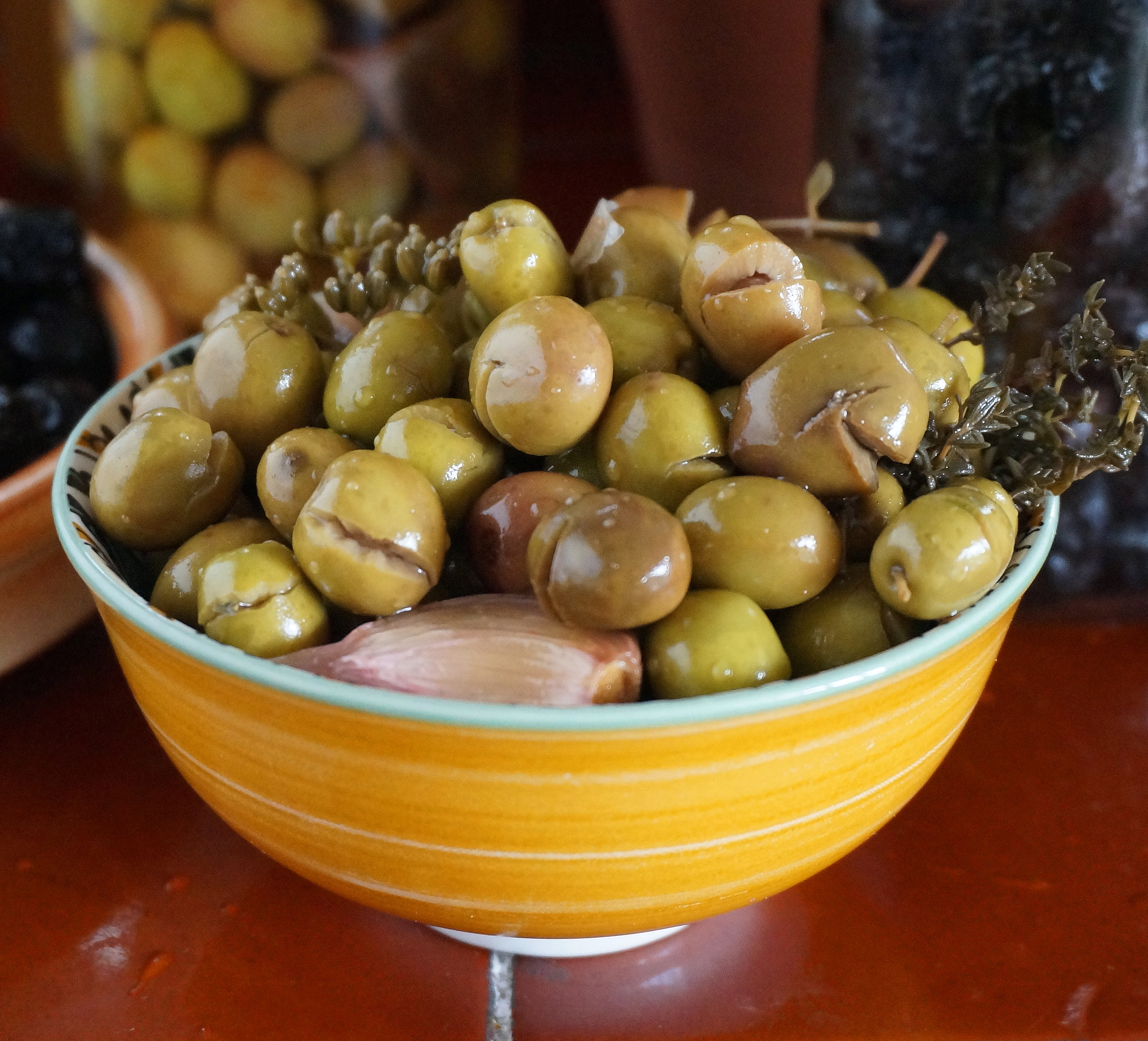
That text appears in the headnotes for Herb-Marinated Olives in my new book, FLAVORS OF AL-ANDALUS, The Culinary Legacy of Spain. The method described in the old text is exactly the same as the way table olives are prepared in the pueblo where I live—cracking, sweetening in water, then curing in brine with thyme, fennel, and garlic.  
Home-cured table olives.

We pick a small quantity of olives, mainly fat Manzanillas and small, fleshy Moriscas, for curing. The rest go to the mill to be pressed for oil. 

You do not have to have an olive tree to make the olive recipe in Flavors of al-Andalus. The recipe shows you how to marinate store-bought olives to give them the flavor of herb-flavored Andalusian olives.) 


This year we're trying out a "new-fangled" contraption for cracking the olives. Place it over a bucket with the flat piece of wood braced against your body. Put a handful of olives in the well, use the clapper to crack them lightly, and release them into the bucket. The old-fashioned way was to split them, one by one, with a mallet or stone. I've cracked thousands that way in my time! 


*The directions on how to prepare olives comes from The Best of Delectable Foods and Dishes from al-Andalus and al-Maghrib: A Cookbook by 13th Century Andalusí Scholar Razīn al-Tujībī (1227–1293), translated by Nawal Nasrallah (Brill, 2021).


Yes, that's a clothesline tied between two olive trees. My house is nestled in the midst of 18 olive trees. Not all of them produce in a single year. After spring rains, the trees are really loaded this year. We pick about half the crop in one go in order to get them to the mill within a few days. The remainder will wait on the trees until after we get some rain (fingers crossed). 


Olives loaded in Ben's car, we're off to the mill. The local mill (featured in this post) is no longer operational, so we're headed for Molisur, a big one in the next town.

Once in the bin, the fruits of our five days of picking don't look like much. There is a tense moment when the jefe scrutinizes some shriveled olives--those picked de suelo, off the ground, are paid at half the price as those de vuelo, from the tree. But most are fresh and plump, so we get the highest rate, this year 60 centimos per kilo. He advises us to keep them in containers like the one shown so air can circulate and the olives don't deteriorate. 

In a booth above the olive reception floor, she tracks the weights (posted on the display screen facing us) and fills out the administrative papers. Our olives weighed in at 90 kilos (almost 200 pounds).  

Off they go, up the chute to the hopper where the olives are tumbled to separate leaves, twigs, and other debris before crushing and extraction. 

We take the receipt to the front office. 


The mill doesn't yet have new oil available. So we collect Euros for our olives€54and buy a liter of last year's oil in the shop for €7.20. Hopefully, when we return with the rest of our olives we can take away fresh extra virgin olive oil.

Photos were taken at Aceites Molisur, Alhaurin el Grande (Málaga). The mill offers guided tours:
We are located in a unique environment, at the foot of the Sierra de Alhaurín el Grande, where you can enjoy nature and at the same time learn everything about the extra virgin olive oil that we produce at Aceites Molisur. We offer guided tours accompanied by the specialized staff of the oil mill.

***   ***   ***
FLAVORS OF AL-ANDALUS 
The Culinary Legacy of Spain

This new cookbook has recipes for olives and helpful information about cooking and frying with olive oil. Ask for Flavors of al-Andalus from your favorite bookseller or click below to order. 

This cookbook explores the fascinating story of the deep and lasting influences that Islamic culture has left on modern Spanish cooking. 
Author and Spanish cooking expert Janet Mendel tells the story of the Moorish influence on Spanish cooking through 120 recipes and photographs for modern-day dishes, from salads and vegetables to fish, poultry and meat to sweets and pastries, that trace their heritage to foods served in medieval times. Dishes from this era include exotic spices such as saffron, the use of fruits and almonds with savory dishes, and honeyed sweets and pastries. The flavors of al-Andalus live on in modern Spanish cooking and are what makes Spain’s cuisine distinctive from the rest of Europe. (Hippocrene Books)    


 Order on IndiePubs

Use PROMO CODE HIPPOCRENE40 for 40% off on all Hippocrene titles at IndiePubs online bookstore.

***

Order on amazon


***   ***   *** 


Saturday, November 30, 2024

MY BIG FAT SPANISH OLIVES

 
Fat Manzanilla olives.

I’m celebrating an anniversary! This blog has been going, pretty much weekly, for 15 years! In honor of the occasion and of olive-picking season, I am posting that first blog with updates and a new recipe. 


(November 2009.) I like to tell my guests that the olives they are nibbling come from the tree they’re sitting under. No, don’t reach up and pluck one! Straight from the tree, they are impossibly bitter and astringent. Olives need a curing process to make them edible.

That’s what I’m doing this week, picking, sorting, cracking and soaking olives that will become table olives, eating olives. They are picked green—soon after the first fall rains soak the parched earth and plump up the olives. 

Nov. 2024. We picked more than a month ago and are now tasting the cured olives. 

Most of my olive trees are varieties usually pressed for oil. But I have several Manzanilla trees that produce big fat, fleshy olives, the same kind you usually find in jars at the supermarket. The home-cured ones are very different from commercial olives. Commercial olives are soaked in an alkaline solution (lye) to remove the bitterness. Home-cured ones require nothing more than water and salt, plus seasoning. 

I prepare my olives in the Andalusian style that I learned from local country people many years ago. 

Cracking olives before brining.
First, the olives must be cracked with a stone or mallet to split them open. This allows the soaking liquid to quickly penetrate to the pit. Uncracked olives require months to sweeten; split ones take about three weeks. 

I wear old clothes because smacking olives splatters oil everywhere. I’ve also tried the method from Extremadura, where olives are rayado, incised with a sharp blade. (I resisted buying a rough wooden tool that had both a clapper for splitting open the olives and a hole with blades for slitting them.) As an experiment this year, I used a little gizmo, like a hole-punch, to remove the pits from some of the olives. (I’ll report back on whether this was successful or not.)

I place the olives in small earthenware jugs, orsas.  I cover them with water. I use non-chlorinated well water. It’s extremely hard water (high in calcium, demonstrated by limescale on my kettle), which may help keep the olives crisp. I drain off the water and refresh it every two or three days until, when tasted, the olives are no longer bitter. 

Defining bitter is very subjective. I bought some cured olives at the market a few days ago that I would say were still really bitter. It’s a matter of taste. I let mine soak, changing the water every few days, until they are really sweet. That takes about three weeks. 

The olives are then immersed in brine, where they continue to cure, as well as take on flavor. Years ago, I learned that the brine should be strong enough to float an egg. That can vary depending on the freshness of the egg! Optimal measures: measure the water required to cover the olives. Use 7 tablespoons of kosher salt or any non-iodized salt for every 4 cups of water. (Basically, use a 10 percent brine for initial fermentation, then store the olives in a 12.5 percent brine.)

Now comes the flavoring. In my village, traditional flavoring for olives includes quartered lemons, unpeeled cloves of garlic, sprigs of thyme and flowering bracts of fennel. Elsewhere in Spain, I have sampled olives flavored with strips of red pepper, chile, oregano, vinegar. 

Although the olives are ready to eat in a few days, flavor develops as fermentation continues. After about a month, I pack the olives into clean jars and refrigerate them. Without conservatives, they last for months. That is, they last if I haven’t given them all away by Christmas.  

Four kinds of olives this year. Ben took charge of cracking, soaking, brining and seasoning the Moriscas in the clay jar and a small jar of whole ones. I doggedly had another go with whole, uncracked Manzanillas. The dry-salt cured black olives were a new experiment. 

Garlic, thyme, fennel to flavor.

(Nov. 2024) After years of experimenting, I have discovered that the fat Manzanilla olives do not keep well with the home-cure. They lose their crispness and the skins become leathery.  (Next year we may try the method with sosa caustica, lye, for the Manzanillas.) 

Years ago my friend Antonia told me that the only variety of the several on my land that are good para endulzar, to fix as table olives, is the Morisca. This olive is smaller than the Manzanilla but with a good ratio of flesh to pit and a thinner skin. After the fermentation process, the olives stay crisp in seasoned brine for months. Ben took charge of the cracking and seasoning this year. They are the best olives ever!
Salt-dried black olives.

We also experimented with dry-salt curing of ripe, black Manzanilla olives. Coated with coarse salt, the olives were left to drain and dry in a slotted container. The result is wrinkly black olives somewhat like Greek or Moroccan varieties, but very big and juicy. Will they keep?
Whole Manzanillas.

I put one jar of whole (not cracked), green Manzanillas in brine for about two months. They’re delicious, but already are becoming soft. Another jar of whole Moriscas is better.


You can add flavor to bottled, store-bought olives. Buy unpitted Seville olives (big Manzanillas). Drain them and rinse well. Marinate them for two days with slivered garlic, salt, sprigs of fresh or dried thyme, a sliced lemon and a little extra virgin olive oil. 

In Spain, olives are enjoyed as a tapa and alongside meals. They top typical salads, from mixed greens to exotic orange, onion and salt cod. They are used rarely in cooking, although duck with olives is a Sevilla classic. Olivada is an olive pâté, sensational spread on toasts. 

The olive blog was originally published Nov. 7, 2009. A month later (Dec. 10) I posted a follow-up, The Taste Test, and deleted the original blog. Check the blog archives for more entries about olives. You can search for recipes or product information in the little window that appears in the upper-left hand side of the screen. (To see the search window on a mobile phone screen, scroll to the end of the blog and switch to “view web version.” The (tiny) search window appears in the upper left corner.)

Cooks love feedback! If you enjoy reading these reports and recipes from My Kitchen in Spain, let me know in the Comments. I’ve been sharing these (copyrighted) recipes for free for 15 years. Do you think it’s high time I added advertising? Or switched to a subscription newsletter? Any opinions?

Pork Stew with Olives (2024)
Estofado de Cerdo con Aceitunas

Strips of pork are braised with Sherry, olives added at the end of cooking.

Serves 4. 

1 pound pork shoulder
Salt
Freshly ground black pepper
Flour
3 tablespoons olive oil
1 cup chopped onion
3 cloves garlic
1/3 cup dry Sherry
½ cup grated tomato pulp or canned crushed tomatoes
2 cups meat stock or water
Carrots (optional)
Pinch of winter savory or thyme
4 medium potatoes, cut in small pieces
1 cup pitted olives
Chopped parsley

Slice and cut the pork into 3-inch strips. Sprinkle with salt and pepper and let them come to room temperature. Dredge the pork in flour and pat off excess. Heat the oil in a heavy skillet. Brown the pork strips and remove them.

Add the onions and garlic to the skillet and sauté them until softened and beginning to brown, 5 minutes. Add the Sherry and cook 2 minutes. Add the tomatoes, stock and carrots, if using. Return the pork to the pan. Season with salt, pepper and savory or thyme. When the liquid is bubbling, regulate the heat so the stew cooks gently. Cover and cook 15 minutes. Add the potatoes and cook 15 minutes longer or until potatoes are done and meat is tender. Add the olives and heat thoroughly. Serve the stew sprinkled with parsley.

Add a pop of color to olive-drab stew with a sprinkling of cranberries or pomegranate kernels.

More recipes with olives: