Showing posts with label garden vegetables. Show all posts

Saturday, June 6, 2026

GIVE PEAS A CHANCE!


Are you one of those people who always keeps a packet of peas in the freezer? Ready to hand for a quick side dish or addition to soup or stew? Not me. I don’t like frozen peas. In my opinion, they are fairly tasteless and ever so starchy. At least they’re green. Canned ones don’t even have that attribute. 


But peas picked fresh from the garden are a revelation, tender and sweet, almost like a different vegetable. Without even sorting for size, I shell them immediately and plunge them into boiling water. I drain them after 1 minute and chill in ice water. Even the fat, mature peas are good to eat at this point. The peas can be added to cooked foods without further cooking or refrigerated for later use. These fresh-podded peas, once blanched, won’t need further cooking; just reheat them briefly.

I never seem to have more than a small basketful at any one picking. A pound of peas in their pods will make from 1 to 1 ½ cups shelled. Shelling takes about 10 minutes. I can watch the afternoon news while I pop the peas from their pods.

Not everyone has a nearby pea-patch. If you find shelling peas at the farmers’ market, give them a try. Hopefully, they were picked the same morning and maintain their natural sugars. 

Here are some of the ways I served peas during the magical few weeks of pea-picking. 


Ham, Eggs, and Peas on Toast. Utterly simple, incredibly delicious. Fry eggs in olive oil. Place on toasted bread that is “buttered” with extra virgin olive oil. Top with thinly sliced ibérico ham. Quickly heat the blanched peas in the skillet and spoon them over the top of the eggs. A few chips of fried garlic, if you like. Salt and freshly ground pepper. Ya está--that's it! 


Mixed Vegetables (Menestra). This classic vegetable stew changes with the seasons. In spring, garden peas, artichokes, asparagus, and fava beans are included in varying proportions. Each vegetable is cooked separately, then combined. Add a poached or fried egg per person, if desired.  Here's the complete recipe for menestra: Medley of Garden Vegetables.


Potatoes Panaderas with Peas and Egg. Panadera potatoes are sliced and baked with garlic, strips of green pepper, wine, and olive oil. (The recipe for patatas panaderas is here.) I warmed up leftover potatoes with blanched peas and topped them with a poached egg. What a satisfying supper dish! 


Soupy Rice with Peas (Risi e Bisi). This is an Italian recipe but I’ve given it a Spanish twist, using only olive oil, no butter, and aged Manchego cheese instead of Parmigiano. Spanish paella rice is a medium-short grain, much like Italian Arborio. 

After shelling, the pea pods are cooked in stock to add flavor to the cooking liquid for the rice. (If you don’t have stock, cook the pods in salted water with onion.) 


Soupy Rice with Peas (Risi e Bisi)
Arroz Caldoso con Guisantes


Serves 4

2 pounds peas in their shells (2 cups shelled peas)
5 cups chicken stock
4 tablespoons extra virgin olive oil + more to serve
2 ounces pancetta or bacon cut in strips
¼ cup finely chopped onion or shallots
1 cup short-grain rice
2 tablespoons chopped parsley
Salt
Freshly ground black pepper
¼ cup grated cheese + more to serve

Shell the peas. Reserve the pods. Cook the shelled peas in boiling water 1 minute. Drain and cool them in ice water. Drain and reserve.

Place the washed pods in a pot with the stock. Bring to a boil and cook until the pods are tender, 45 minutes. Use an immersion blender to blend the pea pods and stock until pods are pureed. Pass the puree through a strainer, pressing on the solids to extract all the liquid.  

Heat the oil in a deep skillet and fry the pancetta until crisp. Tilt the pan and skim out the pancetta. Add the onion to the pan and sauté on medium heat until softened, 4 minutes. Stir in the rice and cook 1 minute. Add the stock with pea-pod puree, half of the reserved pancetta, 1 tablespoon of the parsley, salt to taste, and pepper. Bring the liquid to a boil, reduce to medium-low, and cook, stirring occasionally, until rice is tender, about 15 minutes. 

Remove the pan from the heat and stir in the peas and grated cheese. Serve with additional cheese, remaining pancetta, and chopped parsley. Drizzle with additional olive oil.


From my pea-patch: GIVE PEACE A CHANCE!

More recipes for peas (ok to use frozen ones):


Learn more about the vegetables of Moorish Spain that have come down to us today. (Hint--no tomatoes or peppers, yes peas.) Much more about the flavors of al-Andalus in my slideshow presentation for the Culinary Historians of New York: Al-Andalus: The Enduring Influence of Islamic Culture on Spanish Cuisine.  And, for lots of vegetable recipes, get the cookbook FLAVORS OF AL-ANDALUS--The Culinary Legacy of Spain. (See below for where to order.)


This cookbook explores the fascinating story of the deep and lasting influences that Islamic culture has left on modern Spanish cooking. 

Author and Spanish cooking expert Janet Mendel tells the story of the Moorish influence on Spanish cooking through 120 recipes and photographs for modern-day dishes, from salads and vegetables to fish, poultry and meat to sweets and pastries, that trace their heritage to foods served in medieval times.  (Hippocrene Books)    

 Order on IndiePubs (USA) 

Use PROMO CODE HIPPOCRENE40 for 40% off on all Hippocrene titles at IndiePubs online bookstore.

Saturday, April 5, 2025

FROM GARDEN TO TABLE, cont.

 
From the garden to my table.

The winter-to-spring garden—a plot of not much more than 125 square feet, fenced against wild boar intrusion—continues to produce. I am now picking small broccoli florets that the plants produce after the large, center heads have been cut. These cook in about 3 minutes. The cute “baby” cauliflowers and cabbages are a perfect size for a small household. 


The chard goes on and on. The favas and peas are nearly finished. A second round of lettuce arrived to remind me that I won’t be eating soup forever. Here are some of the dishes that have been on my table this week. 


On a sunny spring day, my favorite lunch salad, straight from the garden: lettuce, raw cauliflower, and peas embellished with sliced cooked potato, egg and canned tuna. A sprinkling of (garden) green onions. Dressing is simply extra virgin olive oil and Sherry vinegar. (There soon will be new potatoes from the garden plot.) Another cauliflower recipe: Moroccan Cauliflower Salad with Olives. And a recipe with broccoli Fettucine with Broccoli and Blue Cheese.


Oven-baked brown rice casserole with broccoli and cauliflower. I learned this technique of cooking rice years ago when experimenting with Macrobiotic cooking. The rice grains are toasted before baking. It remains one of my favorite ways to cook brown rice (arroz integral), although I have varied the ingredients considerably. The dish makes an excellent vegetarian main dish or a side with meat, chicken or fish. (Recipe is below.)


Broccoli and cauliflower al ajo arriero, or "muledrivers' style. Different from the typical muledrivers' preparation, these vegetables are cooked crisp-tender.

1 ½ cups cauliflower florets
2 ½ cup broccoli florets
¼ cup olive oil
Bacon slivers (optional)
1-2 cloves garlic, sliced
Red pepper flakes, to taste
¼ teaspoon cumin seeds
3 tablespoons lemon juice
Salt and freshly ground black pepper
Pimentón (paprika) to garnish

Bring a pan of salted water to a boil. Add the cauliflower and cook 1 minute. Add the broccoli and cook 3 minutes. Drain the vegetables and refresh them in cold water. Place in a serving bowl.

In a small skillet heat the oil. Add bacon strips, if using, garlic, red pepper and cumin. Fry until the garlic turns golden. Remove the pan from the heat and add the lemon juice, salt, and pepper. Immediately before serving pour the dressing over the broccoli and cauliflower. (Lemon juice will darken the broccoli if allowed to macerate in the dressing.) Sprinkle with pimentón. 


The cabbages are small but they go a long way. A quarter of a head is perfect for a stir-fry for two with strips of pork. I've made potaje de coles, a sturdy Andalusian stew with chickpeas and sausages (recipe is here). This week, with prayers for peace in Ukraine, I am making borscht, a Ukrainian soup with beef chuck, carrots, celery, turnips, potatoes, beets and cabbage. (Only the cabbage is from the garden, although there are carrots yet to come.) I finished the soup with a squeeze of sour-orange juice instead of usual cider vinegar. More soups with cabbage: Pork and Vegetable Soup (Garbure Navarro) and Mallorcan "Dry" Soup with Cabbage (Sopas Mallorquinas)


Cabbage from the garden is both tender and crisp, a delight to eat raw. So, coleslaw. My version with grated carrots and onions as well as cabbage has a dressing of olive oil, Greek yogurt, jarred mayonnaise, and Sherry vinegar. 


Only a handful of fava beans and peas. I made a small tortilla with them plus a diced cooked potato and diced serrano ham. More recipes with favas Fava Beans with Ham (Habas con Jamón)Fava Bean Puree (Porra)Chopped Salad with Favas (Machacao)Cuttlefish with Fava Beans (Chocos con Habas)

Baked Rice with Vegetables
Arroz al Horno con Verduras

Use either medium-short grain (Spanish) or long grain brown rice for this recipe. The vegetables can be varied according to what are available in the garden or farmers’ market. Miso (fermented soybean paste, white or black) adds meaty umami to the dish, but if not available, just omit it. Neither pepper nor herbs were included in the original version of baked rice, but they are fine additions, to taste. 

Serves 4 as a main dish or 8 as a side.

1 ½ cup brown rice
Boiling water or vegetable stock
4 cups broccoli and cauliflower florets
Salt
1 tablespoon miso (optional)
3 tablespoons olive oil
1 cup chopped onion
1 cup diced carrot
1 cup chopped mushrooms
1 cup chopped chard
Freshly ground black pepper (optional)
Chopped herbs such as oregano or thyme (optional)
Toast rice without oil.
Place a heavy skillet on medium-high heat and add the rice. Do not add any oil. Toast the rice grains, stirring frequently, until they are golden and fragrant, about 4 minutes. Remove the skillet from the heat and pour the rice into an oven-safe casserole. Add ¾ cup of boiling water or stock and stir well. Leave the rice to soak.

In a small bowl combine the miso, if using, with ¼ cup boiling water or stock and stir to dissolve the miso.

Mix vegetables with rice and bake the casserole.
Add the broccoli and cauliflower to a pan of boiling salted water. When the water returns to a boil (30 seconds) remove the pan from the heat, drain, and refresh the vegetables under cold water. Stir the broccoli and cauliflower into the rice in the casserole.

Preheat oven to 400ºF.

Heat the oil in a skillet on medium and sauté the onion, carrot, mushrooms, and chard until softened, 5 minutes. Stir in the miso-water. Add the sautéed vegetables to the casserole with 3 cups boiling stock or water. Season as desired with salt, pepper, and herbs. 

Cover the casserole with a lid or foil and place in the oven. Lower oven temperature to 375ºF. Bake the rice until tender and most of the liquid is absorbed, about 40 minutes. Remove from the oven and let the rice sit, covered, 5 minutes. Serve hot or room temperature. 

Brown rice baked with vegetables.


Saturday, July 13, 2024

ENOUGH GREEN PEPPERS

 
One-day's picking: frying peppers.

Green peppers to spare! Enough for gazpacho (only needs a small piece), for pipirrana chopped salad (maybe a couple of peppers), for stuffing (two or three per person). I’m picking a small basket of them every day or two, so it’s time to try some other favorite recipes.


We only planted one variety of pepper—Italian frying peppers. No bell peppers, no chiles. In Spain this pepper is an all-purpose variety, used for everything.

It’s a long, slim pepper, sometimes kinky; thin skinned, with crisp flesh, a bittersweet taste. Raw, frying peppers are chopped into salads such as pipirrana. They are the best pepper for sofrito, the sautéed mix of onion, garlic, peppers, and tomatoes that is the starting point for so many dishes in Spanish cooking, from paella to stew. Oh, yes, they are also used for frying.

The peppers are not fried crisp, but cooked in oil until they are completely tender, only lightly browned. Serve them hot or room temperature as a tapa, with bread to accompany. Use them as a side with grilled meat or fish. Heap them on a burger or make a serranito, a classic sandwich of pork loin, serrano ham, fried peppers, and alioli (garlic mayo). 

Fried peppers, tapa bar-style.

Classic serranito sandwich--fried peppers, pork loin, cured ham, and alioli.

Fried Green Peppers
Pimientos Fritos

Fry peppers in one layer.

You only need about ½ inch of oil in a large skillet. Heat the oil very hot, then reduce the heat. Place the peppers in a single layer in the skillet. If hot oil tends to splatter as peppers release their water, partially cover the pan. Fry the peppers until they are limp and the skins wrinkled and very lightly browned, 20 to 30 minutes. Repeat with additional batches. The peppers can be served hot, room temperature or cold. They can be packed in sealed bags and frozen.

To eat the peppers, tapa bar-style, hold a pepper by the stem and lower it into your mouth. Bite off the pepper; discard the stem and seeds. 


12 peppers
Olive oil for frying
Flaky salt

Wash and dry the peppers. Leave them whole, but cut a slit in their tips. Heat oil to a depth of ½ inch in a large skillet. Place peppers in the oil in a single layer and lower the heat to medium. If hot oil splatters, partially cover the pan. Fry the peppers slowly until wrinkly and beginning to brown, then turn them and fry the reverse side. Fry the peppers until completely limp, 20 to 30 minutes. Remove and drain on paper towels. Continue frying remaining peppers. Sprinkle them while hot with salt.

Serranito Sandwich
Bocata de Serranito

Fried green peppers add a special touch to this sandwich with pork loin and ham. Sliced tomato is optional. 


Use a crusty sandwich roll (bollo) or a section of baguette for the serranito. Split it open and toast the halves in a toaster or on a plancha. Spread with alioli (garlic mayonnaise), plain mayo or olive oil with crushed garlic. 

Remove stem and seeds from the fried peppers before adding to the sandwich. If desired, the peppers can be skinned as well. 

Makes 1 sandwich

1-2 thin slices boneless pork loin
Salt and freshly ground black pepper
Olive oil
Crusty sandwich roll (bollo), toasted
Alioli or mayonnaise
2-3 fried green peppers
Thinly sliced serrano or ibérico ham
Slices tomato (optional)

Alioli or mayo from a squeeze bottle on toasted roll.
Sprinkle the sliced pork loin with salt and pepper. Cook them quickly on a lightly oiled plancha or skillet until lightly browned. Remove.

Split the sandwich roll in half. Spread with alioli or mayonnaise. Put the pork loin slices on the bottom half. Remove stems and seeds from the peppers and heap them on top of the pork. Add sliced ham and tomato, if using. Cover with the other half of the roll. Place the sandwich on a cutting board and slice it in half.


More peppers to come!

More ways to use green peppers:

Piperade (Piparrada). (Make the piperade with all green frying peppers)


Saturday, May 28, 2016

FRESH FROM THE GARDEN

The garden is in transition stage right now—kale and chard are long gone, peas and favas have finished and tomatoes, peppers and green beans are still many weeks away.

But, I’ve got a basketful of sweet onions and some green garlic, lots of lettuce, some fugitive arugula and a few artichokes. Sounds like salad to me, fresh from the garden. 


Ingredients from the garden for a spring salad.

Salad fits right in with the healthful Mediterranean Diet (this is International  Mediterranean Diet Month), which places fruits, vegetables, grains, olive oil and nuts at the very base of the pyramid, the starting point for healthy eating.

Pull up the lettuces before hot weather causes them to bolt.

Arugula escapes from captivity! Planted once, now it comes up from seed, like a weed. I love it.


Today in the garden--green garlic, artichokes, arugula and romaine.
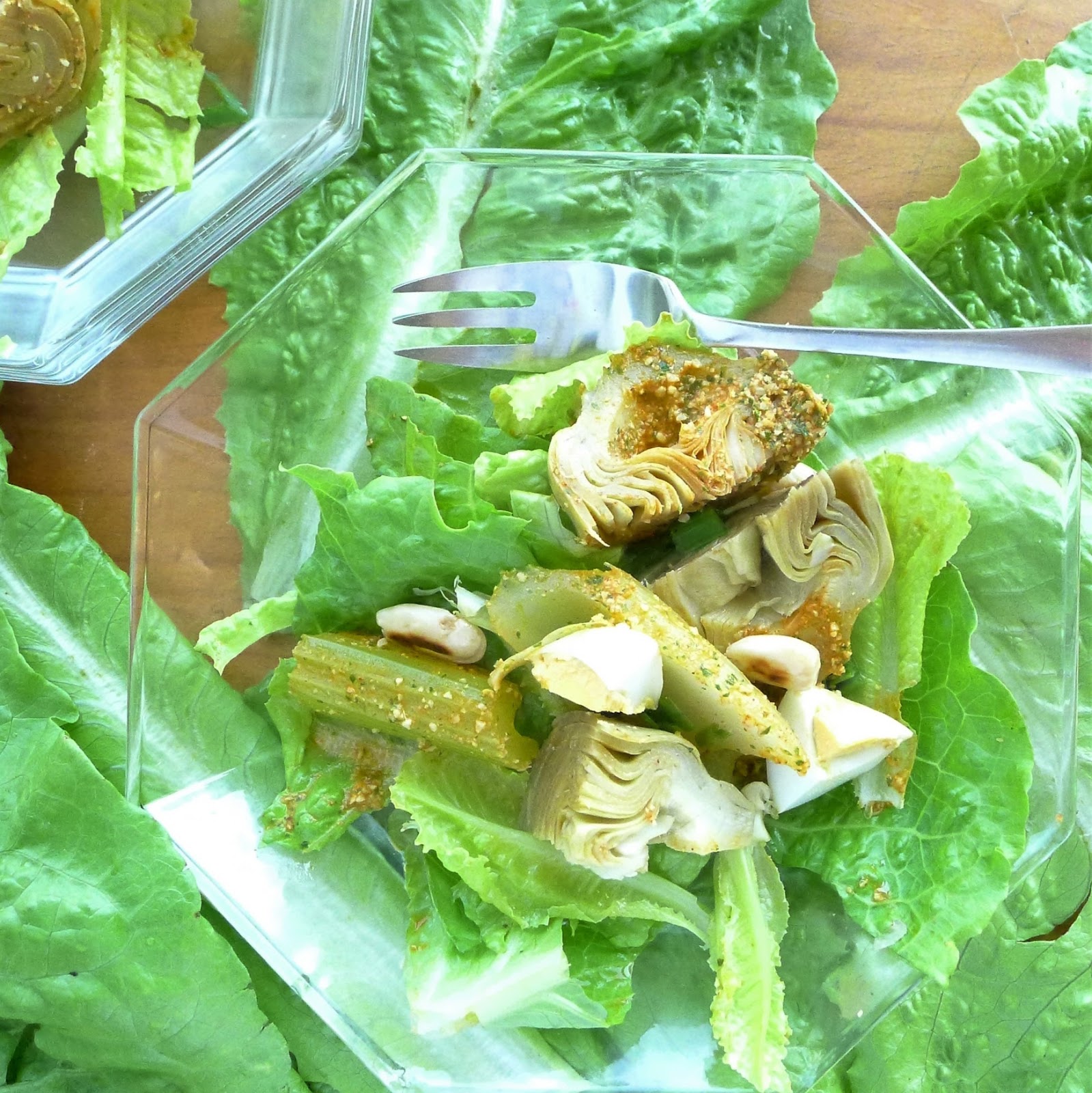
A spring salad of fresh artichokes and celery with a romesco dressing.


I’m making a Tarragona style artichoke salad. The name, “Tarragona style” has nothing to do with the herb tarragon. Rather, Tarragona is a city in Catalonia that is famous for its exceptional romesco sauce, made with dried sweet peppers and nuts. The romesco is the dressing for the artichokes and salad greens.

This is actually a quickie romesco—made with pimentón (paprika) instead of the classic ñora peppers. Use ordinary sweet pimentón, not smoked, plus a little hot pimentón or cayenne. You can marinate the vegetables in the romesco or spoon the sauce over the salad at serving time. 


Dried red peppers, ground almonds, garlic, parsley and olive oil make the romesco sauce. Use it as a marinade for the vegetables or a dressing, spooned over right before serving.

If time is short or fresh artichokes are not available, canned artichoke hearts or canned cardoons, cardos, another vegetable in the thistle family, can be used instead. Cardoons look like celery and taste like artichokes, which explains why I’ve used celery in this salad. The sauce is brilliant with all vegetables—green beans, cooked cabbage, potatoes—so make your own variations on Tarragona style. In fact, a little tarragon might be very nice!

Artichoke Salad, Tarragona Style
Ensalada Tarragonense

Serves 6 as a starter.
Snap leaves off at base.

6-8 small artichokes or 4 large ones
Lemon
3 stalks celery, cut diagonally into 2-inch pieces
2 teaspoons sweet pimentón
½ teaspoon hot pimentón
2 dozen skinned almonds
¼ cup olive oil
¼  cup chopped parsley
3 cloves garlic
½  teaspoon salt
2 tablespoons wine vinegar
3 cups torn romaine or escarole
1 hard-boiled egg
1 teaspoon chopped fresh mint leaves or tarragon
1 tablespoon chopped scallions or green garlic

Use a serrated knife to slice.
Bring a large pot of salted water to a boil. Meanwhile, snap off the outer leaves of the artichokes.  Then cut them crosswise just above the heart, discarding upper leaves. (A serrated bread knife works well to cut through the artichokes.) Cut the artichokes in half, if small, or quarters, if large.

Remove fuzzy choke.
Use the tip of a knife to nip out the fuzzy choke in the center. Rub artichoke pieces with a cut lemon. Add the pieces to the boiling water and cook until the artichoke pieces are just tender, about 10 minutes. (The artichokes are done when an outer leaf pulls off easily.) Drain. 

Blanch the pieces of celery in boiling salted water for 6 minutes. Drain and refresh under cold water. (Use a vegetable peeler to strip off the strings from the celery before blanching.)

Combine the two kinds of pimentón in a small bowl and mix with ¼ cup of water until smooth.

In a small pan toast the almonds in 2 teaspoons of the oil until golden. Remove from heat. (If you like, save a few almonds to garnish the finished salad.)

Sauce is easy in processor.


In a blender or food processor, chop the parsley, then add the garlic and process until finely chopped. Add the toasted almonds and process until fine. Add the salt, vinegar and ½ cup of water and continue to process until the mixture is quite smooth. Then add the pimentón paste and the remaining oil. This makes 1 cup of dressing.  (The dressing can be served with other vegetables and salads.)

Place the artichokes and celery pieces in a bowl and pour over the dressing. Allow to marinate for one hour at room temperature.

On a large platter prepare a bed of romaine or escarole. Arrange the artichokes and celery on top. Garnish with sliced egg, chopped mint and chopped onion. 

Serve the salad as a starter.

Artichokes marinate in romesco dressing.