Showing posts with label chocolate. Show all posts

Saturday, July 17, 2021

CELEBRATE CHOCOLATE!

Chocolate.

Did you celebrate World Chocolate Day (July 7)? Oblivious of the occasion, I nevertheless was moved to make a chocolate dessert. Visiting friends presented me with a lovely gift, a 1 ¾ -pound block—like an ingot--of dark chocolate. I couldn’t just let it sit there to be chipped away in bits.


July 7, 1550, was, supposedly, the date Hernán Cortes, Spanish explorer, introduced chocolate to Spain. Chocolate was originally consumed by the Mayans of Central America. The Aztecs discovered cacao when they took control of Mayan lands in trade expansion. Known as “food of the gods,” it became so valued that only the nobility was allowed to partake of it. Emperor Moctezuma served a chocolate beverage flavored with vanilla in cups of gold. The Spaniards were impressed.

Back in Spain, the Spaniards added sugar to the bitter brew and chocolate soon became all the rage with the nobility. From 1521 until 1600, Spain had a virtual monopoly on the trade in cacao from the New World. Only after that did the British, Dutch and French expand cultivation of the treasured cacao in other parts of the world (Indonesia, Africa, the West Indies). 

Spain still has a passion for thick, drinking chocolate. What is surprising is that they invented few desserts based on chocolate. Even if you spell it “mus” or call it “espuma,” chocolate mousse is still French. 

I’m making a chilled, no-bake chocolate tart. 

Easy to make, no baking required--rich chocolate tart.


Tart has a crunchy crumb crust, creamy filling and intense chocolate ganache topping.


Peanuts on top and peanut butter in the filling add depth to the chocolate.


No-Bake Chocolate Tart
Tarta de Chocolate sin Horno

This tart needs to be chilled at least 8 hours to firm it up. It also can be frozen. 

Use any dark chocolate (from 54 to 70 percent). If you’re using very bittersweet chocolate, you may want to add sugar to the filling mix. 

Galletas for crumb crust.
Unbaked crumb crust needs butter to set up firm, so this is one recipe in which olive oil doesn’t substitute well. Use plain cookies, such as Spanish galletas Marías, digestives, vanilla wafers or graham crackers to make the crumbs for the crust. 

A food processor works well for grinding the crumbs and mixing the cream cheese and chocolate for the filling.

Chop the chocolate to make melting easier. Melt it over hot water or in the microwave.

PX Sherry, a sweet, raisiny wine, adds a subtle fruity taste to the chocolate. If you don’t have it, use a tablespoon of milk to mix the filling.

For the crumb crust:
12 ounces galletas (plain cookies) to make 3 1/3 cups crumbs
2 tablespoons unsweetened cocoa powder
1 tablespoon peanut butter
½ cup melted butter (3 ½ ounces)

Grease a 9-inch springform mold. 
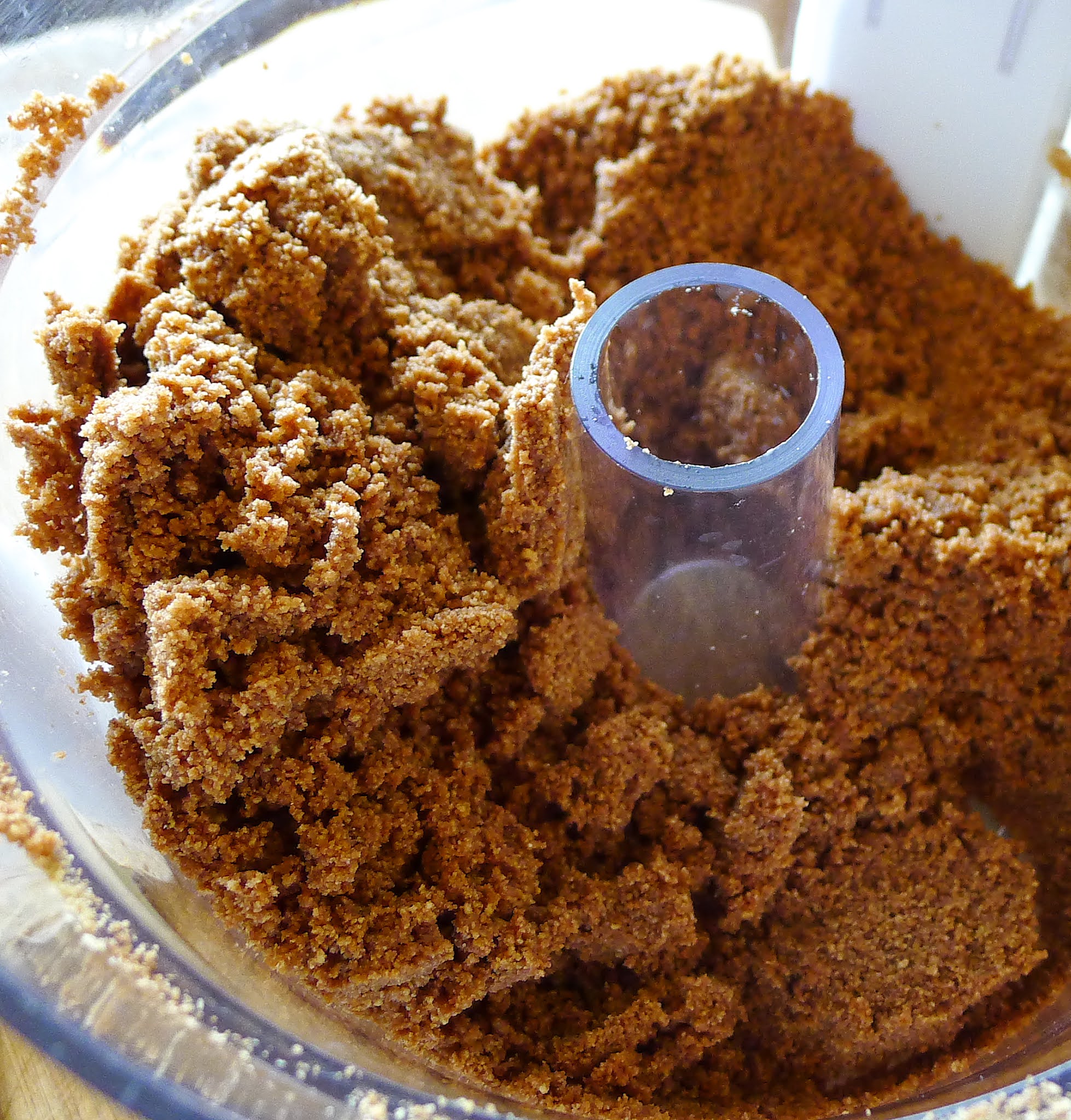

Grind the galletas in a food processor to make fine crumbs. (Save 2 tablespoons of the crumbs for the topping.) Add the cocoa powder to the crumbs and process again. Add the peanut butter and combine. With the processor running, pour in the melted butter and process until the crumbs come together in a ball.  

Spread the crumb-butter mixture evenly in the springform pan. Use a large spoon or flat plate to press it firmly. Refrigerate the crumb crust at least 1 hour before filling.


For the chocolate filling:
7 ounces dark chocolate, chopped
1 ½ cups cream cheese (12 ounces), softened
1 ¼ cups mascarpone (9 ounces), softened
2 tablespoons peanut butter
1 teaspoon vanilla extract
1 tablespoon PX (sweet raisin wine)
Pinch of salt

Place the chopped chocolate in a heatproof bowl and set it over a pan of boiling water. Heat the chocolate without stirring until most of it appears melted. Stir the chocolate until smooth and remove it from the heat. Let it cool before incorporating in the filling mixture.

Combine the cream cheese and mascarpone in the bowl of a food processor. Process until they are smooth and creamy. Add the peanut butter and process again. With the processor running, pour in the melted chocolate. Add the vanilla, the PX wine and the salt. 

Pour the chocolate filling into the chilled crumb crust. Spread it evenly. Cover the pan with plastic film and refrigerate at least 8 hours.

For the topping:
4 ounces dark chocolate, chopped
½ cup whipping cream
2 tablespoons roasted salted peanuts
1 galleta

Place the chocolate in a heatproof bowl. Place the cream in a small saucepan. Bring it just to a boil. Immediately remove and pour over the chocolate. Let it stand 5 minutes to soften the chocolate. Then stir until chocolate is completely smooth.

Place the peanuts and galleta in a mini-processor and process until coarsely chopped. 

To finish the tart:
Loosen the sides of the tart in the springform pan. Release the side and carefully remove it. Place the tart on a cake dish. Pour the chocolate topping evenly over the top of the tart, letting excess drip over the sides. 

Sprinkle the top with the mixture of chopped peanuts and galleta. 

Return the tart to the refrigerator until ready to serve.

Thanks to Sharman Haley, who gifted me with a 1 3/4-pound block of dark chocolate. Sharman is the granddaughter of the founder of Brown & Haley (Tacoma, WA), makers of Almond Roca and other chocolates.

More recipes with chocolate:


Saturday, February 8, 2020

CHOCOLATE—SHARE THE LOVE!

Why do chocolate and romance go together? While chocolate has never been proven to have aphrodisiacal properties, its consumption certainly soars on Valentine’s Day. Here’s a dessert to share the love. 


Chocolate = romance. A luscious chocolate custard for Valentine's Day.

Unlike airy chocolate mousse, this custardy chocolate dessert is dense, intensely chocolatey. While not overly sweet, it is sublimely rich. A little goes a long way. I’ve noted a yield of six half-cup servings, but the custard could easily be divided into much smaller servings.

Chocolate with no sugar added.

You need to start with good quality dark chocolate, at least 70 percent cacao. I’ve used chocolate with no added sugar. The sweetening is a combination of malitol and stevia. A touch of raisiny dessert wine, either Málaga Muscatel or Pedro Ximénez, complements the chocolate’s natural fruitiness.

The hot, eggy custard mixture melts the chopped chocolate. Blending turns it smooth and glossy.  

The dessert is best served at room temperature. It can be prepared in advance and refrigerated, but bring it to room temperature before serving.

How to serve the custards? With a luscious strawberry imbedded in the chocolate. With a sprinkling of Muscatel raisins that have been plumped in Muscatel or PX wine. With a dollop of crême fraiche or Greek yogurt (sweetened to taste). Sprinkled with chopped nuts. Spread on a crumb crust. The custards could probably be put into heart-shaped molds and unmolded after firming in the fridge.


Share the love! Rich chocolate custards are an easy, make-ahead dessert for a dinner party.

Chocolate marries well with berries, with raisins and figs, with oranges. 

Serving options: a dollop of Greek yogurt or crême fraiche.


Dark Chocolate Cream Custards
Crema de Chocolate Intensivo

Makes 6 (½ -cup) servings.

12 ounces dark (70%) chocolate
4 large egg yolks
Pinch of salt
¾ cup heavy cream
1 cup milk
¼ cup + 1 tablespoon sweet Muscatel or Pedro Ximénez wine

Chop the chocolate finely. (This is easy to do in batches in a mini food processor.) Place the chocolate in a heat-proof bowl.

Whisk the egg yolks in a heat-proof bowl with a pinch of salt.

Whisk hot cream into yolks.

Place the cream, milk and ¼ cup of sweet wine in a saucepan. Bring to a boil. Remove from heat. Whisk half of the hot cream into the egg yolks. Return the egg yolks to the saucepan. Cook on moderate heat, stirring constantly, until custard is thick enough to coat the back of a spoon, 3 to 4 minutes.

Hot custard melts chocolate.

Pour the hot custard over the chopped chocolate and allow to stand a few minutes to soften the chocolate. Stir to mix the chocolate and custard completely.

Blended custard is smooth and glossy.


Transfer to a blender. Add 1 tablespoon sweet wine and blend the mixture until smooth and satiny. Divide between custard cups or dessert glasses. 


More about Spain and the history of chocolate: 

More chocolate dessert recipes:

Sunday, March 10, 2013

SURF 'N TURF, WHERE THE TURF IS CATALUÑA

Chicken cooks with shellfish in a rich sauce for Spanish surf 'n turf.
Years ago when I started collecting recipes around Spain, I came across one in Cataluña (northeastern Spain) that struck me as really exotic, “Chicken with Lobster.” Chicken cooked with shellfish seemed pretty strange, until I recalled the American steakhouse specialty, surf and turf—lobster with steak.

When I first tasted the dish, also known as mar y montaña, sea and mountain, I assumed adding chicken was a way to extend the pricey lobster. A single lobster plus chicken could feed six or more. I have since read in Coleman Andrews’ CATALAN CUISINE that its origin was exactly the opposite, the lobster was to extend the chicken: “Chicken was expensive, taking time to raise and money to feed, while every cast of the net brought up shrimp and spiny lobster,” wrote Andrews. (Langosta, by the way, is spiny lobster, which has no claws. The kind with claws is called bogavante in Spanish.

I have come across many variations of mar y montaña (or mar i muntanya in Catalan). The three in Coleman Andrews’s book are chicken and shrimp; rabbit with snails, monkfish, cuttlefish and shrimp, and rabbit with pork, sole and mussels. The most elaborate version I found, Ampurdan style, calls for jumbo shrimp (langostinos), sea crayfish (cigalas), cuttlefish, mussels, sausage, pigs’ trotters, rabbit, chicken, snails and mushrooms!

What all of these land and sea combos have in common is the addition of a picada. Picada is a paste made of ground nuts, garlic and bread that both thickens and seasons the sauce. The picada for mar y montaña usually also contains chocolate. Now, that really is exotic! Unless, of course, you’ve already savored Mexican mole, also a sauce with ground nuts and chocolate.

Cuttlefish, cleaned and ready to cut up.
Cuttlefish, like squid and octopus, is a cephalopod. It has eight short tentacles, an interior cuttlebone and ink sac. The medium-sized cuttlefish (jibia or sepia) shown in the photo is cleaned and ready to cut up. The thick flesh needs slow cooking (about an hour) to become tender. Tiny ones can be grilled or flash-fried.
Over the years, I have adapted mar y montaña to suit myself, as lobster is not readily available or affordable. (Although, the last time I shopped at HiperCor, El Corte Ingles’s supermarket, I saw lobsters, the kind with claws, imported from Canada at a reasonable price.) I usually make the dish with free-range chicken and cuttlefish (jibia or sepia). Meaty cuttlefish has such a deep-sea flavor. If cuttlefish is not available, squid or monkfish could be used instead, although they do not require such long cooking. 

Typically, a braised dish such as this is served on its own, with only crusty bread or triangles of fried bread as an accompaniment. But, because the picada-enriched sauce is so delicious, I like to serve rice as a side to soak it up. Yesterday, instead of rice, I served mar y montaña with creamy polenta. Wonderful.

Chicken cooks with cuttlefish and shrimp in a sauce of almonds and chocolate.

Mar y Montaña
Surf and Turf (Chicken with Seafood)


Serves 4 to 6.

2 tablespoons olive oil or lard
1 slice bread, crusts removed
3 cloves garlic
30 almonds, blanched and skinned
Parsley sprig
4 jumbo shrimp
2 pounds chicken in serving pieces
Salt and pepper 
1 chicken liver (optional)
1 onion, chopped
1 cup chopped tomatoes (3 medium)
1 pound cleaned cuttlefish, cut in bite-size pieces
2/3 cup dry Sherry or white wine
1 tablespoon dry anisette or brandy 
2/3 cup water or stock
Strip of orange zest
1 bay leaf
½  teaspoon saffron, crushed 
1 ounce dark chocolate, chopped
Pinch of cinnamon
Fried bread to serve (optional)           
Chopped parsley to garnish


Heat the oil or lard in a large cazuela or deep skillet. Fry the bread, 2 cloves of the garlic, almonds and a sprig of parsley until bread and almonds are golden. Skim out and reserve.

Sauté the jumbo shrimp in remaining oil until they are pink and just cooked through. Remove and set aside.

Season the chicken pieces with salt and pepper. Brown them in the fat with the chicken liver, if using. Remove the chicken pieces and liver when browned. Add the chopped onion and remaining clove of garlic, chopped. Sauté 5 minutes until onion begins to brown. Add the tomatoes and cook a few minutes over medium-high heat. Add the cut-up cuttlefish, Sherry, anisette, water, orange zest and bay leaf. Cover and simmer 15 minutes.

Return the chicken pieces (but not the liver) to the cazuela. Continue cooking until both cuttlefish and chicken are tender, about 40 minutes longer.

Meanwhile, prepare the picada. In a mortar, food processor or blender, grind together the fried bread, almonds, 2 cloves of garlic and parsley, chicken liver, saffron, chocolate and cinnamon. Mix with about ½ cup of sauce from the cazuela and blend to make a smooth paste.

Stir the picada into the cazuela. Cook 15 minutes longer. Place the shrimp on top and garnish with chopped parsley. Serve with strips of fried bread, if desired.

Chocolate is a secret ingredient in the sauce.

Sunday, February 10, 2013

THE CHOCOLATE CONNECTION

Chocolate-covered figs, a sweet treat for Valentine's Day.

With Valentine’s Day coming up, everybody is writing about chocolate this week. It’s a good enough excuse for me too. Chocolates make a wonderful gift. Chocolate is reputed to be aphrodisiac. Chocolate, usually, is sweet, as in “sweetheart”. No matter if it’s only a marketing ploy, chocolate is worth the celebration.

Spain has a very special chocolate connection, dating back to 1502 when Columbus first discovered cacao beans in what is today Honduras, on his fourth trip to the Americas, and sent some back to Spain.  But it was not until Hernán Cortés tasted chocolate in Mexico (around 1521), where the Emperor Moctezuma served it flavored with vanilla in cups of gold, that Spaniards took notice of the beverage.

The Spaniards added sugar to the bitter brew and, after that, chocolate became all the rage with the Spanish nobility. From 1521 until 1600, Spain had a virtual monopoly on the trade in cacao from the New World. Only after that did the British, Dutch and French expand cultivation of the treasured cacao in other parts of the world (Indonesia, Africa, West Indies). 

Chocolate was originally consumed by the Mayans of Central America. The Aztecs discovered cacao when they took control of Mayan lands in trade expansion. Known as “food of the gods,” it became so valued that only the nobility was allowed to partake of it.

Chocolate mona de pascua in a Barcelona shop.
In Spain, chocolate was deemed by the Catholic church to be an acceptable potion to be imbibed during Lenten fast days, when many foods were forbidden to the faithful.  Perhaps this is why chocolate is especially beloved during the Lenten season. Chocolate eggs, bunnies and chicks symbolize the springtime festival.  In Catalonia, the custom reaches extravagant proportions with the confection of monas de pascua, richly decorated chocolate delicacies consumed on Easter, when more than 300,000 of them are sold. 

I find it fascinating that, to this day, Spain favors drinking chocolate (see the recipe for chocolate a la taza  here) and has never really developed a repertoire of desserts such as chocolate mousse, chocolate cake, fudge, chocolate ice cream, brownies.

Nevertheless, artisanal products such as chocolate-covered figs, a product of Extremadura, are an exquisite rendition of the chocolate arts. (Order them here from La Tienda .) Or, make these bonbons yourself for your sweet love.

Hand-dipping candied orange peel.
I didn’t make the chocolate-fig bonbons pictured in the photo at the top. I purchased them at a local artisanal chocolate factory called Mayan Monkey Mijas. In the photo to the right, a chocolate artisan at Mayan Monkey dips candied orange peel in dark chocolate.


Chocolate-Fig Bonbons
Bombones de Higos


These figs have a chocolate cream filling and are bathed in bittersweet chocolate. Don’t worry if your hand-dipped bonbons don’t have a slick professional finish—they will still taste wonderful.

A thermometer is useful in tempering the chocolate coating for the bonbons. You don’t need a candy thermometer, as the chocolate never heats more than120ºF. Use a dairy thermometer.

Makes 75 bonbons.

1 pound small dry figs
1 cup plus 2 tablespoons sugar
3 cups water
¼ cup brandy
16 ounces bittersweet chocolate, chopped or grated
2 tablespoons extra virgin olive oil
1/3 cup boiling water


With a sharp knife cut a slit in the bottoms of the figs, leaving the stems intact.

Combine 1 cup sugar and 3 cups water in a saucepan. Bring to a boil, stirring to dissolve sugar. Cook 3 minutes. Add the brandy, bring again to a boil, and stir in the figs. Remove the pan from the heat and let the figs macerate 15 minutes.

Drain the figs in a colander, saving the brandy sugar syrup for another use. Spread the figs on a rack and allow to dry in a well-aired place for 2 hours.

Prepare the chocolate cream filling. In the top of a double boiler over boiling water melt 4 ounces of the chocolate. Stir in the olive oil, 2 tablespoons of sugar, and the boiling water. Place the pan over medium, direct heat and cook, stirring, for 3 minutes. Scrape into a heatproof bowl. Cool the chocolate, then refrigerate.

To stuff the figs with the chocolate cream filling, poke a finger or wooden dowel into the slit to make a hollow and use the tip of a small knife to push about 1/8 teaspoon of the chocolate cream into the center. Place each fig on a tray as it is filled. (You may not need all of the chocolate cream. Reserve unused chocolate for another use.) Set aside in a cool place (not refrigerator) for at least 30 minutes or up to 6 hours.

Place the remaining 12 ounces chocolate in the top of a double boiler. Position a thermometer in the top section of the double boiler. Place over boiling water and melt the chocolate, stirring, until it reaches 125ºF.

Remove the chocolate from the heat and allow to cool to 85ºF.

Heat the water in the bottom of the double boiler to 90ºF and maintain this heat. Place the chocolate over the water again and let it warm to 90ºF.

Dip the figs, one by one, into the melted chocolate. Use 2 forks to remove them, letting excess chocolate drip off, and place the figs on a rack lined with waxed paper. Let the figs dry in a cool place for 3 hours.

 Place the figs in individual bonbon papers or in a box lined with waxed paper. They are ready to eat immediately, but may be kept, refrigerated, for up to 1 month.


Sunday, March 20, 2011

STREET FOOD


Hooray, Carnaval! Cancelled two weeks in a row because of rain, today carnaval processions hit the streets in my village with raucous banging, ringing, singing and dancing.


Carnavales are the pre-Lenten bacchanalia that, by the Church calendar, should have ended a week ago. But, all that planning for costumes shouldn’t go by the wayside because of a few rainstorms!


After the groups make their way through village streets, everyone congregates in the big plaza for more music, shenanigans, showing off and awards for best costumes. And, of course, food. On this sunny afternoon a couple of bars are serving drinks and snacks.


Pinchitos are spicy mini-kebabs grilled on a plancha. Also from the plancha are hamburgers and thinly-sliced pork loin placed on mini-buns and garnished with lettuce and tomatoes. A huge paella gets a final garnish of shrimp before being served up to the crowds.

Another stall (this one in benefit of a charity) sells small bowls of potaje de callos, a tripe and sausage stew with garbanzos (the recipe is here).


Later in the afternoon, ladies fire up a vat of oil to fry buñuelos, small crullers or doughnuts, so good with the thick, thick hot chocolate ladled from a big pot. (The recipe for drinking chocolate is here.)


Mini-Kebabs with Moorish Spices

Pinchitos Morunos

Exotic Moorish spices from nearby Morocco give the meat—usually pork—a lot of flavor. In Spain, spice vendors sell a ready-mixed blend, especia para pinchitos, pinchito spice, which contains lots of cumin, coriander, red chile, turmeric and ginger. If you can´t get the spice mix, use instead a spoonful of curry powder combined with ground cumin.

The trick is to cut the meat into quite small pieces, so that it cooks in the few minutes it takes to brown. Thin metal skewers work best and can be reused. If using bamboo skewers, soak them first in water and take care that they don´t come in contact with the heated griddle.

Makes 16 mini-kebabs.

1 tablespoon ground cumin
1 tablespoon Madras curry powder
2 pounds boneless pork shoulder, cut in ¾ inch cubes
6 tablespoons chopped parsley
10 cloves garlic, chopped
2 teaspoons salt
½ cup fresh lemon juice

Combine the cumin and curry powder. Place half the cubes of pork in a non-reactive bowl and sprinkle with half the parsley, garlic, salt, spice mixture and lemon juice. Add remaining pork, then parsley, garlic, salt, spice and lemon juice. Marinate, covered and refrigerated, for 24 hours. Turn the meat 2 or 3 times.

Thread 4 or 5 pieces of meat onto thin metal skewers. Cook them on a hot griddle, turning until browned on all sides, 7 to 8 minutes.

Sunday, March 13, 2011

SPAIN, FROM THE HEART


 Families and Food
 

If you live in the US and have an interest in the food of Spain, you likely have heard of La Tienda, an on-line retail store that specializes in foods imported from Spain. Not so many years ago, before pimentón, chorizo, olive oil from Spain, serrano and ibérico ham became popular in many American supermarkets, La Tienda http://www.tienda.com/  was one of a very few places to find authentic Spanish products.

La Tienda is featuring recipes from one of my cookbooks, TAPAS—A BITE OF SPAIN on its web site. TAPAS, with scrumptious photos by Michelle Chaplow, was published by Santana Books in Spain. La Tienda has a near-exclusive stock of this book in America. The current recipe is “Piquillo Peppers Stuffed With Prawns.” Piquillo peppers imported from Spain are available from La Tienda. Have a look at the recipe here http://www.tienda.com/recipes/emails/021511.html . Should you wish to order the book from La Tienda, just click on the picture of it at the end of the recipe.  (And, my blog about piquillo peppers here  http://mykitcheninspain.blogspot.com/2009/11/pick-peck-of-piquillo-peppers.html .)

La Tienda is a family business that was founded in 1996 by Don Harris and his wife, Ruth. The couple lived in Spain with their children during the 1970s, in El Puerto de Santa María (Cádiz), when Don was stationed at the nearby naval base of Rota.

Explained Don, La Tienda was a way to share a taste of Spain as well as the country’s  grace, warmth and traditions that have brought so much to the lives of their family.

“Family is our focus,” Don writes on the web site. “Just as the family is central to life in Spain, we hope to share that emphasis with everyone we work with: our customers, our employees, and our vendors. And, of course, nothing brings a family together like a wonderful meal!” Two of their three sons also work in the business. All make frequent trips to Spain, renewing friendships and searching out products.

Now Don has written a book, THE HEART OF SPAIN—FAMILIES AND FOOD (Duende Press; Williamsburg, VA.), telling about the producers and purveyors and their families in Spain as well as some of the background about certain products. He takes you to visit a cheese maker in La Mancha, Sherry families in Jerez, bean producers in La Granja, ham on the hoof, saffron in the field, shopkeepers, cooks and sauce makers. The book is a little bit of a travel guide, but always illustrated with personal encounters. If there were a “cloud” of most-used words, it would emphasize the words “family,” “traditional,” “values,” “warmly,” “dignity,” “friendship,” “continuity,” “spirituality”  

There are no recipes in THE HEART OF SPAIN, so I selected a recipe from one of my own books, using a product from La Tienda. This is Chocolate a la Taza, thick drinking chocolate, often served with churros, fried strips of batter, for dunking. La Tienda sells Valor brand chocolate a la taza for making drinking chocolate.
In his book, Don Harris relates the story of King Philip II, an early (16th century) aficionado of chocolate. The king, a pious Catholic, faced a dilemma: if chocolate was considered a food, then he would be deprived of it during Lent. But, if the Church classified chocolate as a beverage, he was within bounds, for beverages were not included in the rules of fasting. His confessor assured the scrupulous Philip that drinking chocolate was exempt from fasting requirements. Chocolate continues to be a sweet and comforting delight during the otherwise austere Lenten fast leading up to Easter.
The squares of chocolate already contain sugar and thickening. All you do is add squares of the Valor bar to milk, simmer it on the stove and stir occasionally until it reaches desired thickness. The thickness can be adjusted by the number of chocolate squares used and how long it is heated. On average, 2-3 squares per cup of milk and around 2 minutes simmering time  produces a delicious mug of hot chocolate!

The following recipe is for making Spanish-style drinking chocolate if you don’t have tablets of Valor chocolate a la taza handy. It is adapted from MY KITCHEN IN SPAIN, the cookbook. There is no recipe there for churros, the fried strips of batter to accompany the chocolate, as I find them difficult to make in the home kitchen, but there is a recipe for buñuelos, also served to accompany chocolate. (That recipe is here.)

 (Photo of chocolate and churros by Jerónimo Alba from COOKING IN SPAIN.)

Hot Drinking Chocolate
Chocolate a la Taza

   
This is more like liquid chocolate pudding than like cocoa. It’s thick enough to coat a spoon. It can be prepared with water, milk or a combination.

Serves 4.
 
  8 ounces (8 squares) semi-sweet chocolate
3 cups water
3 tablespoons cornstarch
2 cups milk
1/4 cup sugar, or to taste
1/2 teaspoon vanilla extract

Break the chocolate into pieces and put in a pan with 2 cups of the water. Heat, stirring, until the chocolate is melted and smooth.

Stir the cornstarch with 1 cup water until it is smooth. Return the chocolate to the heat. Beat in the milk, sugar and cornstarch. Cook, stirring constantly until the mixture thickens. Cook 2 minutes longer. Remove from heat and stir in the vanilla. Add additional sugar, if desired.

Pour into mugs and serve. The chocolate can be kept hot in a double boiler over simmering water. It can be reheated in a microwave.