Showing posts with label sweet potatoes. Show all posts

Saturday, November 2, 2024

AUTUMN IN A BASKET

 
Create an autumnal meal with these fruits, nuts and vegetables.

Roasted chestnuts and sweet potatoes; huesos de santo (saints’ bones, a sweet made of almond paste); pine-nutty panellets from Catalonia, and buñuelos, puffy fritters—all are symbols of the autumn holidays of Todos los Santos (All Saints, Nov. 1) and Fieles Difuntos (Day of the Dead, Nov. 2). 


It’s also the season of the saffron harvest in La Mancha and of newly pressed extra virgin olive oil from my local mill. Coming Nov. 4-10 is International Sherry Week. Also in my autumnal basket are pretty pomegranates, knobbly quince and mushrooms. I’m going to put them all in a pot to celebrate the season.

A slow-cooked stew of pork cheeks with mushrooms and chestnuts in a savory sauce of pomegranate and Sherry with sweet potato fries on the side.


Pork Cheeks with Chestnuts
Carrilladas de Cerdo con Castañas

Pork cheeks are perfect for slow-cooked stews but you could substitute any stew meat in this recipe. 

Pink pomegranate is sweet.

Not all pomegranates have ruby-red kernels. You may have ripe fruit with pale pink arils. They are wonderfully sweet but a disappointment to a food stylist looking for that pop of color to finish a dish. Red pomegranate juice, by the way, cooks to a brownish color. 

A small pomegranate will yield about ¼ cup of juice. If pomegranate is not available substitute grated tomato pulp.

Slit chestnuts and microwave.
A microwave works fine for “roasting” the chestnuts in order to peel them. Cut a slit in the shells across the pointy end of each. Place them, about 6 at a time, on a microwave-safe plate. Microwave on High until the chestnuts begin to hiss as they release steam, 1 to 2 minutes. The slits should open slightly. Wrap the very hot chestnuts in a clean towel. While they are still warm, remove the shells, keeping them whole, if possible. The brown inner skins should come off with the shells. If necessary, scrape off the skins. 

By all means use autumn wild mushrooms such as boletus and níscalo (saffron milk cap) if available. Otherwise meaty portobellos or shitakes are a good stand-in.

Chocolate in a meat sauce? Yes, it’s typical in some Galician and Catalan recipes. And, besides, this week is the first international Chocolate and Cacao Week (Guadalcao) which is being celebrated in Sevilla. Add chocolate to the autumnal basket.

Serves 2

8 ounces (12-14) chestnuts (to make 1 cup chestnut meats)
1 small pomegranate
4 pork cheeks (about 4 ounces each)
Salt
Freshly ground black pepper
Flour for dusting the meat
3 tablespoons olive oil + more to fry the sweet potatoes
1 cup chopped onion
1 clove chopped garlic
½ cup diced carrot
3 tablespoons chopped apple or quince
4 large mushrooms, cut in half
3 tablespoons Brandy de Jerez
¼ cup pomegranate juice
1/3 cup fino or oloroso seco Sherry
1 cup water or meat stock + more as needed
Sprig rosemary + more to garnish
Sprig of fennel
Pinch of saffron (optional)
½ ounce dark chocolate, chopped (optional)
2 medium sweet potatoes (14-16 ounces)

Microwave the chestnuts and remove their shells as described above. 

Peel the pomegranate and separate the arils (kernels) from the membrane. Set aside a few of the kernels for garnish. Place the rest in a blender and grind them. Sieve the pulp, pressing on the seeds to extract all the juice. 

Trim pork cheeks.
Use the tip of a knife to remove most of the membrane that covers one side of the pork cheeks. Sprinkle the cheeks with salt and pepper and dust them lightly with flour. Heat the oil in a heavy pan and brown them on both sides. Remove the meat.

Add the onion, garlic, carrot and apple to the oil and sauté them on medium until lightly browned, 5 minutes. Add the mushrooms. Add the brandy and cook off the alcohol, 1 minute. Add the pomegranate juice and Sherry and cook them 1 minute. Add the water. Return the pork cheeks to the pan. Season with salt, pepper, rosemary, fennel and saffron, if desired. When liquid begins to simmer, cover the pan and cook 30 minutes.

Turn the pork cheeks and add the chestnuts to the pan. Cover and cook 30 minutes more. 
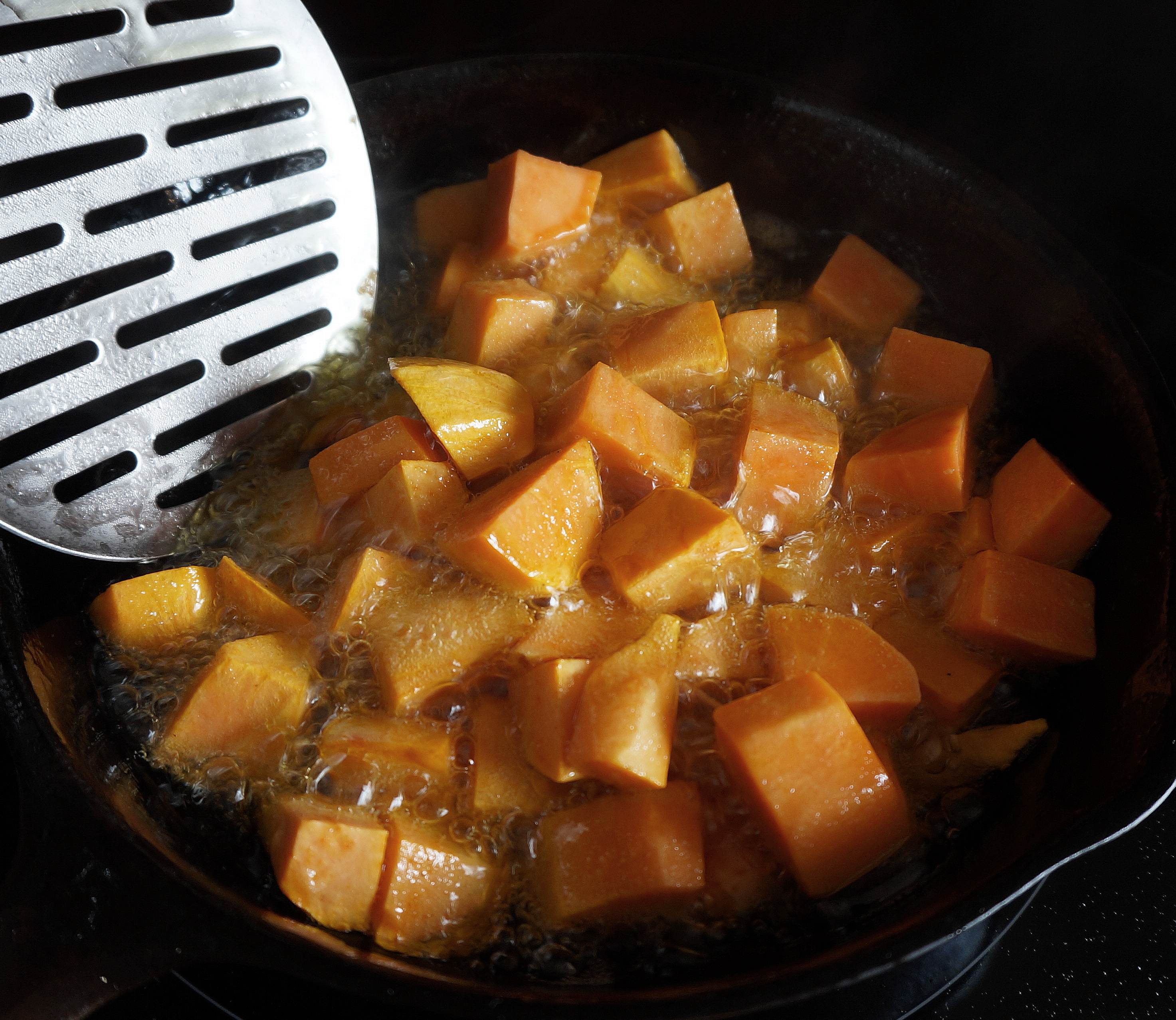
Fry cubed sweet potatoes in olive oil.


While the meat is cooking, prepare the sweet potatoes. Peel and cut them into ¾-inch cubes. Place oil to a depth of ½ inch in a small skillet and heat. Add the sweet potatoes and fry them on medium-high until they are lightly browned and tender, about 5 minutes. Remove them with a slotted spoon and drain on paper towels. Sprinkle the sweet potatoes with salt.
Sauce after blending.

Test the meat for doneness. If not completely tender, cook it 30 minutes longer. When it is fork-tender, remove the pan from the heat. Remove the meat, whole chestnuts (leave any crumbled chestnuts in the pan) and mushrooms. Discard the sprigs of herbs. Scrape the cooking liquid and vegetables into a blender container. Add the chocolate, if using. Blend until the sauce is smooth. Return the sauce to the pan with additional water or stock as needed to make a pouring gravy. Return the meat to the pan to reheat.

Serve the pork cheeks, sauce and fried sweet potatoes garnished with sprigs of rosemary and reserved pomegranate kernels.

A bouquet of fall flowers and a hearty red wine to accompany the autumn flavors.

More recipes with autumn flavor:


Saturday, October 29, 2016

SWEET POTATO BUNS

Why does pumpkin get all the publicity this time of year? Sweet potatoes, also in season now, can do everything pumpkin can—sweet or savory, vegetable or dessert. 


In Spanish villages sweet potatoes (called batatas or boniatos) are roasted in bread ovens and sold, piping hot, along with bread. Warm sweet potatoes as well as roasted chestnuts are a favorite snack for chill evenings visiting the cemetery on the Day of the Dead. (In Spain, November 1 is a national holiday, Todos los Santos—All Saints’ Day, so that is when most families visit their dear departeds in the cemeteries.)

Here is a recipe from La Mancha for tortas de boniato, sweet potato buns, a yeast bread with spice and just a little sugar. The sweet potatoes give the buns a lovely color and moistness. Serve them with soft cheese and marmalade for breakfast. Split the buns crosswise and fill with sliced turkey or toast them and use with burgers (salmon burger or lamb burger would be especially good, I think).

Sweet potato in the dough gives these buns a great color.

Breakfast buns! Split them and toast on a ridged grill pan.

Spread buns with cream cheese and top with jam.


A change from bagels--buns with cream cheese and smoked salmon.


Tostadas are like bruschetta--crisp toasts ready for toppings. Slice the buns crosswise. Brush with olive oil and place on baking sheets, oiled sides down. Bake in 375ºF oven until golden on the bottom, 5 minutes. Brush the tops with more oil and turn the slices over. Bake until bottoms are lightly browned, about 5 minutes longer.

Leftover turkey? Sandwich it on these buns, with mayo and mango chutney.


Sweet Potato Buns
Tortas de Boniato


You will need about 1 cup mashed sweet potato. You can use leftover cooked sweet potato in this recipe. Added spices are fine; but, if potatoes have been sweetened, eliminate the sugar from the bread recipe.

Heating the oil with aniseed and lemon zest infuses flavor. Don’t let the oil bubble, just warm.

The small quantity of sugar makes the dough somewhat sticky. Use enough additional flour when kneading to keep the dough from sticking to the board. For additional sweetness, sprinkle sugar on top of the buns before baking. If you are going to use them for sandwiches or other savory preparations, skip the sugar topping.

Makes 12 large buns.

Ingredients for the buns. Note the bubbly yeast (upper right). Below it is olive oil infused with aniseed.
1 medium sweet potato (14 ounces), peeled and cut in pieces (to make 1 cup mashed sweet potato)
½ cup olive oil plus additional for oiling bowl and baking sheets
¼ teaspoon aniseed
Strip of lemon zest
½ cup warm water (110ºF)
Sugar
1 envelope active dry yeast
2 eggs
1 ½  teaspoon salt
1 ½ cups milk, warmed to 110ºF
8 cups flour plus additional for kneading
1 egg yolk
1 tablespoon milk


Cook the sweet potato in boiling water to cover until fork-tender. Drain well. Mash the sweet potato or put through a ricer.

Heat the oil in a saucepan with the aniseed and strip of lemon zest. Remove from heat and discard the zest. Allow the oil to cool.

Place the warm water in a small bowl with ½ teaspoon sugar and sprinkle the yeast over it. Allow to stand until bubbly, 10 minutes.

Beat the eggs in a large mixing bowl with 2 tablespoons sugar and the salt. Beat in the oil and aniseed. Add the sweet potatoes, yeast, and warmed milk. Use a large wooden spoon to stir in about 6 cups of flour. Knead in remaining 2 cups of flour.

Turn the dough out onto a floured board and knead until smooth and shiny, 5 minutes. Sprinkle the board with additional flour as needed to keep the dough from sticking. Gather the dough into a ball.

Oil a clean, large bowl. Place the dough in the bowl, turn it to coat all sides lightly with oil. Cover the bowl with a damp cloth and place in a warm place until dough has doubled in volume, about 2 hours.

Prepare 2 baking sheets. Lightly oil the sheets and dust with flour. With a floured hand, punch down the dough. Knead briefly on floured board. Divide the dough into 12 balls (about 5 ounces each). Roll or pat them into disks about 5 inches in diameter and ½ inch thick. Place them on the baking sheets. Cover the buns with plastic wrap and set in a warm place to rise 1 hour.

Preheat oven to 375ºF.

Discard plastic wrap. Combine egg yolk with 1 tablespoon milk. Brush  the tops of the buns with the egg. Sprinkle them with 2 tablespoons of sugar (optional).

Bake the buns in the middle rack of the oven, changing position of the sheets after 10 minutes, until they are golden on top and sound hollow if tapped on the bottom, 20 to 25 minutes.

Cool the buns on wire racks.


More about sweet potatoes here.

Saturday, November 23, 2013

SWEET POTATOES FOR THE HOLIDAYS

Two kinds of sweet potatoes, orange and white.
In the US, Christmas has to wait, at least, until after the Thanksgiving holiday. In Spain, without that cut-off date, Christmas decorations and foods begin to appear early in November. Already the boxes of special sweets are stacked in shops, hams (serrano and ibérico) are stocked and awaiting the buyers, glittery decorations and lights gleam in shop windows. And, my village neighbors are already making empanadillas—fried turnovers with sweet potato filling, a Christmas treat.

Sweet potatoes, grown in southern Spain (called batata or boniato), appear in the market in time for All Saints’ Day (November 1), when they are roasted and eaten with chestnuts, and last through Christmas. (Sweet potatoes are not yams. Real yams, ñames, a starchy root, somewhat resembling sweet potatoes, are grown and eaten in the Canary Islands, much the same as in West Africa.)

Both orange-fleshed and white sweet potatoes are found in Spanish markets. The orange ones are sweeter and have a more pasty flesh; the white ones are mealy, somewhat like regular potatoes.

My kids, when they were in primary school in the village, ate lunch with a Spanish family (no school lunchroom in those days). This time of year, they often had boiled sweet potato for dessert or snack—no added sugar, just the sweet flesh spooned out of the skin.
Although I’ve lived 40 years outside of the United States, I still like to celebrate Thanksgiving, an occasion for feasting, for getting together with friends and family, for enjoying harvest foods.

Jugs of new olive oil.
This week I am celebrating the bringing home of the new olive oil! I took five sacks of my olives to the mill and came home with 10 liters of extra virgin olive oil. (I picked all those olives, with help from my son Ben, who cut down high branches for me.)

As it happens (once in a thousand years or so), this Thanksgiving (Thursday, November 28) is also the first night of Hanukkah, the Jewish festival of lights, when it is customary to eat fried foods. So. Let’s bring this all together now! Sweet potatoes, olive oil, Thanksgiving, Hanukkah! Good times! Celebrate!

Frying caramelizes the sugars in sweet potatoes.

Sweet Potato Fries

Serve these sweet-savory fries alongside a hamburger dolloped with some harissa-ketchup. Or, how about a turkey-burger and cranberry ketchup for a casual take on traditional Thanksgiving foods?

Burger and sweet potato fries.

Peel the sweet potatoes, cut them as for “french” fries. Heat olive oil in a skillet to a depth of 1 ½ inches. Fry the potatoes until they are golden-brown and tender (about 8 minutes). Drain on paper towels. Sprinkle with salt and ground cumin.

Fried turnovers are filled with sweet potatoes.

Turnovers with Sweet Potato Jam
Empanadillas Rellenas con Batatas


These small fried pies could definitely fill in for good-ole pumpkin pie. And, take a flavor hint—aniseed, clove and cinnamon are marvelous with sweet potatoes.

Makes about 28 small turnovers.

Spread filling on dough.

1 recipe for dough for fried pastries (below)
1 ½ cups sweet potato jam (recipe follows)
Oil for deep frying (olive or sunflower)
2 tablespoons sugar


Roll out the dough very thinly on a lightly floured board. Prick the dough all over with a fork. Use a 4 ½ -inch cookie cutter or the rim of a glass to cut circles.

Working with one disk at a time, place a spoonful of jam on one half. Moisten the edges of the dough with water, then fold the circle in half, enclosing the filling. With fingers or the tines of a fork, crimp the edges together firmly to seal the turnover. Place on a tray.

Continue filling and shaping the remainder of the dough.

Heat oil in a deep skillet to a depth of at least 1 ½ inches. Fry the turnovers, four or five at a time, until they are golden brown on both sides. Remove and drain on paper toweling. Sprinkle them with the sugar.

Filled turnovers are fried in oil.

Dough for Fried Pastries
Masa Para  Empanadillas

   
¾ cup olive oil
1 strip lemon peel
1 tablespoon sesame seed
1 tablespoon aniseed
½ tablespoon cinnamon
1/8 teaspoon ground cloves
½ cup white wine
1 tablespoon brandy or anise brandy
2 tablespoons orange juice
¼ teaspoon salt
3 ¼ cups all-purpose flour plus additional for flouring board


Heat the oil in a small skillet with the lemon peel. Remove from heat, cool for 1 minute. Remove and discard the lemon peel. Then stir in the sesame seed and aniseed. Pour into a mixing bowl and allow to cool.

Add the cinnamon, cloves, wine, brandy, orange juice and salt to the oil. Using a large wooden spoon, stir in the flour to make a soft dough. Turn out on a lightly floured board and knead very briefly, just to combine well.

Let the dough rest, refrigerated, for at least 1 hour or up to 12 hours.

Roll out very thinly (less than 1/8th inch) on a lightly floured board. Shape and fry as in the following recipe.

Fried pies are filled with sweet potatoes and sprinkled with sugar.

Sweet Potato Jam
Polvo de Batatas


This sweet paste, used to fill the turnovers, can also be rolled into balls and served as a “candy.” You will need about 2 ½ pounds of sweet potatoes to obtain 2 cups of cooked pulp. Cook them until tender, drain well, then mash or put through a sieve. Pumpkin or other squash can be used instead of sweet potatoes.

Makes about 2 ¾ cups of jam.

2 cups sweet potato purée
2 ¼ cups sugar
1 teaspoon minced lemon peel
1/8 teaspoon ground cloves
3-inch cinnamon stick


Place the purée, sugar, lemon peel, cloves and cinnamon in a heavy pan. Place on heat, partially covered to prevent splattering, until mixture is bubbling. Reduce heat and cook, stirring frequently with a wooden spoon, until the purée is thickened to jam consistency, 20-25 minutes. (A heat disperser is useful to prevent the purée from scorching.)

Place in clean jars and seal. Cool completely, then refrigerate. Keeps for several weeks.