Showing posts with label cabbage. Show all posts

Saturday, May 23, 2026

CABBAGE-CENTRIC


I’m in a cabbage state of mind. With a plenitude of cabbages from the garden, I have been searching my files for cabbage recipes. With only one or two people to feed, a single cabbage goes a long way—half a head makes a veggie main dish for one meal, coleslaw with another quarter, an addition to Asian stir-fry for the rest. I even pulled out The Joy of Cooking in search of a recipe for sauerkraut (but did not try it). This week it’s trinxat, a Catalan dish of cabbage and potatoes.


I posted a recipe for trinxat way back in 2014. The recipe was taken from Chef Jeff Weiss’s book, Charcutería, The Soul of Spain. With the addition of butter, that recipe is rather more cheffy than the traditional, rustic dish, which is made with pork fat and olive oil. 

The traditional recipe comes from the Catalan region of the Cerdanya, the top northeast of Spain, where the Pyrenees mountains divide Spain and France. It can be made with scraps of pancetta, bacon, pork sausage, or Catalan butifarra sausage. Trinxat means “chopped” or “mashed,” as the cabbage and potatoes are crushed while frying in pork fat. 

Trinxat makes a splendid supper dish or might be served as a vegetable side. (For a vegetarian version, omit the porky bits and use additional olive oil.) 

Hash-brown cabbage and potatoes are topped with bacon and garlic, served with tomato sauce alongside.


Catalan Cabbage and Potato Hash
Trinxat

The idea is to fry the cooked cabbage and potatoes into a sort-of cake, somewhat like a potato tortilla. Start by boiling the cabbage and potatoes. Drain them well. Fry them in bacon fat, crushing them with a wooden spoon or potato masher until completely smashed. Press the mixture into a round cake, firming up the edges, and let it brown on the bottom. Either flip the mixture over, like a thick pancake, or, in the manner of a potato tortilla, hold a flat plate over the skillet and reverse it, turning the vegetables onto the plate, then sliding them back to brown on the reverse side. Unlike a tortilla that is set with eggs, the trinxat is not firm enough to hold its shape. It will slump. Never mind. Spread it out into a cake again and let the bottom brown. If the mixture falls apart, just scoop it up and serve it like hash. 

Serve the trinxat, if desired, accompanied by a simple sofrito (fried tomato sauce). 

Serves 4.

8 cups coarsely chopped cabbage (½ cabbage, about 1 ¾ pounds)
2 ½ cups diced potatoes (1 pound)
Salt
6 tablespoons olive oil
4-6 ounces pancetta, bacon, butifarra, or pork sausage
2 cloves garlic, sliced
1/8 teaspoon cumin seeds
Freshly ground black pepper

Cook the cabbage and potatoes in boiling salted water until very tender, 20 minutes. Drain well. Return the vegetables to the pan over a low heat to evaporate all the moisture. 

Cut the pancetta or bacon into strips. If using sausage, remove from casings and break into pieces. Heat 2 tablespoons of the oil in a non-stick skillet. Add the pancetta and garlic and fry until pancetta is crisp. Remove the pan from the heat, tip it so the oil runs to one side, and skim out the pancetta and garlic. 

Return the pan to the heat. Add the cabbage and potatoes. Use a wooden paddle, spoon, or potato masher to chop and mash the vegetables until they are reduced to a lumpy mush. Stir some of the pancetta and garlic into the vegetables, reserving the rest to garnish the top of the dish. Season with salt to taste, cumin, and pepper.
Firm edges.

Keep turning the vegetables until they are thoroughly heated. Now press them into a cake, using the wooden paddle or spatula to firm the sides, pulling them away from the rim of the pan. Add 2 tablespoons of oil around the edges of the “cake.” Keep frying on medium-high until the vegetables begin to smell like they are browning on the bottom.
Slide hash back into skillet.
Lightly oil a flat plate that will fit over the top of the skillet. Hold it tightly on top of the skillet and reverse the cake onto the plate. Don’t worry if it loses its round shape. Add remaining 2 tablespoons of oil to the skillet. With a spatula, push the cake off the plate back into the skillet. Again, smooth it into a round cake and firm the sides. Let the bottom brown. 

Either slide the cake out onto a clean serving plate or, again, reverse it onto the serving plate. Top it with the reserved pancetta and garlic. 


Trinxat shaped into individual patties.

Another rendition of trinxat. Here the cabbage-potato mixture is shaped into patties and fried. That recipe (along with a chef's recipe for sofrito tomato sauce) is here.

More recipes from my cabbage repertoire:


This cookbook explores the fascinating story of the deep and lasting influences that Islamic culture has left on modern Spanish cooking. 

Author and Spanish cooking expert Janet Mendel tells the story of the Moorish influence on Spanish cooking through 120 recipes and photographs for modern-day dishes, from salads and vegetables to fish, poultry and meat to sweets and pastries, that trace their heritage to foods served in medieval times.  (Hippocrene Books)    

 Order on IndiePubs (USA) 

Use PROMO CODE HIPPOCRENE40 for 40% off on all Hippocrene titles at IndiePubs online bookstore.

Saturday, September 23, 2023

CABBAGE FOR ALL SEASONS

 
Cabbage, all dressed up for autumn.

There’s no better relish to accompany a summer’s grill meal than crunchy coleslaw. No soup more warming than a cabbage and bean potaje. For every season, there is a cabbage dish. For this transition into cold weather, here’s a cabbage recipe that can go either way. It works as a cold dish, perhaps alongside grilled salmon, or a side, cozying up with roast pork. 


The seasoning for the cabbage is caraway seed (alcaravea), a spice not nearly so common in Spanish cooking as its near-relative, cumin (comino).  Caraway turns up in the cooking of La Mancha and inland Murcia. In this recipe, I’ve called for a very small quantity, but if you like the flavor, add as much as a teaspoon of caraway. Don’t add the caraway to the cooked cabbage until you remove it from the heat to avoid turning it bitter. 

Autumn fruit: pomegranate.


The (optional) garnish of red pomegranate arils marks the dish as autumnal. The sweet-tangy flavor of this fall fruit complements cabbage, both raw and cooked. 

For a crunchy, slaw-like salad, blanch the chopped or shredded cabbage for only one minute. For crisp-tender, boil about five minutes. For completely soft vegetables, cook the cabbage 15 minutes.  

Cook cabbage crisp-tender. 


Cabbage, raw or cooked, cold or hot, makes a fine side dish with meat, chicken, fish.

Crisp croutons and jewel-like pomegranate give cabbage a fancy touch.

Murcia-Style Cabbage with Garlic and Caraway
Col Estilo de Murcia


2 pounds cabbage (8 cups, chopped)
2 tablespoons white wine vinegar
1 tablespoon salt
½ teaspoon coarse salt
10 peppercorns
1/8 teaspoon caraway seeds
¼ cup olive oil
3 cloves garlic, sliced
1 cup diced bread (1-2 slices, crusts removed)
2 tablespoons lemon juice
Pomegranate to garnish (optional)


Chop cabbage in pieces.

Remove outer leaves and core of the cabbage.  Chop the cabbage into small pieces. Bring a pot of water (about 10 cups) to a boil. Add the vinegar and 1 tablespoon of salt. Add the chopped cabbage and cook to desired doneness, about 5 minutes for crisp-tender. (Save a cupful of cabbage cooking water.) Drain the cabbage.

In a mortar crush the coarse salt, peppercorns and caraway seeds. Reserve.

Heat the oil in the same pot in which the cabbage cooked. Fry the sliced garlic and diced bread just until they are golden. Skim them out. Return the cabbage to the pot with the remaining oil. Reheat the cabbage in the remaining oil, adding some of the reserved cooking water, if necessary. Remove from the heat and stir in the spices from the mortar. 

Immediately before serving, toss the cabbage with the fried garlic and croutons. Garnish the cabbage with kernels of pomegranate, if desired.  


More cabbage recipes:


Saturday, March 7, 2020

FEEDING THE HUNGRY BLOG

How does my blog get done, week after week? Or, as someone asked me, how do I keep finding new stuff to write about? 


Early in the week I start thinking about it: what do I want to eat (that I haven’t already covered on the blog)? I try to choose Spanish recipes or, at least, make dishes using iconic Spanish ingredients.

What’s fresh and seasonal, in the market or in my garden? What new ingredient have I found? What have I seen to inspire me in one of the hundreds of Spanish cookbooks in my collection or on Facebook/Instagram/Foodgawker/NewYorkTimesCooking/other folks’ blogs? Where have I recently travelled and what have I eaten outside my own kitchen? What’s in the news that has a possible food angle (e.g., Trump's tariffs on Spanish black olives)?

By midweek, I have a plan. I shop and cook. I cook in the daylight hours, so that I can photograph the food with natural light. Having been a writer/journalist all my life, I find that writing is the easy part. Cooking is the fun part. Photography is what’s hard.

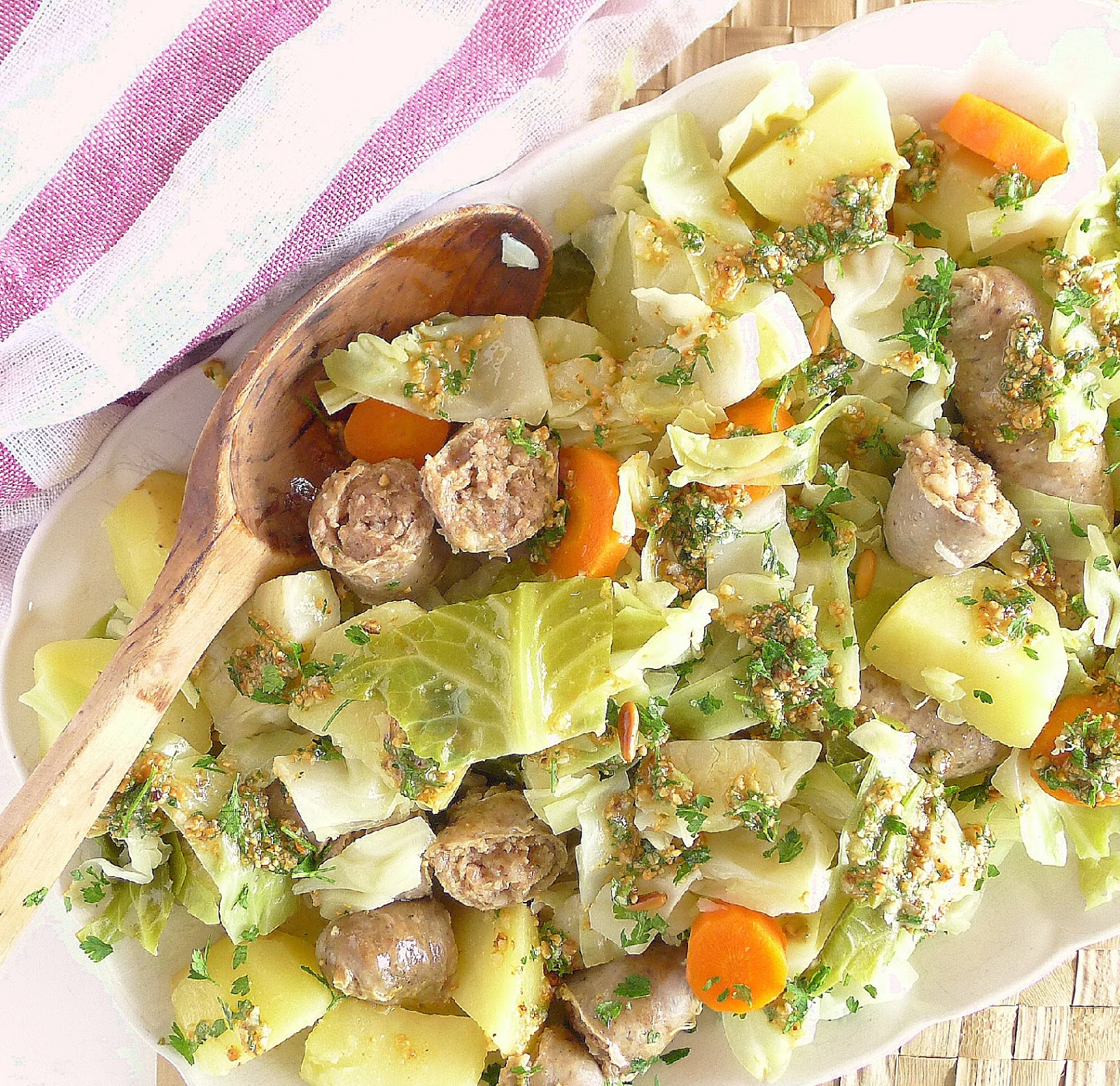
Not the stuffed mushrooms I intended to blog about. This last-minute dish is cabbage from the garden, sausages, potatoes and carrots, topped with a pine nut picada with garlic and parsley.

This week I was inspired by finding enormous (at least 5-inch) portobello mushrooms in my local market. I planned to stuff them two ways. But, by Friday, even with a special order, no more giant mushrooms were to be had.

Serendipity kicked in. I pulled up a cabbage from my vegetable plot (you will recall, this is the “year of the cabbage”) and found some chorizo criollo in the freezer. Potatoes and carrots. A pine nut picada to give it extra oomph. Take the beauty shot. Dinner plus blog, done.

Picada is a Catalan preparation or sauce, a little like gremolata, that is stirred into a dish or spread on top of it at the end of cooking.  This version uses pine nuts instead of the more usual hazelnuts or almonds. They can be pounded in a mortar, finely chopped or, easiest, ground in a mini food processor.

I like chorizo criollo. It is flavored with garlic and pimentón like cured Spanish chorizo, but this is a raw sausage. It's especially juicy for cooking. Use any fresh pork sausage in this dish. Sausage stays juicier if cooked whole. Use kitchen scissors to cut it into bite-size pieces immediately before serving.

The garlicky picada topping gives pop to braised cabbage and juicy sausage.


The dish is juicy, not soupy.


Cabbage and Sausage with Pine Nut Picada
Guiso de Coles y Salchichas con Picada de Piñones

Serves 4.

Cabbage from the garden.
1 medium cabbage (1 ½ pounds)
1 carrot, sliced
3-4 medium potatoes (1 pound), peeled and cut in pieces
Thick slice of onion
Salt
Freshly ground black pepper
3-4 cups water
14 ounces fresh pork sausage, such as chorizo criollo
3 tablespoons olive oil
3 tablespoons pine nuts (1 ounce)
3 cloves garlic, peeled
Pinch of cumin seed (optional)
¼ cup parsley, finely chopped

Discard tough outer leaves of the cabbage. Cut it in quarters and cut away the core. Slice the cabbage. Place it in a medium stew pot with the carrot, potatoes and slice of onion. Season with 1 teaspoon of salt and pepper. Add enough water to almost cover the cabbage. Tuck the whole sausage links into the vegetables.

Cook just until vegetables are tender.

Bring to a boil, cover and simmer until the cabbage and potatoes are tender, 10-15 minutes.

Fry pine nuts and garlic.

Meanwhile, heat the oil in a small skillet. Fry the pine nuts, whole cloves of garlic and cumin seed, if using, until pine nuts are golden. Remove from heat. When slightly cooled, place the contents of the skillet and ½ teaspoon salt in a mini food processor and process until finely chopped. (If desired, save out a few pine nuts to garnish the finished dish.) Stir in 2 tablespoons of the cooking liquid from the cabbage pot. Immediately before serving, stir in the chopped parsley.


Use a slotted spoon to remove cabbage, potatoes, carrots and sausages from the pot. Cut the sausages into chunks. Add only enough of the cooking liquid to keep the cabbage juicy, not soupy. Spoon the pine nut picada over the cabbage. Serve hot.


More recipes with picada:

Links to lots more recipes with cabbage here.

Recipes from the black olive trade war here.


Saturday, January 18, 2020

THE YEAR OF THE CABBAGE

“Bring me broccoli plants,” I told my sometimes-gardener. But, when I went out to the huerta (kitchen garden), I found a row of baby cabbage plants instead of broccoli. “That’s all there were,” he said. Cabbage is a vegetable I like, sure, but I rarely eat more than a couple heads of it in a season. This is going to be the Year of the Cabbage.


Cabbages in the garden.

So far, it’s turning out to be a season of good fortune. The small cabbages are sweet and crisp, a delight in coleslaw and stir-fries. Plain, “boiled” cabbage makes an easy side dish, seasoned with a refrito of olive oil, garlic, pimentón (paprika) and a dash of vinegar. Yet to come, my version of stuffed cabbage (see link to that recipe below). 

Today I’m making a cabbage-potato gratin dish. It makes a terrific side with pan-grilled sausages or baked spareribs. But it would also serve as a vegetarian main dish with salad and good bread as an accompaniment.

Cabbage in Spanish has a redundancy of nomenclature: col, repollo and berza are all names for the same type of cabbage with green outer leaves and pale, almost white inner ones. (Confusingly, “berza” is the name of an Andalusian potaje, as in berza de acelgas, that contains green vegetables such as chard, but no cabbage.) Col de Milán is crinkly green Savoy cabbage. Lombarda is red cabbage. 

Under a crunchy gratin of cheese and breadcrumbs, layers of potatoes and cabbage.


Baked cabbage stays juicy. 

Cabbage gratin could be a vegetarian main dish--

or a side dish with baked spareribs.

As a side, the cabbage is good with ribs, sausages, chops.


Cabbage and Potato Gratin
Gratinado de Coles con Patatas

Remove core from cabbage.
Serves 6.

1 ½ pounds potatoes (5 medium)
1 ¾ pounds cabbage (1 small)
5 tablespoons olive oil
3 cloves chopped garlic
1/8 teaspoon cumin seeds (optional)
2/3 cup white wine
Salt
Freshly ground black pepper
4 ounces cheese, grated (1 ½ cups)
1 cup fresh bread crumbs
Pimentón (paprika), preferably smoked

Cook the potatoes in boiling water until they are just tender when pierced with a skewer. Drain. When cool enough to handle, peel the potatoes and slice them 3/8 inch thick.

Discard outer leaves from the cabbage. Cut it in quarters and cut out and discard the core. Slice the cabbage crosswise.

Heat 3 tablespoons of the oil in a deep skillet. Add the garlic and cumin seeds, if using. When garlic begins to turn golden, add the cabbage. Sauté until it begins to wilt and lose volume. Add the wine. Raise the heat until liquid boils. Season the cabbage with salt and pepper. Reduce heat and cover the pan. Cook gently until tender, about 10 minutes. Remove cover and cook off most of remaining liquid, if necessary.

Preheat oven to 350ºF.

Layer potatoes and cabbage, top with cheese and crumbs.

Generously oil a cazuela or glass baking dish. Put a layer of sliced potatoes in the bottom. Sprinkle them with salt and pepper. Cover the layer of potatoes with all of the cabbage. 

Sprinkle half of the grated cheese on top. Layer the remaining potato slices over the cabbage and cheese. Cover with remaining cheese. Top with bread crumbs. Sprinkle with pimentón. Drizzle 1 tablespoon oil over the top.

Cover the top of the cazuela with foil. Bake until the potatoes and cabbage are bubbling, about 25 minutes.

Raise oven temperature to 400ºF. Remove foil from the baking dish. If oven has an upper heating element for gratin, place the dish under it. Bake until the top is browned, 5 minutes. Serve the gratin hot.


Gratin is best hot out of the oven.

Spareribs are rubbed with adobo spices and marinated 24 hours before roasting in the oven. Top them with a picada of chopped raw garlic and parsley. (Link to recipe for spareribs is below.)


More recipes with cabbage:

Related recipes:

Saturday, January 27, 2018

THE CABBAGE IS ON A ROLL

When a cold wind whips through the olive trees, I start to think of cabbage. Cabbage seems an antidote to chill. Heart-warming, stick-to-the-ribs. I pulled up a recipe for cabbage rolls, Sevilla style, that I hadn’t made for years. The moment had arrived. 


These cabbage rolls with a meat and olive stuffing are breaded and fried.

Cabbage leaves are rolled around a meat stuffing. Olives in the stuffing. “Seville” olives—green manzanillas, black ones or stuffed with red pimiento—make this dish sevillano style. 

The rolled packets are first breaded and fried. They can be served just like that, crisp and golden, with an accompanying sauce, or added to a tomato sauce to cook until very tender. I enjoyed them both ways. I served a few hot out of the frying oil with a spicy brava sauce for dipping. Then I simmered the rest of the rolls in tomato sauce for another meal.

Serve the fried rolls hot with a spicy sauce for dipping.

Or, simmer the cabbage rolls in tomato sauce.

Cabbage Roll-Ups, Sevilla Style
Liadillos Sevillanos

Dipping the head of cabbage in boiling water loosens the leaves making it easy to remove them. Ground beef or chicken can replace the ground pork in the stuffing for the rolls.

Serves 4.
Grated nutmeg in the stuffing.

1 medium cabbage (2 ½ -3 pounds)
2 tablespoons olive oil
¼ cup finely chopped onion
2 cloves chopped garlic
12 ounces ground pork
2 ounces chopped bacon and/or serrano ham
1/8 teaspoon cumin seed
Grated fresh nutmeg
Salt
Freshly ground black pepper
1 tablespoon chopped parsley
½ cup pitted olives, halved
Flour
1 large egg, beaten
¾ cup fine dry bread crumbs
Olive oil for frying
For tomato sauce:
1 (14-ounce) can crushed tomatoes
½ cup water
1 teaspoon pimentón (paprika)
2 cloves garlic
Oregano
Parsley and olives to garnish

Brava sauce to serve (optional), recipe below

Cut around core, then boil to loosen leaves.

Bring salted water to a boil in a deep pot. Discard any damaged exterior leaves from the head of cabbage. Cut deeply all around the core. Submerge the whole cabbage in the boiling water for 2 to 3 minutes. Turn it over and boil another 1 minute. Very carefully remove the cabbage and let it drain until cool enough to handle. Reserve the pot of water.

Remove 12 to 14 leaves from the cabbage. (Reserve inner part of cabbage for another use.) Return them to the boiling water and cook just until the leaves are limp, about 3 minutes. Do not overcook, or the leaves will tear. Drain well and refresh the leaves in cold water. Drain again.

Heat 2 tablespoons of oil in a skillet and sauté the onion and garlic until softened, 2 minutes. On medium-high heat, add the ground pork. Fry without stirring until it begins to brown. Break up the meat and turn it, cooking until it loses pink color, about 5 minutes. Add the bacon and/or ham and cook 2 minutes more. Season with cumin, nutmeg, ½ teaspoon salt, pepper and parsley. Stir in the olives.

Place spoonful of meat stuffing mixture in center of leaf.

Fold sides over the filling, then roll up from the stem end.

Place a kitchen towel on a work surface. Spread open a cabbage leaf. Cut out the thick end of the stem. Place a heaping spoonful of the meat mixture in the center. Fold the sides of the leaf over it. Starting from the stem end, roll the leaf up. Secure it with a toothpick or kitchen twine. (Leave a tail on the twine to make it easier to find and remove it after frying.) Use the meat filling to roll 12 leaves. Use the extra leaves to patch any leaves that tear by overlapping pieces with the leaf. 

It's a wrap. Cabbage leaves are rolled and tied, ready to be breaded and fried.

When all of the leaves have been filled and rolled, place the flour in a shallow bowl, beaten egg in another shallow bowl. Place half of the bread crumbs in a shallow pan. Roll the cabbage rolls first in flour, patting off excess. Dip them into beaten egg then roll them in the crumbs. Add more crumbs as needed. Place on a baking sheet as they are breaded. (They can be allowed to dry at room temperature for up to 1 hour.)

In a deep frying pan place oil to a depth of 1 inch. Heat until it is shimmering, but not smoking. Fry the cabbage rolls, a few at a time, turning them to brown all sides. Remove when they are golden and drain on paper towels.

Serve the cabbage rolls immediately accompanied by the sauce, if desired.

If preferred, cook them further in tomato sauce.

Place canned tomatoes, water, pimentón, whole crushed garlics and a sprig of oregano in a saucepan large enough to hold the cabbage rolls in one layer. Season with salt and pepper. Bring the tomatoes to a boil, then lower heat and cook 3 minutes.

Place the cabbage rolls in the tomato sauce. Cover and cook gently 20 minutes. Turn the rolls and cook 20 minutes more.

Serve the cabbage rolls and tomato sauce hot, garnished with chopped parsley and a few sliced olives.

Cabbage rolls cook very tender in tomato sauce.

Spicy “Brava” Sauce
Salsa Brava

Hot and sweet pimentón add spice to this sauce.

This version of the famous tapa sauce, typically served with cubes of fried potatoes, doesn’t start with tomato sauce. Sweet and hot pimentón (paprika) give it color. Use some smoked pimentón if you like the flavor. If hot pimentón is not available, use cayenne, but decrease the quantity.

¼ cup olive oil
1 tablespoon chopped onion
2 cloves garlic, peeled
¼ cup flour
2 teaspoons sweet pimentón (paprika), smoked or unsmoked
2 teaspoons hot pimentón, smoked or unsmoked
½ teaspoon cumin
1 ¼ cups + water
1 tablespoon Sherry vinegar
Salt


Heat the oil in a saucepan. Sauté the onion and garlic 2 minutes. Stir in the flour. Cook the flour, stirring, for 2 minutes. Stir in the two kinds of pimentón and cumin. Add the water and vinegar. Add ½ teaspoon salt.

Cook the sauce, stirring constantly, until it is thickened. Cook 4 minutes.

Puree the sauce with an immersion blender, adding enough additional water (about 2 tablespoons) so that the sauce is the consistency of thick cream as it cools to room temperature.


More recipes with cabbage: