Showing posts with label tagarninas. Show all posts

Saturday, April 30, 2016

A SPRINGTIME TRIP TO RONDA


I´ve been away from my kitchen for a few days. A friend and I took a driving trip through the Sierra de las Nieves (“mountains of the snows,” although the snow is all gone now) to the inland town of Ronda. After spring rains, wildflowers bloomed on rocky slopes and fields were vivid green with new wheat.


Ronda's landmark "New Bridge" (1793) spanning the tajo (gorge) that separates the old quarter of Ronda from the new city. On the right is the Parador Nacional, a hotel right on the edge of the tajo. The building was once the townhall.

Looking down from Ronda's cliffs to green fields and olive groves.

Sure sign of spring--bikers touring Spain after the motorcycle Gran Prix in Jerez de la Frontera. Jerez is over the mountains to the west of Ronda. A dozen of them stopped for lunch at the Mirador el Campillo in Ronda's Old Town.


Ibérico ham--what we had for lunch. Ibérico-breed pigs are raised in the Ronda area. Although they are not de bellota--finished on acorns--the hams and fresh pork are excellent.

Ronda also is known for its morcilla--blood sausage. Here the sliced sausage is scrambled with eggs and potatoes in a revuelto.
Skinny spring asparagus for a revuelto (scrambled eggs).
The menu on the wall? A fish and a mare depicted by prehistoric peoples in the La Pileta cave, a short distance from Ronda. These are reproductions of the drawings, recreated in the Ronda Museum which is in the Mondragón Palace, a building that dates from 1491, with astonishing views from the cliff's edge to the distant mountains.

From the Church of Espiritu Santo, at upper right, a path descends to Arab Baths where the Moorish town was situated (end of 13th century).

Path to the Arab Baths.

Thistles line the path.


Poppies and wildflowers along the path.

A different wild thistle. These are tagarninas ((Scolymus hispanicus). The prickly leaves are stripped away and the stems chopped to cook in a revuelto with eggs. In villages of the Serranía tagarninas go into a cocido with potatoes, chickpeas and pork. Tagarninas taste a little like artichokes, to which they are related.

A fine place for sundowners or a sunset dinner--Restaurant Abades Ronda, located right on the cliffside, behind the Plaza de Toros (bull fighting arena). The restaurant opened only a month ago and the staff is still working out a few kinks (the waiter's device didn't communicate to the kitchen, so one of our main dishes didn't arrive). But the food was fine and the setting spectacular.


An updated version of a traditional dish, rabo de toro or braised bull's tail. Ronda is a famous bull-fighting town. The meat is served atop truffled potatoes and topped with crisp purple potato chips. We enjoyed a bottle of a red wine from a winery within the Sierras de Málaga/Serranía de Ronda dominación. with our meal at Abades. There are some 16 wineries in the Ronda area, all of which can be visited with prior appointment.
 

Cock of the walk in the gardens of the small hotel where we stayed. Hotel Jardín de la Muralla is built against the old walls of Ronda. Rooms and terrace have views over surrounding countryside.

Pinsapo, a species of fir native to the Sierra de Grazalema and Sierra de las Nieves around Ronda, has been around since before the Ice Age. This specimen is in the garden at the Hotel Jardín de la Muralla.

Breakfast--a thick slab of toasted bread topped with extra virgin olive oil and grated fresh tomato and freshly-squeezed orange juice. Sunshine on the hotel's east-facing terrace. (Photo by D.Ellefson.)

A recipe with tagarninas (wild thistle) is here. A recipe for rabo de toro (bull's tail) is here.

Hotel Jardín de la Muralla

Restaurante Abades Ronda

Tourist office Ronda


Strutting his stuff in a courtyard of the Casa del Rey Moro (18th century). Steps from the garden descend to the bottom of the cliff where a mina, or spring, once provided town water.

Saturday, March 15, 2014

A WHIFF OF SPRING

Fennel fronds--a sure sign of spring.

Tramping through an overgrown field, I catch the first whiff of spring—the  unmistakable scent of wild fennel. The first sprouts of fennel, crushed underfoot, give off a distinctive sweet, springy-green, anise smell.

Wild fennel grows on dry slopes where I live in southern Spain. After spring rains, the plant sends up the first green fronds that grow to tall, rangy stems by the end of summer. Late in the year, the stalks bear yellow flowers (source of fennel pollen) and bracts of immature seeds. The seeds eventually turn brown and fall away and the  plant dies back in the winter.

Tender fennel shoots for spring soup.
In Andalusia (southern Spain), country folk gather the first feathery shoots of fennel to cook in a potaje, a stew with chickpeas or beans, wheat berries and sausage. Snippets of the fronds are also sprinkled on spring vegetables such as fava beans, peas and artichokes. 

To use wild fennel, choose only young, tender stems. They should be pliable and easily sliced with a knife. Strip off the feathery leaves, saving a few for garnish. If wild fennel is not an option, cultivated fennel bulbs, which you’ll find at the green grocer’s, can be substituted.

Fennel, whether wild or store-bought, loses its pungency with slow cooking, adding a subtle background flavor to the soup. A garnish of chopped fennel leaves, added just before serving, returns the sweet spring aroma to the dish.

Two versions of Fennel Soup, bottom, with sausage; top one is vegan.

Potaje de Hinojo
Fennel Soup with Chickpeas, Wheat and Sausage


The first version of wild fennel soup comes from the upland regions of Granada and Almería, where springtime can be blustery and cold. The robust soup is made with pork ribs, pig tail, fat and sausage (my interpretation is slightly modified) plus chickpeas or beans, sometimes both, and wheat kernels. Besides wild fennel, it might include other foraged greens, such as cardillo (also known as tagarninas), a kind of thistle, or wild asparagus. If morcilla sausage is not available, you could use any pork sausage in the soup.

Wheat berries are delightfully chewy. If not available, try brown rice in the soup, but don’t add it until the last 40 minutes of cooking. I used cooked chickpeas. I soak and cook chickpeas in large batches, then keep them in the freezer to use as needed—quickie hummus, salads, soups. If desired, you can start with uncooked chickpeas. Soak 1 ½ cups chickpeas 12 hours. Drain and place them in the soup pot at the very beginning of cooking. They need about 90 minutes to become tender.

Fennel soup with chickpeas, sausage and wheat.

Chopped fennel stems.

1 cup wheat berries
4 ounces pancetta or bacon
1 cup chopped wild fennel stems or fennel bulb
1 carrot, sliced
2 teaspoons salt
8 ounces morcilla de cebolla (blood sausage with onion)
2 cups cooked or canned chickpeas
2-3 potatoes, cut in pieces
1 cup green beans, cut in small pieces
1 thick slice bread
1 tablespoon vinegar
3 cloves garlic
½ teaspoon pimentón (paprika)
Fennel leaves for garnish


Pour 1 cup of boiling water over the wheat berries and let them soak for 3 hours.

Drain the wheat and add to a soup pot with the pancetta, fennel, carrot and salt. Add 6 cups of water.  Bring to a boil, then lower heat and simmer 30 minutes.

Add the morcilla, chickpeas, potatoes and green beans. Simmer 30 minutes more.

Place the bread in a bowl and sprinkle it with the vinegar. Let it set until vinegar is absorbed. Place the bread in a blender with the garlic and pimentón. Ladle in enough of the liquid from the soup pot to soften the bread. Blend until smooth.

Stir the mixture from the blender into the soup and cook another 15 minutes. Remove the piece of pancetta and the morcilla from the soup. Use kitchen scissors to cut them into pieces. Return to the soup.

Allow the soup to settle for 10 minutes before serving. Garnish with chopped fennel leaves.


Potaje de Hinojo para Vigilia
Lenten Fennel Soup with Beans


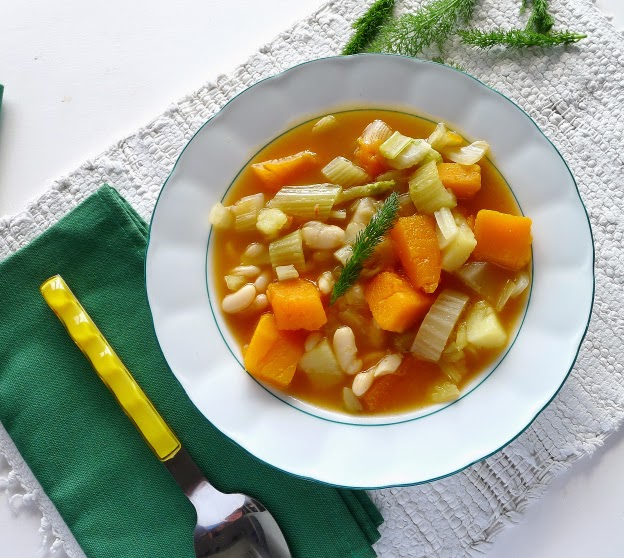
This vegan version of fennel soup is suitable for Lent, which is right now. It has olive oil instead of pork fat to give it substance. I used cultivated fennel bulb for this soup. Cut it lengthwise in quarters, cut out the stem and slice it crosswise.

Canned beans make this soup easy to cook in a short time. If starting with uncooked beans, soak them 12 hours, drain and add to the soup at the very beginning of cooking.They need about one hour to become tender.
Mash the cooked vegetables.

The soup is thickened by a mash of cooked tomatoes, onions, pepper, squash, potatoes and garlic. The garlic is typically char-roasted before being added to the soup pot.

To char-roast a whole head of garlic, spear it on a fork or hold it with tongs over a flame (on a gas stove) or place under the broiler, turning until it is blackened on all sides. When cool enough to handle, rub off outer blackened layer. Cut the top off the head of garlic and add the whole bulb to the soup pot. After cooking, separate and peel  two, three or more of the cloves and add them to the blender mash.


Fennel, pumpkin and beans for a Lenten soup.
Cultivated bulb fennel.

2 cups chopped fennel bulb (1 or 2 bulbs)
1 small tomato, core removed
½ small onion
½ green bell pepper
1 head garlic, char-roasted
2 cups cut-up butternut squash
2-3 potatoes, cut up
1 ½ teaspoons salt
3 tablespoons olive oil
6 cups water
½ teaspoon cumin
1 ½ teaspoons pimentón (paprika)
Pinch of ground cloves
1 cup cooked or canned white beans (drained)
Fennel leaves to garnish


Put the fennel in a soup pot with the tomato, onion, pepper, garlic, squash, potatoes, salt and 1 tablespoon of oil. Add the water, bring to a boil, lower heat to a simmer and cook until vegetables are tender, about 30 minutes.

Skim out the tomato, onion, pepper, garlic, a few chunks of squash and potato. When they are cool enough to handle, slip the skins off the tomato and pepper and some of the cloves of garlic. Place them in a blender with the cumin, pimentón, cloves and remaining 2 tablespoons of oil. Add enough liquid from the soup to make a smooth puree. Stir it into the soup. Add the beans. Cook 10 minutes more.

Serve the soup sprinkled with chopped fennel leaves.


Fennel flower in summer.


More about wild fennel on this earlier blog post. http://mykitcheninspain.blogspot.com.es/2011/08/foraging-for-wild-fennel.html


Tagarninas, wild thistle.

And, about another foraged spring green, wild thistle, (Scolymus hispanicus) http://mykitcheninspain.blogspot.com.es/2010/01/wild-things.html

Monday, January 11, 2010

WILD THINGS

Tagarninas are stems of wild thistle.
Today at the village market I found big bunches of tagarninas, the tender stems of a wild thistle that makes its appearance in frosty January. Related to the artichoke, this thistle (Scolymus hispanicus) is foraged in upland areas of Andalusia and Extremadura.

I first tasted it in Extremadura, where it was cooked in a delicate vegetable flan. But, country folk who gather it usually fold the chopped stems into scrambled eggs. So that’s what I had for lunch today.

My first encounter with tagarninas in the wild was in the hills around the mountain town of Ronda, where I had gone to interview a goatherd. The goatherd showed me the plants growing. The first leaves appear after winter rains, forming a flat rosette about two feet across. Later in the summer the plant sends up tall stalks on which bloom yellow flowers. My guide pulled the whole plant up by the roots and, with bare hands, stripped off the prickly leaves, leaving the slender stems. These are chopped and blanched before cooking with eggs in a revuelto, a soft scramble. 

Eggs Scrambled with Wild Thistles
Revuelto de Tagarninas

Here’s how. Cut away the root ends and chop the stems. (Twelve ounces of tagarninas will make about 2 ½ cups chopped greens, serving two.) Blanch them in boiling, salted water for 5 minutes. Drain well. Heat 2 tablespoons of olive oil in a skillet. Add 2 cloves sliced garlic, ¼ cup chopped serrano ham, a pinch of red pepper flakes and the greens. Sauté on medium heat for 4 minutes. 

 Break 4 eggs into the skillet. Let them set for 1 minute. Use a wooden spatula to push the egg whites around and combine with the vegetable and ham. Then, gently, turn the yolks over, letting them break up and mix with the greens. Turn the eggs and greens out onto heated plates before the yolks are completely set. Add salt and pepper to taste. Serve with toast “buttered” with olive oil.

You could substitute skinny green asparagus for the tagarninas in this recipe. You won’t need to blanch asparagus more than a minute. But should your foraging turn up wild thistles, by all means try them. 

Wild greens scrambled with eggs and ham.