|
| Spanish national flag, la roja y gualda. |
Spaniards love their national flag--la roja y gualda--the red and yellow (except, that is, for die-hard republicans who add a band of purple and for Catalan separatists who add an inset of a lone star on the red and yellow bars). The national flag waves at World Cup soccer matches and basketball championships, at the Olympics, at tennis tournaments when Rafael Nadal is playing.
Even at the dinner table Spaniards are said to love the roja y gualda. Foods colored red with pimentón or yellow with saffron are amongst the nation's favorite dishes. La comida amarilla--the yellow meal--so appreciated everywhere in Spain, is best represented by paella, but there are many more yellow dishes. While the orange-red of pimentón is appreciated in many regions, it seems to be a basic color of life in Galicia.
Saffron is a spice of the Old World, known to the Romans and re-introduced to Europe by the Moors, who brought it to Spain. Pimentón, the dried and milled capsicum pepper, is a spice of the New World, discovered by Columbus who was after a fast-track to the Spice Islands.

About saffron. Saffron (azafrán) is like gold--precious and expensive. It's expensive because it takes the tiny stigmas of 75,000 crocus sativus to make a half-kilo of the spice. They come from a mauve-colored crocus that's blooming now, late October into early November. The finest saffron comes from La Mancha (where it has denominación de origen) and Murcia, but cheap saffron from Iran is imported, packaged in Spain and marketed globally.
 |
| Denominación La Mancha. |
Because it is so valued, saffron has long been an ingredient in special foods, those served on fiesta days, for weddings and baptisms. But for ordinary cooking, la comida amarilla is made with artificial yellow coloring.
 |
| Artificial yellow coloring. |
The powdered yellow coloring is widely called azafrán, although it is not, or else by the most popular brand name, Aeroplano. Many bright-yellow paellas served up in ordinary bars and restaurants contain not a wisp of true saffron. Not to be substituted, however, is turmeric, another yellow spice, which has a powerful aroma of its own, used in many curries.

Real Spanish saffron is sold in natural threads (hebras) in sachets or plastic packets, weighing from a half-gram to two or three grams. One-half gram, about a teaspoonful of threads, is enough for two or three meals, whether paella, bouillabaisse or risotto. The good stuff has an aroma of honey, sweet hay, a little medicinal. It's color intensifies the longer it is soaked in hot liquid.
Store saffron in a dry place, protected from direct light. The threads should be pulverized before using in cooking. If they are crisp and dry, that's easily done in a mortar or in a teacup, using the butt-end of a knife. If the saffron wisps are limp, wrap them in a piece of foil or parchment and toast them in a frying pan for a minute. Then crush them.
Dissolve the crushed saffron in a little hot liquid--stock, water, milk--and allow to infuse for 10 minutes. Then add the saffron liquid to the food to be cooked. For a sumptuous gilding to a finished dish, scatter a few wisps of saffron on top.
 |
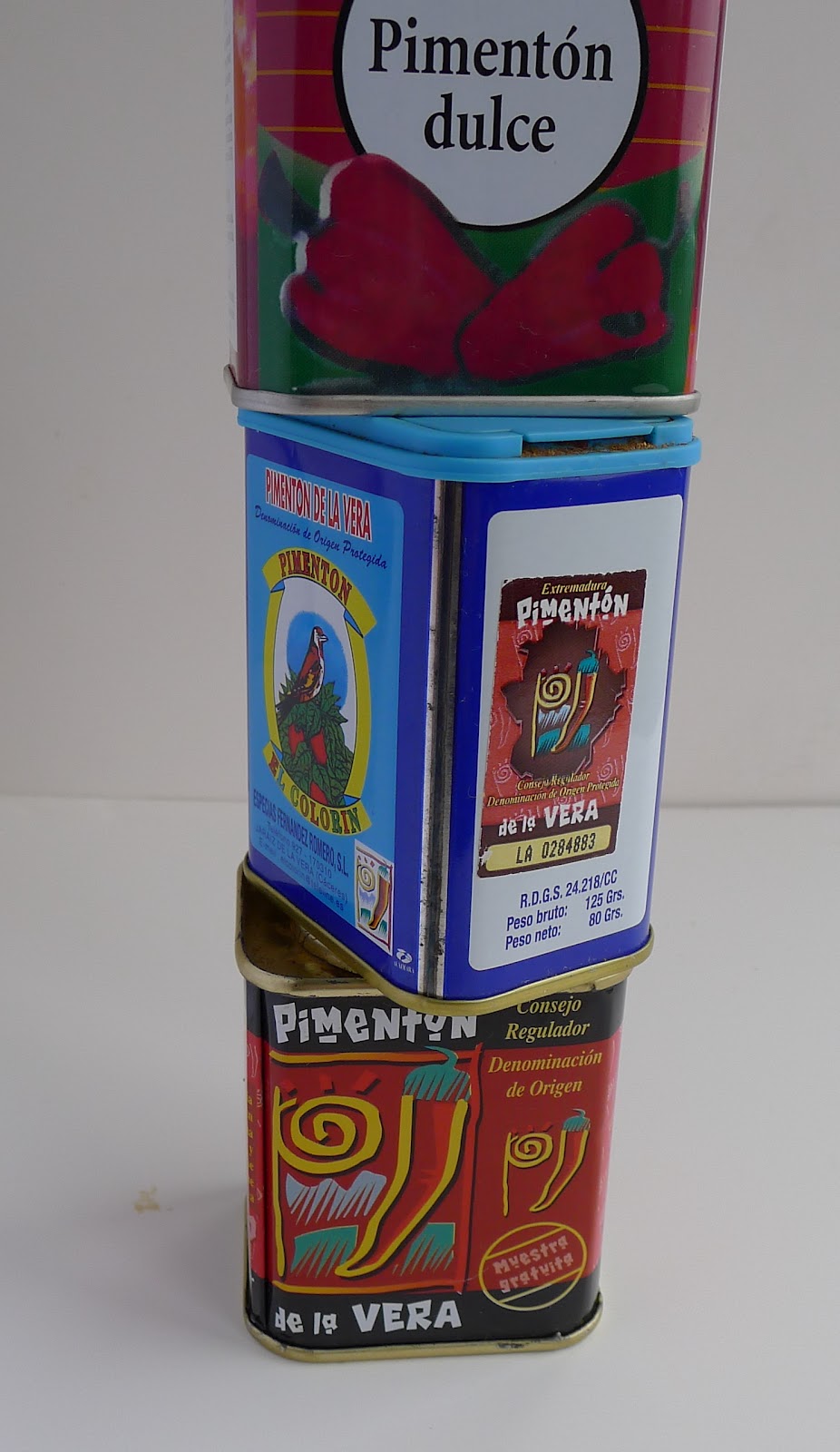
| Pimentón de la Vera, smoked paprika from Extremadura. |
 |
| Two types of capsicums dried for grinding into pimentón, choriceros on the left, and ñoras. |
About pimentón (paprika). Not just a colorful sprinkle on the top of a dish, pimentón is used lavishly for both color and flavor. It is, arguably, the most important spice in the Spanish repertoire.
In Spain there are at least two types of pimentón--pimentón dulce, sweet paprika, and pimentón picante, piquant paprika, with a bite, but not as hot as cayenne.
There are further distinctions. Several regions of Spain are renowned for the quality of their pimentón--Navarra, Extremadura and Murcia, in particular. Some even have denominación de calidad--a designation of quality.
One of these is Pimentón de la Vera, paprika from the La Vera region of Extremadura. Sweet and piquant peppers are slowly dried in oak-fired kilns, which give them a wonderful ruddy color and dusky, smoky flavor.
Pescado en Amarillo
Fish in Saffron Sauce
 |
| Sea bass fillets en amarillo, in a saffron sauce. |
Use a solid-fleshed fish in this dish. Good choices are grey mullet (lisa), conger eel (congrio), monkfish (rape), cuttlefish (sepia), dogfish (cazón), sea bass (lubina) or swordfish (pez espada). The sauce is usually thickened with bread and/or ground almonds. Potatoes may be cooked right in the sauce. Any dish cooked en amarillo, yellow, is usually garnished with green peas and parsley.
I didn't thicken the sauce, but reduced it. I used sea bass fillets, pan-frying them separately and placing them on top of the sauce.
4 (6-ounce)fillets of sea bass
Salt and pepper
1/2 teaspoon saffron threads, crushed
1/4 cup hot water
2 tablespoons olive oil plus more for frying the fish
1/2 cup chopped onion
2 cloves chopped garlic
1/4 cup chopped tomatoes
1 teaspoon flour plus more for dredging the fish
1/4 cup white wine
1 1/2 cups fish stock
Cooked potatoes to serve (optional)
Cooked peas or broccoli florets, to serve
Chopped parsley to garnish
Sprinkle the fish with salt and pepper and let it stand at room temperature for 30 minutes.
Place the crushed saffron in a small bowl and add the hot water. Let it steep for at least 10 minutes.
Heat the oil in a skillet and sauté the onion and garlic until softened, 5 minutes. Add the tomatoes and fry a few minutes longer. Stir in the teaspoon of flour. Add the wine, fish stock and the saffron water. Simmer the sauce, covered, for 20 minutes. Puree in a blender and, if desired, sieve it (to remove any tomato seeds or skin). Return the sauce to the pan.
Dredge the fish fillets in flour and pat off excess. Heat oil in a large skillet to a depth of 1 inch. Fry the fish, flesh side down, until golden. Turn and fry, skin side down, until golden. Remove and keep warm.
Reheat the sauce. Divide it between four dishes and top with the pieces of fish. Add cooked potatoes and peas or broccoli. Garnish with parsley.
Pescado en Pimentón
Fish in Pimentón Red Sauce
 |
| Chunks of fish cooked in a red pimentón sauce. The recipe is here. |
Cazuela de Patatas (Rojas y Gualdas)
Potato Casserole, Red or Yellow
 |
| Potatoes--rojas (pimentón) y gualdas (saffron). |
This cazuela dish can be cooked red or yellow. At the Spanish table, it might be served as a first course, instead of a soup. It's also good as a side or, add meat, fish, shellfish or poultry and serve it as a main dish.
The yellow version is especially good with the addition of fish (even canned sardines or tuna), clams or mussels. It can be thickened with ground almonds. Again, green peas, peppers and parsley are usually added, but other green vegetables are fine.
The red pimentón potatoes make a great side with grilled or roasted meat. Add mushrooms, bacon or ham to ramp up the flavor. I used a mixture of pimentón--1 teaspoon hot (picante) pimentón, 1 teaspoon smoked pimentón de la Vera, and 1 teaspoon ordinary sweet pimentón.
Use "baking" potatoes, such as russets. They soak up the flavors of the sauce.
2 pounds potatoes, cut in 1-inch dice
4 tablespoons olive oil
1 onion, chopped
6 cloves garlic, not peeled, lightly crushed to split them
1 small green pepper, chopped
1/2 cup water or stock
1 teaspoon salt
Freshly ground black pepper
Bay leaf, thyme or rosemary
Pinch of ground cumin
For the yellow potatoes:
1/2 teaspoon saffron threads, crushed
1/4 cup hot water
For the red potatoes:
1/2 cup chopped tomatoes added to the sofrito of onions and peppers
4 teaspoons pimentón (sweet, hot, or smoked)
If preparing the potatoes in advance, cover them with water until ready to cook. Drain them before adding to the pan.
If preparing the yellow potatoes, place the crushed saffron in a small bowl and add the hot water.
Heat the oil in a cazuela (earthenware casserole) or heavy skillet. Sauté the onion, garlics and green pepper for 5 minutes. Add the potatoes and fry 5 minutes longer. (If preparing the red potatoes, add the tomatoes too.) Add the water or stock, salt and pepper, bay, thyme or rosemary and cumin. (If preparing the yellow potatoes, add the saffron water.)
Bring the liquid to a boil, cover and reduce to a simmer. Cook, stirring frequently, until potatoes are tender, about 20 minutes. Allow to set 10 minutes before serving.
 |
| Cazuela patatas en amarillo. |
 |
| Cazuela de patatas en pimentón. |
 |
| Just for fun, la roja y gualda, made with potatoes. |