Showing posts with label olive oil pie crust. Show all posts

Saturday, September 27, 2025

PLUM GOOD

 
Four varieties of plums go into this galette. The small green Claudias, although not quite ripe, had the most complex flavor--sweet, tart, and floral. The big dark purple plums (a vendor at my local market called them huevo de toro, "bull's balls") were juicy and sweet. The big yellows were juicy but lacking in flavor. The smaller red plums with yellow-green flesh were, to my taste, the best with tangy skin and sweet flesh.

Seduced by the jewel-like colors, I could not resist buying a bagful of plums. I intended to stage a taste-test to decide which variety I liked best. But instead I combined them all, from the tiny green Claudias to the big red plums in a galette pastry crust.


Galette is a free-form pie. This one filled with plums has a crust spiced with aniseeds.


Galette is a French word for a freeform pie, a rustic tart in which the fruit is heaped in the center of a round of pastry dough which is then folded up over the fruit. You can make a galette with any favorite pie crust dough, with buttery pâte brisée, or storebought pasta quebrada

My version, made with an olive oil dough, is inspired by those beloved tortas de aceite, crisp olive oil “cookies,” with their subtle flavors of aniseed and sesame.** (A few weeks ago I used the tortas as a base for a quickie dessert—fruit heaped on top of the tortas, topped with whipped cream, and drizzled with caramel sauce.) This pie crust is super fast to mix up, but it does need time to chill before rolling. 
**There is a recipe for making tortas de aceite in my new cookbook, FLAVORS OF AL-ANDALUS.


Plum Galette with Aniseed
Ciruelas en Tarta Rústica con Matalahúga 

Use any variety of plum, from eight to twelve depending on size, and more or less sugar, depending on their tartness. The galette is good hot or cold, accompanied by whipped cream, Greek yogurt, or ice cream.

Serves 4-5.

8-12 plums
1 cup all-purpose flour + additional for rolling out dough
¼ teaspoon salt
¼ teaspoon baking powder
1 teaspoon aniseeds
1 tablespoon sesame seeds
1 egg yolk 
3 tablespoons olive oil 
4-5 tablespoons ice water
2 tablespoons almond flour
1 tablespoon cornstarch
1-2 tablespoons granulated sugar (optional)

Halve the plums and remove pits. 

Combine 1 cup flour, salt, baking powder, aniseeds and sesame in a mixing bowl. Combine the egg yolk, oil and 4 tablespoons of water in a small bowl. Whisk to mix them.

Make a well in the center of the flour and pour in the yolk-oil-water mixture. Gradually stir the flour into the liquid ingredients to make a soft dough. Add additional water if necessary. Turn the dough out on a lightly floured board and gently knead just to combine the ingredients well. Gather the dough into a ball and place it in the bowl. Cover with a clean cloth. Chill the dough at least 1 hour. (The dough can be prepared a day in advance, wrapped in plastic wrap and refrigerated.) 

Fold dough up over the fruit.

Preheat oven to 375ºF. Line a baking sheet with parchment.

Roll the dough out thinly on a lightly floured work surface to a circle about 14 inches in diameter. Roll the dough onto the rolling pin and unroll it onto the baking parchment. Sprinkle it with the almond flour. 

Combine the plum halves and cornstarch. Place the plums, skin-side up, in the center of the dough leaving a 1 ½ -inch border around them. Sprinkle the plums with 1 tablespoon of sugar, if using. Fold the border of dough up over the plums, pleating the dough as needed. Sprinkle with remaining sugar if desired.

Bake until the plums are bubbling and the pastry crust is golden, about 40 minutes. Serve hot or cold.

Serve galette with a dollop of Greek yogurt.


More ideas for using plums:


***   ***   ***

FLAVORS OF AL-ANDALUS 
The Culinary Legacy of Spain

This new cookbook has menus and recipes for Tapas Party, Brunch, Summer Barbecue, Family Dinners (including vegetarian), Sunday Lunch, Dinner Party, Spring Holiday Meal, and Autumn/Winter Holiday Meal. From your favorite bookseller or click below to order. 

This cookbook explores the fascinating story of the deep and lasting influences that Islamic culture has left on modern Spanish cooking. 
Author and Spanish cooking expert Janet Mendel tells the story of the Moorish influence on Spanish cooking through 120 recipes and photographs for modern-day dishes, from salads and vegetables to fish, poultry and meat to sweets and pastries, that trace their heritage to foods served in medieval times. Dishes from this era include exotic spices such as saffron, the use of fruits and almonds with savory dishes, and honeyed sweets and pastries. The flavors of al-Andalus live on in modern Spanish cooking and are what makes Spain’s cuisine distinctive from the rest of Europe. (Hippocrene Books)    


 Order on IndiePubs

Use PROMO CODE HIPPOCRENE40 for 40% off on all Hippocrene titles at IndiePubs online bookstore.

***

Order on amazon

FLAVORS OF AL-ANDALUS by Janet Mendel is the #1 New Release in Spanish Cooking on Amazon!


Saturday, April 30, 2022

THE PASTEL CONUNDRUM

Is pastel a cake or a pie, a tart or, simply, “pastry”? This spinach pie—or is it a tart?—is called “pastel.” I was reminded of pastel de espinacas a couple weeks ago when I made a Sephardic dish, called mina, for a vegetarian Passover meal. It consists of spinach with egg-cheese custard layered with matzo. That recipe is Turkish-Sephardic, but it probably came originally from Spain. So I went searching for the Spanish original that doesn’t require matzo to make.


“Pastel” is usually a custardy mixture, often with vegetables, baked in a crust, open-faced, like a tart, or completely encased. But it can also be baked with no crust in a loaf pan, thus, more of a terrine (also called cuajado). Versatile and delicious, the pastel can be served either hot or cold. Add a grain salad for a vegetarian lunch. Pair it with smoked salmon for brunch. Pack the pastel on a picnic. 

 
This spinach tart has a flaky pastry crust, a cheesy-spinach layer, a custard layer and cheese-crumb topping.


Serve the tart with a grain salad for a vegetarian lunch.


Or, pair the tart with smoked salmon for brunch.


Spinach Tart
Pastel de Espinacas

The spinach tart is vegetarian, but it can be embellished with diced bacon or ham, if desired. 

You could use store-bought prepared pie dough. I made a simple pasta quebrada, flaky pastry crust with olive oil. Bake the open-faced tart in a round, square or rectangular pan. 

 Any soft or crumbly cheese, such as well-drained cottage cheese, ricotta or crumbled feta cheese, is suitable for the tart. I used queso fresco de cabra, a soft, fresh white goat’s milk cheese. Part of the cheese-egg-milk mixture gets mixed with the spinach; the rest goes on top of the spinach to form a custard.

I used two bags of fresh spinach, weighing about 1 ¼ pounds. Once cooked and drained, the spinach weighed 12 ounces, making about 1 ¾ cups. Frozen spinach can be substituted for fresh. After thawing, be sure to squeeze out as much moisture as possible.

For the olive oil crust (pasta quebrada) :
1 ¼ cups flour + additional for rolling out dough
¼ teaspoon salt
¼ teaspoon baking powder
1 egg, separated 
3 tablespoons olive oil + additional for the tart pan
4-5 tablespoons water

Combine the flour, salt and baking powder in a mixing bowl. Place the egg yolk in a small bowl. (Reserve the egg white to add to the spinach pie batter.) Whisk the oil and 4 tablespoons of water with the yolk.

Make a well in the center of the flour and pour in the yolk-oil-water mixture. Gradually stir the flour into the liquid ingredients to make a soft dough. Add additional water if necessary. Turn the dough out on a lightly floured board and gently knead just to combine the ingredients well. Gather the dough into a ball and place it in the bowl. Cover with a clean cloth. Leave at room temperature to rest at least 1 hour. (The dough can be prepared a day in advance, wrapped in plastic wrap and refrigerated. Bring it to room temperature before rolling out.) 

Line baking pan with dough.

When ready to bake the tart, roll the dough out on a lightly floured board into a rectangle. Fold it in thirds and roll it out again. Repeat, folding and rolling two more times. 

Oil a (9X12-inch) baking pan. Roll the dough into a rectangle to fit the baking pan. Roll the dough onto the rolling pin and lift it onto the baking pan. Line the bottom and part way up the sides of the pan with the dough. 


Soft goat's cheese with spinach for the filling.
For the spinach tart:
1 ¼ pounds fresh spinach
3 tablespoons olive oil
2-3 leeks and/or spring onions, chopped (2 cups)
2 cloves garlic, chopped
1 ounce diced bacon (optional)
Salt
Freshly ground black pepper
Pinch of ground cloves
4 eggs (or 3 eggs + 1 reserved egg white)
16 ounces queso fresco or equivalent cheese
1 cup evaporated milk
Grated nutmeg
Tart pan lined with pastry dough (recipe above)
2 ounces grated cheese (1 cup)
1 ounce fine dry bread crumbs (¼ cup)
1 teaspoon pimentón de la Vera (smoked paprika)

Cook, drain and chop the spinach.
Wash the spinach if necessary. Place in a pot with a little water. Cover and cook until the leaves are wilted. Drain well. When cool, pick up handfuls of the spinach and squeeze out as much liquid as possible. Place the cooked spinach on a cutting board and chop it coarsely.  

Heat the oil in a skillet on moderate heat. Add the chopped leeks or onions, garlic and bacon, if using. Sauté until leeks are softened, but not browned, 10 minutes. Add the chopped spinach to the skillet. Season with ½ teaspoon salt, pepper and cloves. Remove from heat and let cool.

Preheat oven to 400ºF.

Combine the eggs, cheese and evaporated milk in a deep mixing bowl. Use an immersion blender to beat the ingredients until smooth. Season with salt (½ teaspoon or to taste—depending on how salty the cheese is) and nutmeg. 

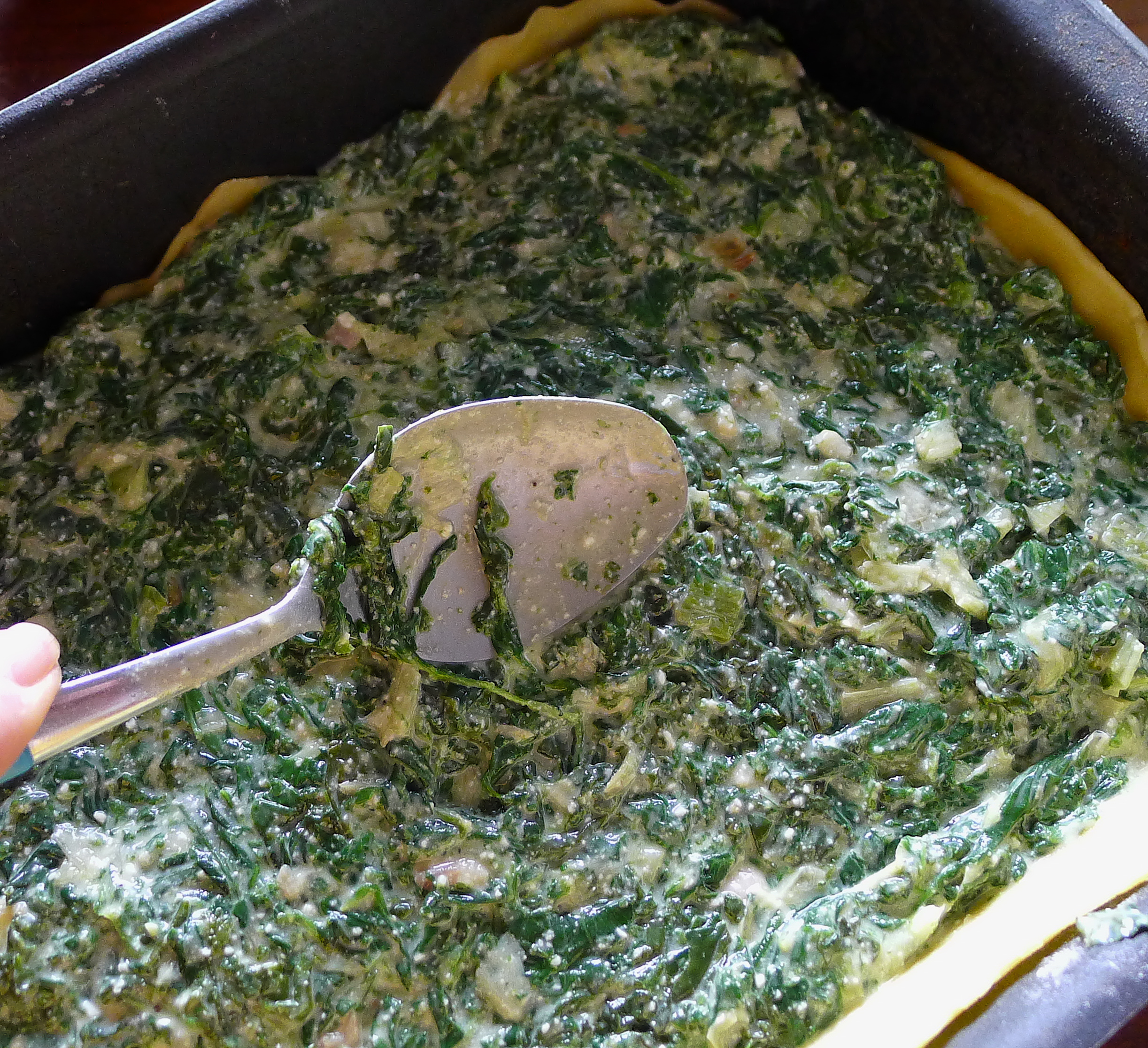
Spread spinach on crust.
Mix 1 ½ cups of the egg-cheese-milk mixture into the spinach. Spread the spinach evenly in the dough-lined pan. Pour the remaining egg-cheese-milk mixture evenly on top of the spinach.

In a small bowl, combine the grated cheese, bread crumbs and pimentón. Sprinkle the cheese-crumb mixture on top of the tart.

Bake 10 minutes. Lower temperature to 375ºF. Bake until a skewer comes out clean, 25 minutes more. Let the tart rest 10 minutes before slicing. Serve it hot, warm, room temperature or chilled.

Grain salad to accompany the spinach tart.

The grain salad served with the spinach tart is made with wheat berries, a product called trigo tierno that only needs 10 minutes cooking time. Farro or barley would be a good substitute. The grains are mixed with chopped radishes, scallions, celery, cucumber, cherry tomatoes and pistachios. The dressing is extra virgin olive oil, lemon juice and chopped mint plus salt and pepper.


This is a slice of mina, the spinach-cheese-matzo Passover pie that I made a couple weeks ago. Obviously related to pastel! 


More versions of pastel, tart, terrine, pie and timbale:


Saturday, March 29, 2014

VEGETARIAN OPTIONS

Chard and cheese pie for a vegetarian meal.
A friend recently asked me for suggestions for Spanish vegetarian dishes. Uh, well, hmmm. Oh, yeah, tortilla de patatas, potato tortilla (eggs, potatoes, olive oil). Truth be told, I couldn’t think of another dish that vegetarians would find everywhere in Spain.

In your own kitchen, it’s easy to adapt Spanish recipes to a vegetarian diet. All those great legume stews, rice dishes, vegetable-based soups—all you have to do is omit the meat or fish.

But, for a tourist traveling in Spain and dining out all the time, apart from dedicated vegetarian restaurants, the pickings are slim. There are some seriously good vegetable dishes—fava beans, spinach, green beans—but they are invariably cooked with bits of ham or sausage. And the wonderful legume soups/stews, with chickpeas, lentils or beans, almost always contain meat, pork fat, sausages, ham bone, just for the flavor they contribute.

During Lent, cuaresma, observant Catholics in Spain (as well as those who honor traditional foodways) abstain from eating meat. But, rather than consume vegetarian meals, they are more likely to replace meat with bacalao, salt cod, or other seafood.

The section of the menu that most reliably includes vegetarian possibilities is Eggs. Besides the classic potato tortilla, other omelets, with cheese or vegetables, are good choices (assuming, of course, that the vegetarian diners are not vegan). Another category of egg dish is the revuelto, a sort of egg scramble with mushrooms, asparagus and garlic. Although revuelto often includes ham or shrimp (as do the versions I’ve published before on this blog), because it is made to order, it may be possible to order it without the meat/fish. 

A great tapa bar dish, huevos rotos, eggs “broken up” with fried potatoes, usually comes with ham, but can be ordered without. Another, patatas a lo pobre, “poor folk’s potatoes,” is often served as a side with fish or meat, but makes a great vegetarian entree.

Gazpacho is vegetarian as is traditional sopa de ajo, garlic soup, made with water, not stock.  One great dish that is not only vegetarian, but vegan, is espinacas con garbanzos, a pimentón-flavored soupy-stew of spinach with chickpeas, a tapa bar specialty in Sevilla.

Here are links to the spinach-chickpea recipe and some other vegetarian recipes that have appeared on this blog.
Espinacas con garbanzos, spinach with chickpeas  (the vegetarian recipe appears alongside one for a stew chock-full of sausages!)

Pisto, vegetable medley (somewhat like ratatouille, with eggplant, zucchini, tomatoes, peppers and onions cooked in olive oil).

Patatas a lo pobre, "poor folk's" potatoes (potatoes layered in a cazuela with peppers, tomatoes, onions, garlic, parsley, olive oil).

Paella, vegetarian paella (my version is with brown rice, legumes and lots of veggies).

Nuts and raisins add texture to the chard.

The vegetarian menu at my house this week features Chard and Cheese Pie,  a recipe from COOKING FROM THE HEART OF SPAIN, FOOD OF LA MANCHA. The cheese is actually requesón, similar to ricotta. In La Mancha, where Manchego cheese comes from, it would be made with sheeps’ milk requesón, but any ricotta, feta or well-drained cottage cheese may be substituted.

Flaky, olive oil pie crust for the pie.

I’ve used a really easy, all-olive oil pastry dough for the pie. It makes a rich, flaky crust. No reason you can’t substitute store-bought pie crust.

Pie has a layer of requesón cheese (like ricotta) in the middle.

Chard and Cheese Pie
Torta de Acelgas con Queso


If you are making the Flaky Pastry (recipe follows) using two egg yolks, use the whites with one whole egg in this recipe. Otherwise, use two whole eggs.

Serves 8.

Chard from the garden.
1 recipe for flaky shortcrust pastry dough (below)
2 pounds chard, stems and leaves chopped (12 cups)
2 tablespoons olive oil
¼ cup pine nuts or slivered almonds
1 cup chopped onion
2 cloves chopped garlic
1 egg + 2 egg whites or 2 eggs
½ teaspoon freshly ground black pepper
1/8 teaspoon grated nutmeg
1/8 teaspoon ground ginger
1/8 teaspoon cinnamon
1 ½ teaspoons salt
2 tablespoons raisins
1 ½ cups (10 ounces) requesón (ricotta)


Preheat oven to 400ºF.

Flatten the pastry dough to make a disk. Place it in a 10-inch tart pan with removable sides. Press the dough firmly to cover the bottom and sides of the pan. Prick the bottom of the dough all over with a fork.

Bake the crust for 10 minutes and remove from oven.

Lower oven heat to 350ºF.

Cook the chard in boiling, salted water until tender, 15 minutes. Drain and refresh in cold water. Drain very well, pressing to eliminate all liquid.

Heat the oil in a skillet and sauté the pine nuts or almonds until they are lightly toasted. Skim them out and reserve.

Add the onion and garlic to the skillet and sauté until onion is softened, 5 minutes. Add the chard to the onions and sauté a few minutes more.

Beat the egg and egg whites in a bowl with the pepper, nutmeg, ginger, cinnamon, and salt. Add the chard, raisins and half the pine nuts. Combine well.


Spread requesón on the chard.

Pour half of the chard mixture into the crust. Spread the requesón on top. Cover with the remaining chard. Scatter the pine nuts over the top and press them gently into the chard.

Bake the pie until pastry is lightly golden, 35-40 minutes. Cool on a rack for 10 minutes. Release the crust from the sides of the tart pan. Remove the outer ring. Serve warm or cold.

Flaky Shortcrust Pastry Dough
Pasta Quebrada


Use this dough for empanadas and both sweet and savory pie crusts. Be sure to let it rest at room temperature for at least 1 hour. The dough works well whether the crust is filled with raw ingredients and baked, or baked “blind” and then filled with a cooked filling. The dough freezes well. Thaw completely before rolling out on a floured board.

Makes enough dough for a 10-inch pie crust.

1 ¾ cup all-purpose flour, plus additional for rolling out dough
1 teaspoon baking powder
½ teaspoon salt
2 egg yolks
½ cup olive oil
3 tablespoons water

Sift the flour, baking powder and salt into a mixing bowl.

Mix oil and egg into flour.
Make a soft dough.
Combine egg yolks and the oil. Make a well in the flour and pour in the yolks. Use a fork to blend the flour into the yolks. Add enough of the water to make a soft dough that can be patted into a ball.

Turn the dough out onto a pastry board and knead it very briefly. Cover and let it stand at room temperature for at least one hour. (The dough can be covered in plastic wrap and refrigerated overnight. Bring to room temperature before continuing.)

Roll out the dough between two sheets of wax paper or press it into the pie pan.


As starter or main, chard pie is a lovely springtime dish.