Showing posts with label vegan. Show all posts

Saturday, December 14, 2024

VEGETARIAN CHORIZO

 When clouds and a winter chill descended on us this week, a pot of black beans seemed like a good idea. Usually I would throw a few links of chorizo in the pot along with vegetables. Chorizo is a powerful flavor pack. But because I was expecting a vegetarian guest for dinner, I decided to make vegetarian chorizo.


Black beans served with sautéed peppers and vegetarian chorizo sausages.


Garlic and pimentón give the vegetarian chorizo a taste a lot like the porky version.

I used tofu plus bread crumbs (gluten-free is fine) for the “meat” of the chorizo and olive oil instead of fatty panceta (belly bacon) for unctuousness. The seasoning was traditional—lots of smoked pimentón, garlic and a few other spices. And, plenty of salt. 

The vegetarian mixture could be stuffed into non-animal sausage casings, if available, making the resulting links more like real chorizo. Another alternative is to roll the mixture in cheesecloth or parchment.

Adding beaten egg to the sausage mixture helps to bind the ingredients so they don’t disintegrate in cooking. If you prefer a vegan sausage, eliminate the egg and, instead of rolling the mixture into sausage links, fry it “loose” or in small patties. 

My no-meat chorizo had good flavor and complemented the black beans nicely. But the texture was nowhere near the real thing. Tofu just doesn’t have much chew to it. I recently tasted some morcilla (blood sausage) that had finely chopped almonds in it. I think that would be good in the vegetarian chorizo, adding a little crunchiness to a sausage lacking in texture. 

Vegetarian Chorizo
Chorizo Vegetariano

Tofu, bread, oil, garlic and spices.
Serves 4.

8 ounces firm tofu
2 cloves
1/8 teaspoon cumin seeds
¼ teaspoon black peppercorns
½ teaspoon coarse salt
1 clove garlic, coarsely chopped
2 teaspoons sweet (dulce) smoked pimentón (paprika)
½ teaspoon hot (picante) smoked pimentón
½ teaspoon oregano
2 slices day-old bread (1 ½ ounces)
½ cup coarsely chopped walnuts or almonds (optional)
3 tablespoons olive oil + additional to fry the chorizo
1 teaspoon soy sauce or miso paste
1 tablespoon lemon juice
Salt to taste
1 egg, beaten (optional)

Cut the block of tofu into 8 pieces. Place them on paper towels and cover with additional paper towels. Place a weight (such as a cutting board) on top and let the tofu drain 10 minutes.

In a mortar crush the cloves, cumin and peppercorns with the salt. Add the garlic and mash it. Add the two kinds of pimentón and oregano.

Grind tofu in food processor
Break up the tofu into a food processor. Break the bread into pieces and add to the processor with the mixture in the mortar, oil, soy and lemon juice. Grind these ingredients until well combined. Taste the mixture and add salt as needed (½ teaspoon or more).  If using egg, mix it in.
Roll sausages in parchment.

Shape the mixture into two logs approximately 8 inches long and 1 inch thick. Place each one on a strip of parchment. Roll the chorizo log up using the parchment to compact it. Twist the ends of the parchment to make a sausage roll. Chill the chorizo logs 24 hours.

Cut each sausage into four “links.” Poach them in boiling salted water 5 minutes and drain well. When ready to serve, pat the chorizos dry and fry them in hot oil to brown on all sides.  


Recipe for homemade pork chorizo is here.

If you need to refresh your knowledge about pimentón.


Saturday, February 4, 2023

OLLA GITANA--A WAYFARER’S VEGETABLE STEW


Old-fashioned olla stewpot.

The olla is the great stewpot, source of everything delicious—comfort food from mother’s kitchen; lusty soups with legumes and sausage; delicate broths, and sumptuous stews. The olla is both sustenance and jubilation. Everyday and fiesta.


The potbellied stewpot, which can be set on a tripod over a cooking fire, is the cooking vessel for gypsy wayfarers and itinerant laborers, who might pluck a few vegetables from a field or fruits from an orchard on their passage down a country road. Their vegetable and legume stew came to be known as olla gitana or “gypsy pot.” 

Although vegetarian, this stew is remarkably contundente—robust—packed with nourishment and flavor. Perfect winter days.

Olla Gitana comes from the region of Murcia, famed for its horticulture. It includes chickpeas and often white beans as well as squash, flat green beans (bajoques) and pears. Yes, pears. The Andalusian version usually has the addition of a maja’o, or “mash” of fried bread, almonds and garlic.

Murcia produces superb sweet pimentón, paprika that is sun-dried, not smoked, which would typically be used in this recipe. But, add a little smoked pimentón, if that pleases you. Some might even like a pinch of hot pimentón picante, hot paprika. Be sure to add a sprig of mint to the hot stew at the end. 

A vegetarian stew, with both chickpeas and white beans, squash, potatoes and green beans, flavored with a sofrito of onions, tomatoes and pimentón. The surprise ingredient is pears!

A robust vegetable stew. Here, finished with fried garlic and almonds.


Gypsy Stewpot
Olla Gitana

You will need cooked chickpeas and white beans for this recipe. If using dry legumes, soak them overnight, drain and cook in fresh water until tender. Or, use canned or jarred peas and beans, drained and rinsed. Use wide, flat green beans (romano beans), if possible. If they are fresh, cut them in short lengths and blanch them before adding to the stewpot. I just happened to have a jar of beans in conserva in my pantry (they had been requisitioned for a sailing voyage and never used), so I incorporated them. 

Use any variety of firm pear for this stew. If pears are soft, add them at the very end of cooking time. Cut small ones in quarters, large ones in chunks.

I served the bowls of stew with a refrito of fried sliced garlic and almonds.

Jars of legumes, canned tomatoes go into the stew.
Serves 6-8.

4 tablespoons olive oil
1 cup chopped onion
2 cloves garlic, chopped
Pinch of saffron threads
1 tablespoon pimentón (paprika, not smoked)
1 cup crushed tomatoes
2 cups cooked and drained chickpeas
7 cups water
1 carrot, cut in pieces
1 pound squash or pumpkin, cut in chunks
¾ pound potatoes, cut in chunks
2-3 teaspoons salt
1 bay leaf
Pinch of dried mint
2 cups cooked and drained cannellini beans
2 cups canned or cooked green beans, drained
2-3 pears
Fresh mint, to serve
For the refrito (optional)
Olive oil
Sliced garlic
Almonds, chopped
Red pepper flakes or minced red chile (optional)

Sofrito with pimentón.

Heat the oil in a skillet and sauté the onion and garlic until softened, 3 minutes. Add the saffron and fry it briefly. Remove the pan from the heat and stir in the pimentón. Add the tomatoes. Return the skillet to the heat and cook until the tomatoes lose their moisture. Remove from the heat.


Add the onion-tomato sofrito to a large stew pot. Add the chickpeas, water, carrot,  squash and potatoes. Season with salt, bay and dried mint. Bring the water to a boil, reduce the heat and cook, covered, 20 minutes. Add the cannellini beans and continue cooking, 5-10 minutes or until the potatoes and squash are tender. 

Peel the pears, remove cores and, if they are small, quarter them. If large, cut the pears in chunks. Add the pears to the stew pot with the green beans. Cook 5 minutes. Remove the pot from the heat and allow to settle 5 minutes.

Heat 2 tablespoons of oil in a small skillet. Fry sliced garlic with chopped almonds and red pepper flakes, if desired. 

Serve the vegetable stew with sprigs of fresh mint and a spoonful of the garlic-almond oil.

Be sure to add a spring of fresh mint to the stew before serving.


Saturday, January 21, 2023

OH MY UMAMI!


In several recent recipes, I’ve called for “miso” in the ingredient list, although the recipes had nothing to do with Japanese cooking. And, I’ve noticed that a fellow blogger, Mad Dog, who posts Spanish/Catalan recipes, often lists “anchovy paste” as an ingredient, for example, in sopa de fideos or carne con tomate. A French acquaintance always adds Vietnamese nuoc mam fish sauce to his otherwise traditional Spanish paella. 


What’s going on here? Miso, a fermented soybean paste; anchovies, and Asian fermented fish sauces all add umami—the fifth taste element perceived by the taste buds, along with sweet, salty, sour and bitter. Umami means yummy, mouth-watering, big-time savory, Umami ingredients add depth of flavor and richness to foods. 
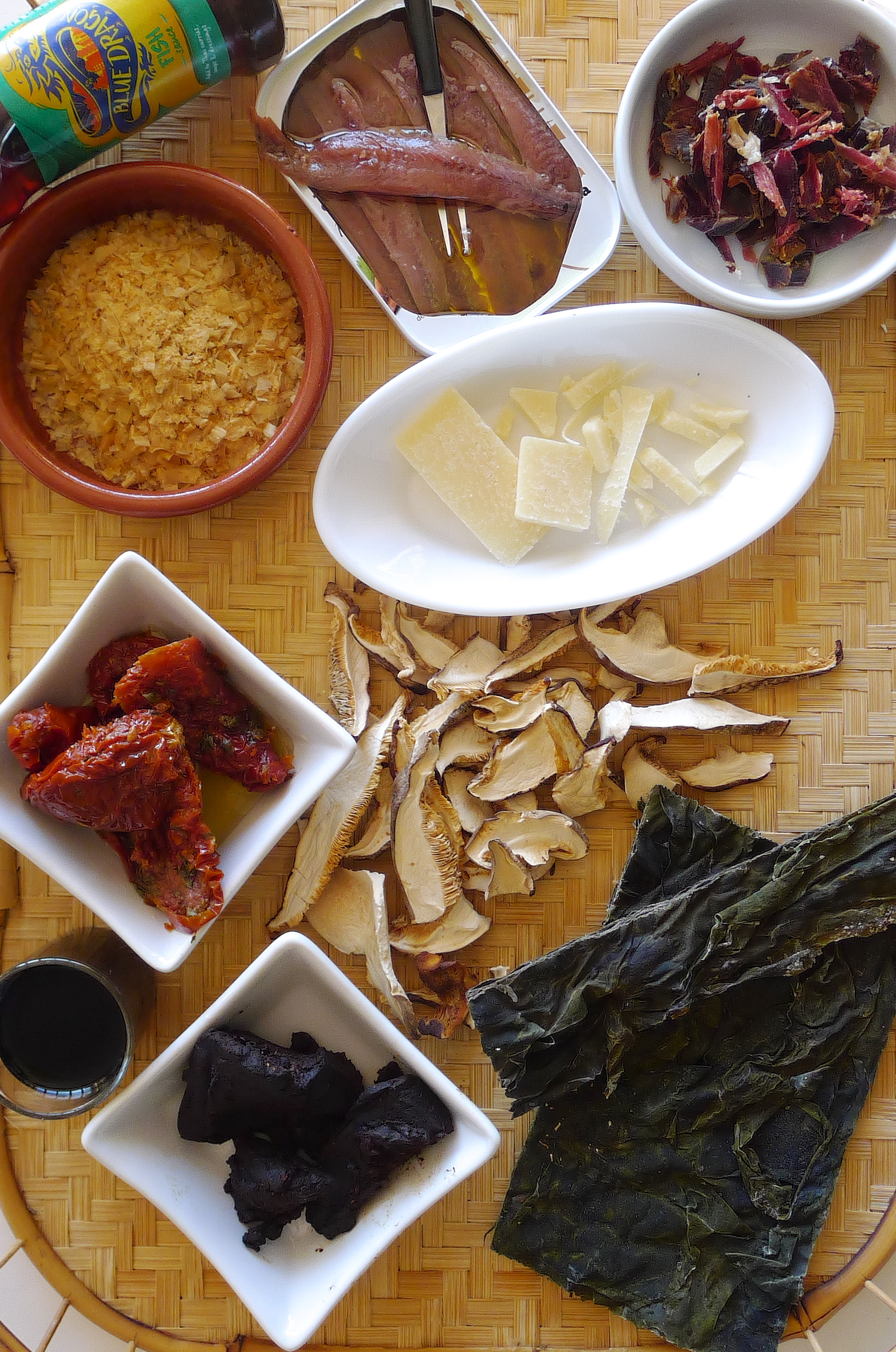
Umami ingredients pictured, clockwise from bottom left, miso, soy sauce,
 sun-dried tomatoes, bonito flakes, fish sauce, anchovies, slivered ibérico ham,
 aged cheese, shitake dry mushrooms and kombu seaweed. 

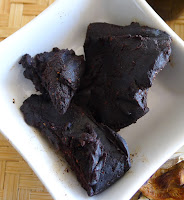
I first bought miso when, preparing an all-vegetarian holiday dinner, I needed something to punch-up the gravy. My local “health food store” had only hatcho miso, a dark, almost black, paste the consistency of peanut butter. It was brilliant, giving the gravy a deep, beefy color and meaty taste. 

The flavor-enhancing effect comes from the presence in the food of glutamic acid, one of the amino acids that are components of protein. The glutamic acid bonds with other amino acids to produce the savory, mouth-watering effect. 
 
Here are foods, a few vegetarian, that are high in umami-making glutamates: seafood, especially molluscs, and cured fish (bonito flakes, anchovy paste); mushrooms, especially dried shitake; fermented pastes and sauces such as soy, tamari, nuoc mam, kecap; fermented foods such as kimchi; seaweed, especially kombu; fruits and vegetables such as oranges and tomatoes (especially sun-dried tomatoes; meat, especially dry-cured ham and cured sausages. 

Of course, you could just add a spoonful of umami powder—MSG, monosodium glutamate, also known by its original Japanese name, aji-no-moto. It appears in many packaged foods, such as soups. Oddly enough, I have been unable to find it where I shop, although it is available on-line at Amazon España. 

I continue to experiment with miso, as you can see in my recipe for arroz with ibérico pork. That rice dish gets a triple umami whammy, with ibérico pork, ham broth and a smidgen of miso. Today, I’m using miso to make a flavorful stock for sopa de ajo, a vegetarian version of Spanish garlic soup.
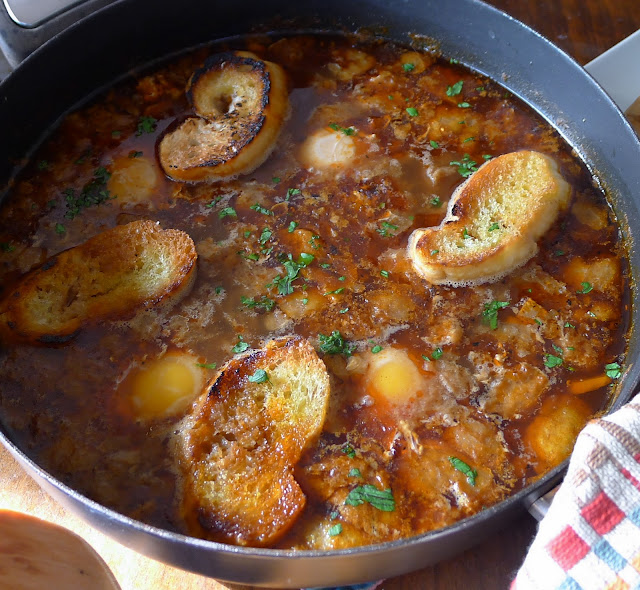
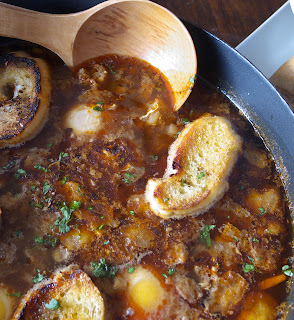
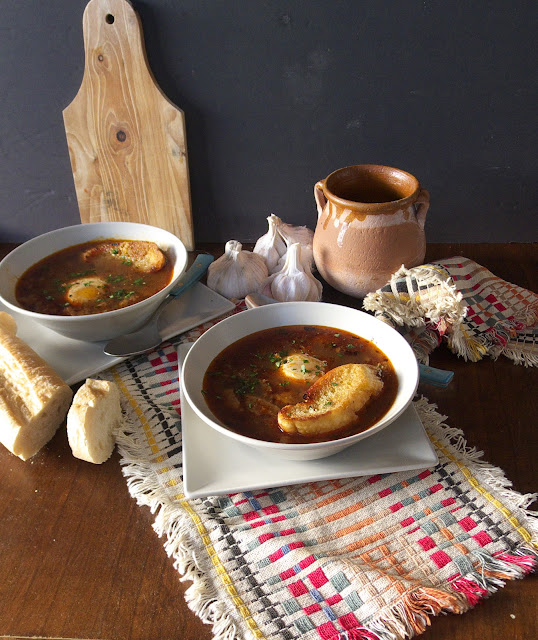
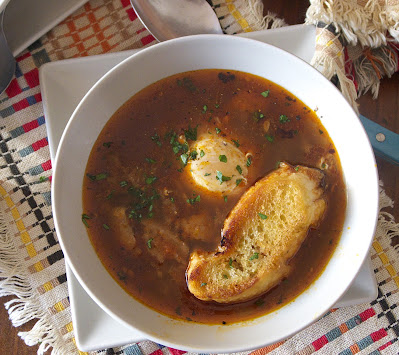
A robust Castillian garlic soup: chunks of bread soak up the savory broth. Pimentón and, in this variation, dark miso paste, give the soup its color. 

Poach eggs right in the soup.

Sopa de ajo, perfect for chill winter days.

Throw some greens, chard maybe, into the soup if you like.

Eggs can be poached in the soup or, poach them in a separate pan, add them to the soup bowls at the last minute. Keep the yolks runny--use the spoon to break up the egg into the bread-thickened broth.


Garlic Soup with Miso
Sopa de Ajo con Miso

Taking a cue from Japan’s iconic miso soup, I added miso to a very traditional sopa de ajo, Castillian garlic soup. Originally a peasant soup, made with garlic, olive oil, bread and water—basically vegetarian—garlic soup now is usually made with chicken or meat stock with diced ibérico ham adding umami. I’ve reverted to a vegetarian version, using miso to punch up the flavor.

Diced seitan (wheat gluten) subs for the ham that usually goes into garlic soup. If you want a vegan soup, substitute cubes of silken tofu for the eggs.
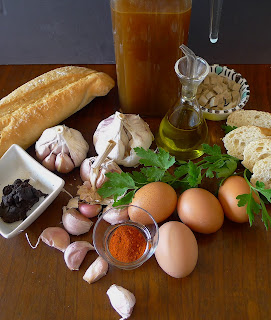
Miso (left) goes into this garlic soup.

Serves 4.

8-10 cloves garlic, peeled
1/3 cup olive oil
8-10 slices baguette
1 ounce seitan or smoked tofu, diced
2 teaspoon pimentón de la Vera (smoked paprika)
6 cups vegetarian stock (recipe follows)
1 teaspoon miso
4 eggs
Chopped parsley or scallions to garnish

Cut the cloves of garlic in half lengthwise. If they have a green sprout in the center, remove it with the tip of a knife. Slice the garlic crosswise and set aside.

Heat 2 tablespoons of the oil in a wide, deep pan such as a cazuela or Dutch oven. Add the slices of bread and brown them on both sides. Remove and reserve them. Add the diced seitan to the pan with 1 tablespoon more oil and fry until it is browned. Skim it out.

Add remaining oil to the pan on medium heat. Add the sliced garlic and fry it, stirring, until it begins to turn golden. Take care that the garlic doesn’t burn. 
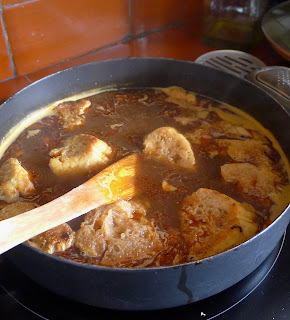
Add fried bread to the soup while it cooks.


Remove the pan from the heat and stir in the pimentón. Immediately add the stock. Return the pan to the heat. Add all but 4 slices of the toasted bread. Heat the soup, but do not let it boil. Cook, stirring frequently to break up the bread into small pieces. Cook 20 minutes.

Remove ½ cup of the hot stock and add to the miso. Stir to dissolve the miso. 

Return the fried seitan to the soup. Stir in the miso. Break eggs, one by one, into a saucer and slide them into the hot soup. Cook on low heat until the whites are set but yolks still very runny. Remove the pan from the heat. 

Serve the soup, sprinkled with parsley, in the same pan or ladled into soup bowls. 


Vegetarian Soup Stock with Miso
Caldo Vegetariano con Miso
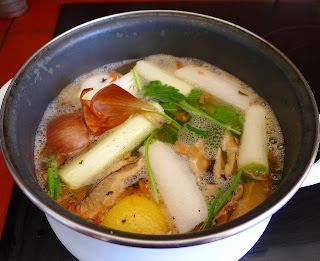
Miso beefs up the stock pot. Onion skins add color. 


Dark hatcho miso paste.
This deeply flavorful stock based on miso is a good starting point for soups, sauces and gravy. Hatcho (black) miso contributes color as well as flavor, but white or red miso can also be used. 

I learned from a Japanese cookbook that kombu should be skimmed out of the stock-pot before the liquid comes to a boil, so that it doesn’t become bitter. And, miso, the star ingredient, should never boil or it loses its healthful properties (pro-biotic enzymes). Nevertheless, it still adds flavor, so I wasn’t too finnicky about cooking it.


Crank up the umami--miso, tomatoes, mushrooms.

Makes about 6 cups stock.

½ ounce dried shitake mushrooms
1 cup boiling water
8 cups water
1 onion, not peeled
4 cloves
1 leek, cut in thirds
¼ turnip, peeled
1 stalk celery
1 carrot, peeled
¼ cup sun-dried tomatoes or chopped fresh tomatoes
1 bay leaf
Sprig of thyme
2-inch piece of kombu
¼ teaspoon black peppercorns
¼ lemon
1 tablespoon miso
Salt, if needed
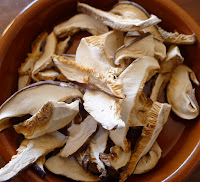
Dry shitake mushrooms.

Place the mushrooms in a heat-proof bowl. Pour the boiling water over them. Allow the mushrooms to soak 30 minutes to hydrate them.

Place the 8 cups of water in a soup pot. Add the mushrooms and their liquid. Cut the onion in half. Stick the cloves into the onion halves. Add both halves of the onion, (onion skins add color to the stock). Add the leek, turnip, celery, carrot and tomatoes. 
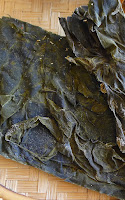
Kombu seaweed.
Add bay leaf, thyme, kombu, peppercorns and lemon. Bring the water to a boil. Skim off any froth that rises to the top. Skim out the kombu. Lower heat so the water bubbles gently. Cover and cook 30 minutes.

Place the miso in a small bowl. Ladle ½ cup of the hot stock over the miso. Stir until the miso paste is dissolved. Add the miso to the stock pot. Taste the stock and add salt, if needed. 

Uncover the pot and cook 15 minutes longer. Do not boil. Remove from the heat and let the stock stand 15 minutes. Carefully pour it through a colander. (Save vegetables for another use, if desired. Discard herbs and lemon.) Pour the stock through a fine sieve. Store it, covered and refrigerated, until ready to use for soup.


More garlic soup recipes:


Saturday, February 5, 2022

A MONTH OF MEATLESS MONDAYS

Are you trying to cut down on meat eating? Join the meatless Monday brigade. Or, perhaps, you´re meatless on Fridays for Lent (begins March 2 with Ash Wednesday)? Here are some menu ideas, mostly Spanish, for meatless meals, all vegetarian, some vegan. There’s one new recipe, a rich vegetable terrine, plus links to other recipes that have appeared on the blog. 


Fish and shellfish are not “meat,” so, unless you are keeping vegetarian, you might search on the many recipes for seafood. Spain’s beloved potato tortilla and most of its variations are also vegetarian. 


Vegetable Terrine (Pastel de Verduras)

 
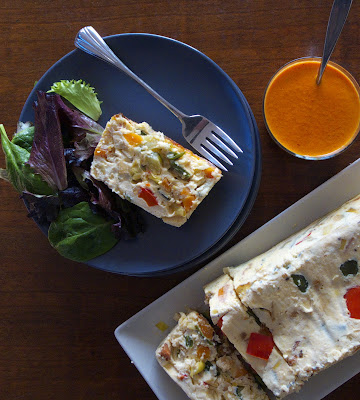
This terrine, chock-full of vegetables and rich with cheese, is perfect for special occasions. There's a piquillo pepper cream sauce to serve with it. For a vegetarian meal, add a tomato-noodle soup as a starter and a saffron rice pilaf with mushrooms as a side. Sliced and served cold, the terrine makes a terrific sandwich filling. Spread the piquillo cream sauce on the toasted bread. (Recipe for terrine and sauce are below.)

Fideo Noodles with Tofu and Vegetables (Cazuela de Fideos con Tofu y Verduras)

Sometimes called "pasta paella," this traditional noodle dish, usually made with seafood, has been reinvented as a vegan dish, with tofu and seaweed standing in for the seafood. It´s packed with flavor. Serve a big salad with the noodles. (The fideo recipe is here.)

Best-Ever Veggie Burger (Burguer Vegetariana)

 I have tried dozens of veggie burger recipes, and I think this is the best of all. The rice makes it all stick together, so it doesn’t need egg. The mushrooms contribute the necessary umami whammy. Olive oil keeps the burgers juicy. Smoked pimentón adds that char-grilled essence. Carrots give some texture. I use TVP (textured vegetable protein, a soy product) in this, but coarse, dry breadcrumbs can be substituted.

Serve the burgers on toasted buns with eggplant fries (dust eggplant strips with flour and fry until golden in olive oil) and coleslaw with olive oil dressing. Piquant herby green sauce stands in for mayonnaise. (Recipe: Best-Ever Burgers)

Zucchini Boats Stuffed with Quinoa (Canoas de Calabacín con Quinoa)

Chewy quinoa and smoky pimentón give this vegetarian main dish a meaty flavor. Serve avocado toasts as a starter and sliced tomato salad on the side. (Recipe: Zucchini Boats Stuffed with Quinoa and Vegetables.


Chard and Cheese Pie (Torta de Acelgas con Queso)


This chard and cheese pie has pine nuts and raisins in it. The flaky pastry is made with olive oil. Serve the pie hot or cold. It would be good with mushroom soup as a starter. (Recipe: Chard and Cheese Pie) 


Spinach with Chickpeas (Espinacas con Garbanzos)

Here´s a traditional Spanish tapa dish that's vegan. The basic ingredients are chickpeas and spinach, Olive oil, plenty of garlic, pimentón (paprika) and cumin flavor the combo of vegetable and legumes. (Recipe: Spinach and Chickpeas)

Vegetable Terrine
Pastel de Verduras


Change the taste of the terrine by using different cheeses. A semi-cured Manchego or smoky Idiazábal, a creamy gallego or a pungent Asturian blue. Any cheese that melts smoothly, such as Gruyere or Cheddar, will work. 

You will need about 6 cups of chopped vegetables for the terrine. I´ve used wide romano beans, carrots, onion, leek, red bell pepper and zucchini. Other possibilities are peas, mushrooms, florets of cauliflower or broccoli, asparagus cut in 1-inch pieces, quartered artichoke hearts. Some vegetables such as green beans, cauliflower and artichokes should be par-boiled before incorporating with the sautéed vegetables. Cool the vegetables and strain off accumulated liquid before adding them to the egg mixture. 

I used a food processor to grate the cheese and to mix the milk and eggs for the custard mixture.

You´ll need a 4-cup loaf pan or mold (in Spanish, a “plum-cake” pan) to bake the terrine. Lining the bottom with baking parchment guarantees easy unmolding. The terrine can be baked low and slow (350ºF for 60+ minutes) or hot and fast (400ºF for 45 minutes). It´s done when a skewer comes out clean.  Place the loaf pan in a larger pan of hot water. 

Let the terrine set 15 minutes before unmolding. Use a serrated knife to slice the terrine. Don´t use much pressure, but use a sawing motion to cut through the pieces of vegetables to prevent dislodging them.


Serves 6-8.

1 cup green beans cut in 1-inch pieces
3 tablespoons olive oil
1 cup diced carrots
1 cup chopped onion
1 leek, sliced
1 cup red pepper cut in 1-inch pieces
1 cup diced zucchini
Salt
Freshly ground black pepper
6 ounces cheese, grated (about 2 cups grated)
4 eggs, beaten
1 cup evaporated milk
½ cup milk
1/8 teaspoon smoked pimentón picante (hot paprika)
Thyme leaves

Par-boil the beans in boiling water until crisp-tender, about 2 minutes. Drain and refresh them in cold water. Reserve.

Sauté chopped vegetables in olive oil.


Heat the oil in a skillet. Add the carrots and onion and sauté on moderate heat 5 minutes. Don´t let them brown. Add the leek, red pepper and zucchini. Sprinkle with ½ teaspoon salt and pepper to taste. Continue sautéeing until the carrots are beginning to soften, 5 minutes. Add the par-boiled green beans. Turn up the heat and cook 2 minutes more to cook off most of the liquid the vegetables give off. Remove the vegetables to a bowl and allow them to cool.

Preheat oven to 375ºF. Oil a 4-cup loaf pan and line the bottom with a piece of baking parchment. Set the loaf pan in a larger pan.

In a mixing bowl (or food processor) combine the cheese, eggs, evaporated and regular milk. Season with pimentón, thyme and ¼ teaspoon salt. 

Drain the vegetables (save the liquid for another use). Stir the vegetables into the egg mixture.

Carefully ladle the vegetable-egg mixture into the loaf pan. Add hot water to the larger pan to a depth of 1 ½ inches. Place the pan in the oven. Bake until the egg-milk mixture is set and a skewer comes out clean, about 50 minutes.

Remove the pans from the oven. Remove the loaf pan from the pan of water. Allow the terrine to set for 15 minutes before unmolding it onto a serving plate.

Allow to set 15 minutes before unmolding.


Piquillo Cream Sauce
Crema de Pimientos Piquillos


1 (185-gram) can piquillo peppers
1 clove garlic
1 teaspoon Sherry vinegar
Salt and freshly ground black pepper
½ cup cream

Empty the contents of the can of peppers into a blender. Add the garlic and vinegar. Blend to make a smooth puree. Pour the puree into a small saucepan and add the cream. Season with salt and pepper. Bring to a boil, then simmer 5 minutes until the sauce is slightly reduced. Serve the sauce hot or cold.


Saturday, July 11, 2020

MENU FOR SUMMERTIME EASY LIVING

Keep it cool, keep it simple. That’s my advice to self in planning summertime menus.  Even with the “new normal” easing of restrictions, I keep my shopping to a minimum. I’m looking to the garden, the pantry and the freezer for meal-planning inspiration. 


A few zucchini from the garden (before searing terral winds left the plants stripped and desiccated) inspired me to plan a vegetarian menu starring this summer vegetable. Zucchini pancakes are the main course. Add a sauce, some baba ghanoush (dip made with roasted eggplant), pita crisps, couscous taboulleh salad and fresh tomatoes to create a complete meal.

Made with chickpea flour, the zucchini pancakes are gluten-free. I’ve also got a recipe for a vegan alternative, zucchini fritters with no egg, no cheese.

Zucchini pancakes are the main dish for a vegetarian menu that includes eggplant dip with pita crisps, sliced tomatoes, taboulleh salad with couscous and a sauce of cilantro and yogurt. Cool. Simple. Summer.

A garlicky, lemony eggplant dip made with char-roasted eggplant from the previous night's grill meal. Pita crisps are perfect for dipping.

Eggplant was roasted on the grill the previous day. The flesh scooped out and mixed with tahina (sesame paste), olive oil, lemon juice and garlic makes tasty baba ghanoush dip.


Couscous needs no cooking. With olive oil, lemon, chopped cucumber and tomatoes and lots of fresh mint, it makes an easy taboulleh salad.

Zucchini pancakes are fried in olive oil. They can be served room temperature or reheated in the oven.

A splendid summer meal--zucchini pancakes with yogurt sauce, pita crisps with eggplant dip, couscous salad and tomatoes. 

A bit of grated cheese gives the pancakes a creamy texture. I used chopped basil for a summery flavor.

These fritters (vegan) are similar to the pancakes. Without the egg, they fry up very crisp.


Zucchini Pancakes
Tortitas de Calabacín

Your choice of fresh herbs to mix into the batter—parsley, basil, cilantro, mint or dill are all good.

Add the batter to the pan by tablespoons and flatten them to about 3 inches.

Makes 8-10 small pancakes.

Instead of wheat flour.
1 pound zucchini (1 medium-large)
¼ medium onion
1 teaspoon salt
1 egg
2 tablespoons grated cheese (such as cured Manchego)
Freshly ground black pepper
¼ teaspoon cumin
Pinch of hot pimentón (paprika) or cayenne
2 tablespoons chopped fresh herbs
3-4 tablespoons chickpea flour
Olive oil for frying
Yogurt sauce to serve (optional)

Drain grated zucchini.

Use a box grater or food processor to grate the zucchini and onion. Place them in a colander and mix with the salt. Allow to drain 30 minutes. Squeeze out as much of the liquid as possible.

Beat the egg in a mixing bowl. Add the cheese, pepper, cumin and hot pimentón. Stir in the chopped herbs and chickpea flour. Mix in the drained zucchini and onion. Batter should be about the consistency of pancake batter. (The batter can be prepared up to this point and allowed to stand up to 3 hours.)

Add ¼ inch of oil to a heavy skillet. Heat over moderately high heat. Scoop up zucchini batter with a tablespoon and drop into the oil. Pat it out to a thin disk. Regulate heat so the pancakes don’t brown too fast, allowing the zucchini to cook. Turn the pancakes once and brown reverse sides. (Fry them in two batches so as not to crowd the pan.) Remove and drain on paper towels.

Serve hot or room temperature, accompanied by sauce, if desired. (The pancakes can be prepared in advance and reheated in a moderate oven.)


Cilantro-Yogurt Sauce
Aliño de Yogur con Cilantro

Chopped fresh cilantro adds pungency to the creamy yogurt. Spoon it on the pancakes.

½ cup Greek yogurt
1 tablespoon finely chopped onion
1 clove minced garlic
¼ cup chopped cilantro
½ teaspoon salt
Chopped guindillas or jalapeños (optional)

Mix together the yogurt, onion, garlic, cilantro, salt and guindillas, if using.


Zucchini Fritters
Tortitas de Calabacín

A thin batter makes a lacy, crisp fritter.


These crisp fritters make a great snack or tapa with drinks. Serve them with the same sauce as the pancakes or with sliced lemon.

Don’t squeeze the moisture out of the grated zucchini. Add enough water to make a loose batter that spreads into a lacy disc in the skillet.

The fritters are best served shortly after frying.

Add water to make a loose batter.

1 cut grated zucchini (6 ounces, about ½ zucchini)
1 tablespoon finely chopped onion
1 tablespoon chopped parsley
¼ cup chickpea flour
2 tablespoons cold water
Olive oil for frying
Salt

Combine the grated zucchini, onion and parsley in a bowl. Add the chickpea flour and use a fork to combine it. Add the water and mix to make a loose batter. Let the batter stand for 15 minutes and mix it again.

Fry the batter in olive oil.


Heat oil to a depth of ¼ inch in a heavy skillet. Scoop up batter with a fork and drop into the oil. Fry until well browned and turn the fritter to brown on the reverse side. Remove the fritters as they are cooked and drain them on paper towels. Sprinkle with salt.

Serve the fritters hot or room temperature.

Fritters are best served right after they're fried.

Tomatoes from the garden. Must be summertime.


Accompaniments:
Pita Crisps.
Couscous Taboulleh.

Another vegetable pancake/fritter: Spinach Fritters.

More recipes with zucchini:
Fried Zucchini "Fish."
Zucchini Tubs Stuffed with Shrimp.
Zucchini Boats Stuffed with Vegetables and Quinoa.
Batter-Fried Zucchini.
Zucchini Timbale.
Zucchini Flan.
Zucchini Noodles with Pesto.
Tortilla with Zucchini and Potatoes.
Quickie Zucchini (microwave).
Zucchini-Chocolate Cake.