Showing posts with label manzanilla. Show all posts

Saturday, September 24, 2022

SANLÚCAR CELEBRATES: THE WORLD IS ROUND


The Juan Sebastián de Elcano sails into Sanlúcar de Barrameda as part of the V Centenary celebrations commemorating the first voyage around the world. (Photo La Voz de Cádiz)

One September day, 500 years ago, a single ship, the Nao Victoria, arrived in Sanlúcar de Barrameda (Cádiz) with 18 of the original crew that set out to sail west to the Spice Islands.


The voyage began in 1519, when five Spanish ships with 247 men on board under the command of explorer Fernando de Magallanes (aka Magellan) left Sanlúcar. Like Columbus before him, Magallanes envisioned finding a route to Asia and the East Indies by sailing west from Europe.

Magallanes never made it back. (He was killed by natives in the Philippine Islands.) Juan Sebastián Elcano, a Basque, commanded the Victoria, the only remaining ship, from the Asian ocean (named “Pacific” by the explorers), around Africa and home to Sanlúcar, arriving September 1522. The Elcano, named in his honor, is a training ship of the Spanish navy. 

Sanlúcar harbor was the setting for the 500th anniversary celebrations. The ship Elcano, under the command of reigning King Felipe VI, in white dress uniform, arrived under full sail at Sanlúcar, along with a replica of the Victoria, naval vessels and helicopters for the commemoration of the circumnavigation of the globe. 

In celebratory mode, Sanlúcar, where globalization began, was named the Capital Gastronómica de España 2022. An occasion to celebrate the food and drink of this city situated where the Guadalquivir River flows into the Atlantic Ocean. 

Sanlúcar is famous for its seafood—in particular, the langostinos de Sanlúcar, tiger shrimp; for its Manzanilla (Sherry), and for its potatoes.(See below for more recipes typical of Sanlúcar.) 

Langostinos are in short supply this season, as, apparently, global warming has affected the catch. Instead, I am celebrating Sanlúcar with a favorite Sanlúcar tapa bar specialty, tortillitas de camarones, crispy shrimp fritters.

Tortillitas de camarones are fritters made with a kind of tiny shrimp found in waters around Sanlúcar de Barrameda. 

Make the tortillitas big or small.


Manzanilla from Sanlúcar is the perfect accompaniment to these fritters. Although, a cold beer goes nicely too.

Crisp, lacy edges of the fritters.


Shrimp Fritters
Tortillitas de Camarones


Camarones are tiny shrimp, unpeeled.

Camarones are not baby shrimp, but a diminutive variety of shellfish that thrive in the estuaries around Sanlúcar. In the markets of Cádiz, you’ll find them in baskets, still jumping around like grasshoppers. They go into the batter, shells and all, giving an extra crunch to the fritters. (Camarones are also “harvested” by aquaculture.) 

The secret to these fritters is getting the batter thin enough so that it can be spread to a lacy pancake in the frying pan. Some cooks use agua con gas (seltzer) instead of water to make the fritters lacy. Chickpea flour adds flavor and texture but can be substituted for all wheat flour, if preferred. 

Olive oil for frying is essential. It needs to be about 1/2-inch deep in the skillet so the fritters can float on the oil.

If these tiny shrimp are not available, make the fritters with peeled shrimp that have been coarsely chopped. Optional additions to the fritter batter: chopped seaweed, corn kernels, red pepper flakes. 

Makes 10-12 (6-inch) fritters.

6 ounces camarones (tiny shrimp)
1 cup flour
1 cup chickpea flour
1 ¼ teaspoon salt
1 ½+ cups ice water
¼ cup finely chopped parsley
1/3 cup finely chopped scallions or onion
½ ounce seaweed such as wakame or sea spaghetti (optional)
Red pepper flakes (optional)
Olive oil for frying the fritters

Place the camarones in a bowl and add cold water to cover. Sluice them around and pick out and discard any bits such as detached heads, antenna or other debris. Drain very well.

Thin the batter with ice water.
In a mixing bowl combine the two kinds of flour and salt. Add 1 cup of the ice water and whisk to blend into a smooth batter. Add the parsley, scallions and camarones. If using the seaweed, soak it for 10 minutes in water, then drain and chop. Add to the batter. Fold all of the ingredients into the batter. Cover and refrigerate the batter 30 minutes.

When ready to fry the fritters, thin the batter with additional ice water. Place oil in a skillet to the depth of ½ inch. Heat the oil until shimmering, but not smoking. 


Scoop up batter with a small ladle or large spoon. Make the fritters any size desired. Drop the batter into the oil and immediately use the back of the spoon to spread it as thinly as possible. Fry the fritter until golden-brown, turn and fry the reverse side. 


Remove the fritters as they are fried and drain on paper towels. Serve them recently fried (or reheat in a skillet with no additional oil).


Market in Sanlúcar. The famous langostinos are at the top.


More recipes from Sanlúcar de Barrameda

Saturday, February 12, 2022

SUNSET IN A GLASS (AND STUFFED SQUID)


“Picture yourself on Bajo de Guía beach at the western edge of Sanlúcar de Barrameda right at sunset”. You’ve got a half-bottle of chilled Manzanilla and a plate of grilled langostinos, fresh tiger shrimp. As the sun slowly sinks, it reflects and refracts through your Sherry glass. 

The sea breeze, the color-streaked sky, the taste of those shrimp and the cool wine.  That´s the evocative opening of Sunset in a Glass, a book by Gerry Dawes, self-described “food and wine road warrior in Spain.” (Sunset in a Glass, enhanced photography edition, is available here.)


Sunset in a Glass is not quite a memoir, definitely not a guidebook. It´s a collection of very personal stories about life, food, wine and people in Spain. Gerry easily switches from evocative (that sunset on the beach, ravishing landscapes) to provocative (would he pay $180 for a bottle of Vega Sicilia wine?), but always with good humor.

I first knew Gerry Dawes early in his adventures in Spain when he and his then-wife, Diana, lived in Mijas, the village in southern Spain where I still live. Our paths have crossed a number of times in the subsequent years—stomping around olive groves on press tours in Spain sponsored by the International Olive Oil Council (on one of those jaunts, in Gerry´s company, I first tasted the famed Vega Sicilia wine at a restaurant in Córdoba); tagging along as he made the rounds at Madrid Fusión, the grand annual food fest (Gerry knows absolutely everybody in Spain’s food world); fellow moderators at symposiums about Spanish food at the Culinary Institute of America in St. Helena, CA., and the San Antonio, TX., Culinaria Week;  
 
Although he tells how he first came to Spain (1968, stationed at Rota Naval Base) and his early forays into Sevilla and its barrios and flamenco, Gerry follows no real chronology in the book, but backs and forths between regions and characters at will. As Chef José Andrés writes in the book's foreword, “I am amazed at his reach.” Gerry promises more to come, with three more volumes of Sunset in a Glass to follow.

Quim Márquez (Photo by Gerry Dawes)
My favorite tales are the ones about amazing cooks and memorable meals. A visit to Barcelona´s vibrant La Boquería market includes a “second breakfast” at the stall of Quím (Márquez) de la Boquería—steaming cockles, grilled asparagus, fried artichoke hearts, sizzling shrimp, small white beans with butifarra sausage and alioli, foie gras with crispy leeks—all prepared in a miniscule kitchen at the market stall. A meal washed down with Cava rosat—pink sparkling wine.

In Castile, Gerry meets up with an old friend, Ambrosio Molinos, a cheesemaker and a  trencherman like himself, for an extraordinary meal at De Galo in Covarrubias, (Burgos)   The meal begins with a cold dish, sea bream escabeche, served with coarse Castilian bread for mopping up the sauce. This is followed by a local specialty, red Ibeas beans, cooked with chorizo, served with grilled morcilla and guindillas (piquant peppers), “a must with bean dishes.” The main course is baby lamb chops (with their kidneys) grilled over vine cuttings, roasted potatoes, and pimientos de piquillo, the slightly spicy little red peppers that are one of the great delicacies of Spain. 

Gerry relates a different sort of meal that´s as much a delight for the setting and the group of friends, all taking a break from the frenzy of the San Fermines festival in Pamplona, as for the simple, rustic food. Following in the footsteps of James Michener, as related in Iberia, each year “we, too, made the pilgrimage to this historic little valley in the pass that is haunted by the ghost of brave Roland and by the spirits of generations of pilgrims who passed this way…on… the Camino de Santiago.”

It´s a hard-to-find spot on a steep road that climbs up to a pilgrim’s sanctuary at the top of the pass. “We unloaded the luncheon bounty from our cars. The men helped Alicia down the steep grassy slope to the green mossy banks of the stream… Diana, who had recruited some of the women to collect the food at the Pamplona Mercado Municipal that morning, laid out our splendid repast: salty anchovies cured in oil; roasted red pimientos; streaky pink slices of jamón; garlicky red-orange chorizo; white Parmesan-like Roncal from the Pyrenees east of Roncesvalles and smoky Idiazábal ewes’ milk cheeses from a town south of San Sebastián; olives cured with rosemary, thyme and garlic; crusty, country bread; and fruits—blushing ripe peaches, big black picota cherries,and honeydew melons. I put a dozen bottles of Las Campanas Navarra Rosado (the same rosé wine Hemingway carried in his car around Spain following the bullfights) and the melons in the cold rushing little rivulet to cool, then dispatched a detail of volunteers for dry firewood to build a small fire.”

Chef Ferran Adrià (left) with Gerry Dawes. (Photo by Soler)

From the rustic to the sublime—Gerry recounts several meals he sampled at elBullí, the restaurant of Ferran Adrià in Roses (Catalonia) which, for awhile, was billed as the best restaurant in the world (the restaurant has since closed its doors). According to him, his story about elBullí that appeared in Food Arts magazine in 1997 was the first and seminal article published in America about rising star Ferran Adrià and his elBulli restaurant. 

I can´t resist quoting from the book as Gerry relates what he ate at that first meal at elBulli (menus evolved over the years, with fewer of the “foams” that once seemed so far-out). The meal began with “snacks” in the kitchen. “Nothing too weird so far,” Gerry opined. Then, to the table.

“Served by very serious young wait people dressed in funereal black Nehruesque jackets and pants, began the parade of unbelievably inventive, undoubtedly weird, and sometimes downright delicious Adrià concoctions, complete with verbal instructions on how and when to eat it.” 

There were Parmesan-flavored ice cream sandwiches between Parmesan wafers; guacamole mousse with crunchy toasted corn; a “caramelized” quail’s egg yolk; and then the first espuma, a smoked meat-flavored wisp of foam. Next came a biscuit glacé (very salty ice cream with hazelnuts”); a tepid, exotic eggplant “soup with Fisherman” that included yogurt-filled raviolis, pine nuts and  little chips of minty, balsamic-flavored Fisherman's Friend throat lozenges. 

A cold dish followed, mejillones de roca con frambuesa (little rock mussels with a dot of raspberry puree on top, surrounded by a gelatin of mussel juices flavored with julienned ginger. Zamburiñas a la gallega were traditionally flavored tiny sea scallops in their shells with paprika, thin quick-fried scallion rings, and crunchy bits of sautéed garlic. 

“I headed into the home stretch, where Ferran Adrià really hit his stride. The espuma de bacalao con cebollitas was followed by a tortilla de alcachofas, a spoonful of two pieces of crunchy, deep-fried artichoke leaves in a creamy, egg yolk sauce; Paquetitos de sepia y coco al jengibre (ravioli-type packets made from sepia squid bodies and filled with a ginger-soy sauce (‘Don’t break the packets, put them in your mouth and let them explode,’ instructed my waiter.)"

 Next, chop suey de almejas, cold clams in a warm sauce with corn, diced zucchini, button mushrooms, and braised endive. The next to the last dish was merluza con calabaza y tomate al perifollo, grilled hake served with spaghetti squash and gelatinous, seed-studded tomato “hearts,” topped by a shard of caramelized pumpkin and chervil. The finale, lamb brains with sea cucumbers, mushrooms, and grilled meat-flavored oil. 

Javier Hidalgo, Sanlúcar (Photo Dawes)
But, back to that sunset on the beach at Sanlúcar. After the sun has gone down and the bottle or two of Manzanilla has been finished, it´s time to head to one of the famed beach restaurants, such as Casa Bigote, a taberna marinera, for local specialties such as delicias de pescado frito, mixed fried fish with small whole hake, cazón en adobo (marinated  dogfish shark); boquerones (fresh anchovies), acedias  (baby sole) and calamares (squid). There’s Bigote’s superb arroz marinero (seafood rice), cazuela marinera con huevo (monkfish and shrimp with an egg poached in a bubbling Manzanilla sauce. 

Gerry writes movingly about meals shared with his good friend, Javier Hidalgo, of Bodegas Hidalgo in Sanlúcar, where manzanilla comes from. One lunch, at a rustic place in the Marismas near Doñana, begins with tortillitas de camarones, fritters of tiny shrimp, and, of course copitas of manzanilla.

Although he´s included no recipes in the book (with the exception of José Andrés’s gin-tonic), Gerry relates ingredients and methods for a number of dishes as told to him by his culinary fellow-travellers. One, from Sanlúcar de Barrameda, for calamares rellenos con huevas de merluza (squid stuffed with hake roe), Gerry says is an example of great folk dishes of southern Spain—originally simple fishermen´s fare—that is “a delicacy worthy of the most exalted gourmet.”  I was inspired to re-create the dish in my kitchen. Without the beach and the sunset, but absolutely with a copa of manzanilla. 
(The photos above are from the book Sunset in a Glass by Gerry Dawes and are used with permission. The photos below are taken by me in my kitchen.)

Whole squid is stuffed with shrimp and fish roe. After poaching, the squid are sliced and served with a parsley vinaigrette and seasoned mayonnaise. 

Stuffed squid makes an elegant starter with copitas of manzanilla.


Accompany the squid with two sauces, a parsley-spring onion vinaigrette and a pimentón-spiked mayonnaise.


Squid Stuffed with Hake Roe, Sanlúcar Style
Calamares Rellenos con Huevas de Merluza a la Sanluqueña

Lobes of hake roe.

Early spring is the season for fresh hake roe (fish eggs, huevas). The “packets” or lobes of fresh roe can be poached, sliced and served with vinaigrette. In this recipe from Sanlúcar de Barrameda, as described in Sunset in a Glass, roe is used along with shrimp and, if available, huevos de choco, milt from cuttlefish, as a stuffing for squid. Sliced and served cold with a piquant parsley-onion sauce and seasoned mayonnaise, the squid makes quite an elegant starter. 

The delicate packets of roe are easier to handle if they are first blanched. Add them to simmering, salted water for 5 seconds, skim out and drain well. Then use scissors to cut away any dark-colored veins, but don´t remove the thin membrane that encloses the tiny eggs. Cut the lobes into three or four pieces. Handle them very gently, so as not to break up the delicate roe. 

If available, use real langostinos, tiger shrimp, from Sanlúcar. Otherwise, use any small shrimp. Eight ounces of shrimp with heads and shells will make about 4 ounces peeled. Use the heads and shells to make stock (6 cups water, salt, bay leaf and onion, cooked 40 minutes) in which to poach the stuffed squid. 

After poaching, chill the squid at least 2 hours or overnight to allow the stuffing to firm-up. Use a very sharp knife to slice them crosswise about ½ inch thick. 
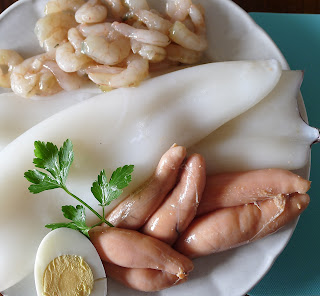
Squid pouches, shrimp (top) and roe.

Serves 6 as a starter.

1-2 medium-large squid (about 1 ¾ pounds)
6 ounces fresh hake roe 
Salt
4 ounces peeled shrimp
¼ cup fresh bread crumbs
¼ cup fino manzanilla or Sherry
1 egg white, lightly beaten
½ of a hard-boiled egg, chopped
6 cups shrimp stock, fish broth or water
Shredded lettuce, to serve
Sliced cooked potatoes, to serve
Pimentón (paprika)
Sauces to accompany the squid (recipes follow)

Clean the squid by pulling the head and tentacles free from the body. Leave the body pouch whole. Pull off and discard the discolored outer membrane and remove the cartilage on the inside. Pull off the fins and separate the tentacles from the head. (Save the fins and tentacles for another use.) Discard the mouth and ink sac. Keep the squid bodies covered and refrigerated until ready to stuff them.

Cut roe into chunks.
Bring salted water to a boil. Reduce the heat to a simmer and blanch the whole lobes of roe for 5 seconds. Skim them out and drain well. Trim off dark veins. Cut the lobes into ¾-inch chunks. Keep refrigerated until ready to use.

Chop the shrimp into ½-inch pieces and reserve, refrigerated.

Place the bread crumbs in a mixing bowl. Add the manzanilla and egg white. Stir in the chopped cooked egg. Add the pieces of roe and the chopped shrimp. Season with ¾ teaspoon salt. Use a wooden paddle to very gently fold the roe and shrimp into the breadcrumb mixture. 

Fill squid with stuffing.
Place squid pouch upright in a cup. Spoon the stuffing mixture into the squid Use the handle of a wooden spoon to push the stuffing down. Don´t fill the pouch more than ¾ full. Close the top opening with a toothpick or small skewer. Use remaining stuffing mixture to fill the second squid in the same manner.

Place the shrimp stock in a pan just large enough to hold the squid in one layer. (If using water instead of stock, add salt and a bay leaf.) Bring the stock to a boil, reduce the heat to a simmer and place the stuffed squid in the pan. There should be enough liquid to just cover them. Place a heatproof plate on top to keep the squid submerged. 

After the squid have cooked 3 minutes, use a skewer to pierce the skin in two or three places in order to eliminate air pockets in the stuffing. Cook the squid 15 minutes. Very gently, turn them over. Replace plate on top. Cook until squid are very tender when tested with a skewer, about 15 minutes longer. Remove the pan from the heat and allow the squid to cool 30 minutes in the cooking liquid. 

Remove the squid from the pan (stock can be strained and saved for another use). Place the squid in a container and tuck a sheet of plastic wrap around them. Cover the container and refrigerate at least 2 hours and up to 8 hours.

Slice the squid crosswise. Serve on a platter or on individual plates with shredded lettuce and sliced cooked potatoes. Sprinkle with pimentón. Accompany with sauces.

Parsley-Spring Onion Vinaigrette
Vinagreta de Perejil y Cebolleta

Use spring onions (also known as green onions, cebolletas) or scallions for this sauce.


1 cup chopped spring onions
½ cup chopped flat-leaf parsley
¼ cup finely chopped red bell pepper
1 clove garlic, minced
½ teaspoon salt
2 tablespoons extra virgin olive oil
1 tablespoon Sherry vinegar

Combine the onions, parsley, pepper and garlic in a small bowl. Add salt and dress with oil and vinegar. Mix gently. Serve in a sauce bowl alongside the squid or spoon some of it over the sliced squid.


Pimentón Mayonnaise
Mayonesa con Pimentón


This sauce is best if home-made with extra virgin olive oil. If using bottled mayo, beat a tablespoon of olive oil into it.

½ cup mayonnaise
1 tablespoon fresh lemon juice
½ teaspoon pimentón (paprika, not smoked)
Pinch of pimentón picante (hot paprika) or cayenne
Salt to taste
1 teaspoon capers

Combine the mayonnaise, lemon juice, two kinds of pimentón, salt and capers. Serve in a sauce bowl alongside the sliced squid or spoon some of it over the squid.


Saturday, July 11, 2015

HERBAL REFRESHMENT

In my herb garden is a little shrub that I had thought was manzanilla, chamomile. When it began to flower, I started looking for ways—besides the familiar, soothing tea—to use chamomile.


Manzanilla--dried chamomile flowers.

I found an intriguing recipe in Food & Wine magazine that called for cooking chicken with chamomile flowers and, on a blog, the idea of infusing cream with chamomile, chilling it and whipping it to serve with berries. 

But, when I picked the yellow flowers and sniffed them, the scent was definitely not chamomile! (Still haven’t identified my mistaken-identity herb.) By then, I was launched on my chamomile project, so I visited the herboristería in my local market and bought a packet of dried manzanilla flowers.

Three kinds of manzanilla--wine, olives, herb.
Chamomile in Spanish is manzanilla. In Spain, three unrelated products are called manzanilla. One is the herb, chamomile (matricaria recutita), commonly used as an infusion; another is Manzanilla Sherry, a fino made in Sanlucar de Barrameda, and the third is a variety of olive tree grown in Andalusia and source of the world-famous Sevilla olives.

"Manzanilla" means “little apple” and the herb apparently was named in Greek for the resemblance of the flower to a little apple. However, the wine takes its name from the town of Manzanilla (in the province of Huelva, near the Sherry district), which traditionally made a similar style of wine. The olive variety, as far as I can tell, is named because the fat olives somewhat resemble “little apples.” I also detect a slight similarity in flavor in all three—a bitter apple, subtly saline taste—but, perhaps that is only the power of a name.

Chamomile tea and a shot of anise.
In herbal medicine, chamomile is traditionally used as an antimicrobial, antiinflammatory and antispasmodic. The tea is prescribed for colic or any stomach upset. My midwife used a dilute solution of chamomile to wash the eyes of my newborn son. Andalusian campesinos (field workers) start the day with chamomile tea and a shot of strong aguardiente, anise brandy.  Chamomile makes a good hair rinse for blondes, to bring out golden highlights. It’s a soothing bath for prickly skin.

I chose to turn manzanilla into summer refreshment.


Limonada con Manzanilla
  Herbal Lemonade
When life gives you lemons--
 Inspired by a bucket of end-of-season lemons, I made a chamomile-infused, whole-lemon lemonade. Very refreshing on its own, it would also be a bitter-lemon mixer for an alcoholic tall drink. (Try it with aguardiente, an anise liqueur.) You will have to sweeten the lemonade to taste—I used stevia, a non-calorie sweetener—and dilute it with water to take the edge off the bitterness.

Made with whole lemons, this chamomile-infused lemonade has a grown-up bitter taste. Sweeten to taste.
4 cups water
4 chamomile tea bags (or about 2 tablespoons dried chamomile flowers)
Sugar or stevia (about ¼ cup)
3 whole lemons
1-2 cups water
Ice cubes to serve


Bring 4 cups of water to a boil. Add the tea bags or flowers. Cover and let the tea steep until cool. Remove tea bags or strain out flowers.
.
In blender or food processor, chop the lemons with 2 cups of the tea and sugar or sweetener. Strain the lemon water, discarding the solids. Add remaining tea and 1 to 2 cups more water. Chill the lemonade.

Serve cold with ice cubes.

Gin con Manzanilla
Chamomile Gin

Herb-infused gin and tonic. Cool.
Gin already has a herbal, botanical essence. Steeping chamomile in it adds another dimension. Use the infused gin for cocktails or for that ever-popular summer refresher, gin-tonic.

7 chamomile teabags (or 3 tablespoons chamomile flowers)
Zest of 1 lemon
2 cups gin

Open the tea bags and place the contents in a jar with the lemon zest. Add the gin. Close tightly and infuse for 24 hours or up to 1 week. Pour through a fine strainer. Store in a tightly stoppered bottle. 


Triple-Manzanilla Martini

Manzanilla (herb) in the gin, Manzanilla (wine) in the martini and Manzanilla (olive)  in the cocktail.

Manzanilla multiplied by 3: chamomile-infused gin, Manzanilla Sherry and Manzanilla olives.

Makes 2 cocktails.

Manzanilla olives
Cracked ice
4 oz chamomile gin (recipe above)
1 oz Manzanilla Sherry


Chill the martini cocktail glasses. Place 2 olives in each.

Place ice in a jar or cocktail shaker. Add the gin and Manzanilla Sherry. Shake or stir. Strain the martini into the cocktail glasses and serve.
Gin with chamomile. Cocktails?

Sunday, October 20, 2013

JUMPING ON THE OLIVE BANDWAGON


¡PRACTICA EL ACEITUNING!  Before you say “Gesundheit!” to “aceituning,” let me remind you that the Spanish word for “olive” is aceituna. Olivo, a word that comes from the Romans, is an olive tree, but aceituna, from the Arabic, is the fruit of that tree.

Practica el aceituning is the catchy slogan for the grand marketing campaign rolled out this week by the producers of table olives. Spain is the world’s principal producer and exporter of table olives. What is aceituning? “To add original and creative seasonings to commercially bottled olives from Spain.”

Some examples: olives with pesto, cheese and salt cod; black olives with cayenne and orange peel; green olives with goat cheese, honey and hazelnuts; black olives with strawberries, tomato and PX vinegar; olives with soy sauce and ginger. (See more recipes.)

Brining my olives.
I’m practicing aceituning in my own way. I just put my hand-picked olives into salmuera, a brine seasoned with garlic, thyme and fennel. They should be ready to eat in a couple of weeks. I’m also using store-bought olives in some new ways.

Queen-sized Gordal olives.


The most familiar Spanish table olives are Manzanilla, sometimes marketed as “Seville” olives. Manzanilla is the name of the variety of olive tree. It produces a plump, meaty olive. Manzanillas make up the bulk of Spain’s table olive production, but the fat Gordal olive (also called “queen”) is another favorite commercial table olive.

The olives are hand-picked when still green. The curing process entails first soaking in an alkaline solution to remove the bitterness. Then the olives are left in a brine to ferment, which converts the olives’ natural sugars into lactic acid. This is what gives them that wonderful tangy flavor. They are canned or bottled whole and unpitted, pitted and stuffed.

Black olives are picked green.
Most olive varieties, when fully ripe, turn a purplish color, not black. Black olives that you buy in a can—gorgeous for garnishing salads and cold dishes—are not really ripe olives. They are picked green, processed in alkaline solution, then the black color is fixed by oxidation.

These are by no means the only olives in Spain. Every olive-producing region has its particular varieties and methods of curing and flavoring olives.

In Andalusia, you might sample aceitunas partidas, green olives (Manzanilla, Hojiblanca or Morisco)  that have been cracked to split them open, then brine-cured (no alkaline is used). They may be flavored with thyme, fennel, cloves of garlic, slices of lemon, oregano and strips of red pepper.

Split and brine-cured.
In Extremadura and La Mancha, ripe Cornicabra and Cacereña olives are prepared rayado, incised with a sharp blade, then cured in brine and flavored with local herbs. Arbequina is the varietal best-known in Catalonia, especially Lérida. These are tiny olives with a delicate flavor, simply brine-cured. The Empeltre olives of Aragón and Navarre are cured in brine when they reach a purplish-black degree of ripeness. In Murcia and Alicante, the Cuquillo olive is cured when nearly black.

You can add flavor to bottled, store-bought olives by draining them, then marinating for two days in salt water with slivered garlic, fresh or dried thyme,  sliced lemon and a splash of extra virgin olive oil. Or, practice some extreme aceituning and get a little adventuresome.

Olive Bread with Sardines. Inspiration for this recipe comes from a recipe booklet published by the board of the Denominación de Origen Protegida Aloreña de Málaga. The Aloreña olive is a type of brine-cured Manzanilla.  The recipe calls for a sort of focaccia bread made with Aloreña olives and roasted red pepper, topped with grilled sardines, olive “air,” and a smear of strawberry alioli. The bread recipe didn’t work so well for me and the “air” required techniques and ingredients with which I am not familiar. So I topped the bread with canned sardines and stacked some sliced Aloreña olives on top. The strawberry alioli (garlic mayonnaise) was, uh, interesting.

 Potato-Olive Salad. I “aceituned” a typical Spanish potato salad, papas aliñadas, by upping the proportion of olives. For 1 cup of diced, cooked potatoes, I used 1 cup of pitted brine-cured olives. (Split olives are easily pitted by pressing them on a board to squeeze out the pits.) Other ingredients are diced tomato, parsley, green onions, chunks of tuna, hard-cooked egg, olive oil and Sherry vinegar.


Olive-Cream Cheese Dip. This is incredibly easy! In a blender or mini processor, blend 1 cup softened cream cheese, 2 cloves garlic, 2 tablespoons chopped onion, ½ teaspoon pimentón de la Vera (smoked paprika), and ½ teaspoon ground cumin. Add 1 cup pitted green Manzanilla olives and process until they are coarsely chopped. Serve with regañás  or any crisp crackers for dipping.


Black Olive, Corn and Avocado Salsa. Relish, salsa or salad?  Combine equal quantities of pitted black olives, corn kernels and chopped avocado with roasted red pepper, scallions, chile to taste, olive oil, lemon juice and a garnish of cilantro. Because olives are salty, you may not need to add salt.

Monday, September 27, 2010

COCKTAILS WITH SPANISH FLAIR


The first time I encountered a mixed drink made with Sherry—a Sherry-tini—I  was horrified. I guess I’m a purist—I like my fino Sherry straight up and chilled, in a proper stemmed Sherry copa. Likewise, it seems a shame to mess with a mellow amontillado or palo cortado.

Nevertheless, I must admit that Sherry, slightly nutty, lightly fruity, a tiny bit salty, adds complexity and depth of flavor to a cocktail. It’s anyway more interesting than vermouth. I decided to give it a whirl. Or shake. Or stir.

By the way, Sherry is a protected denomination for wines made in the region of southern Spain around Jerez. (That’s why I always write Sherry with a capital “S”.) It comes in several types. The driest one is pale fino. One sort of fino comes only from Sanlucar de Barrameda and is called manzanilla. So far, I’ve only experimented with fino in cocktails, but I am guessing that oloroso Sherry, on the sweet spectrum, might make a good mixer.

Gorgeous autumnal weather is a fine excuse for a cocktail party. Here are two to try, plus a recipe for cheese puffs to accompany the drinks.

Sherrytini Cocktail

Dry Sherry stands in for vermouth in this twist on a classic martini. If you use manzanilla Sherry, spike the drinks with manzanilla olives. If you choose dry fino, finish with a twist of orange peel. Warming the twist over a lighted match releases the citrus fragrance. Chill the martini glasses before mixing the cocktail.

Makes 4 cocktails.

8 olives or 4 twists orange peel
Cracked ice
8 oz gin
2 oz manzanilla or fino Sherry


Stick olives on 4 picks and place in four chilled martini cocktail glasses. Or, if using orange peel, hold each strip of peel, skin side down, briefly over a lighted match. Drop the orange peels into cocktail glasses.

Place ice in a jar or cocktail shaker. Add the gin and Sherry. Shake or stir. Strain the Sherrytini into the cocktail glasses and serve.

Sherry-Lemon Cocktail

Makes 4 cocktails.

Grenadine is pomegranate syrup. It gives a fruity flavour and a deep blush to this cocktail. If available, add a few ruby seeds from a fresh pomegranate to the drink. Brandy de Jerez is Spanish brandy from the same region where Sherry is made.

Cracked ice
4 fl oz dry Sherry
4 fl oz Brandy de Jerez
6 tablespoons grenadine syrup
4 tablespoons lemon juice
4 strips lemon peel


Put the ice in a cocktail shaker. Pour over the Sherry, brandy, grenadine and lemon juice. Shake the cocktail. Strain into four cocktail glasses. Hold each twist of lemon peel, skin side down, briefly over a lighted match and drop it into the cocktail.

Buñuelos de Queso
Cheese Puffs


Vary the flavour by choosing different cheeses. Manchego is excellent, but smoked Idiazábal will give the puffs a different dimension. The puffs can be fried or baked.

Makes about 45 puffs.

1 cup water
½ teaspoon salt
Pinch of thyme
Pinch of cayenne
1/3 cup olive oil
1 cup plain flour
4 eggs
2 cups grated cheese
Olive oil for deep frying


Place the water, salt, thyme, cayenne and oil in a pan. Bring to a boil. Lower the heat and add the flour all at once, stirring hard with a wooden spoon until the mixture thickens and pulls away from the sides of the pan. Remove from heat and allow to stand 2 minutes.

Beat in the eggs, one at a time. Thoroughly mix in one egg before adding the next. Stir in the grated cheese.

Place oil in a deep frying pan to a depth of 1 in and heat it until shimmering,  360ºF. Dip two teaspoons in oil. Scoop up batter with one spoon and use the other to push the batter into the hot oil. Don’t crowd the pan. Puffs will bob to the surface. Carefully turn them so they brown on both sides. Remove when golden, 2 to 3 minutes, and drain on paper towels.  Serve immediately.

Variation: Bake the cheese puffs instead of frying them. Line an oven tin with baking parchment. Drop spoonfuls of the batter at least 1 in apart. Bake in preheated oven, 375ºF, until golden, 30 minutes.