Showing posts with label Gerry Dawes. Show all posts

Saturday, May 25, 2024

CHEESE, CONTINUED


Cheese board with Cabrales, a blue-veined cheese from Asturias. With bubbly cider, white wine and dry Sherry.

I wrote last week about an unusual cheese, Torta del Casar from Extremadura. I’ve got another cheese up my sleeve, so to speak, also purchased at the Feria Nacional de Queso in Trujillo. This one, Cabrales, comes from northern, green Spain, the Principado de Asturias.


Cabrales is the name of the region where the cheese is made, specified on the label as a protected denomination of origin. It can officially be made with cow’s milk or with a mixture of cow, goat and sheep milk. The cheese is matured in mountain caves where the Penicillium mold causes it to form blue-green veins throughout. Its aroma is intense, the texture is creamy, buttery. The flavor of Cabrales is salty, mildly acidic, somewhat piquant. 


Cabrales cheese can be served as an appetizer or dessert cheese accompanied by bread, crackers or toasts and fresh or dried fruits. It also lends itself well to combining with other ingredients for sauces or for embellishing variations on pizza or quiche. 

Creamy Cabrales sauce tops a burger with grilled mushrooms and sautéed piquillo peppers.


Cabrales sauce makes an interesting change for pasta with broccoli.

Cabrales whipped with yogurt for a tasty dip or dressing.

Slivers of Cabrales top a salad with pears, endive, and almonds. Serve the dressing separatley.

Burgers with Cabrales Blue Cheese Sauce
Burguer con Salsa Cabrales

Vegetarians can forgo the meat burger and pile the grilled mushrooms on buns with the piquillos and Cabrales sauce. 

Toasted buns
Grilled burgers
Oyster mushrooms grilled with garlic
Sautéd piquillo peppers and onions with red pepper flakes
Cabrales blue cheese sauce (recipe below)


Place mushrooms on buns and top with the sautéd piquillo peppers. Place a burger on the stack and spoon warm Cabrales sauce on the meat. (The burgers pictured are made with ground chicken thighs.)


Fettuccine with Broccoli and Cabrales Blue Cheese Sauce 
Pasta con Brócoli y Salsa Cabrales

Make this vegetarian by omitting the bacon.

Serves 4. 

8 ounces fettuccine noodles
Salt
2 cups broccoli florets
3 tablespoons olive oil
½ cup diced bacon
2 cloves sliced garlic
1 cup Cabrales blue cheese sauce (recipe follows)
Grating of fresh nutmeg
Freshly ground black pepper
Chopped chives

Cook the noodles in boiling salted water according to package directions. Reserve 1 cup of the pasta cooking water. Drain the pasta.

Blanch the broccoli florets in boiling water 1 minute. Drain and reserve.

Heat the oil in a large skillet with the bacon and garlic. When garlic starts to turn golden, add the broccoli and fry a few minutes. Stir in the Cabrales sauce. Season with nutmeg and pepper. Add salt to taste. Add the reserved pasta cooking water and heat. Add the cooked noodles and mix them well with the sauce. Serve garnished with chopped chives. 

Cabrales Blue Cheese Sauce 
Salsa de Queso Cabrales

Cabrales sauce is classic with entrecôte steak, but it’s also good with hamburgers, baked potato, or pasta. The cheese cooks with cream, making it quite rich and also tempering the greenish color of the mashed cheese. Season the sauce with any favorite herbs. Salt may not be needed at all. For a very thick sauce, let it cook slowly until reduced by half. 

2 tablespoons olive oil
2 tablespoons finely chopped shallots
6 ounces Cabrales blue cheese (about 1 cup)
½ cup cider, white wine or Sherry
Pinch of rosemary or thyme
Freshly ground black pepper
1 cup cream

Heat the oil on medium and poach the shallots until softened, 5 minutes. Do not let them brown. Break up the cheese and mash it in the pan with the shallots. Add the cider and cook, stirring, until the cheese is melted. Add the rosemary, pepper, and cream and cook on medium until the sauce is reduced by almost half, 15 to 20 minutes. 

Serve the sauce hot, warm, or room temperature. Store it covered and chilled.

Salad with Pears, Endive, and Cabrales Blue Cheese
Ensalada de Pera con Endibia y Cabrales

Serves 4

2 ounces Cabrales cheese
2 ripe, firm pears
3-4 Belgian endives
1 tablespoon Sherry vinegar
4 tablespoons extra virgin olive oil
½ cup slivered red bell pepper
4 tablespoons toasted hazelnuts or almonds
Chopped chives to garnish
Cabrales Blue Cheese Dressing to accompany (recipe follows)


While cheese is still cold and firm, cut it into shards and let them come to room temperature.

Peel the pears, cut them in half, and remove cores. Slice them lengthwise. Chop or shred the endive leaves and divide them between 4 salad plates. Arrange the sliced pears on top. Scatter the red pepper and hazelnuts over the salads.

Whisk together the vinegar and oil and drizzle them over the salads. Divide the shards of Cabrales on top. Garnish with chives. Serve the salads accompanied by the Cabrales Blue Cheese dressing.

Cabrales Blue Cheese Dressing
Aliño con Cabrales

This non-cooked sauce makes a great dip with chips or vegetable dippers. Use it as a salad dressing as well. 

¼ cup chopped scallions
½ cup Greek yogurt
4 ounces Cabrales cheese
1 tablespoon dry Sherry
1/8 teaspoon cumin seeds
1/8 pimentón picante de la Vera (smoked hot paprika) or cayenne

Combine all the ingredients in a mini-processor. Process until smooth. 


What to drink with Cabrales cheese? I asked Gerry Dawes, an expert on Spanish wines who knows his way around the cheeses of Asturia. 

"In Asturias, they drink cider, which goes very well with Cabrales.  White wines with good acidity to cut through the creaminess, richness and mold of Cabrales would be Albariño, but especially wines from Ribeiro.  Just like Sauternes with Roquefort, sweet wines are great.  Late-harvest Moscateles from Navarra, sweet Malvasias from the Canarias, Torres San Valentin semi-dulce from Penedès.   Also rosados from Navarra, which have good acidity and, of course, Cava, even the semi-dulce, though Brut Nature Cava will also be a good counterpoint.   The great sherries, from Manzanilla to Tio Pepe to the Palo Cortados and Olorosos.  I would also drink the excellent cream Sherries and Moscatel de Chipiona with Cabrales.” Thanks, Gerry, that’s a wide choice. And not a single red wine! 

(Photo:Gerry Dawes presenting Asturian cheeses at Alimentaria, Barcelona, 2010.) 
Gerry is the author of Sunset in a Glass, a collection of stories about life, food, wine and people in Spain.

Cabrales has its own cheese festival, the Certamen del Queso de Cabrales, in Arenas de Cabrales, Asturias, the last Sunday of August.

 More about Spanish cheeses:


Saturday, February 12, 2022

SUNSET IN A GLASS (AND STUFFED SQUID)


“Picture yourself on Bajo de Guía beach at the western edge of Sanlúcar de Barrameda right at sunset”. You’ve got a half-bottle of chilled Manzanilla and a plate of grilled langostinos, fresh tiger shrimp. As the sun slowly sinks, it reflects and refracts through your Sherry glass. 

The sea breeze, the color-streaked sky, the taste of those shrimp and the cool wine.  That´s the evocative opening of Sunset in a Glass, a book by Gerry Dawes, self-described “food and wine road warrior in Spain.” (Sunset in a Glass, enhanced photography edition, is available here.)


Sunset in a Glass is not quite a memoir, definitely not a guidebook. It´s a collection of very personal stories about life, food, wine and people in Spain. Gerry easily switches from evocative (that sunset on the beach, ravishing landscapes) to provocative (would he pay $180 for a bottle of Vega Sicilia wine?), but always with good humor.

I first knew Gerry Dawes early in his adventures in Spain when he and his then-wife, Diana, lived in Mijas, the village in southern Spain where I still live. Our paths have crossed a number of times in the subsequent years—stomping around olive groves on press tours in Spain sponsored by the International Olive Oil Council (on one of those jaunts, in Gerry´s company, I first tasted the famed Vega Sicilia wine at a restaurant in Córdoba); tagging along as he made the rounds at Madrid Fusión, the grand annual food fest (Gerry knows absolutely everybody in Spain’s food world); fellow moderators at symposiums about Spanish food at the Culinary Institute of America in St. Helena, CA., and the San Antonio, TX., Culinaria Week;  
 
Although he tells how he first came to Spain (1968, stationed at Rota Naval Base) and his early forays into Sevilla and its barrios and flamenco, Gerry follows no real chronology in the book, but backs and forths between regions and characters at will. As Chef José Andrés writes in the book's foreword, “I am amazed at his reach.” Gerry promises more to come, with three more volumes of Sunset in a Glass to follow.

Quim Márquez (Photo by Gerry Dawes)
My favorite tales are the ones about amazing cooks and memorable meals. A visit to Barcelona´s vibrant La Boquería market includes a “second breakfast” at the stall of Quím (Márquez) de la Boquería—steaming cockles, grilled asparagus, fried artichoke hearts, sizzling shrimp, small white beans with butifarra sausage and alioli, foie gras with crispy leeks—all prepared in a miniscule kitchen at the market stall. A meal washed down with Cava rosat—pink sparkling wine.

In Castile, Gerry meets up with an old friend, Ambrosio Molinos, a cheesemaker and a  trencherman like himself, for an extraordinary meal at De Galo in Covarrubias, (Burgos)   The meal begins with a cold dish, sea bream escabeche, served with coarse Castilian bread for mopping up the sauce. This is followed by a local specialty, red Ibeas beans, cooked with chorizo, served with grilled morcilla and guindillas (piquant peppers), “a must with bean dishes.” The main course is baby lamb chops (with their kidneys) grilled over vine cuttings, roasted potatoes, and pimientos de piquillo, the slightly spicy little red peppers that are one of the great delicacies of Spain. 

Gerry relates a different sort of meal that´s as much a delight for the setting and the group of friends, all taking a break from the frenzy of the San Fermines festival in Pamplona, as for the simple, rustic food. Following in the footsteps of James Michener, as related in Iberia, each year “we, too, made the pilgrimage to this historic little valley in the pass that is haunted by the ghost of brave Roland and by the spirits of generations of pilgrims who passed this way…on… the Camino de Santiago.”

It´s a hard-to-find spot on a steep road that climbs up to a pilgrim’s sanctuary at the top of the pass. “We unloaded the luncheon bounty from our cars. The men helped Alicia down the steep grassy slope to the green mossy banks of the stream… Diana, who had recruited some of the women to collect the food at the Pamplona Mercado Municipal that morning, laid out our splendid repast: salty anchovies cured in oil; roasted red pimientos; streaky pink slices of jamón; garlicky red-orange chorizo; white Parmesan-like Roncal from the Pyrenees east of Roncesvalles and smoky Idiazábal ewes’ milk cheeses from a town south of San Sebastián; olives cured with rosemary, thyme and garlic; crusty, country bread; and fruits—blushing ripe peaches, big black picota cherries,and honeydew melons. I put a dozen bottles of Las Campanas Navarra Rosado (the same rosé wine Hemingway carried in his car around Spain following the bullfights) and the melons in the cold rushing little rivulet to cool, then dispatched a detail of volunteers for dry firewood to build a small fire.”

Chef Ferran Adrià (left) with Gerry Dawes. (Photo by Soler)

From the rustic to the sublime—Gerry recounts several meals he sampled at elBullí, the restaurant of Ferran Adrià in Roses (Catalonia) which, for awhile, was billed as the best restaurant in the world (the restaurant has since closed its doors). According to him, his story about elBullí that appeared in Food Arts magazine in 1997 was the first and seminal article published in America about rising star Ferran Adrià and his elBulli restaurant. 

I can´t resist quoting from the book as Gerry relates what he ate at that first meal at elBulli (menus evolved over the years, with fewer of the “foams” that once seemed so far-out). The meal began with “snacks” in the kitchen. “Nothing too weird so far,” Gerry opined. Then, to the table.

“Served by very serious young wait people dressed in funereal black Nehruesque jackets and pants, began the parade of unbelievably inventive, undoubtedly weird, and sometimes downright delicious Adrià concoctions, complete with verbal instructions on how and when to eat it.” 

There were Parmesan-flavored ice cream sandwiches between Parmesan wafers; guacamole mousse with crunchy toasted corn; a “caramelized” quail’s egg yolk; and then the first espuma, a smoked meat-flavored wisp of foam. Next came a biscuit glacé (very salty ice cream with hazelnuts”); a tepid, exotic eggplant “soup with Fisherman” that included yogurt-filled raviolis, pine nuts and  little chips of minty, balsamic-flavored Fisherman's Friend throat lozenges. 

A cold dish followed, mejillones de roca con frambuesa (little rock mussels with a dot of raspberry puree on top, surrounded by a gelatin of mussel juices flavored with julienned ginger. Zamburiñas a la gallega were traditionally flavored tiny sea scallops in their shells with paprika, thin quick-fried scallion rings, and crunchy bits of sautéed garlic. 

“I headed into the home stretch, where Ferran Adrià really hit his stride. The espuma de bacalao con cebollitas was followed by a tortilla de alcachofas, a spoonful of two pieces of crunchy, deep-fried artichoke leaves in a creamy, egg yolk sauce; Paquetitos de sepia y coco al jengibre (ravioli-type packets made from sepia squid bodies and filled with a ginger-soy sauce (‘Don’t break the packets, put them in your mouth and let them explode,’ instructed my waiter.)"

 Next, chop suey de almejas, cold clams in a warm sauce with corn, diced zucchini, button mushrooms, and braised endive. The next to the last dish was merluza con calabaza y tomate al perifollo, grilled hake served with spaghetti squash and gelatinous, seed-studded tomato “hearts,” topped by a shard of caramelized pumpkin and chervil. The finale, lamb brains with sea cucumbers, mushrooms, and grilled meat-flavored oil. 

Javier Hidalgo, Sanlúcar (Photo Dawes)
But, back to that sunset on the beach at Sanlúcar. After the sun has gone down and the bottle or two of Manzanilla has been finished, it´s time to head to one of the famed beach restaurants, such as Casa Bigote, a taberna marinera, for local specialties such as delicias de pescado frito, mixed fried fish with small whole hake, cazón en adobo (marinated  dogfish shark); boquerones (fresh anchovies), acedias  (baby sole) and calamares (squid). There’s Bigote’s superb arroz marinero (seafood rice), cazuela marinera con huevo (monkfish and shrimp with an egg poached in a bubbling Manzanilla sauce. 

Gerry writes movingly about meals shared with his good friend, Javier Hidalgo, of Bodegas Hidalgo in Sanlúcar, where manzanilla comes from. One lunch, at a rustic place in the Marismas near Doñana, begins with tortillitas de camarones, fritters of tiny shrimp, and, of course copitas of manzanilla.

Although he´s included no recipes in the book (with the exception of José Andrés’s gin-tonic), Gerry relates ingredients and methods for a number of dishes as told to him by his culinary fellow-travellers. One, from Sanlúcar de Barrameda, for calamares rellenos con huevas de merluza (squid stuffed with hake roe), Gerry says is an example of great folk dishes of southern Spain—originally simple fishermen´s fare—that is “a delicacy worthy of the most exalted gourmet.”  I was inspired to re-create the dish in my kitchen. Without the beach and the sunset, but absolutely with a copa of manzanilla. 
(The photos above are from the book Sunset in a Glass by Gerry Dawes and are used with permission. The photos below are taken by me in my kitchen.)

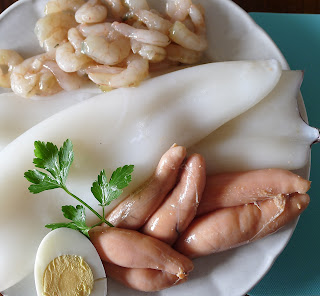
Whole squid is stuffed with shrimp and fish roe. After poaching, the squid are sliced and served with a parsley vinaigrette and seasoned mayonnaise. 

Stuffed squid makes an elegant starter with copitas of manzanilla.


Accompany the squid with two sauces, a parsley-spring onion vinaigrette and a pimentón-spiked mayonnaise.


Squid Stuffed with Hake Roe, Sanlúcar Style
Calamares Rellenos con Huevas de Merluza a la Sanluqueña

Lobes of hake roe.

Early spring is the season for fresh hake roe (fish eggs, huevas). The “packets” or lobes of fresh roe can be poached, sliced and served with vinaigrette. In this recipe from Sanlúcar de Barrameda, as described in Sunset in a Glass, roe is used along with shrimp and, if available, huevos de choco, milt from cuttlefish, as a stuffing for squid. Sliced and served cold with a piquant parsley-onion sauce and seasoned mayonnaise, the squid makes quite an elegant starter. 

The delicate packets of roe are easier to handle if they are first blanched. Add them to simmering, salted water for 5 seconds, skim out and drain well. Then use scissors to cut away any dark-colored veins, but don´t remove the thin membrane that encloses the tiny eggs. Cut the lobes into three or four pieces. Handle them very gently, so as not to break up the delicate roe. 

If available, use real langostinos, tiger shrimp, from Sanlúcar. Otherwise, use any small shrimp. Eight ounces of shrimp with heads and shells will make about 4 ounces peeled. Use the heads and shells to make stock (6 cups water, salt, bay leaf and onion, cooked 40 minutes) in which to poach the stuffed squid. 

After poaching, chill the squid at least 2 hours or overnight to allow the stuffing to firm-up. Use a very sharp knife to slice them crosswise about ½ inch thick. 

Squid pouches, shrimp (top) and roe.

Serves 6 as a starter.

1-2 medium-large squid (about 1 ¾ pounds)
6 ounces fresh hake roe 
Salt
4 ounces peeled shrimp
¼ cup fresh bread crumbs
¼ cup fino manzanilla or Sherry
1 egg white, lightly beaten
½ of a hard-boiled egg, chopped
6 cups shrimp stock, fish broth or water
Shredded lettuce, to serve
Sliced cooked potatoes, to serve
Pimentón (paprika)
Sauces to accompany the squid (recipes follow)

Clean the squid by pulling the head and tentacles free from the body. Leave the body pouch whole. Pull off and discard the discolored outer membrane and remove the cartilage on the inside. Pull off the fins and separate the tentacles from the head. (Save the fins and tentacles for another use.) Discard the mouth and ink sac. Keep the squid bodies covered and refrigerated until ready to stuff them.

Cut roe into chunks.
Bring salted water to a boil. Reduce the heat to a simmer and blanch the whole lobes of roe for 5 seconds. Skim them out and drain well. Trim off dark veins. Cut the lobes into ¾-inch chunks. Keep refrigerated until ready to use.

Chop the shrimp into ½-inch pieces and reserve, refrigerated.

Place the bread crumbs in a mixing bowl. Add the manzanilla and egg white. Stir in the chopped cooked egg. Add the pieces of roe and the chopped shrimp. Season with ¾ teaspoon salt. Use a wooden paddle to very gently fold the roe and shrimp into the breadcrumb mixture. 

Fill squid with stuffing.
Place squid pouch upright in a cup. Spoon the stuffing mixture into the squid Use the handle of a wooden spoon to push the stuffing down. Don´t fill the pouch more than ¾ full. Close the top opening with a toothpick or small skewer. Use remaining stuffing mixture to fill the second squid in the same manner.

Place the shrimp stock in a pan just large enough to hold the squid in one layer. (If using water instead of stock, add salt and a bay leaf.) Bring the stock to a boil, reduce the heat to a simmer and place the stuffed squid in the pan. There should be enough liquid to just cover them. Place a heatproof plate on top to keep the squid submerged. 

After the squid have cooked 3 minutes, use a skewer to pierce the skin in two or three places in order to eliminate air pockets in the stuffing. Cook the squid 15 minutes. Very gently, turn them over. Replace plate on top. Cook until squid are very tender when tested with a skewer, about 15 minutes longer. Remove the pan from the heat and allow the squid to cool 30 minutes in the cooking liquid. 

Remove the squid from the pan (stock can be strained and saved for another use). Place the squid in a container and tuck a sheet of plastic wrap around them. Cover the container and refrigerate at least 2 hours and up to 8 hours.

Slice the squid crosswise. Serve on a platter or on individual plates with shredded lettuce and sliced cooked potatoes. Sprinkle with pimentón. Accompany with sauces.

Parsley-Spring Onion Vinaigrette
Vinagreta de Perejil y Cebolleta

Use spring onions (also known as green onions, cebolletas) or scallions for this sauce.


1 cup chopped spring onions
½ cup chopped flat-leaf parsley
¼ cup finely chopped red bell pepper
1 clove garlic, minced
½ teaspoon salt
2 tablespoons extra virgin olive oil
1 tablespoon Sherry vinegar

Combine the onions, parsley, pepper and garlic in a small bowl. Add salt and dress with oil and vinegar. Mix gently. Serve in a sauce bowl alongside the squid or spoon some of it over the sliced squid.


Pimentón Mayonnaise
Mayonesa con Pimentón


This sauce is best if home-made with extra virgin olive oil. If using bottled mayo, beat a tablespoon of olive oil into it.

½ cup mayonnaise
1 tablespoon fresh lemon juice
½ teaspoon pimentón (paprika, not smoked)
Pinch of pimentón picante (hot paprika) or cayenne
Salt to taste
1 teaspoon capers

Combine the mayonnaise, lemon juice, two kinds of pimentón, salt and capers. Serve in a sauce bowl alongside the sliced squid or spoon some of it over the squid.


Saturday, June 26, 2021

ON THE ROAD AGAIN


On the road again! Off to Ronda for lunch.


We drove to Ronda to meet some friends for lunch. It’s the first time I’ve been out of my own municipality since the beginning of the pandemic. Without thinking twice, I hugged the friend, shook hands with another. All of us vaccinated, hooray! 


We lunched at Restaurante Pedro Romero, right across from the Ronda bull ring. We sat at tables inside, with table cloths and proper napkins. Although QR symbols were posted for consulting the digital menu, we happily made our selections from real menus. We took off our masks when the bottle of wine was opened (Los Cipreses, a Garnacha rosado from Ronda bodega, Huerto de la Condesa). We ate very well and sat talking over coffee until late in the day. Life seems almost normal.

Ronda is an inland mountain town, once known for its smugglers and bandoleros  The road from the coast winds up through the steep hills of the newly proclaimed Parque Nacional Sierra de las Nieves, home to the Pinsapo fir tree, a remnant of the Pleistocene Age.

Rabo de toro at Pedro Romero restaurant.

Ronda is close enough to the sea to have fresh fish on the restaurant menu, but it’s especially known for its sierra cuisine—sturdy potages—some with wild greens such as tagarninas, thistles; small game such as partridge and rabbit; ibérico ham and fresh pork, and, in this town famous for its bullfighting (Antonio Ordoñez, et al.), rabo de toro, braised bull’s tail. 

We started with ajo blanco, Málaga’s emblematic white gazpacho made with almonds and garlic and here served with smoked sardines instead of the usual grapes; morcilla, blood sausage, a Ronda specialty, accompanied by roasted red peppers, and a carpaccio of thinly sliced beef. Best of all was a plate of magnificent sliced tomatoes of the heirloom Castellano variety. They were sweet and juicy. 

Here’s my rendition of the Cazuela de Conejo that I sampled in Ronda.

Pieces of rabbit are cooked in a sauce with wine. Spanish style, the rabbit is accompanied by fries and the first of the season's sliced tomatoes.


Aromatic rosemary, thyme, bay and cumin add flavor. I added a few small carrots for color (the rabbit cooked in less time than the carrots).


Rabbit is white meat, but the sauce is rich. Serve with a light, unoaked red or a crisp, cold rosado.


Rabbit in Cazuela
Cazuela de Conejo Estilo de Ronda

The rabbit’s liver thickens the sauce and deepens its flavor (chicken liver can be substituted). If you do not have liver or prefer not to use it, Use a slice of fried bread to thicken the sauce. Blend it with the fried garlic. Thin the sauce with additional water if it seems too thick. After cooking the rabbit, the sauce can be sieved or pureed in a blender, if desired. (I didn't; I like the texture of chopped onions, carrots and peppers in the sauce.)

In Ronda, the rabbit with its rich sauce is typically served with patatas fritas, fries, but rice goes nicely with it as well.

Cut rabbit in large pieces to avoid splintery bones.
1 rabbit, cut in serving pieces (2- 2 ½ pounds)
Salt 
Freshly ground black pepper
1/3 cup olive oil
1 rabbit liver (2 ounces) or slice of bread
3 cloves garlic, peeled
Sprig of rosemary
1 cup chopped onion
¼ cup finely chopped green pepper
¼ cup diced carrot
2 medium tomatoes (1 cup grated pulp)
1 tablespoon pimentón (paprika, not smoked)
¼ teaspoon cumin
¼ teaspoon coarsely cracked black pepper
½ cup white wine
1 ½ cups water
1 bay leaf
Sprig of thyme

Sprinkle the rabbit with salt and pepper and allow it to come to room temperature.

Heat half of the oil in a cazuela or heavy pan. Cut the liver into 4 pieces and fry it with the garlic cloves, turning, until they are browned on all sides. (If using bread instead of liver, fry it until golden on both sides.) Skim out the liver and garlics and place them in a blender.

Brown rabbit in oil.

Add the pieces of rabbit to the cazuela with the sprig of rosemary. Fry them on moderate heat, turning, until rabbit is browned on both sides. Remove the pieces of rabbit. Discard the rosemary.

Add remaining oil to the pan. Sauté the onion, green pepper and carrot until softened and beginning to brown, 5 minutes. 

Grate tomatoes.

Meanwhile, grate the tomatoes and discard the skins. Stir the pimentón into the onion sofrito. Add the tomato pulp, cumin, cracked black pepper, ½ teaspoon salt and wine. Bring to a boil and simmer until the alcohol is cooked away.

Add 1 cup of water to the liver and garlic in the blender. Blend until smooth. Pour this mixture into the pan. Return the pieces of rabbit and their juices to the pan with the bay leaf and thyme. Add enough additional water to partially cover the rabbit.

Liquid partially covers the pieces of rabbit.


Bring to a boil, then lower heat so the liquid bubbles gently. Cook, uncovered, 15 minutes. Turn the pieces of rabbit in the sauce. Cook another 15 minutes or until the rabbit is tender when pierced with a fork. If sauce is very thick, add additional water.

Remove from heat and allow to set 5 minutes. Serve the rabbit and sauce in the cazuela or plate it. 


More rabbit recipes:


Notes from another visit to Ronda here.

Restaurante Pedro Romero, where we lunched in Ronda.

Lunch in Ronda with old friend, Gerry Dawes (left) and new friend, Tom Perry.


Gerry Dawes leads individually-designed wine, food, culture and photography tours of Spain. He is working on a book about his travels on the food and wine beat:  Sunset in a Glass: Adventures of a Food and Wine Road Warrior in Spain. Some of his stories have been published here.

Tom Perry is a marketing consultant for the Spanish wine trade and a wine educator. He writes about wine, La Rioja and travels in Spain at Inside Rioja.


Gerry Dawes, getting the shot, Ronda overlook.


Thanks to my driver,  my son, Ben Searl, here saying hello to Orson Welles, whose ashes are buried in Ronda.


Toro bravo sculpture, outside the bull ring in Ronda.


Saturday, October 19, 2019

THE MANY VERSIONS OF GAZPACHUELO

Gazpachuelo nine different ways was the special offer at a seaside Málaga restaurant, Balneario Baños del Carmen. We sampled four of them. Following on platters of sardines roasted on espetones (skewers) and accompanied by a crisp Albariño white wine, the gazpachuelo soups made up birthday lunch for my friend and colleague, Gerry Dawes, the expert on Spanish gastronomy, wine and travel, who does specialized custom tours for culinary luminaries (Rozanne Gold, chef and cookbook author, and Michael Whiteman, restaurant consultant, were the guests at this lunch). 

Tables on the edge of the sea at Málaga's Balneario Baños del Carmen. 

Gazpachuelo is not gazpacho. It’s a hot soup, typical of Málaga’s fishermen’s quarter. Basically, it is nothing more than egg, olive oil, bits of fish or shellfish and either bread or potatoes. In the inland village where I live, it is even simpler—egg, olive oil and potato. But, gazpachuelo is more than the sum of its parts. The egg and oil make an emulsified mayonnaise, creating a creamy, satisfying, tasty soup that has inspired local chefs to ring the changes on the simple original.

Seafood and Viña AB Sherry.
Of the ones we sampled at the Balneario, two were almost identical—the malagueño and the one with almejas (clams). The Viña AB, which I remember from the now defunct Restaurante Alegría in the center of Málaga, contains more fish and shellfish, plus a shot of Viña AB amontillado Sherry. The fourth one we tried was pretty radical—gazpachuelo de callos, or tripe. The soup had a pinkish-orange tinge, probably smoked pimentón, and a background flavour of morcilla, or blood sausage. The pieces of pig’s tripe were incredibly tender and succulent.

Inspired by our gazpachuelo lunch and a review of the book, Gazpachuelos de Málaga, by Fernando Sánchez Gómez, with 102 versions of the soup, I tried some variations of my own: turkey meatballs in a chicken-broth-based soup.

Gazpachuelo with turkey meatballs, purple and white potatoes and a snippet of chorizo sausage.


Play with the garnishes to add color and texture. Perhaps some saffron in the meatballs, to give them a yellow color?

Turkey Meatballs in Gazpachuelo Soup
Gazpachuelo con Albóndigas de Ave

You can prepare the soup in stages. If you’re making home-made chicken broth, start at least a day before finishing the soup, so it has time to chill, solidifying the fat on top of the broth. 

Chicken breast could be used instead of turkey for the meatballs (or, look at other meatball and fish ball possibilities, listed at the end of the recipe). Turkey bones could be used instead of chicken for the broth. Sub in rice in place of potatoes. Use different varietals of olive oil to change flavors. (Hojiblanca varietal is typical of Málaga.) Vary the garnishes when serving the soup.

For the chicken broth:
Makes about 10 cups of broth.

2 pounds chicken pieces, such as backs, wings, necks
12 cups water
1 leek
½ onion
1 carrot
1 stalk celery
Parsley stems
2 teaspoons salt
2 tablespoons white wine vinegar
10 peppercorns
1 bay leaf
Sprig of thyme

Wash the chicken pieces and place them in a large soup pot. Add the water and bring to a boil. Skim off the froth that rises to the top. Add the leek, onion, carrot, celery, parsley, salt, vinegar, peppercorns, bay leaf and thyme. Bring again to a boil, reduce heat and cook, covered, 1 hour.

Remove from heat. Let the broth cool slightly, then pour it through a colander into a heat-proof bowl that can be refrigerated. Save the carrot, if desired, to add to the finished soup. Discard the bones, vegetables, spices and herbs.

Refrigerate the broth, covered, overnight or up to 3 days. Before continuing with the soup, remove the congealed fat from the top of the broth. 

For the olive oil mayonnaise:
1 large egg, room temperature
¾ cup extra virgin olive oil
2 tablespoons or more freshly squeezed lemon juice
½ teaspoon salt

Blender mayonnaise.

Place the egg and oil in the container of an immersion blender. Blend at high speed until the mixture begins to thicken and emulsify. Raise and lower the blender blade to completely combine the mayonnaise. Blend in the lemon juice and salt. Taste the mayonnaise and add more lemon juice as desired.
Keep the mayonnaise in the blender container while continuing with the soup.

If making the mayonnaise in advance of finishing the soup, refrigerate it, covered. Bring to room temperature before continuing with the recipe.


For the turkey meatballs:
Parsley, garlic, nutmeg for meatballs.
This is traditional seasoning for meatballs—garlic, parsley, nutmeg. You could vary the flavors—a pinch of thyme, perhaps, or grated ginger. As these meatballs are not floured and fried before being added to the soup, they are very white. A pinch of saffron would be a nice addition.

The meatballs can be prepared in advance of making the soup. Either poach them in the chicken broth or in salted water. Reheat the meatballs before adding to the soup.

Makes about 30 (1-inch) balls

1 pound ground turkey breast
3 slices bread (3 ounces), crusts removed
¼ cup milk
1 egg, beaten
1 tablespoon chopped parsley
1 clove garlic, finely minced
½ teaspoon salt
Freshly grated nutmeg
Freshly ground black pepper


Break the bread into pieces and place in a small bowl. Pour over the milk and allow it to soak 5 minutes. Squeeze out as much of the milk as possible. Place the bread in a mixing bowl and mash it with the beaten egg. Add the parsley, garlic, salt and nutmeg. Mix in the ground turkey, using a fork to combine it thoroughly.

Chill the meatball mixture at least 30 minutes or, covered, until the following day.

Dip hands in cold water and roll the meat into small (1-inch) balls. Place them on a rimmed baking sheet while heating the soup.

Cook the meatballs in the simmering soup (see below).

For the soup:
The process is pretty simple. First, you’re going to “temper” the mayonnaise by blending in some of the hot soup. Then, you will whisk the diluted mayonnaise into the soup. Either serve the soup immediately or very gently reheat it without letting it come to a boil, which would cause the mayonnaise to “break,” or coagulate, spoiling the gorgeous velvety texture of the soup.

Be sure to taste the soup after the addition of the mayonnaise to the soup pot. Depending on the broth, the soup may need more salt or more lemon juice.

Classic gazpachuelo contains potatoes. I chose to use part purple potatoes, just to give the soup some visual pizazz. Rice can be used instead of potatoes. And, why not add some more vegetables? On a second day appearance, I added baby spinach to the soup and meatballs.

Serves 6.

10 cups chicken broth
Turkey balls
2 medium potatoes (12 ounces), white and/or purple, diced
¼ cup fino (dry) Sherry
¾ cup olive oil mayonnaise
Cooked carrot, sliced
1 slice cured chorizo, cut in small triangles
Chopped scallions or parsley to garnish
Toasted croutons (optional)


Place the broth in a large soup pot. Bring to a boil. Lower the heat to moderate and add the turkey balls. Cook, stirring them gently, until they are cooked through, about 6 minutes. Use a slotted spoon to remove the meatballs and keep them warm while finishing the soup.

Add the diced potatoes to the soup and cook them until just tender (5-10 minutes, depending on variety). Add the Sherry and the carrot to the soup and cook 4 minutes. Lower the heat to low.

Ladle 1 cup of the hot broth into a heat-proof measuring cup. Give the mayonnaise another whir with the blender. With the blender running, slowly pour in the hot broth. Whisk the tempered mayonnaise into the hot soup.

Place the meatballs in shallow soup bowls. Ladle the soup and potatoes over them. Garnish with pieces of chorizo and chopped scallions. Serve croutons on the side.

To reheat leftover soup: Bring the soup to room temperature and strain out the meatballs. Combine 1 tablespoon cornstarch with ¼ cup water. Place about 6 cups of the soup in a pan on moderate heat and whisk in the cornstarch mixture. Cook, stirring, until soup is hot (180ºF). Do not let it boil. Return meatballs to the soup to heat.

Meatballs and potatoes in creamy olive oil-chicken soup.


Happy birthday, Gerry! Carrot cake and Veuve Pelletier rosé to finish our seaside lunch.

Related recipes:
Mediterranean Seafood Chowder (classic gazpachuelo).
Classic Gazpachuelo with a chef's suggestions.
Fish Balls.
Cuttlefish Balls.
Meatballs (pork and beef).
Chicken Meatballs.

The Jornada Gastronómica del Gazpachuelo at Balneario de Baños del Carmen continues through November 25.

Gazpachuelos de Málaga, by Fernando Sánchez Gómez is published by the Diputación de Málaga and Sabor a Málaga.

Gerry Dawes.
Rozanne Gold.
Michael Whiteman.

Saturday, October 11, 2014

TWO CHEFS COME TO LUNCH

Here’s how I came to make lunch for two American chefs. An old friend, Gerry Dawes, got in touch, saying he was taking two young chefs around western and southern Spain on a mission to explore regional Spanish cooking. One of them, Ryan McIlwraith, will be the executive chef for a new, Spanish-inflected restaurant  in San Francisco (at 888 Brannon), part of the Absinthe Group (name and opening date still not announced). The other, Joel Erlich, will be the executive sous chef there.

Lunch at my house: Chef Ryan McIlwraith (left) and Gerry Dawes, gastronome.
I know Gerry from way back in the 1970s, when he lived in the same village where I live. Now he’s  an expert on Spanish gastronomy, wine and travel, who does specialized custom tours for culinary luminaries.

Gerry said they would be traveling from Sanlucar de Barrameda via Ronda to Málaga and would like to stop off in Mijas so he could introduce the chefs to me and to my cookbooks.

Sure, I said, come for a late lunch.

Ohmygod. Whatever will I cook for a couple of chefs? This would be Ryan’s third culinary trip to Spain, so he was no novato. He was previously chef de cuisine at Michael Chiarello's  Coqueta (San Francisco) where he garnered experience working with Iberian-inflected cuisine.

“What do you know about gazpachuelo?” Gerry asked me. “Ryan wants to try a version of that while we’re down there.  Is there any place we can have it?”

Gazpachuelo--Mediterranean seafood chowder.
Gazpachuelo, although it sounds like “gazpacho,” is not a cold soup. It’s a hot soup, typical of the traditional Málaga kitchen. The simplest version is made with nothing more than egg, olive oil and potatoes, although refined versions usually include fish and shellfish, ham and a bit of Sherry as well.

So, it would be gazpachuelo for lunch. As starters, I added another village dish, calabaza frita, sauteed pumpkin (I just happen to have a pile of pumpkins from the garden), and a salad of oranges, onions, olives and salt cod, called salmorejo in my village (yes, salmorejo is something entirely different in Córdoba).

Calabaza frita, pumpkin sautee, for a starter.

Another starter--salmorejo--salad with oranges, onions, olives and salt cod.


Chefs Joel Erlich (left) and Ryan McIlwraith in my kitchen.
Chef Ryan serves the soup.

Ryan and Joel joined me in the kitchen as I finished off the soup, poaching chunks of hake in fish stock, whipping up olive oil mayonnaise (Hojiblanca varietal oil, so typical of Málaga) and whisking it into the hot soup. Pros that they are, the chefs served the soup.

What did they think?

“I enjoyed it very much,” said Ryan. “Sure, my chef brain kicks in and starts reworking every morsel I put in my mouth. That just comes naturally after awhile. A little more salt and umami (ham bones, mushrooms in the stock, more Sherry) would have elevated the dish pretty quickly.

“I'm also always looking for acid, texture, and freshness. Would herbs or spices make this dish more exciting for American palates?  What about a topping of crispy potatoes or leeks?  What seasonal Californian vegetables would have brought texture and freshness to the dish—radishes, beets, cardoons, watercress, sun chokes—maybe all of the above,” he laughed.

“What local fish would work best? Lingcod, black cod, or petrale sole maybe. Maybe a finishing oil of chive or sorrel oil would give it punch and break up the flavors on the palate.  And, because we always eat first with our eyes, what dish would it be best served in? Some sort of local ceramic pottery or classic Spanish cazuela.”

“Wow!” says I. A glimpse inside the mind of a chef. I will definitely think about Ryan’s ideas next time I make gazpachuelo. My rendition absolutely needed  more salt and I completely forgot to add the lemon juice to the mayonnaise. Ham bone in the fish stock is a great idea. Crispy leeks would be fine. But, no, no, no beets in it! Don’t go there, Ryan!

Chef Ryan is not saying whether gazpachuelo will be on the menu of the new restaurant, nor revealing anything else on his menu yet. It's all still top secret.

The point of Ryan and Joel’s trip (Madrid-Ávila-Segovia-Sevilla-Sanlucar-Granada-Córdoba), planned by Gerry Dawes, who knows everybody in Spain who is part of the gastronomy world, was to familiarize themselves with regional dishes, with an emphasis on Andalusian-style tapas and dishes with Moorish and Jewish roots. 

“We visited all four of the ibérico ham regions,” said Ryan. “In California, we buy Cinco Jotas, so it was amazing to see their new facility and all of the history and science that goes into preserving the true Iberian pig.” They also spent time with Florencio Sanchidrian, a master ham cutter, to learn the art of slicing jamón ibérico.

“We’ve met so many outstanding people on this trip,” said Ryan. “One is Javier Hidalgo of Bodegas Hidalgo La Gitana (Sanlucar de Barrameda).  He gave us a tour of his family’s bodega and a great education in Sherry.  We had lunch with him at Casa Bigote and went to the market with him in Sanlucar.  He is also a biologist and horse jockey, what a smart and interesting individual.

“Almost every morning for breakfast we had café con leche, fresh squeezed OJ, and pan con tomate with ibérico de bellota ham.  I would attack each day with a smile if that was my breakfast every day for the rest of my life.”

Ryan noted the absence of eggs for breakfast in Spain, with egg dishes appearing throughout the rest of the day.

“I’m a huge fan of eggs with dinner,” he said. “Fabulous scrambled eggs with wild asparagus for lunch or Spanish-style fried egg on top of vegetable and ham dishes are some that won’t leave my taste memory anytime soon.”

“Why a Spanish-themed restaurant in San Francisco?” I asked Ryan.

“Small plates with bold flavors, shared amongst friends—it’s my favorite way to dine," he replied.  "Spain has such a rich history of undiscovered gems that you find in all the different regions.  As a chef, studying Spain and Spanish food continues to drive me forward."


In my kitchen with the chefs--video by Gerry Dawes.


MEDITERRANEAN SEAFOOD CHOWDER
GAZPACHUELO


This is the recipe for gazpachuelo that I served to the chefs. Following their suggestions, I’ve added more olive oil and Sherry to the recipe. Oh, yeah, and salt. Important to taste! The fish I used was merluza (fresh hake). I used the head, bones and trimmings to make a fish stock.

Serves 6.

1 egg, room temperature
¾ extra virgin olive oil
¼ cup fresh lemon juice
1 teaspoon salt
8 cups fish stock
1 ½ cups diced potatoes
¼  cup shelled peas, fresh or frozen
1 ½  cups boneless chunks of white fish
¼ cup chopped serrano ham
1/3 cup peeled shrimp (3 ounces)
Roasted red pepper, chopped (optional)
½ cup Sherry (fino or amontillado)
Salt, to taste


Place the egg in a blender container. With the motor running, add the oil in a slow stream until it is emulsified. Blend in the lemon juice and salt. Set aside.

Put the fish stock in a soup pot and bring to a boil. Add the potatoes and simmer, covered, 10 minutes. Add the peas and cook 5 minutes more.

Then add the chunks of fish, ham, shrimp and Sherry. Bring the soup to a boil, then reduce to a simmer.

With the motor running, ladle some of the hot soup into the emulsion in the blender. Remove the soup from the heat and whisk the emulsion into the soup. Serve immediately. The soup can be reheated, but do not boil.

Orange and Cod Salad
Salmorejo

In my village this salad is called salmorejo. But in Córdoba and Sevilla salmorejo is something else altogether, a thick gazpacho. The salad, also known as remojón or ensalada malagueña (Málaga salad) sometimes includes potatoes as well as oranges.

The cod is scattered on top almost like a seasoning. Chunks of canned tuna, drained; cooked shrimp, or strips of serrano or ibérico ham can be substituted for the dry salt cod.

4 ounces dry salt cod (bacalao)
4 oranges, peeled and pith removed
6 scallions or 1 small red onion, thinly sliced
10 green or black pitted olives
1 clove garlic, minced
2 tablespoons olive oil
1 tablespoon Sherry vinegar
Red pepper flakes (optional)


Place the cod in a bowl and cover with water. Soak it, changing the water once, for 12 hours. Rinse, squeeze out water, then pat dry on paper towels.

Toast the salt cod under over a gas flame or under the broiler until it is lightly browned. Shred or chop the cod, discarding any skin and bones.

Slice the oranges or else separate them into segments and cut the segments in half to make bite-sized pieces. Arrange on a serving plate. Scatter sliced onions on top. Arrange the olives on the oranges.

In a small bowl combine the minced garlic, oil, vinegar and red pepper flakes. Scatter the bits of cod over the salad and drizzle with the dressing.

The recipe for calabaza frita (pumpkin sauté), pictured above, appears here.