Showing posts with label chard. Show all posts

Saturday, March 29, 2025

BACALAO FOR LENTEN MEALS

Do you observe Lent? Fish on Fridays and abstinence from luxuries and alcohol are some of the observances for the 40-day period preceding Easter (April 20, 2025). Spain, a predominantly Catholic country for the past 500+ years, has hundreds of special dishes and sweets for cuaresma, Lent. They are called comida de vigilia, or meals of abstinence, and include, besides fish, vegetarian and dairy dishes. Heading the list are the many recipes for bacalao, dried salt cod. 


Bacalao is dry salt cod.

Why cod, a fish that is not even captured in Spanish waters? Medieval Basques who engaged on long whaling expeditions, invented the method of salt-curing cod, making it an important food that would keep on long ocean voyages. Salt fish became an important item of trade. Before the days of refrigeration, unless you lived within a few hours by mule from a coastal port or on the banks of a trout stream, salt-cured fish was the only fish available. For observant Christians eating fish on Fridays meant salt cod and other salt fish as the only alternative to meat during Lent. 


Garden chard ready to cut.

Anyone interested in the history of cod should read Cod: A Biography of the Fish That Changed the World by Mark Kurlansky (Penguin Books, 1998).

My annual tribute to bacalao this Lenten season is an Andalusian potaje of bacalao, chickpeas, and chard. Chard because I am blessed with a small plot of chard (acelga) that needs harvesting right now.  

Potaje, which means “pottage,” is neither a soup nor a stew. It’s soupy and almost always contains legumes and other vegetables, sometimes with meat and sausages, sometimes vegetarian, and, this time of year, often with bacalao or fresh seafood. 

A hearty main dish with chickpeas, potatoes, vegetables, and cod.


A serving of potaje with eggs and crushed croutons.

Lenten Stew with Chickpeas, Bacalao, and Chard
Potaje de Cuaresma con Bacalao y Acelgas

Bacalao is sold whole, in pieces (the thick lomo or loin is the choicest cut), and in migas or scraps. In specialty shops you can find it already desalted and ready to use. 

If you are starting with dry salt cod, allow two or three days to desalt it. Wash the pieces of salt cod to remove surface salt. Place them in a glass container and cover with cold water. Cover the container and refrigerate. Soak the cod for 36 hours, changing the water twice daily during the soaking period. Drain well and keep refrigerated until ready to cook it.

If you’re starting with dried chickpeas: Put the chickpeas to soak in hot water for 8 hours or overnight. If your water is very hard, use bottled water or add a pinch of baking soda to both the soaking water and the cooking water. Add the chickpeas to a saucepan of hot water and bring to a boil. Add a whole tomato and onion. Cover the pan, reduce the heat, and simmer until tender, about 90 minutes. Drain the chickpeas, saving the cooking liquid and the cooked tomato and onion. One cup of dried chickpeas yields approximately 3 cups cooked. Puree the tomato and onion in a blender and use them in the recipe instead of the chopped onion and crushed tomatoes.

Serves 4-6.

1 pound desalted salt cod
12-16 ounces chard
¼ cup olive oil
1 cup chopped onion (or cooked onion)
½ cup diced carrot
3 cloves garlic
½ teaspoon smoked pimentón (paprika)
Pinch hot pimentón or cayenne (optional)
1 teaspoon cumin
½ cup crushed tomatoes (or cooked tomato)
4 cups drained, cooked chickpeas
5 cups water, chickpeas cooking liquid or fish stock
1 bay leaf
Salt to taste
2 medium potatoes, diced
Croutons of fried bread
Hard boiled eggs to garnish
Chopped parsley to garnish

Cut the cod into 1-inch pieces. Discard any skin and bones. Refrigerate the cod until ready to cook.

Wash chard and separate leaves and stalks. Strip away any stringy fibres from the stalks and chop the stalks. Shred or chop the leaves. 

Heat the oil in a soup pot and sauté the onion, carrot, and garlic until softened, 5 minutes. Stir in the pimentón and cumin. Add the tomatoes and chickpeas. Cover with the water and add the bay leaf and salt to taste. Bring the water to a boil and add the potatoes and chard. Reduce heat to medium-low and simmer, partially covered, until potates are tender, 15 to 20 minutes. 

Immediately before serving add the pieces of cod to the pot. Cover and cook 2 minutes. Remove the pan from the heat and allow to settle 5 minutes. Lightly crush the croutons with a rolling pin or in a mini food processor. 

Serve the potaje in bowls garnished with quartered egg, the crouton crumbs, and parsley.

More potajes for Lenten meals:


Saturday, May 11, 2024

MY BEAUTIFUL SPRING BOUQUET

 
Just-picked red chard.

A gorgeous bunch of red chard landed in my kitchen this week. Picked in a friend’s garden, it was almost too beautiful to eat.


Cooking, of course, darkens the bright green of the leaves and leaches out the red of the stems. While the chard would look stunning in a salad, chard, unlike spinach, is—to my taste—a little too chewy raw.

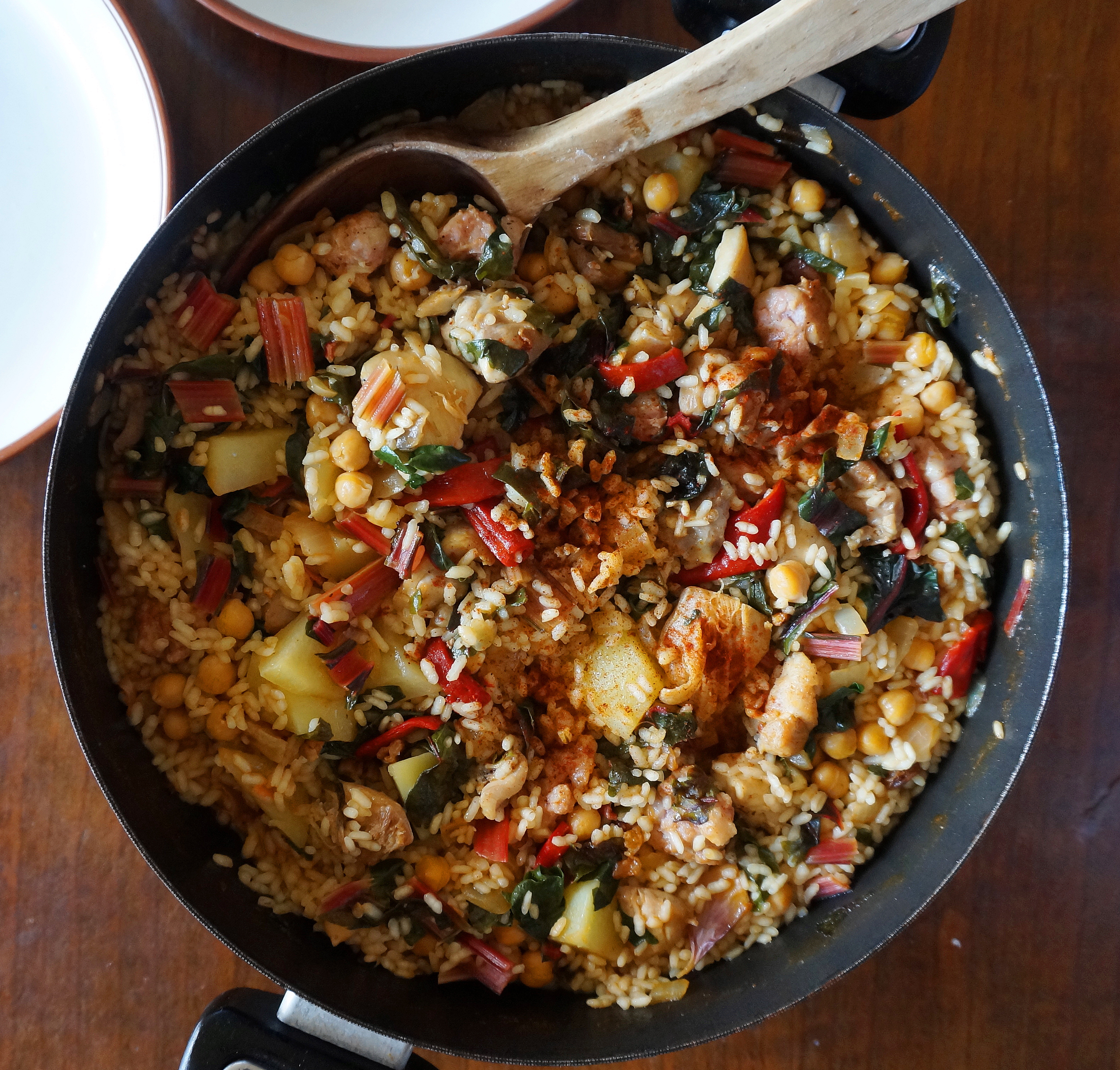
I decided on a rice recipe from València for arroz con acelgas. But, instead of the snails called for in the recipe, I added some chicken and sausage. For a vegetarian version, just skip the meat. The red chard stems faded but some bits of (canned) piquillo peppers gave the rice some pop. 

This rice is meloso, or juicy, not “dry” like paella. But it shouldn’t get “creamy” like risotto, so don’t stir the rice because stirring releases the starch. Use a medium-short grain variety of rice, the same as for paella. Bomba is one of the best because it won’t get gummy.

Rice with red chard, chicken, sausage, and chickpeas. The chard stems have faded to pink, but piquillo peppers give a pop of bright red.


Rice with Chard and Chickpeas
Arroz con Acelgas y Garbanzos


¼ cup olive oil
12 ounces boneless chicken thighs, cut in pieces (optional)
4 ounces pork sausage, sliced (optional)
½ cup chopped onion
3 cloves garlic
1 bunch chard, stems and leaves (6-8 ounces)
1 teaspoon pimentón de la Vera (smoked paprika)
½ cup grated tomato pulp
4 ½ cups water or stock
2 teaspoons salt
Freshly ground black pepper
1 ½ cups medium-short grain rice
1 medium potato, cut in small pieces
1 tablespoon seedless raisins (optional)
1 cup cooked chickpeas
2 piquillo peppers, cut in strips
½ cup boiling water

Heat the oil in a cazuela or deep sauté pan. Brown the pieces of chicken and sausage. Skim them out and reserve. Add the onion to the oil in the pan. Lightly crush the garlics and add them whole to the pan.

Mix in rice and chard, then do not stir the rice again!
Separate chard stems from the leaves. Chop the stems and add to the pan. Sauté until the onion is softened. 

Stir in the pimentón. Add the tomato pulp. Return the chicken and sausage to the pan. Add the water or stock and bring to a boil. Season with salt and pepper. Stir in the rice. Add the potato, raisins, if using, and chickpeas. Roll and cut the chard leaves and add them to the pan. 

Stir briefly to combine the ingredients, but don’t stir the rice any more. Cook on medium-high heat 10 minutes.

Add the strips of pepper. Reduce the heat to medium-low and cook 5 minutes, shaking the pan occasionally. Do not stir the rice. Pour the boiling water over the rice, give the pan a shake and cook on low 3 minutes. Rice and potatoes should be cooked. Remove the pan from the heat, cover with foil and allow to rest 5 minutes.

Serve the rice from the cazuela. 


More recipes with chard:


Saturday, October 31, 2020

WELCOME TO WINTER VEGETABLES


Inspiration! Leafy chard heralds winter vegetables.

The chard, kale and broccoli in my huerta (vegetable garden) won’t be ready until, at least, the winter solstice. But the markets already are heaped with autumn-to-winter produce. It was this bunch of leafy chard that inspired me to cook up a menestra, a vegetable medley featuring winter vegetables.

Menestra comes from the same Latin root (ministrare, “to dish up”) as Italian minestra and minestrone. In Spain, it’s not a soup but a vegetable mélange, incorporating both fresh seasonal vegetables and vegetables en conserva, canned ones. 

In home-style meals, menestra is typically served as a starter, instead of soup, to be followed by a main course of meat, or else as a main dish for a lighter lunch or supper. Restaurants dish up a simplified menestra as a side dish (find it in the frozen foods section). 

The menestra I learned to make in Andalusia, with fava beans and peas, usually has tomatoes—fresh ones or canned tomate frito. But the menestra of Navarra, La Rioja and Euskadi (Basque Country) does not. Sometimes, though, it has enough pimentón, paprika, to give it a reddish color.

Chard, carrots, beans, potatoes cooked in a savory sauce are topped with a refrito of garlic and ham. 


Chard stems and leaves are like two different vegetables in one.


Serve menestra as a starter or light main dish.


Garnish the dish with cooked egg or add a poached egg per person for a more substantial dish.


Serving options: press the menestra into a circular mold. I added cauliflower to the mélange on the second day.

While this is a very old and traditional dish, it has plenty of “modern” interpretations. Traditionally, the vegetables are very well cooked. Overcooked, we might say today. And finished in a flour-thickened sauce. Newer versions call for cooking the veggies al dente or even grilling them, then combining in a sauce made with pureed vegetables. Sometimes the chard greens are chopped, rolled into balls, dipped in flour and beaten egg and fried. Served with the menestra, they give textural contrast. Dress up the humble menestra with lashings of ibérico ham on top and alongside. Turn menestra into a vegetarian main by using vegetable stock, omitting the ham and serving with egg. 

Use chicken stock or the vegetable cooking water to finish cooking the vegetables. A pinch of baking soda to cook the chard stems keeps them nice and green. However, the cooking liquid tends to darken if it sets. 

Other vegetables to use in the menestra are borage (borraja), cardoons (cardo), broccoli, Brussels sprouts, mushrooms or canned vegetables such as artichokes. (See the link below for a recipe for springtime menestra with fresh artichokes, asparagus, peas and fava beans.) 

I’m making a traditional menestra—a very comforting dish for winter. 

Medley of Winter Vegetables 
Menestra de Verduras de Invierno


Serves 6 as a starter or side; 4 as a main dish.

1 ½-pound bunch of chard
Pinch of baking soda
3 carrots (10 ounces)
1-2 potatoes (10 ounces)
6-8 ounces romano (flat) green beans
8 ounces cauliflower florets
Salt
7 tablespoons olive oil
1leek, sliced 
½ cup chopped onions
2 tablespoons flour
2 cups stock or vegetable water
3-4 cloves garlic, sliced thinly
1 ounce diced serrano ham
Eggs, hard-boiled or poached (optional)

Separate the stems and leaves of the chard. Strip away fibrous threads from the stems and cut them into 2-inch lengths. Bring a pan of salted water to a boil. Add a pinch of baking soda and the chard stems. Cook them until tender when pierced with a knife, about 8 minutes. Skim the chard out with a slotted spoon and rinse in cold water to stop the cooking.

Roll and slice chard leaves into ribbons.
Slice the chard greens into ribbons. Add them to the pan of boiling water and cook until they are very tender, 10 minutes. Drain the chard leaves in a colander, pressing out excess liquid.

Bring another pan of salted water to a boil. Cook the carrots until tender, 10 minutes. Remove them and rinse in cold water. Cook the potatoes until tender, 10 minutes, and drain them. Cook the green beans to desired doneness, 4 minutes for crisp-tender, 12 minutes for very well cooked. Drain well. (If desired, keep the cooking water to finish cooking the vegetables in their sauce.)

Bring a fresh pot of water to a boil and add the cauliflower. Cook until crisp-tender, 4 minutes, and drain. Refresh in cold water.

Cook each vegetable separately before combining in the sauce. In the center are chard stems. Clockwise from the top are chard leaves, sliced leeks, green beans, sliced garlic, carrots, potatoes and diced serrano ham.

In a cazuela or deep skillet, heat 3 tablespoons of the oil. Sauté the leeks and onions until they are very soft, 10 minutes. Moderate the heat so the onions don’t brown. 

Add the cooked carrots, potatoes and cauliflower to the pan with 1 tablespoon more oil. Sauté these vegetables 4 minutes. Move them to the outer edge of the pan and add the flour. Drizzle the flour with 1 tablespoon oil and stir to mix it in. Then stir the flour into the vegetables.

Use stock or vegetable cooking water for sauce.

Add the stock or vegetable water. Cook, stirring, until the sauce thickens. Cook it gently 5 minutes. Add the beans, chard stems and chard leaves. Combine well and cook gently until all the vegetables are thoroughly heated.

Heat remaining 2 tablespoons of oil in a small skillet. Add the sliced garlic and fry it until it just begins to brown. Remove the pan from the heat and add the diced ham.

Retrito of garlic and ham.


    Serve the vegetables and sauce on a platter or in a bowl and spoon the garlic, ham and oil on top. Add quartered cooked eggs or poached eggs, if desired.


More menestra:

More recipes with chard:

Saturday, January 20, 2018

A SHRIMP BY ANY OTHER NAME--

Rather than sheepishly apologize for cooking with frozen, imported shrimp (oh, gosh, the pre-Christmas oferta was too good to pass up), I’m using my crustacean stash to make  a dish that’s traditional, but not very common—garbanzos con langostinos—chickpeas with shrimp.


Made with shrimp, this potaje with chickpeas is not as heavy as with pork and sausage. Squash and chard are optional vegetables.

This is a typical potaje, much like the cold-weather soup-stews with legumes and laden with pork and sausages. With shrimp in place of meat, this potaje is suitable for Lenten meals (Lent begins February 14). In ports where fresh shrimp once was plentiful and cheap, it used to be a common dish made by fishermen’s families to use up the catch that didn’t sell.

I do buy fresh, wild, local shrimp (gambas) for making sizzled shrimp al ajillo, for adding to paella, for my favorite creole gumbo. Rarely do I buy Spanish langostinos (big shrimp) because they are so expensive. The most famous are those of Sanlucar de Barrameda (Cádiz), where the Guadalquivir River flows into the Atlantic, and Vinaròs (Castellón), near the delta of the River Ebro where it flows into the Mediterranean.

Langostinos in the market at Sanlucar de Barrameda (Cádiz). These are exquisite cooked a la plancha, on a hot griddle.

Part of my cache of frozen langostinos, these imported from fish farms in Venezuela. I couldn't resist the price---

I call them “shrimp;” but maybe you say “prawn.” The restaurant menu calls them “scampi.”  When is it a gamba and when is it a langostino? Does it matter?

The Brits tend to call any of the species (which belongs to the decapoda, or 10-legged family) “prawns.” Americans call them “shrimp. But sometimes the English call tiny ones “shrimp,” and, on the Pacific coast of the US, Americans have taken to calling one variety of shrimp, “prawn.”

In Spanish, gamba refers to the smallish common pink or white shrimp. Langostinos (which are not the same thing that the French call “langoustine”) are big prawns or jumbo shrimp, measuring up to 8 inches (22 cm). Stripy ones are “tiger shrimp.” 


True scampi are not shrimp. (Cigala in Spanish.)
Scampi is the plural of scampo, which in Italian refers to a Dublin Bay prawn, which is not a prawn or a shrimp. It’s also called “Norway lobster,” “sea crayfish,” “cigala” in Spanish, “langoustine” in French. It looks like a miniature lobster with pink-tipped claws. When you find scampi on a restaurant menu, it usually refers to a dish made with big shrimp, not real scampi.

Use any shrimp, prawn or scampi in this recipe.

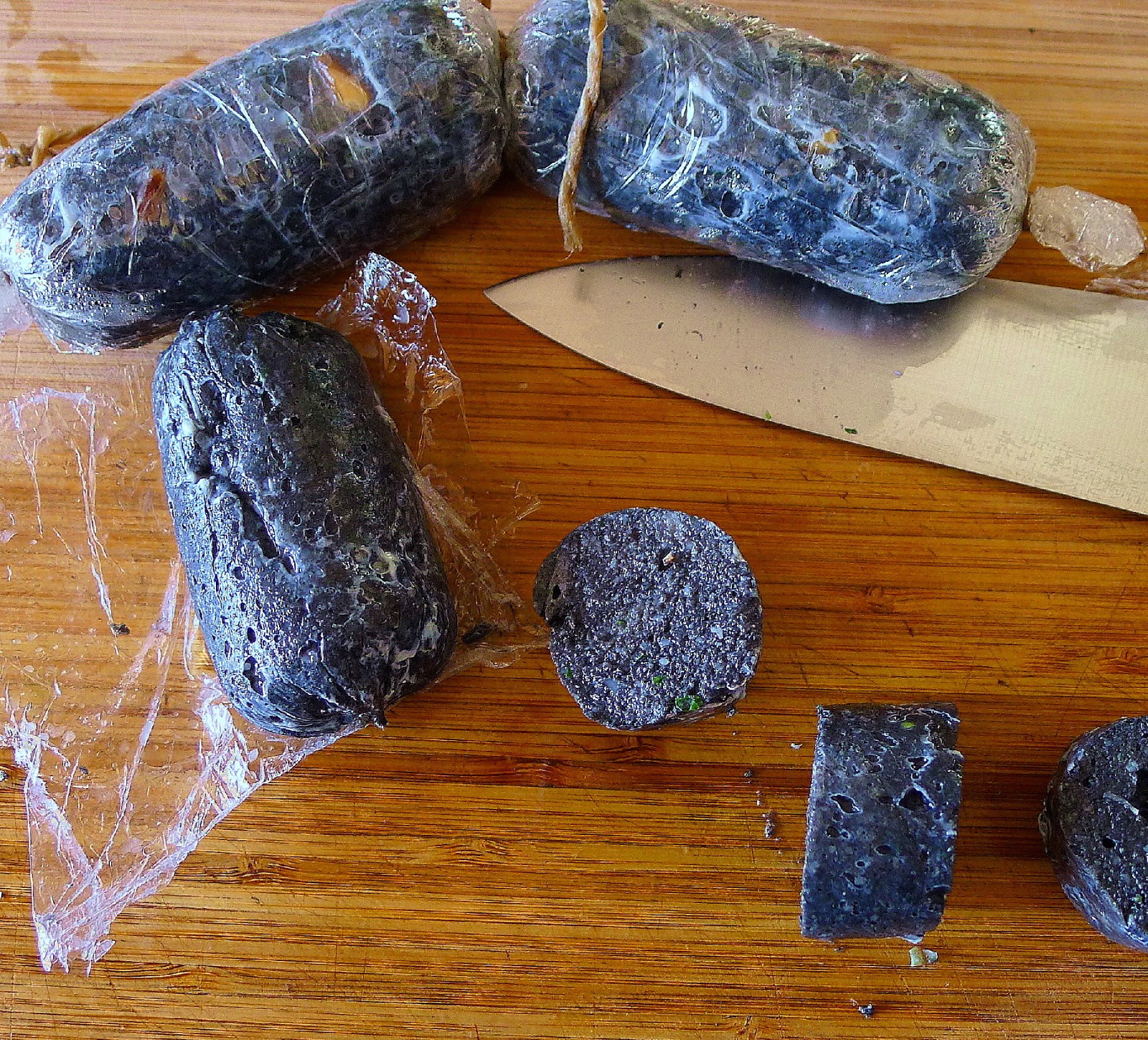
This potaje with shrimp reminds me so much of one of my favorites, berza, a sturdy  Andalusian stew with chickpeas, vegetables, pork, chorizo and blood sausage. So, on a whim, I decided to make a black seafood sausage to add to the shrimp. I used frozen cuttlefish ink to make the white fish sausage look like black blood sausage.

A traditional dish of chickpeas and shrimp, with the addition of non-traditional black seafood sausage.

Chickpeas with Shrimp
Garbanzos con Langostinos

Put the chickpeas to soak a day before cooking the stew. If your tap water is hard, add a pinch of baking soda to the soaking water or use low-mineral bottled water. (Hard water prevents chickpeas from cooking up soft.)

Heads and shells for flavor.

A simple stock made with shrimp heads and shells gives the chickpea stew a lot of flavor. Notice the coral roe in the heads--huge flavor. The shrimp stock can be made in advance. Refrigerate the peeled shrimp until ready to use. If using peeled shrimp instead of whole ones, either allow an extra ¼ pound to make stock or else substitute prepared fish stock or clam broth.

Serves 4.


2 cups dry chickpeas
Warm water
1 pound whole shrimp (with heads)
3 tablespoons olive oil
1 ½ cups chopped onion
1/3 cup white wine or dry Sherry
8 cups water
3 cups hot water
1 bay leaf
Salt
3 cloves garlic
2 teaspoons pimentón (paprika, not smoked)
¾ cup grated tomato pulp or crushed tomatoes
1 cup diced butternut squash (optional)
1 cup (or more) chopped chard (optional)
Black seafood sausage, optional
¼ cup chopped parsley
½ teaspoon grated lemon zest
1 tablespoon toasted pine nuts


Soak the chickpeas in warm water to cover for at least 8 hours.

Peel the shrimp. Refrigerate the bodies until ready to cook them. Use the heads and shells to make shrimp stock.

Heat 1 tablespoon oil in a soup pot. Add the shrimp shells and heads and ½ cup of the chopped onion. Sauté on medium-high heat until the shells turn pink. Add the bay leaf and wine. When alcohol is cooked off, add 6 cups of water. Bring to a boil, then reduce heat and cook 30 minutes. Don’t add salt to the stock.

Strain the stock, pressing on the solids to extract flavor. Discard shells.

Drain the soaked chickpeas. Put them in a soup pot or cazuela with the 3 cups of hot water. Bring to a boil, Skim off any froth that rises to the top. Cook the chickpeas 15 minutes.

Add 4 cups of the strained shrimp stock to the chickpeas. Bring again to a boil and cook, covered, 30 minutes.

Meanwhile, prepare a sofrito. In a skillet with remaining 2 tablespoons of oil, sauté the remaining 1 cup of chopped onion with 2 cloves of chopped garlic for 5 minutes. Don’t let the onions brown. Stir in the pimentón and immediately add the tomato pulp. Fry on medium-high until tomatoes lose their juice.

Puré the sofrito in a blender with ½ cup liquid from the chickpeas. (Add some of the chickpeas too to slightly thicken the stew.) Stir the purée mixture into the soup pot with the chickpeas. Add 1 teaspoon salt. Cook until the chickpeas are nearly tender, about 45 minutes more.

Add the squash and chard, if using. Taste again for salt. Cook just until chickpeas and vegetables are tender.

Add the shrimp to the chickpeas and cook until they turn pink and begin to curl, about 5 minutes. Add sliced seafood sausage, if using.

Chop the remaining 1 clove of garlic finely. Combine it with the parsley, lemon zest and pine nuts. Either stir this mixture into the chickpeas immediately  before serving or sprinkle it on top of individual servings.

Add chopped parsley, garlic and pine nuts to the finished dish.

Add caption

Black Seafood Sausage
“Morcilla” de Pescado

Black fish sausage resembles blood sausage used in other potajes with meat.

Little packets of frozen squid or cuttlefish ink can be purchased from some fish sellers and in frozen foods sections of specialty markets. 

Use any white fish for this sausage--cod, hake, whiting, sole. I used corvina.

Use a food processor to make the sausage mix. Chill the bowl and blade before starting. The sausages are then rolled in plastic wrap instead of sausage casings.

The black fish paste can be prepared in advance and refrigerated. Then roll the sausages and poach them immediately. Let them cool slightly before unwrapping and slicing. Reheat the sausages in the stew or in a skillet with a little oil.

Makes 6 (3-inch) sausages.

10 ounces white fish fillets
2 egg whites
1 tablespoon chopped scallions
1 tablespoon fine, dry breadcrumbs
1 tablespoon chopped parsley
1/8 teaspoon allspice
1/8 teaspoon smoked pimentón (paprika)
1 teaspoon salt
½ cup chilled cream
2 (4-gram) sachets frozen squid or cuttlefish  ink


Cut the fish into pieces and place in a food processor with the egg whites. Process until fairly smooth. Add the scallions, breadcrumbs, parsley, allspice, pimentón and salt. Process again. Add the cream and process to make a smooth paste. Squeeze the contents of the sachets of squid ink into the paste and process until combined.

Cover the fish paste and refrigerate at least two hours.

Log of black fish paste on plastic wrap.

Lay a 12-inch piece of plastic wrap on a work surface. Spoon 1/3 of the fish paste across one end. With wet hands, quickly mold it into a compact log about 1 ¼ inch in diameter. Roll the log up in the plastic wrap. Twist the ends and tie them with kitchen twine. Tie the roll again in the middle, making two sausages. Repeat with remaining fish paste. 


Rolled in plastic wrap, these fish sausages are ready to be poached.

 
Poach the sausages in simmering water (180ºF) until they are firm, 12 minutes. Remove the sausages with a slotted spoon and allow them to cool slightly before unwrapping them from the plastic and slicing.

Unwrap the sausage links and slice.


More recipes for potaje soup-stews with legumes:


More recipes with shrimp:

Saturday, April 29, 2017

ROAST LAMB, A SMALL FEAST


Buying a leg of lamb, on a whim, I asked the butcher to bone it for me. He removed the long leg bone without opening out the meat, leaving a pocket for stuffing. Now, what to stuff it with?


I recalled many years ago hosting a mechoui party. Mechoui is the Moroccan roast lamb. I bought a whole lamb and my friend, Dominique, who grew up in Morocco, was in charge of roasting it.

We stuffed the lamb’s cavity with a mixture of cous cous and parsley, maybe some chopped onions. I don’t remember exactly. Once sewed up, the animal was trussed, brushed with olive oil and positioned on a stout stick over smouldering coals. This was an August afternoon. Dominique and his pinche, Mark, turned the lamb for hours, basting it occasionally with salt water to keep the skin crisp. Dripping with sweat, Dominique stripped to his skivvies and turned the garden hose on over his head.

The meat was succulent and deliciously wood-smoke flavored. I served an array of Moroccan and Middle Eastern salads and vegetable dishes to accompany the lamb. What a feast.

Dominique is French photographer Jean Dominique Dallet (http://www.jddallet.com/) He grew up in Fes (Morocco), studied and worked in France and Denmark, before setting up home base in southern Spain, where I got to know him. Dominique clocks around 100,000 miles a year, traveling in search of new images, on assignment for magazines and books worldwide. I rode shotgun on several of Dominique’s forays through La Mancha, where we collaborated on magazine articles.

Traditional mechoui, whole lamb roasted in clay oven. (Photo by JDDallet)

Dominique tells me that traditionally mechoui was cooked (no stuffing) in a vertical clay oven, “until the meat is falling off the bones, so that you can eat it with your fingers, without a knife.” Men cook the mechoui, women serve it. Kebabs of liver wrapped in fat might precede the lamb, Salads are the only accompaniment to the roast lamb.

Today in Morocco, he says, a typical mechoui is sent to roast in the neighborhood  bread oven.

Whole roast lamb--mechoui--with accompanying salads. (Photo by JDDallet)

It was the memory of that mechoui party that inspired me to stuff the leg of lamb with cous cous. Here's my version, boned leg of lamb stuffed with cous cous, chard and pistachios.


Boned leg of lamb is stuffed with cous cous, chard and pistachios.


Roast lamb, a small feast.


Stuffing soaks up meat juices. You may need a spoon to serve it.


Roast Leg of Lamb Stuffed with Cous Cous
Cordero Asado Relleno con Couscous

My boned leg of lamb weighed about 2 ¾ pound. (In the US, lamb is marketed much larger, so a boned leg might weigh more than 4 pounds.)

The meat has a deep pocket where the bone was pulled out. Another way to bone the leg is to butterfly it, by cutting it open, removing the bones and cutting horizontally through the thick sections to create a slab of meat that is more or less of equal thickness. The stuffing is spread on the meat and rolled up. Either way, the meat must be tied to keep the stuffing in and give the roast shape.

Cous cous and chard stuffing.
For the stuffing:
½ cup cous cous
½ cup boiling water
2 teaspoons + 1 tablespoon olive oil
½ teaspoon salt
2 cups chopped chard or spinach (to make 1 cup cooked)
1 tablespoon olive oil
1/3 cup chopped onion
1 clove chopped garlic
¼ cup seeded raisins
¼ cup shelled pistachios
¼ cup chopped parsley or fresh cilantro
Freshly ground black pepper
1 teaspoon grated lemon zest

Press stuffing into pocket of lamb.

For the lamb:
2 ½ - 3 ½ pounds boned leg of lamb
2 cloves crushed garlic
1 teaspoon salt
½ teaspoon ground coriander
¼ teaspoon cumin
¼ teaspoon freshly ground black pepper
Olive oil

Place the cous cous in a heat-proof bowl. Pour over the boiling water. Add 2 teaspoons oil and salt. Cover and let steam until cous cous is tender, 10 minutes. Fluff the cous cous with a fork.

Cook the chard or spinach in a little water until it is tender. Drain, well.

Heat 1 tablespoon of oil in a skillet. Sauté the onions and garlic until softened, 8 minutes. Add the chard and sauté until moisture evaporates. Add the raisins, pistachios, parsley or cilantro, ½ teaspoon salt, pepper and lemon zest. Remove from heat and stir in 1 cup of the steamed cous cous.

For the lamb:

Combine crushed garlic, salt, coriander, cumin, black pepper and 1 tablespoon oil. Rub this mixture on the lamb, inside and out. 

Stuff the lamb pocket with the prepared cous cous and chard. (Or, if using butterflied leg of lamb, spread the stuffing on the meat and roll it up.) 

Turkey skewers and twine to close the pocket.
Use skewers and kitchen twine to close the pocket’s openings. Tie the meat so that it keeps its shape.

Preheat oven to 400ºF. Place the lamb in the oven and lower temperature to 350ºF. Roast the lamb, basting occasionally. Use additional olive oil for basting if the lamb does not have much fat. The lamb is done (medium-rare) when it reaches an internal temperature of 140ºF when tested with an instant-read thermometer. (My 2 ¾-pound roast needed only 50 minutes; a larger piece of meat will take longer.)


Roast vegetables with the lamb.

Allow meat to rest before slicing.

Remove lamb to a cutting board and allow it to rest for 20 minutes before cutting in thick slices. The stuffing will be loose and may need a spoon for serving.


Thanks to my friend Dominique Dallet for his photos of traditional Moroccan mechoui. See more of his work at http://www.jddallet.com/.


More lamb recipes: