Showing posts with label langostinos. Show all posts

Saturday, June 9, 2018

FRY SOME MORE!

Last week when I posted about Málaga mixed fish fry, I touted olive oil as the best medium for frying foods. Yep, forget the old wives’ tale about “low smoking point.” The truth is olive oil is remarkably stable at frying temperatures.


I also made the point that olive oil, unlike other vegetable oils, can be strained and safely reused.  The result is that I’ve got about six cups of once-used, slightly fish-flavored, olive oil to use up.

Laboratory studies have shown that foods fried in olive oil absorb less oil than those fried in other oils. That means the oil lasts longer and the food is less greasy. (The test used potatoes, weighed before and after frying in olive oil, sunflower oil and soy oil.)

Extra virgin olive when heated does lose some of the organoleptic qualities, such as fruitiness, for which it is so valued. For that reason, don’t use your most delicate and expensive oils for frying. They are best saved for using raw. Best for frying is a very stable Picual variety olive oil from Andalusia.

I’m using some of my leftover oil for pan-frying. And, not just for fish—potatoes, eggs, breaded chicken cutlets are all fine. But this is definitely a good excuse to fry some more! How about some gambas rebozadas, batter-fried shrimp?

Batter-fried shrimp are crunchy on the outside, moist on the inside.


Gambas rebozadas is a tapa I learned to make in local (Andalusian) tapa bars. The batter usually includes chopped parsley, saffron or yellow coloring and, often, minced garlic too. Cleverly, the shrimp are speared on toothpicks and dunked into the batter, picks and all.  

The Madrid version, called gambas en gabardinas, or shrimp in “raincoats,” is a little different. Instead of toothpicks, the tails are left on the peeled shrimp and no garlic or yellow coloring is added to the batter.

The simple egg-flour batter has a little baking powder or baking soda to make it puffier. The batter can be prepared in advance, but, if possible, dip and fry the shrimp immediately before serving. The shrimp are best served right after frying, as the coating loses its crispness as it cools. If necessary, reheat them in a skillet lightly coated with oil or in a medium oven.

While Málaga mixed fish fry is served with only lemon, the batter-fried shrimp are often served with a dipping sauce. Alioli, garlic mayonnaise, and salsa rosa, “pink” cocktail sauce, are the most usual, but plenty other sauces will complement the shrimp (see below for some suggestions).

Batter-fried shrimp are a favorite Spanish tapa.


Many dipping sauces for the shrimp. This is alioli, garlic mayonnaise with finely chopped parsley.

Batter-Fried Shrimp
Gambas Rebozadas

The same batter can be used for vegetables such as cooked cauliflower, mushrooms, artichoke hearts.

It is usual to devein shrimp before battering. The vein, a black thread that runs the length of the shrimp, is edible, but not pretty.

Serves 6 as a tapa.

1 ¼  pounds large shrimp (about 30 shrimp)
1 egg
½ teaspoon vinegar
½ tablespoon finely chopped parsley
Pinch of saffron threads, crushed
Minced garlic (opitional)
½ teaspoon salt
½ teaspoon baking powder
½ cup flour
1/3 cup water
Olive oil for frying
Dipping sauce, to serve

Shrimp on the left have been peeled and stuck on toothpicks. The ones on the right have tails intact. Either picks or tails are useful for picking up the shrimp.
Remove vein with knife tip.

Peel and devein the shrimp, leaving tails intact, if desired. Or, peel the tails and spear the shrimp on toothpicks.

Beat the egg in a bowl. Stir in the vinegar, parsley, saffron, garlic, if using, salt and baking powder. Stir in the flour. Add the water and mix to make a smooth batter. The batter should be the consistency of heavy cream so that it coats the shrimp. Add additional water if necessary. Let the batter stand 1 hour.

Place oil to a depth of 1 inch in a skillet and heat to 360ºF. At that temperature, a cube of bread should brown in 25 seconds.

Using tails or picks to pick up the shrimp. Dip them in batter and fry until golden on one side. Use tongs to carefully turn the shrimp to brown on reverse side. They need only 2-4 minutes.

Fry shrimp until golden, turning them once.

Drain shrimp on paper towels to absorb excess oil.

Skim out the shrimp and place on paper towels to drain briefly. Serve hot accompanied by dipping sauce.


Use the same batter to coat vegetables. These are quartered (raw) mushrooms dropped into the batter and added to the hot oil by spoonfuls.

Sauces to accompany batter-fried shrimp:

And, another recipe for batter-fried seafood:

Saturday, January 20, 2018

A SHRIMP BY ANY OTHER NAME--

Rather than sheepishly apologize for cooking with frozen, imported shrimp (oh, gosh, the pre-Christmas oferta was too good to pass up), I’m using my crustacean stash to make  a dish that’s traditional, but not very common—garbanzos con langostinos—chickpeas with shrimp.


Made with shrimp, this potaje with chickpeas is not as heavy as with pork and sausage. Squash and chard are optional vegetables.

This is a typical potaje, much like the cold-weather soup-stews with legumes and laden with pork and sausages. With shrimp in place of meat, this potaje is suitable for Lenten meals (Lent begins February 14). In ports where fresh shrimp once was plentiful and cheap, it used to be a common dish made by fishermen’s families to use up the catch that didn’t sell.

I do buy fresh, wild, local shrimp (gambas) for making sizzled shrimp al ajillo, for adding to paella, for my favorite creole gumbo. Rarely do I buy Spanish langostinos (big shrimp) because they are so expensive. The most famous are those of Sanlucar de Barrameda (Cádiz), where the Guadalquivir River flows into the Atlantic, and Vinaròs (Castellón), near the delta of the River Ebro where it flows into the Mediterranean.

Langostinos in the market at Sanlucar de Barrameda (Cádiz). These are exquisite cooked a la plancha, on a hot griddle.

Part of my cache of frozen langostinos, these imported from fish farms in Venezuela. I couldn't resist the price---

I call them “shrimp;” but maybe you say “prawn.” The restaurant menu calls them “scampi.”  When is it a gamba and when is it a langostino? Does it matter?

The Brits tend to call any of the species (which belongs to the decapoda, or 10-legged family) “prawns.” Americans call them “shrimp. But sometimes the English call tiny ones “shrimp,” and, on the Pacific coast of the US, Americans have taken to calling one variety of shrimp, “prawn.”

In Spanish, gamba refers to the smallish common pink or white shrimp. Langostinos (which are not the same thing that the French call “langoustine”) are big prawns or jumbo shrimp, measuring up to 8 inches (22 cm). Stripy ones are “tiger shrimp.” 


True scampi are not shrimp. (Cigala in Spanish.)
Scampi is the plural of scampo, which in Italian refers to a Dublin Bay prawn, which is not a prawn or a shrimp. It’s also called “Norway lobster,” “sea crayfish,” “cigala” in Spanish, “langoustine” in French. It looks like a miniature lobster with pink-tipped claws. When you find scampi on a restaurant menu, it usually refers to a dish made with big shrimp, not real scampi.

Use any shrimp, prawn or scampi in this recipe.

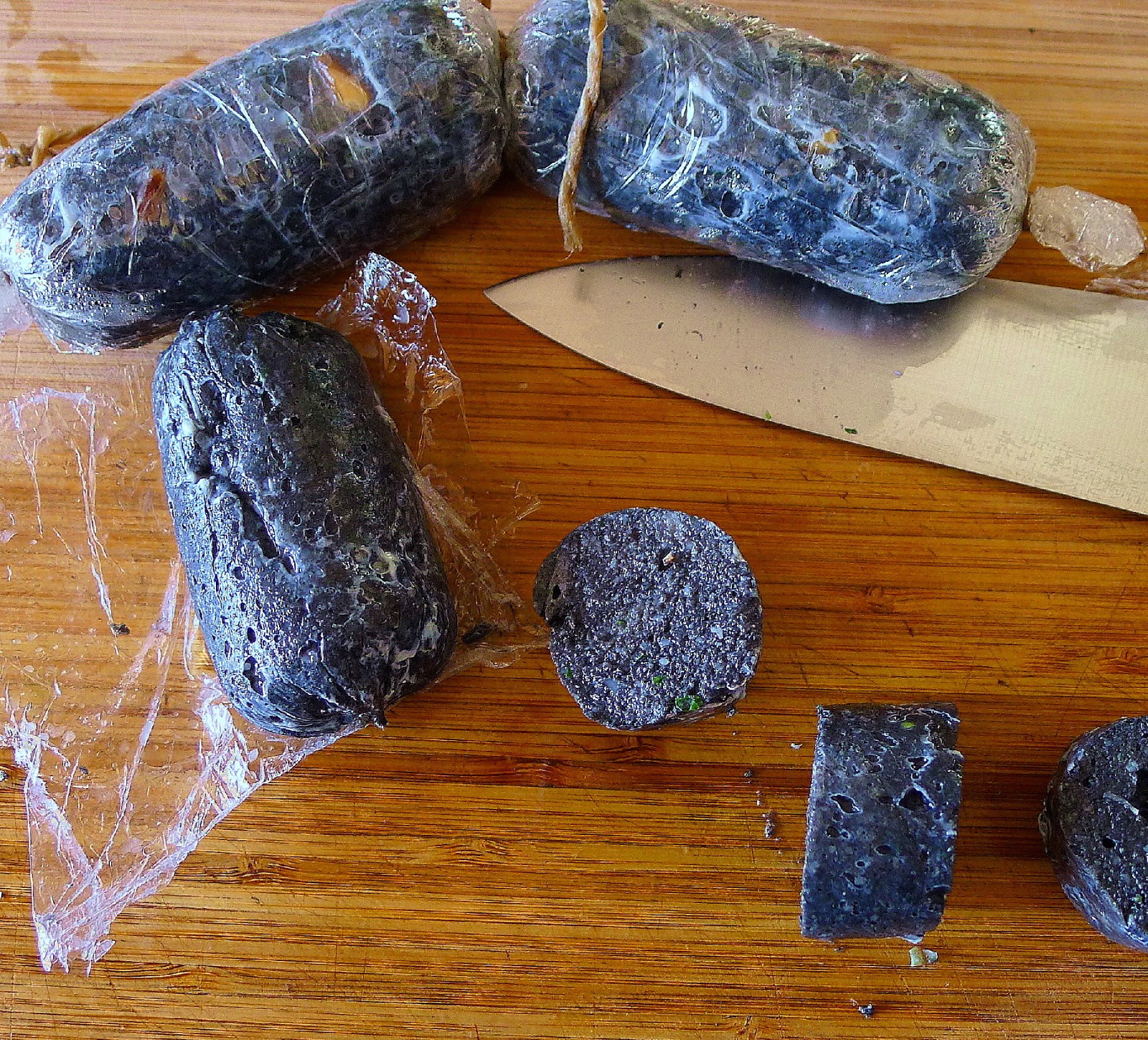
This potaje with shrimp reminds me so much of one of my favorites, berza, a sturdy  Andalusian stew with chickpeas, vegetables, pork, chorizo and blood sausage. So, on a whim, I decided to make a black seafood sausage to add to the shrimp. I used frozen cuttlefish ink to make the white fish sausage look like black blood sausage.

A traditional dish of chickpeas and shrimp, with the addition of non-traditional black seafood sausage.

Chickpeas with Shrimp
Garbanzos con Langostinos

Put the chickpeas to soak a day before cooking the stew. If your tap water is hard, add a pinch of baking soda to the soaking water or use low-mineral bottled water. (Hard water prevents chickpeas from cooking up soft.)

Heads and shells for flavor.

A simple stock made with shrimp heads and shells gives the chickpea stew a lot of flavor. Notice the coral roe in the heads--huge flavor. The shrimp stock can be made in advance. Refrigerate the peeled shrimp until ready to use. If using peeled shrimp instead of whole ones, either allow an extra ¼ pound to make stock or else substitute prepared fish stock or clam broth.

Serves 4.


2 cups dry chickpeas
Warm water
1 pound whole shrimp (with heads)
3 tablespoons olive oil
1 ½ cups chopped onion
1/3 cup white wine or dry Sherry
8 cups water
3 cups hot water
1 bay leaf
Salt
3 cloves garlic
2 teaspoons pimentón (paprika, not smoked)
¾ cup grated tomato pulp or crushed tomatoes
1 cup diced butternut squash (optional)
1 cup (or more) chopped chard (optional)
Black seafood sausage, optional
¼ cup chopped parsley
½ teaspoon grated lemon zest
1 tablespoon toasted pine nuts


Soak the chickpeas in warm water to cover for at least 8 hours.

Peel the shrimp. Refrigerate the bodies until ready to cook them. Use the heads and shells to make shrimp stock.

Heat 1 tablespoon oil in a soup pot. Add the shrimp shells and heads and ½ cup of the chopped onion. Sauté on medium-high heat until the shells turn pink. Add the bay leaf and wine. When alcohol is cooked off, add 6 cups of water. Bring to a boil, then reduce heat and cook 30 minutes. Don’t add salt to the stock.

Strain the stock, pressing on the solids to extract flavor. Discard shells.

Drain the soaked chickpeas. Put them in a soup pot or cazuela with the 3 cups of hot water. Bring to a boil, Skim off any froth that rises to the top. Cook the chickpeas 15 minutes.

Add 4 cups of the strained shrimp stock to the chickpeas. Bring again to a boil and cook, covered, 30 minutes.

Meanwhile, prepare a sofrito. In a skillet with remaining 2 tablespoons of oil, sauté the remaining 1 cup of chopped onion with 2 cloves of chopped garlic for 5 minutes. Don’t let the onions brown. Stir in the pimentón and immediately add the tomato pulp. Fry on medium-high until tomatoes lose their juice.

Puré the sofrito in a blender with ½ cup liquid from the chickpeas. (Add some of the chickpeas too to slightly thicken the stew.) Stir the purée mixture into the soup pot with the chickpeas. Add 1 teaspoon salt. Cook until the chickpeas are nearly tender, about 45 minutes more.

Add the squash and chard, if using. Taste again for salt. Cook just until chickpeas and vegetables are tender.

Add the shrimp to the chickpeas and cook until they turn pink and begin to curl, about 5 minutes. Add sliced seafood sausage, if using.

Chop the remaining 1 clove of garlic finely. Combine it with the parsley, lemon zest and pine nuts. Either stir this mixture into the chickpeas immediately  before serving or sprinkle it on top of individual servings.

Add chopped parsley, garlic and pine nuts to the finished dish.

Add caption

Black Seafood Sausage
“Morcilla” de Pescado

Black fish sausage resembles blood sausage used in other potajes with meat.

Little packets of frozen squid or cuttlefish ink can be purchased from some fish sellers and in frozen foods sections of specialty markets. 

Use any white fish for this sausage--cod, hake, whiting, sole. I used corvina.

Use a food processor to make the sausage mix. Chill the bowl and blade before starting. The sausages are then rolled in plastic wrap instead of sausage casings.

The black fish paste can be prepared in advance and refrigerated. Then roll the sausages and poach them immediately. Let them cool slightly before unwrapping and slicing. Reheat the sausages in the stew or in a skillet with a little oil.

Makes 6 (3-inch) sausages.

10 ounces white fish fillets
2 egg whites
1 tablespoon chopped scallions
1 tablespoon fine, dry breadcrumbs
1 tablespoon chopped parsley
1/8 teaspoon allspice
1/8 teaspoon smoked pimentón (paprika)
1 teaspoon salt
½ cup chilled cream
2 (4-gram) sachets frozen squid or cuttlefish  ink


Cut the fish into pieces and place in a food processor with the egg whites. Process until fairly smooth. Add the scallions, breadcrumbs, parsley, allspice, pimentón and salt. Process again. Add the cream and process to make a smooth paste. Squeeze the contents of the sachets of squid ink into the paste and process until combined.

Cover the fish paste and refrigerate at least two hours.

Log of black fish paste on plastic wrap.

Lay a 12-inch piece of plastic wrap on a work surface. Spoon 1/3 of the fish paste across one end. With wet hands, quickly mold it into a compact log about 1 ¼ inch in diameter. Roll the log up in the plastic wrap. Twist the ends and tie them with kitchen twine. Tie the roll again in the middle, making two sausages. Repeat with remaining fish paste. 


Rolled in plastic wrap, these fish sausages are ready to be poached.

 
Poach the sausages in simmering water (180ºF) until they are firm, 12 minutes. Remove the sausages with a slotted spoon and allow them to cool slightly before unwrapping them from the plastic and slicing.

Unwrap the sausage links and slice.


More recipes for potaje soup-stews with legumes:


More recipes with shrimp:

Saturday, May 18, 2013

THESE SHRIMP ARE SIZZLING!


Shrimp and garlic sizzle in oil.
First you catch a tantalizing whiff of garlic. Then, as the cazuelita is set before you, you feel the heat radiating from the little dish. The lid is lifted and the oil spits and splutters. Small pink shrimp, golden slices of garlic and deep red flecks of chili dance in the oil. Now a taste—don’t burn your tongue!

Gambas al ajillo—shrimp sizzled with garlic— this is the essence of the tapa bar sensory experience.

In bars in Andalusia, this tapa is known as gambas al pil pil, for the onomatopoeia of spitting oil. But Madrileños look askance at such nomenclature, seeing as how “pil pil” in Basque cuisine is something quite different (an emulsified sauce for salt cod, with olive oil and garlic).


In tapa bars, the dish is prepared to order in small, individual cazuelitas, earthenware ramekins. You can do this in a home kitchen by placing the individual ramekins directly over gas burners. If using earthenware, remember that it retains heat, so remove the shrimp from the stove before they are fully cooked.

If you have an electric stove, you will need to use a heat diffuser under clay cazuelas or else use a metal pan instead of clay. If you don’t want to bother with individual servings, cook all the shrimp in a skillet, then plate them. While  they won’t have quite the same sizzle, they will still taste divine!

This dish packs a lot of flavor for just four ingredients—shrimp, olive oil, garlic and a few flecks of hot chili. The juices from the shrimp flavor the oil, creating a sauce for dipping chunks of bread.  It’s best made with whole fresh shrimp, peeled shortly before cooking. However, not everyone can get them fresh, so frozen is an alternative.


Unpeeled shrimp (langostinos)
Incidentally, you and I say “shrimp,” no matter what the size of the crustacean (unless you’re a Brit, in which case you call it “prawn”), but Spaniards have names for every variety. So, in fact, the ones pictured here are not “gambas,” but “langostinos.” That's because the gambas at the market today were very small indeed.

Why are gambas al ajillo usually depicted as jumbo shrimp with their tails intact? Maybe food stylists think they’re prettier with unpeeled tails aloft. In fact, this dish is usually made with small to medium shrimp and always with the whole shrimp peeled, tails as well. No way are you going to use your fingers to pick them out of the boiling oil. They’re meant to be speared with a fork or toothpick and eaten in one bite, with bread for sopping up the juices.

Variations on a theme: Add a splash of manzanilla Sherry to the shrimp. Or, add chopped serrano ham or chopped chorizo along with the sliced garlic.


Shrimp sizzled with chorizo, plated.

Gambas al Ajillo
Shrimp Sizzled with Garlic


Serves 4.

40 medium-size raw, peeled shrimp, about 8 ounces
8 tablespoons olive oil
4 cloves garlic, sliced crosswise
4 slices dried chili pepper
2 tablespoons dry Sherry (optional)
Chopped parsley
Pinch of coarse salt
Bread for serving


If making individual servings, place 2 tablespoons of oil in each of 4 cazuelitas or small pans. Divide the garlic, chili and shrimp between them.

Otherwise, place the oil in a skillet with the sliced garlic and chili. Heat until the garlic begins to turn golden. Add the shrimp in a single layer. Cook them, stirring, until they turn pink, 30 to 40 seconds. Add the Sherry, if using, and cook 1 minute.

Remove the pan from the heat. Sprinkle with parsley and salt. Spoon the shrimp, garlic and juices into 4 individual ramekins or plates. Serve with bread.