Showing posts with label ajo negro. Show all posts

Saturday, July 16, 2022

EXCITEMENT: BLACK GARLIC

 
Fresh garlic turns black, sticky and sweet in a slow fermentation process.

I get excited when I find something new at the grocery store. This time it was “black garlic.” Two whole heads of the garlic, nested in a plastic carton, cost about triple what ordinary garlic costs. The label said they were produced in Las Pedroñeras, a town in La Mancha, known as the garlic capital of Spain. 


Although black garlic has become trendy in Spanish gourmet cooking, it is not a Spanish invention. It probably was invented centuries ago in Asia. 

The whole head of garlic is submitted to a kind of fermentation process (Maillard reaction) with controlled temperature and humidity that turns the cloves of garlic black. The outer, papery skin turns a tan color and the individual cloves become black, soft and sticky and decidedly sweet. Yep, sweet, with a complexity that immediately made me think of chocolate. Or molasses. Although black garlic is virtually fat-free, it has an unctuous, buttery consistency. 

Black garlic has no garlicky smell, no bite, no garlic after-burps. According to what I read, black garlic has got all the health benefits of fresh garlic, with none of the unpleasant side effects such as bad breath. Chew one a day as a potent antioxidant. Better yet, experiment with black garlic to see what best to combine it with. Here are some ideas to get you started.


Squash a clove of black garlic on toast and spread it like butter. Top the toast with orange marmalade. Or anchovies. Or sausage. Cheese, perhaps?

Five slices of toasted baguette have each been spread with a clove of black garlic. They are topped with, from left, sliced hard-boiled egg and a dollop of black garlic yogurt sauce (recipe below) and a sprinkling of smoked pimentón; slices of black-pepper Mallorcan salchichón; sliced avocado and a ribbon of salsa (hot sauce); anchovy fillet with strips of piquillo peppers, and smoked salmon with cream cheese, capers and chives.


Mash several cloves of the black garlic and mix them with mayonnaise, vinaigrette, cream cheese or yogurt. Use the sauce on burgers, vegetables, pasta, potatoes, fish, or just about anything!

Black garlic and yogurt sauce plus a dribble of ketchup top a chicken burger. (Recipe below.) 

Mix crushed black garlic with butter or extra virgin olive oil. Smear it on corn-on-the-cob, baked potato or cooked green beans.

Better than butter! Whip black garlic with extra virgin olive oil and chill it until thickened.

Make a dramatic garnish for gazpacho and salmorejo.

Ajo blanco is a traditional Málaga cold soup, a white gazpacho. It's made with fresh garlic, olive oil, bread and ground almonds. This black and white version is garnished with dollops of black garlic as well as traditional grapes. (Recipe below.)


Add black garlic to chocolate.

Black garlic and chocolate have an affinity. These chocolate clusters incorporate raisins, peanuts and a piece of black garlic clove.

Black Garlic Yogurt Sauce
Aliño de Ajo Negro


Serve this sauce as a spread for hamburgers, a topping for baked potatoes or a finishing touch with vegetables such as green beans. Note that the resulting sauce, once garlic and yogurt are combined, is not black, but a tan color. 

For 1 serving:

2 cloves black garlic
1 tablespoon Greek yogurt
Salt
Pinch of cumin
Few drops of Tabasco or other hot sauce

Mash the garlic in a small bowl. Stir in the yogurt until smooth. Season the sauce with salt, cumin and Tabasco. 

Black Garlic “Butter”
Manteca de Ajo Negro

Why did I think that black garlic and olive oil would emulsify? They don’t. But, after blending, then chilling, the olive oil partially congeals and can be whipped with the garlic to make the perfect “butter” for slathering on corn-on-the-cob. The sweetness of the black garlic complements sweet corn. 

10 cloves black garlic
1 tablespoon water
3 tablespoons extra virgin olive oil
½ teaspoon flaky salt
½ teaspoon chopped parsley

In a blender or mini food processor, puree the garlic and water. Whirl in the olive oil. Season with salt and parsley. Chill the mixture, stirring occasionally, at least 2 hours and up to 24 hours. Immediately before serving, stir the garlic-oil again. Serve it cold.

Black and White Garlic Gazpacho
Ajo Blanco y Negro

Grapes are a traditional garnish for ajo blanco, a white gazpacho. This one has spoonfuls of black garlic as well.

White-garlic gazpacho, made with almonds, raw garlic, bread and olive oil, is a traditional cold soup in Málaga. The black garlic makes a contrasting garnish for the soup. I kept the ajo blanco thick, so that the garnishes don't sink to the bottom. 

Serves 4
For the black garlic garnish:
8 cloves of black garlic
1 teaspoon Sherry vinegar
2 teaspoons water
Salt

Mash the garlic in a small bowl. Stir in the vinegar and water. Season with salt to taste. 

For the white gazpacho:
2 slices (3 ounces) day-old bread, crusts removed
Water
2 cloves garlic
½ cup ground almonds (unsweetened)
¼ cup extra virgin olive oil
2 tablespoons Sherry vinegar
½ teaspoon salt
Grapes, to garnish

Break the bread into pieces and place it in a bowl. Cover with water and let the bread soak until softened. Squeeze out most of the water and place the bread in a blender with the garlic, almonds, oil and vinegar. Add enough water so that the blender works, about 1 cup. Season the gazpacho with salt. It can be thinned with additional water, if desired, but the black garlic garnish will sink if the gazpacho is too thin.

Chill the gazpacho. Serve the gazpacho in small bowls. Garnish each with some of the black garlic. Garnish with grapes.

Chocolate Clusters with Raisins, Peanuts and Black Garlic
Bocados de Chocolate con Pasas, Cacahuetes y Ajo Negro

These chocolate clusters with black garlic are yummy.

So perfectly does the black garlic blend with the chocolate, fruit and nuts that no one is likely to detect it unless you tell them! The candy clusters need to be kept refrigerated, as the chocolate softens quickly in a warm room.

Makes 12 (2-inch) clusters

4 ounces dark (74 percent) chocolate, chopped
Pinch of pimentón picante de la Vera (smoked, hot paprika)
12 pieces black garlic (half-garlic cloves)
2 ounces dark seedless raisins (1/3 cup), chopped if very large
2 ounces roasted, salted peanuts (1/3 cup), coarsely chopped

Line a baking sheet with parchment. Make room for it on a refrigerator shelf.

Place the chopped chocolate in a heatproof bowl over a pan of boiling water. Sprinkle the chocolate with pimentón. Heat until the chocolate is melted.

Drop chocolate onto garlic, chill.
Place the pieces of garlic, a few inches apart, on the baking sheet.

When chocolate is melted, remove the bowl from the pan. Stir in the raisins and peanuts. Scoop up chocolate, fruit and nuts with a teaspoon. Use another teaspoon to push the chocolate on top of each piece of black garlic. When all the chocolate clusters are shaped, place the baking sheet in the refrigerator until the chocolate solidifies, at least 1 hour.

Remove the clusters from the baking sheet. Store them, layers separated with parchment, in a covered container in the refrigerator.


Or, you could just eat the cloves of black garlic like bonbons.


Another recipe with black garlic: Cauliflower with Almond Sauce and Black Garlic.

Saturday, December 16, 2017

EL TOQUE FINAL (THE FINISHING TOUCH)

 
A festive dish: Partridge in escabeche with quinoa salad. And, guess what? The partridge comes out of a can! Garnishes make it special--"teardrop" red peppers, "pearls" of extra virgin olive oil, sliced hard-boiled quail eggs.

Here’s a novel idea for planning your holiday menus—start with the garnish, the finishing touch that makes a dish special. I shopped around, pulling jars, cans and packets off supermarket shelves, to select ingredients that would add a pop of color or punch up the flavor of simple foods.


Some of them were pricey, gourmet products; others were as basic as a handful of fresh parsley or a tin of smoked pimentón (paprika). All of them were produced in Spain. Back in my kitchen, I planned dishes to go with the garnishes.

Some of the ingredients I collected: orange-flavored salt flakes (Alicante), olive oil “pearls” (Jaén); sea urchin roe (Gijón, Asturias); black garlic (Las Pedroñeras, La Mancha); partridge in escabeche (Ciudad Real, La Mancha); “teardrop” red peppers (La Rioja); saffron with D.O. La Mancha; smoked picante pimentón with D.O. De la Vera (Extremadura); purple carrot jam (Cuevas Bajas, Málaga), and purple Empeltre olives (Aragón).

Here's the menu plan.

Aperitifs, for a drinks party or the anticipatory hour before dinner is served. Fino Sherry or Manzanilla is the perfect drink. Bubbly cava is good too.

Easy canapés--duck liver pâté, goat cheese and sea urchin roe with sour cream on crispy (packaged) toasts. A dab of purple carrot jam (mermelada de zanahoria morá) complements both the pâté and the cheese.  For garnish, try alfalfa sprouts, sliced radishes, black olives.

Sea urchin roe doesn't look like much, but packs a walloping big flavor. Place a small spoonful of the roe with sour cream and a sliver of lemon on toasts.  


Sweet jam made from purple carrots! The town where they grow even has a festival dedicated to the zanahoria morá. Look for other interesting jams: onion, tomato, eggplant. (They're pretty good on a peanut butter sandwich, too.)

Starters. Fish and shellfish are traditional for the Spanish Christmas Eve meal. Soups and bisques are perfect starters on wintry days, but salads are a light entrée to a main course.

A seasonal salad--two kinds of citrus fruit, kiwi and avocados--with langostinos, large shrimp. The finishing touches are tangy purple-black Empeltre olives and crunchy salt flakes infused with orange zest.


Fancy flavored salt is a great final touch. This one, from Alicante, is infused with orange zest. The crunchy flakes add textural interest to foods. Some imported salts are also visually thrilling--the black Hawaiian or Himalayan, for instance.


White asparagus bisque is gilded with wisps of saffron. Another last touch; a spoonful or two of fino Sherry to add depth of flavor to the soup.


True luxury, the best saffron has denominacion de origen Azafrán de La Mancha. (Most saffron sold in Spain comes from Iran.)

 Side dishes. An inspired garnish turns ordinary potatoes and vegetables into value-added dishes.

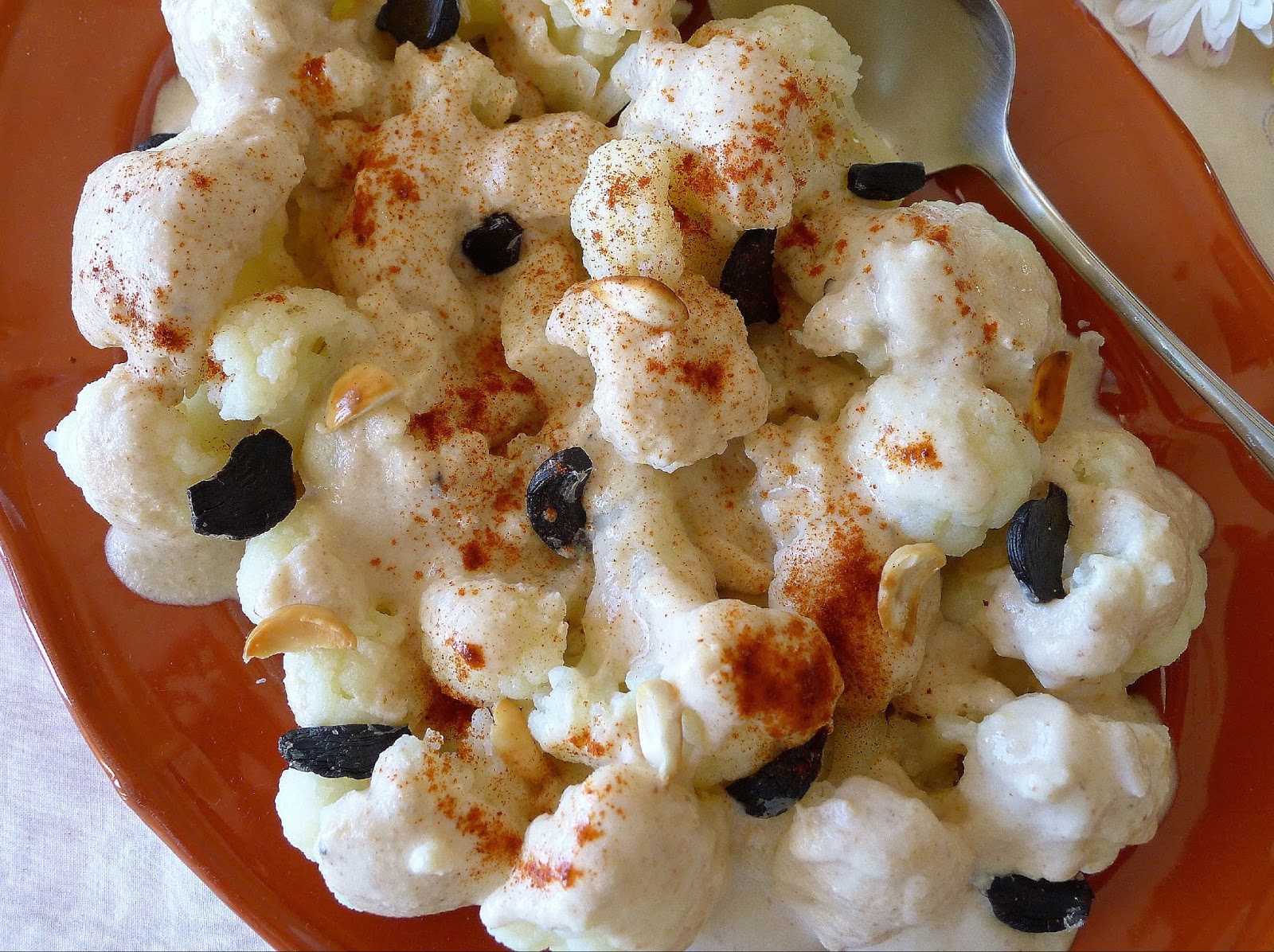
Are those truffles? Nope. They are cloves of sweet black garlic studding a savory dish of cauliflower in almond sauce. And, that's not just any red paprika sprinkled on top. It's smoked pimentón de la Vera, this one picante, or spicy-hot.

Black garlic is ordinary garlic that is "aged" in humid conditions, causing a sort of fermentation. Inside the skin, the white cloves soften and turn black. Black garlic has an amazing sweet taste, without the "bite" of fresh garlic. It can be used whole or mashed to a paste. With oil for a baked potato, on pasta or steak. It is sold, peeled, in jars or in whole heads, as shown in the photo.

Main dish. Quinoa is the basis for this main dish salad that can be vegetarian or not. It gets festive treatment with bright red piquant peppers and tiny "pearls" of olive oil. The pearls are tiny transparent balls that burst when you bite into them, releasing a drop of extra virgin olive oil.

Festive treatment for quinoa--red "teardrop" peppers and tiny pearls of encapsulated olive oil.

"Teardrop" peppers from La Rioja are sweet and piquant.

Tiny pearls of olive oil do not need refrigeration. They are sold in jars. Use them to garnish any dish.


White Asparagus Bisque with Saffron
Crema de Esparragos Blancos con Azafrán


Canned asparagus may seem very mundane. But in Spain, white asparagus is considered a luxury and appears in holiday gift baskets and as a garnish for special salads. Here it is cooked in a smooth bisque, with the tips to garnish the soup. The finishing touch: a spoonful or two of dry Sherry to give depth of flavor to the soup and a scattering of golden saffron on top, for color and inimitable aroma. This makes a lovely starter for a holiday meal.

Serves 6.

1 or 2 cans or jars of white asparagus spears (24 ounces)
3 tablespoons olive oil
2 leeks, white part only, chopped
1 shallot, chopped
1 clove garlic, chopped
1 cup peeled and diced zucchini
1 cup peeled and diced potatoes
5 cups chicken stock
Sprig of parsley
Salt and pepper
½ cup light cream or evaporated milk
2 tablespoons dry Sherry
Saffron threads, preferably D.O. La Mancha


Drain the cans of asparagus, saving 1 cup of the liquid. Cut the tips off the asparagus and reserve them. Chop the spears.

Heat the oil in a soup pot. Sauté the leeks, shallot and garlic on medium heat until softened, 5 minutes. Add the chopped asparagus spears, zucchini and potatoes and sauté 3 minutes. Add the reserved asparagus liquid and the stock. Add the sprig of parsley and salt and pepper to taste.

Bring to a boil and cook gently, covered, until vegetables are very tender, about 20 minutes. Let cool 15 minutes, then puree the soup in a blender. Add the cream or evaporated milk and blend again. .

Shortly before serving, reheat the soup, but do not boil. Add the Sherry.

Serve the soup into shallow soup bowls. Divide reserved asparagus tips between the bowls. Scatter saffron on top of the soup. 

Festive Flamenco Salad with Fruit and Shrimp
Ensalada Flamenca

Add a generous sprinkling of salt flakes to the salad.
On my way to the market the other day, I passed beneath a balcony where a woman was leaning out, telling a guy in the street below how to make her special salad for the cena de Noche Buena (Christmas Eve dinner). Seasonal fruit, she said, avocados, oranges, clementines, kiwi and olives, sliced and arranged on a platter and topped with  bocas de mar, imitation crab sticks made of surimi.

I asked her what the salad was called. “I named it ensalada flamenca,” she said.

It is so traditional to serve fish and shellfish for Christmas Eve celebration. But, my version would be with langostinos, big shrimp, instead of the fake crab. For showiness, I left the shrimp whole, to be peeled at the table. But, for ease of serving, you could remove shells before adding to the salad. Other shellfish can be used as well.

The finishing touch: Instead of the local olives, cracked green ones with thyme and garlic, I used purple-black Empeltre olives from Aragón. And for crunch, orange-flavored salt flakes generously sprinkled over the whole salad.

Serves 6.

12-18 whole shrimp
2 oranges
2 clementines
2 kiwis
2 avocados
Salad greens
Extra virgin olive oil
Olives, black or green
Orange-flavored salt flakes


Cook the shrimp in boiling, salted water with a bay leaf until they turn pink and begin to curl. Drain and plunge the shrimp into ice water to stop the cooking. Drain. Refrigerate until ready to assemble the salad.

Peel and slice the oranges, clementines, kiwis and avocados.

Place salad greens on a serving plate. Arrange the fruit in a single layer on top. Place the shrimp in the center. Garnish with olives. Sprinkle the salad with the salt flakes. 

Cauliflower with Almond Sauce and Black Garlic
Coliflor con Salsa de Almendras y Ajo Negro


Cauliflower with almond sauce is a very traditional side dish for the Christmas Eve meal. The almond sauce can be used with other vegetables as well. If you make it with vegetable instead of chicken stock, it makes a really good vegan gravy.

The final touch: stud the creamy cauliflower with cloves of coal-black garlic, then dust it with deep red pimentón. A side dish with dramatic impact! The black garlic requires no cooking. Just peel the individual cloves and add to the cauliflower immediately before serving.

Serves 6.

1 small head cauliflower, cut into florets
2 tablespoons olive oil
1 slice bread (1 ounce), crusts removed
½ cup blanched and skinned almonds
2 cloves garlic
1 ½ cups chicken stock
Salt and pepper
Black garlic cloves, to garnish
Smoked pimentón picante (spicy-hot smoked paprika)

 
Cook the cauliflower in boiling salted water until just tender, 6-8 minutes. Drain well. Keep the cauliflower warm while preparing the almond sauce. (Or, cook in advance and reheat.)

Heat the oil in a skillet. Fry the bread, almonds and 2 cloves of garlic, turning, until they are golden. Remove them. Reserve a few of the almonds to use as a garnish for the finished dish. Add the remaining almonds, bread and garlic to a blender. Add some of the stock. Blend to make a smooth paste.

Stir the paste into the skillet with the remaining stock. Season to taste with salt and pepper. Cook, stirring, until sauce is thickened and smooth. It should be the consistency of cream, thick enough to nap the cauliflower. If too thick, add additional stock or water.

Place the cauliflower in a bowl or spread it on a platter. Slice the reserved fried almonds into slivers and scatter them over the cauliflower. Stud the cauliflower with cloves of black garlic. Finish with a sprinkle of hot pimentón.


Quinoa Salad with Partridge in Escabeche
Ensalada de Quinoa con Perdiz en Escabeche

One partridge in escabeche is boned and divided between four salads.


This salad features canned partridge in escabeche marinade, a traditional way of conserving partridge in La Mancha, where the wild game bird is abundant. (The canned partridge usually is produced with farm-raised birds.). Allowing one bird per person, this salad makes a main course dish. Boned, it can be divided between four salad servings.

You can use the escabeche marinating liquid to dress the quinoa instead of the oil and vinegar called for in the recipe. You will have more quinoa salad than needed for four servings.

The final touch: little sweet and piquant “teardrop” red peppers add a pop of color to the quinoa salad. (Substitute chopped red piquillo peppers if the teardrops are not available.) Olive oil pearls on top give a touch of luxury. Oh, and some cute little quail eggs make the salad more fun.

Serve the quinoa and partridge at room temperature.

Serves 4

1 ¼ cups quinoa, two colors, if possible
½ cup diced carrots
Salt
5 cups water
3 tablespoons extra virgin olive oil
2 tablespoons Sherry vinegar
¼ teaspoon freshly-ground black pepper
½ cup red teardrop peppers
Pinch of thyme
1 canned partridge in escabeche (415 grams/ 14.5 ounces)
Salad greens
Quail eggs, hard-boiled, to garnish
Olive oil pearls to garnish


Cook the quinoa and carrots in boiling water with ½ teaspoon salt (approximately 12 minutes). Drain well and place the quinoa and carrots in a bowl. Add the oil, vinegar, pepper and ½ teaspoon salt. Stir in half of the red teardrop peppers and a pinch of thyme.

Drain the escabeche liquid from the partridge. Carefully de-bone the partridge, keeping pieces of meat as large as possible.

Make a layer of salad greens on individual salad plates. Place a mound of the quinoa in the center. Lay pieces of partridge around the quinoa. Garnish each salad with a few teardrop red peppers. Peel and halve the quail eggs and put one or more halves around the salad. Put a spoonful of olive oil pearls on top of the quinoa.

More festive recipes:
Purple Carrots with Raisins and Pine Nuts.
Quail in Escabeche.
Saffron Ice Cream with Chocolate Sauce.
Basque Style White Asparagus.