Showing posts with label Coleslaw. Show all posts

Saturday, March 11, 2023

ROSADA—THE PINK FISH FROM FAR AWAY

 “I took my guests out to eat local fish,” a friend told me. “Right on the beach. We had rosada. So fresh, so good.” 


I had to tell her that rosada isn’t local, isn’t fresh. Good, yes. And widely available, even at restaurants on the Mediterranean seafront, in view of the fishing port. (This was near Marbella on the Costa del Sol.)


In Spain, “rosada,” which means “pink,” is a very pretty name for the cusk-eel, fished in the South Atlantic, from Namibia to South Africa (Genypterus capensis), or, from even further afield, in the South Pacific, around Chile and Patagonia on one side and New Zealand and Australia on the other (G. blacodes). Rosada arrives on Spanish shores headless, boneless and usually skinless. Frozen solid. 

Fillets of rosada, a fine (imported) fish.


When rosada first started showing up in local markets, vendors thawed it and displayed it alongside fresh fish. If questioned, they insisted it was “fresh.” Restaurants used to list it on menus as “mero” (grouper), a much-esteemed fish. 

According to Esperanza Peláez, who wrote in Diario Sur (La curiosa historia de la rosada), the Málaga daily newspaper,  with improved refrigeration and transport, rosada now arrives fresh as well as frozen to Spanish markets. 

Felix sells fresh and frozen rosada.


I was able to confirm this at my local village market, where I bought skinned and filleted rosada. Felix, the vendor, showed me the bill of lading—the fish was labeled “refrigerado,” not “congelado” (€14.90/kilo).  He also had frozen rosada with skin and bones (€12.90/kilo); frozen fillet with a lot of extra weight in ice pack (€10.90/kilo) and, what he said was the best quality, frozen fillets, with skin (€17.90/kilo), from New Zealand.  

Rosada is a large fish, with pinkish-orange skin mottled with brown. It’s not a true eel, but has a thick, elongated body and a blunt snout. The fillets really are bone-free. It is not a threatened species, so is a good choice for food fish. Rosada could be used in any recipe calling for cod, conger, grouper, haddock or halibut. It’s good grilled on the plancha, sauced or in fish soups. 
 
Though it comes from far away, rosada has become naturalized in Málaga, where it’s ubiquitous in restaurants and tapa bars. Buchones de rosada—fried fish sticks—are one of the popular preparations.  

These fish sticks are cross-cut slices of filleted rosada, breaded and fried in olive oil. Here, served with fries (chips) and a non-traditional coleslaw. Garlic mayonnaise for dipping.

Instead of mayo, the slaw is dressed with yogurt and olive oil. Besides cabbage and grated carrots, it has diced figs. A nice condiment with fried fish. The fries are fried in extra virgin olive oil.


Rosada is a white fish, flaky but firm, very tasty.

Fried Fish Sticks
Buchones de Rosada

These fish sticks or fish fingers are not made with processed fish, like the frozen ones. The whole fillet of rosada is cut crosswise into strips, so their length and thickness depends on the size of the fillet. Or, cut the fish into smaller pieces and call them “nuggets”. 

Allow time for the fish to marinate in a simplified adobo of lemon juice, garlic and parsley. You can vary the flavorings as desired--oregano, tarragon or cilantro, for example, instead of parsley.

Bread the fish sticks with flour, egg and breadcrumbs. (I've added black sesame seeds to the flour for a little extra crunch.)

Serve the fish sticks with any favorite sauce. In Málaga, that is usually alioli, garlic mayonnaise. But tartar sauce or romesco, chermoula or chimichurri, remoulade or salsa verde, they’re all good. 

Cut fillets crosswise into strips.
Makes approx. 18 (4-inch) fish sticks.

1 ¼ pounds rosada or other firm white fish fillets
Salt
Freshly ground black pepper
1 tablespoon finely chopped parsley
1 clove garlic, minced
3 tablespoons fresh lemon juice
1/3 cup flour
1 tablespoon cornstarch
1 teaspoon sesame seed (optional)
2 eggs, lightly beaten
1 cup fine dry breadcrumbs
Olive oil for frying

Fish marinates in adobo of lemon and garlic.


Cut the fish fillets crosswise into strips about 1 inch wide. Place them in a non-reactive container. Sprinkle with ½ teaspoon salt and pepper, the parsley, garlic and lemon juice. Gently mix the pieces of fish with the adobo ingredients. Cover and refrigerate at least 1 hour and up to 24 hours.

Remove the fish from the adobo, leaving any parsley or garlic that clings to it. Drain the fish and pat the pieces dry with paper toweling. 


Dark specks in flour are black sesame seed.


Combine the flour, cornstarch, sesame, if using, and ½ teaspoon of salt in a shallow bowl or tray. Place the eggs in another bowl and the breadcrumbs in a third bowl. 

Dredge the strips of fish first in flour, patting off the excess. Dip them in egg, coating on all sides. Lift them out of the egg with a fork, allowing excess to drip off. 

Let breaded fish dry before frying.


Place them in the crumbs. Turn the pieces in the crumbs to coat well. Lift them onto a sheet pan covered in parchment. Allow the strips to dry at room temperature up to 30 minutes or, refrigerated, uncovered, up to 4 hours.

In a heavy skillet place the oil to a depth of ¾ inch and heat on medium-high. Fry the pieces of fish until golden-brown on all sides, 2 to 3 minutes. Remove and drain on paper towels. 

Serve the fish sticks hot, room temperature or cold.


More versions of fried fish:


Saturday, January 14, 2023

WHAT TO DO WITH BITTER ORANGES


Bitter orange tree in my garden.

Sure, you could make marmalade. But, not if  you’re the city of Sevilla, where ornamental bitter oranges are emblematic. Sevilla has some 50,000 urban orange trees, creating a major headache for the crews which, during January and February, must pick the fruit before it rots and falls. The oranges on city streets cannot be used for making commercial marmalade because the leaves and skin of the fruit absorb contaminants. 


A pilot project started in Sevilla in 2020 uses street oranges to make juice, which, in fermenting, creates methane that can be converted into biofuel to generate electricity to power the city’s residual water treatment plants. So far, this accounts for only about 3.5 percent of the fruit collected. With funding, the project may continue to expand. Another 7.7 percent of oranges goes to dumps where some become compost. The lion’s share—88.8 percent—is used for industrial purposes such as the distillation of essential oils and to manufacture livestock feed. (These figures are from an article in Diario de Sevilla.)

These oranges, native to China, were first planted in Spain by the Romans. But it was the Moors (Arabs) who extended the plantings widely. The essential oils were used medicinally and as a fragrance. The naranja amarga, known in English as the “Seville orange,” is not actually bitter. The peel is bitter, the juice is sour. Really sour. As mouth-puckeringly tart as lemons. 

Sour oranges can be used in any way you use lemons. Squeeze some on vegetables (brilliant with artichokes and asparagus); on fried fish, in salads. The juice makes a terrific vinaigrette. Or, use it to make a classic orange sauce as in Duck a l'Orange. Biofuel, anybody?

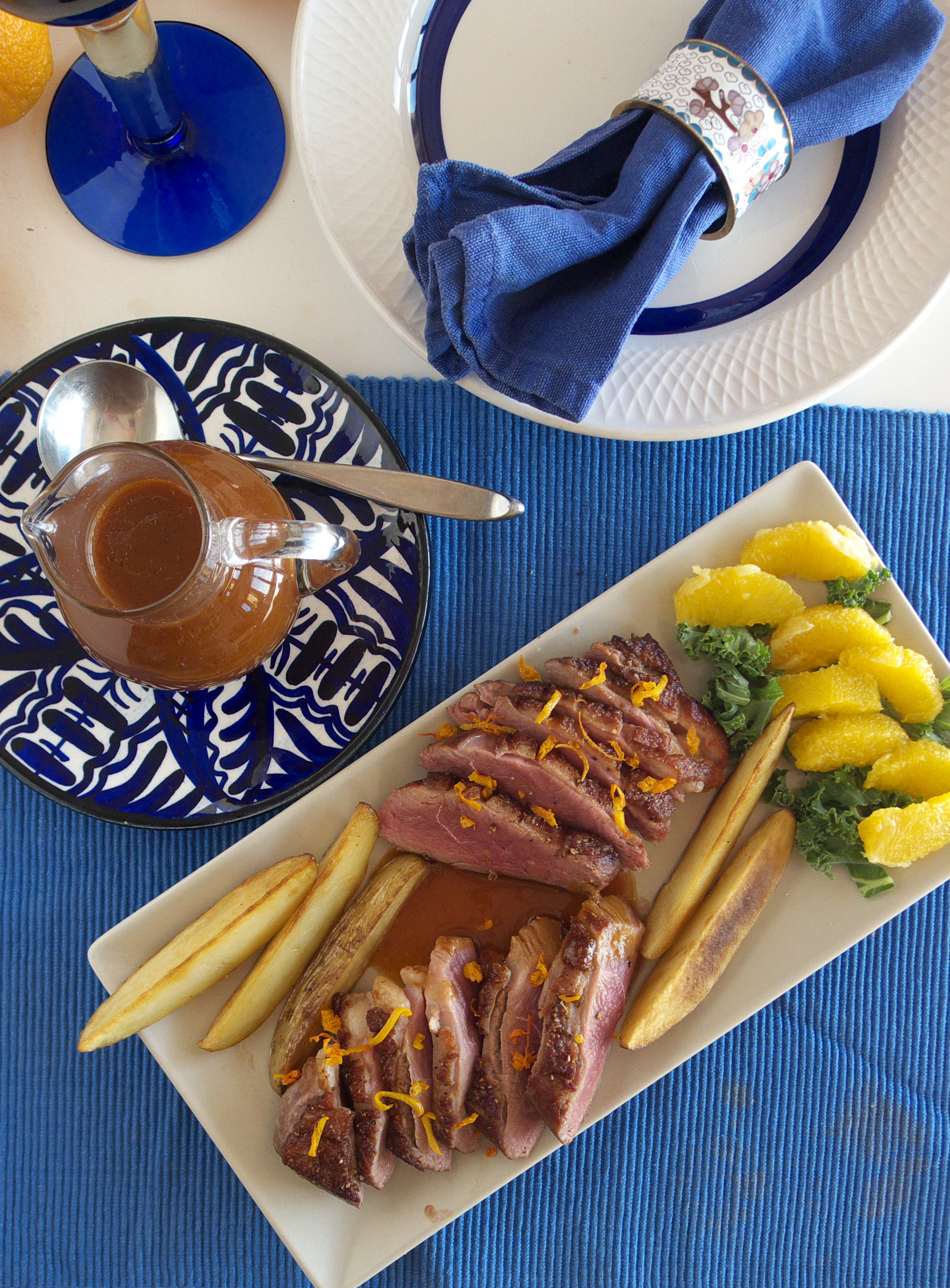
A variation on classic Duck a l'Orange, here made with duck breast. The sauce is made with the juice of sour oranges.


Coleslaw with a difference--shredded cabbage, fennel and carrots are mixed with pieces of sweet orange and dressed with a sour orange vinaigrette.


The same vinaigrette used for the coleslaw is poured over roast salmon. The vinaigrette is made with equal parts sour orange juice and extra virgin olive oil, a half-teaspoon of sesame oil, grated ginger, grated (sweet) orange zest, and chile paste to taste. 


Roast fillet of salmon with a side of slaw, both dressed with sour orange vinaigrette and speckled with black sesame.


Sour orange sponge pudding, baked in oven-proof cups.

Duck Breast a l’Orange
Magret de Pato a la Naranja

Classic French Duck a l’Orange is actually Canard au Bigarade—duck with a sauce made with sour oranges—not, a la Julia Child, with sweet oranges. Bigarade is the Provençal name for the Seville bitter orange. So tangy is the sauce that it really needs the addition of caramel, which both deepens the color of the sauce and sweetens it.

Although the classic recipe calls for roast duck, I’m making a version using magret, boneless duck breast, that cooks in minutes. 

Starting point for the orange sauce is a deeply flavored brown stock. Make it with beef bones or pieces of duck carcass that have been browned in the oven. Add aromatics and herbs and canned tomatoes for depth of color. Take care not to add too much salt, as the stock is going to be reduced, which concentrates the salt.

You can make caramel (melt sugar until dark brown, dissolve it in some water or vinegar to make it  sauce consistency) or, as I chose to do, use store-bought bottled liquid caramel (look for it on the shelves with the baking and pudding ingredients). 

Sour oranges for juicing.

Makes enough orange sauce for 3 duck breasts or 1 whole roast duck.

1 orange (bitter or sweet)
1 ½ cups brown stock (beef and/or duck)
2 teaspoons cornstarch
1 ½ cups sour orange juice, strained
Salt
Freshly ground black pepper
2 tablespoons liquid caramel
2 tablespoons rendered duck fat or butter
Duck breasts, each about 14 ounces
Sweet orange segments to garnish (optional)


Use a vegetable peeler or zester to remove the zest from the orange without any white pith . Cut the zest into julienne slivers. Blanch the zest in boiling water 1 minute and drain. Return the zest to the pan with fresh water, bring again to a boil. Cook sweet orange zest 4 minutes and drain. If using bitter orange peel, cook it 10 minutes. Drain well. Pat dry and reserve the slivered zest.

Place ¼ cup of the stock in a small bowl with the cornstarch. Stir to blend. Combine the remaining stock and sour orange juice in a saucepan. Bring to a boil, reduce heat to medium and cook, uncovered, until the liquid is reduced by half (about 20 minutes). Whisk in the cornstarch mixture and cook until the sauce is slightly thickened. Add salt and pepper to taste. Remove from heat and whisk in the liquid caramel. (Sauce can be made in advance. Reheat when duck is ready to serve.) Before serving, whisk duck fat or butter into the hot sauce.

Score the fat of the duck breast.

For the duck breast: Use a sharp knife to score the fatty side of the duck breast in a diagonal cross-hatch, without cutting into the flesh. Sprinkle generously with salt and pepper. Allow to stand at room temperature for 30 minutes.

Heat a heavy skillet on medium heat. Brown the duck breast, fat side down, until fat is crisped and browned, 4 to 5 minutes. Very carefully drain off excess fat. Turn the duck breast and cook until browned, 3 to 4 minutes. Turn the breast on end to brown the edges. The duck should be browned on the outside and rare in the center.

Remove to a cutting board and allow it to stand 10 minutes. Slice crosswise into ½-inch slices. Arrange slices on a platter or individual plates. Spoon some of the sauce over the duck. Sprinkle with the strips of zest. Garnish, if desired, with sweet orange segments. 

Tangy orange sauce complements the rich and fatty duck breast. The segments used as garnish are sweet orange.


Duck breast is usually served rare. Strips of blanched orange zest garnish the duck.


Sour Orange Sponge Pudding
Flan Bizcochado de Naranja Amarga


This is based on an old favorite dessert recipe, Lemon Sponge Pudding (in The Joy of Cooking by Rombauer and Becker). I like it tart! I’ve used less sugar than called for in the original recipe, even though I have substituted sour orange juice for sweet. 

Serves 4.

½ cup sugar
1 ½ tablespoons butter
1 tablespoon grated zest from a sweet orange
2 large eggs, separated
3 tablespoons flour
1/3 cup sour orange juice
1 cup evaporated milk

Preheat oven to 350ºF.

Cream together the sugar and butter. Add the zest. Beat in the egg yolks. Beat in the orange juice. Add the flour and milk.

Beat the egg whites in a clean bowl until they form stiff peaks. Fold the egg whites into the batter. 

Grease 4 custard cups or oven-proof pudding bowls. Set them in a pan with 1 inch of hot water. Ladle the batter into the cups. Bake until the pudding is set, 40 minutes.  Serve the puddings in the custard cups in which they baked.


More recipes using bitter oranges:


Saturday, July 4, 2020

KEEP IT SIMPLE!

Keeping it simple. This meal comes together in 30-40 minutes--lentils, pan-grilled salmon fillets and coleslaw.

Open a jar of lentils. Empty the contents into a bowl. Add your favorite vinaigrette dressing and some chopped fresh herbs. Serve alongside grilled salmon or roast chicken or lamb chops. Dinner, simplified.


My plan here is, not to complicate this menu, but to customize it a bit. Instead of a glug of bottled vinaigrette, I’m making my own by adding spices to the basic dressing. A special ingredient—Moroccan lemons preserved in brine—adds real pizazz to plain canned lentils.

The “dressed” lentils, served cold or room temperature, are not a salad, but a side dish. They can take the place of a vegetable or of a boring carb such as potatoes. For that matter, with the addition of cubes of queso fresco or feta and quail eggs, the lentils easily become a vegetarian main.

It doesn’t take much to turn basic foods from simple to, if not sublime, at least very tasty.  I found lots of inspiration for this kind of cooking in Radically Simple—Brilliant Flavors with Breathtaking Ease by Chef Rozanne Gold (Rodale; 2010). She’s got at least eight recipes using canned legumes, all of them embellished in unexpected ways. For example, grated fresh ginger “makes the flavor of fresh lemon reverberate” in an otherwise ordinary Italian white bean salad. A couscous salad gets finished with chickpeas, chopped dates, slivered almonds and cardamom. Just wow!

(Some other recipes I liked from Radically Simple, these not with legumes: creamy avocado soup spiked with fino Sherry; halibut roasted with saffron vinaigrette; beef burgers with sun-dried tomatoes; lamb chops with smoked pimentón oil and shards of Manchego cheese; cauliflower with crumbly ras el hanout topping.)

Keeping it simple.

Lentils with a spicy vinaigrette and diced preserved lemon makes an easy side dish with all kinds of foods.

Chilled or room temperature lentils accompany pan-grilled salmon. Slaw is a quick salad-relish.

Mint complements the lentils and salmon.

Or, serve the lentils on the side.

Tangy slaw can serve as a sauce or relish with the grilled salmon. This is made with shredded Chinese cabbage, red bell pepper and diced carrots. No mayonnaise--the dressing includes olive oil, Sherry vinegar, a dribble of honey and a pinch of toasted cumin seeds.


Lentils with Spicy Dressing
Lentejas Aliñadas

Use the rind of preserved lemon.

These are tiny brown pardina lentils. French Puy lentils could be used instead--whatever you have available in cans or jars.

Chopped preserved lemon adds pop to this simple side dish. If not available, substitute capers for a similar tangy, briny flavor.

You could simplify the recipe further by using a ready-mixed spice blend such as ras el hanout, Madras curry powder or za’atar instead of the clove-pepper-cumin-pimentón mix.

Fresh mint leaves.


Chopped mint complements the lentils nicely and points up the Moroccan-ish flavors. But chopped dill, cilantro, basil or parsley would be equally good.


Open a jar of lentils.

2 cups canned lentils
¼ cup finely chopped onion
¼ cup diced preserved lemon
1 tablespoon ketchup
1-2 cloves garlic, crushed
1 teaspoon salt
Pinch of cloves
1 teaspoon coarsely cracked black pepper
¼ teaspoon cumin
1/8 teaspoon hot pimentón (paprika) or pinch cayenne
2 tablespoons fresh lemon juice
¼ cup extra virgin olive oil
Fresh mint leaves, chopped
Hard-cooked quail eggs, to garnish (optional)

Empty the lentils into a colander. Rinse them in cold water and let them drain.

Place the chopped onion in a small bowl. Cover with cold water. Let the onions soak 10 minutes. Drain them well.

Combine the lentils and onion in a bowl. Add the diced lemon.

Spicy vinaigrette.
In a small bowl combine the ketchup, garlic, salt, cloves, pepper, cumin and pimentón. Whisk in the lemon juice and olive oil. Pour dressing over the lentils and very gently stir. Allow the lentils to marinate in the dressing at least 30 minutes or, covered and refrigerated, up to 24 hours.

Immediately before serving stir in the chopped mint. Garnish, if desired, with quail eggs that have been peeled and halved. Serve the lentils room temperature or chilled.


To cook the salmon: Season the fillets with salt and pepper and drizzle them with olive oil. Allow to come to room temperature. Heat a plancha (grill pan) or cast iron skillet until quite hot. Place the fillets in the pan, skin side down. Lower heat to medium-hot. Allow the salmon to cook without moving it until the skin is crisped and flesh is cooked almost to the center. Carefully turn the fillets and finish cooking just until the reverse side is lightly browned.


More recipes in which canned lentils could be used:
Don Quixote´s Friday Lentils (vegetarian).
Lentils with Sausage.

Sunday, October 8, 2017

MOROCCO--THE SALAD TOUR

On our first night in Morocco, at a guest house in the medina of Azrou, a town south of Fes in the Middle Atlas, Fatima placed a salad of chopped tomatoes, onions and cucumber on a tiled table on a rooftop dining area. Lightly dressed with oil, the salad was accompanied by tiny bowls of salt and ground cumin for additional seasoning. A variation of this fresh salad, shlada, appeared as a starter before many Moroccan meals.


Moroccan salad of chopped tomatoes, onions and cucumbers--much like Andalusian pipirrana.

I was part of a photography landscape tour to Morocco. But, really, I was on a salad tour. My photography skills improved a little (thanks to Antonio Martín). My salad appreciation grew hugely as I sampled many variations, from the northern port of Tangier, almost touching Spain, to the distant desert of Merzouga, on the southeastern border of Morocco.


The River Ziz cuts a valley through an arid, desolate landscape of the Middle Atlas.

We drove through the Atlas Cedar Biosphere Reserve, home of majestic cedar trees, Barbary macaques and vendors peddling cedar bowls. Through desolate, arid, rocky landscapes. Where it seemed nothing could thrive, there would appear a herd of sheep, a lone donkey (much smaller species than the burro-taxi of Mijas), a pair of veiled women standing beside the road (bus stop?), a solitary tree.

Then, down from the rocky slopes into the Ziz Valley palm oasis, for lunch at Maison Zouala, an old Berber house, where our host, Hami, offered cold water and dates in welcome. Lunch began with a huge “presentation” salad—potatoes, tomatoes, roasted peppers, carrots, zucchini and green beans arranged on a platter and garnished with quartered egg, olives and sliced oranges.


A typical salad with raw and cooked vegetables arranged around a mound of rice, all beautifully garnished. Bread and olives always accompany salads. Clockwise from the top are marinated zucchini, green beans, potatoes, roasted peppers, chopped tomatoes and carrots. (Recipes below.)


By evening we reached our destination, Hotel Les Dunes d’Or (the “golden dunes”), an oasis on the edge of the desert near Merzouga, on the Algerian border of Morocco. On the terrace near the pool, a slight breeze was a welcome respite after the 100ºF+ temperatures during the day. Another chopped tomato salad refreshed the spirits.

After a morning haggling for scarves, shirts, necklaces, pantaloons and the like in the souk of Rissani (and joking about buying a tender kid-goat at the livestock market), we headed for lunch at the upstairs dining room of the Restaurante Panorama, overlooking the bustling market square. The classic chopped tomato salad here had corn kernels as a garnish. The salad was the perfect accompaniment to chicken brochettes with a side of fries with Arabic ketchup and mustard!

Olives in the souk of Rissani. Black Moroccan olives are intensely salty and oily. Pale green ones are somewhat like commercial Manzanilla olives. Purple olives in red paste are fiery-hot from harissa chile.

On the return trip from the desert of the south to the ferry port of Tangier, we stopped in the holy city of Moulay Idriss in order to visit nearby Roman ruins of Volubilis. There Romans were producing olive oil in the 2nd century AD.


The town of Moulay Idriss rises on the hills above the Roman ruins of Volubilis. This was olive-producing land in the 2nd century AD.


At the Dar Zerhoune guest house in the medina, dinner began with an assortment of salads served in separate bowls, much like Spanish tapas. I especially liked the eggplant salad, called zeilouk, sort of a cross between baba ghanoush and caponata.

Salad ingredients at the souk in Moulay Idriss.


A corner bread seller in the medina of Moulay Idriss. Bread accompanies every meal.


Chopped Tomato Salad
Ensaladilla de Tomatoes


This salad is almost identical to Andalusian pipirrana. It’s good served as a starter or as a side with grilled kebabs or fried fish.

The Moroccan salad may have chopped fresh cilantro instead of parsley and might have cumin or spicy-hot harissa chile paste added to it. Unlike the Spanish version, it does not have raw garlic. 
Harissa chile paste, optional.


1 cup chopped red onion
Salt
4 cups diced tomatoes
1 cup peeled and diced cucumber
3 tablespoons extra virgin olive oil
½ teaspoon cumin (optional)
Harissa chile paste (optional)
¼ cup chopped parsley or cilantro
Black olives

Place the chopped onion in a bowl and sprinkle with 1 teaspoon salt. Add water to cover. Soak the onions 30 minutes. Drain.

Place the onions in a bowl with the tomatoes and cucumber. Add the oil, 1 teaspoon salt and the cumin and harissa, if desired.

Immediately before serving, stir in the chopped parsley or cilantro. If the salad has been prepared in advance, the tomatoes and cucumbers will release a lot of liquid. Use a slotted spoon to serve the salad onto a platter or individual bowls. Garnish with olives.

The Big Salad
La Gran Ensalada

This is Salad II. Clockwise from the top are cabbage, grated raw carrots, sliced cucumbers, sliced tomatoes, cabbage, beets. (Recipes below.)

This grand presentation salad includes five or more vegetables, raw and cooked, arranged on a platter around a mound of rice and nicely garnished with sliced egg and two or more sorts of olives. Here are two versions I enjoyed in Morocco.

For salad I:
These ingredients make enough for two platters of salad, serving 8 to 10.

Cooked rice
Potato salad
Roasted green and red peppers
Diced carrot salad
Chopped tomato salad
Marinated zucchini
Green bean salad
Sliced orange
Black and green olives
Hard-cooked egg, quartered
Salt
Extra virgin olive oil


Mound rice in the center of a two large platters. Working clockwise from 12:00, arrange zucchini, green beans, potatoes, roast peppers, chopped tomato salad and carrots. Repeat. Garnish the platter with orange slices. Scatter olives over all. Place quartered egg on top. Sprinkle with salt and drizzle oil on top. Once assembled, serve the salad immediately.

For salad II.

Cooked rice
Sliced plum tomatoes
Cabbage salad
Beet salad
Grated carrot salad
Sliced cucumbers
2 tablespoons olive oil or additional dressing
Pomegranate seeds
Chopped mint


Mound rice in center of a large platter. Working clockwise from 12:00, arrange sliced tomatoes, cabbage, beets, grated carrots and sliced cucumber in sections. Repeat. Drizzle oil or dressing on top. Sprinkle with pomegranate seeds.and chopped mint.


For salad dressing I:
Salads in Morocco are lightly dressed with oil and lemon juice. In the south, a light vegetable oil such as sunflower seems prevalent. (I did not sample any salads with argan oil.) Around Meknes and  Moulay Idris, good olive oil is produced.

Vinegar is not used in Moroccan salads. Use lemon or sour orange juice to add tanginess. Salt is an essential seasoning. Cumin sometimes is added to salads or served alongside for each person to add to taste.

Salt in dressing draws liquid out of ingredients. If preparing salads in advance, use a slotted spoon to lift the vegetables out of accumulated juices. The citric acid of lemon juice dulls bright green colors. Add the juice to green beans immediately before serving.

Fresh herbs can be added to the dressing or, to preserve freshness and color, tossed with the dressed vegetables immediately before serving.

Use 2 to 3 tablespoons of the dressing for each of the vegetable salads. Extra dressing keeps, covered and refrigerated, for up to 3 days.

3 cloves garlic, unpeeled
½ cup fresh lemon juice
1 teaspoon salt
1 teaspoon pimentón (paprika), not smoked
1 teaspoon cumin
½ cup extra virgin olive oil


Cook the garlic in a little water until soft, 15 minutes. (It can be cooked with any of the vegetables.) Peel the garlic and crush it in a bowl. Stir in the lemon juice, salt, pimentón and cumin. Whisk in the oil.

For salad dressing II:
Makes enough dressing for grated carrot salad and beet salad.

3 tablespoons lemon juice
½ teaspoon honey
½ teaspoon salt
1 teaspoon orange blossom water (agua de azahar)
2 tablespoons extra virgin olive oil


Combine the lemon juice, honey, salt and orange blossom water. Whisk in the oil.

Rice for Salads
Arroz para Ensaladas


Use long-grained or basmati rice for Moroccan salads. One salad I sampled in Morocco had a heap of shell pasta in the center of the vegetables instead of rice. Why not?

4 cups water
1 ½ teaspoons salt
1 cup long-grain rice
1 tablespoon extra virgin olive oil


Bring the water to a boil with the salt. Add the rice, reduce heat and cover the pan. Cook until the rice is al dente, about 12 minutes. Drain the rice thoroughly. Return the hot rice to the pan. Stir in the oil and cover the pan.

When rice is cool, refrigerate until ready to use.

Marinated vegetables are arranged around rice.

Potato Salad
Patatas Aliñadas

Sweet potatoes cut in dice can be prepared in the same manner.

3 cups potatoes cut in ¾-inch dice
1 teaspoon salt
3 tablespoons Salad Dressing I
Chopped parsley


Put potatoes and salt in pan and cover with water. Bring to a boil and cook until potatoes are tender, about 6 minutes. Drain well. Stir in the salad dressing.

Let the potatoes marinate in the dressing at least 1 hour or, covered and refrigerated, up to 24 hours. Stir in chopped parsley immediately before serving.

Marinated Zucchini
Calabacín en Aliño


1 small (8-ounce) zucchini
1 tablespoon olive oil
Salt
1 tablespoon Salad Dressing I
Chopped parsley


Slice the zucchini thinly crosswise. Place it on a microwave-safe plate and drizzle with oil. Microwave on high for 2 minutes. Place zucchini and juices in a bowl and add 1 teaspoon salt and the salad dressing. Marinate 1 hour or, refrigerated, up to 24 hours.

To serve, lift the zucchini out of the marinade with a slotted spoon. Sprinkle with chopped parsley.

Green Bean Salad
Ensalada de Judías Verdes


Cook beans in boiling salted water until crisp-tender. Drain and refresh in cold water. Dress with 1 tablespoon olive oil. Beans can be prepared in advance and refrigerated until serving time.

Immediately before serving, stir in Salad Dressing I and chopped parsley.

Carrot Salad
Ensalada de Zanahorias


Butternut squash can be prepared in the same manner as carrots.

2 cups carrots cut in ½-inch dice
Salt
2 tablespoons Salad Dressing I


Cook the carrots in salted boiling water until just tender, 4 minutes. Drain and refresh in cold water. Add the dressing to the carrots and marinate at least 1 hour or, refrigerated, up to 24 hours.

Roasted Pepper Salad
Ensalada de Pimientos Asados


Green and/or red peppers
Salad Dressing I


Preheat oven to 500ºF. Cut peppers in half lengthwise, remove stem and seeds and place them, skin side up on a baking sheet. Roast until skins are blistered and somewhat blackened, about 10 minutes.

Cool the peppers. Remove skins and pull the flesh into strips. Combine with salad dressing and marinate for at least 1 hour or up to 24 hours.

Orange blossom water adds an exotic hint to this salad.
Grated Carrot Salad
Ensalada de Zanahorias Ralladas


2 cups grated carrots (3 large carrots)
½ teaspoon salt
2 tablespoons Salad Dressing II
Chopped mint

Mix the carrots with salt and salad dressing. Allow to marinate 1 hour or up to 24 hours.

Beet Salad
Ensalada de Remolacha


2 medium beets (12-14 ounces)
Salt
Freshly ground black pepper
2 tablespoons Salad Dressing II
Chopped mint


Cook the whole, unpeeled beets in boiling water until they are tender when pierced with a skewer, about 15 minutes. Drain.

When beets are cool enough to handle, slip off the skins. Cut the beets into ½-inch dice and place in a bowl. Sprinkle with salt and pepper. Stir in the salad dressing. Marinate at least 1 hour or up to 24 hours.

Stir in chopped mint right before serving.

These salads are served in individual bowls instead of on a single platter. Clockwise from top left are chopped zucchini salad, black olives, eggplant salad, coleslaw with pomegranates and cauliflower with preserved lemon and green olives.

Coleslaw with Pomegranate
Ensaladilla de Coles con Granada


3 cups thinly sliced cabbage (about 8 ounces)
Salt
Freshly ground black pepper
3 tablespoons Salad Dressing I
Pomegranate Seeds
Chopped parsley or mint


Bring a pan of salted water to a boil. Add the cabbage. Return the water to a full boil, then remove from heat and drain the cabbage. Refresh it under cold water. Place in a bowl and season with 1 teaspoon salt and pepper. Add the salad dressing. Let the cabbage marinate at least 1 hour or, refrigerated, up to 24 hours.

Sprinkle with pomegranate seeds and chopped mint immediately before serving.

Eggplant Salad (Zeilouk)
Ensalada de Berenjena  


Serve this salad as a dip or spread. Use a potato masher to smash the softened eggplant and tomatoes. It should be mushy, not pureed. The mixture turns very dark as it cools.

2 large eggplant (1 ½  pounds)
½ cup olive oil
3 cloves garlic, chopped
2 cups peeled and chopped tomatoes
1 teaspoon salt
2 teaspoons sweet pimentón (paprika)
½ teaspoon hot pimentón or pinch cayenne
2 teaspoons cumin
2 tablespoons chopped parsley
Lemon juice, if desired
Bread to accompany


Peel the eggplant in stripes, leaving some of the peel. Cut the eggplant in half lengthwise and slice them crosswise.

Heat half the oil in a heavy skillet. Brown half the eggplant slices on both sides. Remove them from heat. Add remaining oil and eggplant to skillet and brown. Remove the eggplant slices.

Add the chopped garlic and tomatoes to the skillet. Return all of the eggplant to the skillet. Season with salt, pimentón, hot pimentón and cumin. Cover and cook, stirring occasionally, until eggplant is very soft, about 20 minutes.


Mash the eggplant and tomatoes with a potato masher. Return to heat and cook, uncovered, until the mixture is thick and no liquid remains.

Remove from heat. Let eggplant cool, then stir in parsley and lemon juice if desired. Serve room temperature with bread to accompany. 

Cauliflower Salad with Olives
Ensalada de Coliflor con Aceitunas


Salty preserved lemons and olives give cauliflower some character.
4 cups florets of cauliflower (about 1 pound)
Salt
3 tablespoons Salad Dressing I
1 tablespoon chopped preserved lemon
2 tablespoons sliced green olives
Chopped parsley


Cook the cauliflower in boiling salted water until crisp-tender, 3 to 4 minutes. Drain and refresh in cold water. Place in a bowl and add ½ teaspoon salt, the salad dressing and chopped preserved lemon. Marinate at least 1 hour or, refrigerated, up to 24 hours.

To serve, scatter sliced olives and parsley on the cauliflower. 

Chopped Zucchini Salad
Ensaladilla de Calabacín


This simple salad packs a lot of flavor. The trick is to keep the diced zucchini crisp. This salad does not need marinating time. Serve it freshly made.

Salt
6 cups water
2 cups diced zucchini (about ¾ pound)
2 tablespoons Salad Dressing I
Chopped onion (optional)
Chopped mint


Combine 2 teaspoons salt with the water. Bring to a boil and add the diced zucchini. Cook 2 minutes. Drain and rinse in cold water to stop the cooking.

Place the zucchini in a bowl and sprinkle with ½ teaspoon salt. Add the salad dressing and chopped onion, if using. Immediately before serving, stir in chopped mint.

(Note: All of the salads pictured here were prepared and photographed in my kitchen in Spain.
©Janet Mendel)


More Moroccan recipes:

Andalusia's twin to Moroccan salad: Pipirrana.


Chopped tomato salad is the perfect accompaniment to grilled chicken brochettes served with Moroccan bread. Salt, cumin and harissa are on the side.  The skewers with cedar-wood handles I bought in Morocco 50 years ago.