Saturday, October 28, 2017

THE SPICE THAT’S CUMIN IN


On a Moroccan table, not salt and pepper, but salt and cumin.

“Pass the salt and pepper, please” said one of my tablemates at our first meal in Morocco. I passed him two small ramekins, one a salt cellar and the other, presumably, containing pepper.


“Not pepper!” he exclaimed. “What is it? Sort of like curry.” I tasted. Cumin, comino, in Spanish. After salt, cumin is the most prevalent seasoning in Moroccan food. It’s added to many dishes during cooking and it’s placed on the table for each person to add according to taste.


Whole cumin seeds and ground cumin. Toast the whole seeds and add, sparingly, to potatoes, beans, legumes.
Cumin is the whole or ground seeds of a plant belonging to the same family as parsley, dill and caraway. Its aroma is pungent, nutty. Its taste, slightly bitter, warm and earthy. A native of south Asia and the Middle East, the spice has found its way into cuisines right around the world, especially in spice blends such as Moroccan ras el hanout; Indian garum masala and curry; Tex-Mex chili powder, and Latin American adobo. It’s often a cohort of hot chile.

I’m always exploring connections between cooking styles and cultures. So, of course I noted that cumin is a spice also used in Andalusia, the region of Spain just across the Mediterranean from Morocco. (So close that, on a clear day, I can see the mountains of North Africa from my kitchen window.)

For instance, the tapa bar favorite, pinchitos, spicy mini-kebabs, is spiced almost identically to the brochettes grilled by street vendors in Morocco, heavy on the cumin, with a little heat from chile. In Málaga and Cádiz, pinchitos are usually made with pork, while in Tangier, just across the narrow Straits of Gibraltar, they are made with lamb or beef.

Cumin even turns up in some versions of gazpacho. It’s used in that favorite Sevilla dish, espinacas con garbanzos, spinach with chickpeas, as well as with lentils and black-eyed peas. Surprisingly, a hint of cumin appears in Andalusian braised vegetables, such as asparagus, artichokes, fava beans and pumpkin.

The Andalusia-North Africa connection is more than just proximity. The “Moors” who ruled Al-Andaluz for seven centuries were Arabs and Berbers from North Africa. They left an indelible mark on the cuisine, customs and language of southern Spain. (Spanish words such as almendras, almonds; albóndigas, meatballs, and aceite, oil, all derive from Arabic.)


This Andalusian vegetable dish seasoned with cumin is a little like Moroccan tagine.

I’ve been cooking a lot of Moroccan food since I returned from a week’s travels there (see the previous four blog posts for recipes). But this week I’m looking for cumin connections in Andalusian food. This is a village recipe—calabaza guisada, or stewed pumpkin—that reminds me a little of tagine, the Moroccan stew of vegetables and meat.

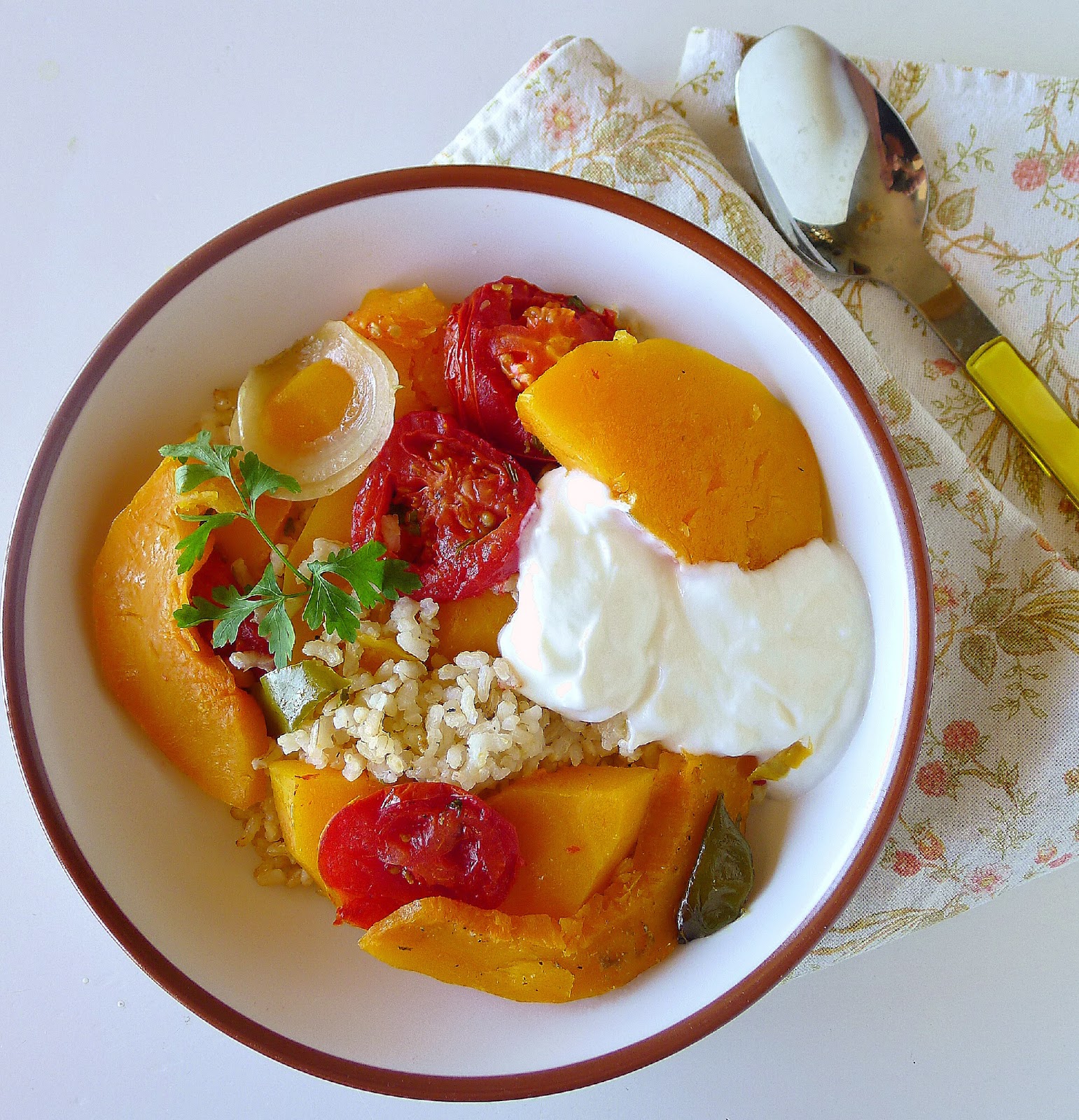
Brown rice makes this vegetable melange a vegetarian main dish.

A dollop of yogurt is a good addition to rice with butternut squash.


Butternut squash in my garden.
The Spanish recipe calls for pumpkin, peppers, onion and tomatoes to be layered in a pan and simmered or baked until tender. I’ve turned the dish into a vegetarian main course, by baking all the veggies on top of a layer of brown rice. I’ve used butternut squash from the garden instead of the more traditional pumpkin.


Baked Squash with Rice
Calabaza Guisada con Arroz


1 ½ cups brown rice
6 cups water
Salt
2 pounds butternut squash
3 plum tomatoes, sliced
1 onion, sliced
2 green peppers, cut in strips
3 cloves garlic, chopped
1 bay leaf
1 tablespoon chopped parsley
½ teaspoon cumin
Freshly ground black pepper
1 tablespoon Sherry vinegar
¼ cup olive oil
1 cup boiling water
Greek yogurt to serve (optional)

Cook the rice in 6 cups of boiling water with 1 teaspoon salt for 8 minutes. Drain. (Rice can be par-boiled in advance of assembling the casserole.)

Preheat oven to 375ºF. 

Cut the squash in half, remove seeds and peel. Slice it crosswise ½ inch thick. Spread the drained rice in the bottom of a lightly oiled cazuela or oven casserole. Layer the sliced squash, tomatoes, onion, green peppers and garlic on top of the rice. Break the bay leaf into pieces and tuck them among the vegetables. Sprinkle with parsley, cumin, salt to taste and pepper. Drizzle over the vinegar and oil. Pour over the boiling water.

Cover the casserole with a lid or foil and bake until squash is tender, about 75 minutes.

Serve hot or room temperature with a dollop of yogurt, if desired.


Some more Andalusian dishes spiced with cumin:

Saturday, October 21, 2017

MOROCCO—DINNER IN THE DESERT


In the desert, late afternoon sun turns the dunes to gold.

The late rays of sun turn the dunes golden orange. We are trekking by dromedary through the Erg Chebbi desert (southeastern Morocco), heading towards a camp of jaimas, for dinner, a night under stars and dawn on the Great Dune. As the sun descends, shadows grow long. The day’s radiant heat abates.

Shadows grow long. Selfie with camel.


Camp for the night--tents in a watering hole set amongst the dunes. Camels wait outside the enclosure.

The caravansary is a group of tents enclosing an open area with low tables and carpets spread on the sand. A few trees ring the enclosure that is tucked in the folds of a sea of dunes. The camels are parked outside for the night.

What's for dinner? Tagine bubbling on a rustic cooker inside a tent.
In a rustic kitchen, our dinner is bubbling away. Dinner is tagine. Tagine is the word for both the finished dish, a stew of meat and vegetables, as well as the cooking vessel, which is an earthenware or metal pot with a shallow base and conical lid.


Morning. First rays of sun break over the dunes.

Salutation to the sun. We've climbed a short way up the Grand Dune.

In a week travelling in Morocco, I ate tagine every single day. There was beef with prunes (twice); kefta meatballs with eggs (twice); chicken with carrots, eggplant and potatoes, and chicken with preserved lemon and olives.

Tagine has long been one of my favorite dishes to cook for family and for guests. I love the simplicity of its preparation—ingredients are layered in the tagine with spices and a little liquid is added. Grated onions in the bottom provide flavor and substance. On top, pieces of meat or chicken and vegetables simmer slowly beneath that conical lid. The lid traps steam and keeps it circulating, resulting in tender food, full of flavor. There’s no browning, no stirring.

However, since I converted last year to an induction cooktop (requiring only steel pans), I haven’t prepared tagine at all. I decided that, instead of getting rid of the clay tagine, I would try it in the oven!

Tagine with kefta meatballs, eggplant, spices and eggs. This version has been cooked in the oven.

Kefta Meatball Tagine with Eggs
Tagín con Albóndigas con Huevo
s

Kefta are very small (1 inch) meatballs, well-seasoned with spices and simmered in a spicy tomato sauce. Ground lamb is best, but beef or chicken can be used instead. Neither bread nor egg is added to the meat, so the kefta are quite dense. (The seasoned meat can also be pressed onto skewers and grilled as kebabs.)

A clay tagine is heavy. Take care in lifting it in and out of the oven. Remove lid first, taking care not to release steam towards your face. Then lift out the bottom. Place each on an insulated board, never on a cold surface.

If you don’t have an earthenware or ceramic tagine, use an oven-safe lidded pan or shallow lidded casserole.

Use a food processor to finely chop together the onion (2 or 3, depending on size) and garlic. Use it for both the meatballs and the sauce. Spices, too, are divided between meatballs and sauce.

Bread for dipping into spicy sauce.


How to serve tagine. In a  Moroccan home, the tagine is served on a low table. Family members sit around the table and eat right out of the tagine, using fingers and bread to help themselves to the delicious nuggets of meat and vegetables. As part of a meal, the tagine might be served with soup or a selection of salads or an additional meat or chicken dish. It is not customary to serve rice or cous cous as a side with tagine. However, if tagine is the main dish, you may want to accompany it with more than just bread. 

Serves 4 to 6 as part of a meal.


1 pound ground lamb
1 ½ cups finely chopped onion
3 cloves garlic, finely chopped
Salt
Freshly ground black pepper
Cumin
Pimentón (sweet paprika)
Hot pimentón or cayenne
Grated fresh nutmeg
2 tablespoons finely chopped parsley
1 tablespoon finely chopped cilantro
4 tablespoons olive oil
2 cups eggplant cut in 1-inch cubes
1 ¼ cups grated fresh tomatoes
¼ teaspoon saffron threads, crushed
¼ cup hot water
¼ teaspoon cinnamon
Pinch of turmeric
Sprig of fresh parsley
Sprig of cilantro
Chile pepper (optional)
3 eggs
Bread, to serve

Place the meat in a bowl. Add 2 tablespoons of the chopped onion and garlic. Add 1 teaspoon each of salt, cumin and sweet pimentón. Add ¼ teaspoon each of black pepper and hot pimentón. Add a grating of fresh nutmeg. Add the chopped parsley and cilantro. Using hands, mix the meat and spices until they are combined very well.

Shape the meat mixture into small (1-inch) balls. Place them on a sheet pan and refrigerate until ready to cook the tagine.

Place kefta on a base of finely chopped onions.
Place 2 tablespoons oil in the bottom of tagine or alternative lidded casserole. Spread the remaining chopped onion and garlic in the bottom of the pan. Place the meatballs in a single layer on top of the onions. Tuck the cubes of eggplant in among the meatballs. Spread the grated tomato pulp on top.

Add the crushed saffron to the hot water in a small bowl and let soak 5 minutes. Add 1 teaspoon each of salt, cumin and sweet pimentón to the bowl. Add ¼ teaspoon each of black pepper, hot pimentón and cinnamon to the bowl. Stir in a pinch of turmeric. Stir in remaining 2 tablespoons of oil.

Drizzle the spice-oil mixture over the tomatoes. Place sprigs of parsley and cilantro in the center and chile, if using, on top. Cover the tagine or casserole.

Ready to cook--tomatoes and spices on top of the meatballs and eggplant cubes.

Place the tagine in a cold oven and set temperature to 350ºF (180ºC). Let the tagine cook 1 hour.

Very carefully, lift off the tagine lid. Remove the tagine from the oven to check if it needs additional liquid. Do not stir it. Return the tagine to the oven. Replace the lid.

Cook 45 minutes more. Remove carefully, as before. Tomatoes should be thickened and eggplant very soft. Use a spoon to make indentations in the surface. Break an egg into each. Return the tagine to the oven and replace the lid. Cook until whites are set, but yolks still liquid, 8 to 10 minutes.

Remove the tagine from the oven. Eggs will continue to cook from residual heat. Serve the kefta from the tagine, removing the lid when the tagine is placed on the table. Accompany with bread.

Place the tagine right on the table. Not one egg per person--expect to break up the eggs when serving.


Bread is the essential accompaniment to tagine.


Another recipe for tagine: Chicken Tagine with Olives and Lemon.

More about clay-pot cooking in the oven: Baked Rice and Seafood Cazuela.

Erg Chebbi, desert near Merzouga, Morocco.
 

Saturday, October 14, 2017

MOROCCO--THE DATE CONNECTION

World's largest palm oasis, in the valley of the River Ziz.
Morocco continually surprises. We drove through miles and miles of desolate, arid, rocky landscape, then, suddenly, pulled over to overlook a lush, green palm oasis. A river of green trees, where small, walled settlements—casbahs—follow the valley, flows in the bottomland of the River Ziz.

Dates, almost ready for harvest.

The palm oasis—possibly the world’s largest—is also the source of Morocco’s date harvest. Right now (mid-October) is harvest season. I was there a few weeks earlier, when huge bunches of dates were still ripening at the tops of the palms.

Date palms laden with ripening fruit, near Erfoud, Morocco.


We dropped down to the valley floor, zig-zagging through palm trees and gardens to arrive at Maison Zouala, an old Berber home that has been turned into a guest house. Our host, Mhamed (Hami) Oukhouya, served us a marvellous cous cous and an orange and date salad.

Hami, of Maison Zouala, tells us about dates and the philosophy of inshallah.


Tafilatet dates are incredibly sweet.


The dates of the Tafilalet region, Hami said, are the Medjool variety, although they differ from California Medjools. Over centuries, the Moroccan date palms have adapted to local climate and soil conditions. They are incredibly soft and sweet.

Interestingly, Arab and Berber settlers carried palm trees to Spain in the 10th  Century AD. They were planted in the area of Elche (Alicante, eastern Mediterranean Spain). Using the same methods as in North Africa, palms were placed along boundaries of irrigated plots to maximize water retention. Elche has Europe’s largest date palm plantation, although because its climate is marginal, fruit doesn’t properly ripen.

And, then, Spanish colonizers established the date palm on California missions in the 17th century. The Morocco connection.

Date palms reflected in the waters of a natural spring. Dates need their "feet in the water, their head in the fire," meaning groundwater for the roots and hot desert, low humidity, for the foliage and fruit ripening.

A roadside stand selling unripe yellow dates.

At the foot of date palms.

Cous Cous with Seven Vegetables and Dates
Cus Cus con Verduras y Dátiles

Sweet dates stud fluffy grains of cous cous with chicken and seven vegetables.

This cous cous recipe is based on one found on a web page about Moroccan food products, (Page 22  http://www.agriculture.gov.ma/sites/default/files/terroirs-of-morocco.pdf. According to that site, it takes six women (of a cooperative) eight hours to prepare 50 kilos of cous cous.

My initiation into preparing cous cous came from Paula Wolfert’s original Moroccan cookbook—Couscous and Other Good Food from Morocco, (Harper and Row, 1987.)

Paula details how to dampen the grain, then steam it twice over the pot of simmering stew. Her very important note: “If the stew in the bottom of the cous cous pot is fully cooked and well seasoned prior to the final steaming of cous cous grains, you should transfer the stew to a separate saucepan, keeping it warm, and perform the final steaming over boiling water.” While it’s ok to cook the chicken until falling off the bones, try not to cook the vegetables until they disintegrate.

Seven is a “lucky” number, but not fixed. Vegetables such as eggplant, cabbage, sweet potatoes, fava beans and artichokes can be added to the stew. Beef or lamb, cut in chunks, can be used instead of chicken.

Most cous cous recipes call for salted butter as well as oil to prepare the cous cous. I've used only olive oil. 

Steamer has perforated bottom.

I'm using a cous cous steamer I bought in Morocco 50 years ago! It has a perforated bottom. It should fit tightly over the big stew pot (this one is not the original). If you don't have a cous cous steamer, use a heat-proof colander. Tie a dampened cloth around the join between steamer and pot so no steam escapes around the sides.

Serves 6 to 8. You may need to serve the cous cous, chicken and vegetables on two platters.


For the chicken and vegetable stew:

Seven vegetables, give or take a few.
6 chicken pieces (legs and thighs)
Salt
Freshly ground black pepper
6 tablespoons olive oil
2 onions
5 plum tomatoes, halved
¼ teaspoon saffron threads
1 tablespoon hot water
1 teaspoon powdered ginger
¼ teaspoon turmeric
1 cinnamon stick
Bouquet of parsley and cilantro
10 cups water
4-6 carrots
2 turnips, quartered
1 pound cous cous (procedure follows)
12 dates
2 zucchini, cut in half lengthwise
½ butternut squash, peeled and cut in pieces
1 red bell pepper, seeds removed and cut in wide strips
12 almonds, blanched and peeled


Sprinkle the chicken pieces with salt and pepper.

Chicken, vegetables, spices and herbs go in the pot raw.


Place 3 tablespoons of oil in the bottom of a large stew pot. Cut 1 onion into wedges and place in the bottom of the pot. Place the chicken pieces on top. Cut the second onion into quarters and tuck them in with the chicken pieces. Add the halved tomatoes.

Crush the saffron in a mortar. Place it in a small bowl and add 1 tablespoon of hot water. Let it infuse 10 minutes.

Add 1 tablespoon of salt, 1 teaspoon of black pepper and the ginger, turmeric, cinnamon and herbal bouquet to the pot with the chicken. Drizzle with 3 tablespoons more of oil. Place the pot on a medium heat and cook, covered, 10 minutes. Add the 10 cups of water and the saffron water. Bring the liquid to a boil, then reduce heat and simmer, covered, 45 minutes.

Peel carrots and, if they are large, cut them in half lengthwise. Add carrots and turnips to the pot with the chicken. 

Prepare cous cous for cooking according to following procedure. Steam cous cous over the chicken-vegetable stew for 15 minutes.

Add zucchini, butternut squash and red bell pepper to the stew. Place cous cous over the stew to steam with the dates for 20 minutes.

To serve: mound cous cous on a large platter. Use a slotted spoon to remove chicken pieces from the big pot. (If chicken is falling off the bone, discard bones.) Place chicken around the cous cous. Discard herbal bouquet, cinnamon sticks and any loose tomato skins. Place vegetables on top of cous cous. Garnish with the dates and almonds.

Ladle some of the cooking liquid into a bowl and serve it alongside the platter of cous cous, chicken and vegetables.


Use wooden fork to break up lumps in dampened cous cous.
To prepare the cous cous:
1 pound cous cous (about 2 ¾ cups)
Water
12 dates
1 teaspoon salt
2 tablespoons olive oil


Place cous cous in a shallow pan and add 2 cups of water. Sluice the water through the grain, then pour into a fine sieve to drain off excess water. Return the cous cous grain to the pan and let it dry 20 minutes. Rake it through with a wooden fork or fingers to break up lumps.

Ladle the cous cous into a cous cous steamer or heat-proof colander that fits over the big stew pot. Bring the contents of the pot to a boil, place the steamer on top, uncovered, then reduce the heat so the stew just bubbles and steam gradually rises through the cous cous. Steam the cous cous 15 minutes.

Turn the cous cous out into the shallow pan. Spread it to dry for 5 minutes. Sprinkle with ¼ cup cold water and 1 teaspoon salt. Add the dates to the cous cous. Drizzle with 2 tablespoons of oil. Use the hands to spread the oil through the cous cous, breaking up clumps of the grains.

Return the cous cous to the steamer and place it over the stew. Steam for 20 minutes.

To serve: mound the cous cous on a large platter. Place the chicken and vegetables on top of it. Stud the cous cous with the steamed dates. 

Serve cous cous with chicken, vegetables and dates. Serve harissa chile sauce on the side.


Date Bars
Barras con Dátiles


A holiday treat, date bars.

For me, dates signify a special occasion because, when I was growing up, dates were a treat for holidays, when my mother made her famous Date Bars, chewy squares, chock full of nuts and sweet dates.

My mother’s recipe for Date Bars, from The Settlement Cook Book (by Mrs. Simon Kander; around 1942), called for melted butter and one cup of sugar. I have substituted olive oil for the butter and eliminated the sugar completely. Dates are so incredibly sweet that I don’t think you’ll miss the sugar. 

Makes 16 bars.

¾ cup flour
¼ teaspoon baking powder
1/8 teaspoon baking soda
1/8 teaspoon salt
¼ teaspoon cardamom or cinnamon
2 large eggs
½ cup extra virgin olive oil
1 tablespoon water
1 teaspoon grated lemon zest
1 cup chopped dates (about 7 ounces pitted dates)
1 cup chopped nuts
Confectioners’ sugar for dusting (optional)

Sift together the flour, baking powder, soda, salt and cardamom.


In a mixing bowl, beat the eggs. Beat in the oil, water and lemon zest. Stir in the dry ingredients to make a smooth batter. Fold in the dates and nuts.

Preheat oven to 350ºF. Oil a rectangular baking pan (7X12 inches). Spread the batter in the pan. Bake until top is springy when pressed, about 20 minutes.

Cut into bars while still warm. Dust with confections’ sugar, if desired.

Chewy date bars are chock full of sweet dates and nuts.


Moroccan dessert: sliced oranges with orange blossom water, cinnamon, dates. Usually with almonds, but I've added seasonal pomegranate seeds instead.

The Moroccan date festival and trade fair, Salon International des Dattes au Maroc, takes place from 26 to 29 of October in the town of Erfoud. http://sidattes.ma/