Saturday, January 10, 2015

EATING HIGH OFF THE HOG: PORK LOIN


Tender, juicy pork loin for a lovely dinner.
A cada cerdo llega su San Martín, For every pig, its day of reckoning arrives. This old saying refers to the holiday of San Martín (November 11) that marks the beginning of the matanza—hog slaughtering—season in the central regions of Castilla-León. Here in southern Spain, the pig slaughtering time comes later, in January, when conditions are cold enough. 

Hog butchering in traditional rural families was a time for celebration, because it meant food in the larder for the coming year. Cured hams, several kinds of sausages, lard, salted pork fat, ribs, trotters, ears, tail, were produced from the butchering and carefully stored to feed a family during many months.

Pork loin marinates with vinegar, herbs, pimentón.
Undoubtedly, the choicest cut of the pig is the loin, which is boned and preserved in adobe, a marinade that keeps the pork conserved for several days  in cold weather. It can be sliced and fried, as required. Or, after marinating, the loin can be cooked in lard or olive oil and kept, totally covered in the fat, as a confit.

My version of the marinated loin isn’t meant to be a conserve. The meat acquires flavor and juiciness from the marinade, then it's roasted. It can be served hot or as a cold-cut for sandwiches.


Herb-Marinated Pork Loin
Lomo en Adobo

Served with chard, potatoes, squash and figs.
Serves 8.

3 pounds boneless pork loin
4 cloves garlic, crushed
1 teaspoon pimentón (paprika)
2 teaspoons oregano
pinch of thyme
pinch of rosemary
10 peppercorns
2 teaspoons salt
2 tablespoons olive oil
3/4 cup wine vinegar (preferably Sherry vinegar)

Place the pork loin in a non-reactive container (glass or earthenware). In a small bowl combine the crushed garlic, pimentón, oregano, thyme, rosemary, peppercorns, salt, 1 tablespoon of the oil and vinegar. Pour this over the loin, rubbing it to cover all the surfaces.

Cover the container and marinate the pork, refrigerated, for two days. Turn the pork in the marinade twice a day. Drain the meat and pat it dry. Allow to come to room temperature.

Preheat oven to 350ºF.


Heat the remaining 1 tablespoon olive oil in a heavy oven-proof skillet or roasting pan. Brown the pork loin on all sides. Place the pan in the oven and roast until pork is done. Meat should be juicy, only slightly pink in the center. If using an instant-read thermometer, it should register 145ºF. Depending on thickness of the meat, this will take from 40 to 60 minutes.

Allow the meat to rest for 10 minutes before slicing.  


Manteca colorá--red lard with sliced pork loin.
In La Mancha, the loin is slow-cooked in olive oil, then packed in an orza, a deep earthenware jar, completely immersed in oil which protects the meat from the air. But, in Andalusia, it’s cooked in lard that’s colored and flavored with pimentón, sweet paprika.

The red lard is used as a spread and as a cooking fat. Absolutely delicious spread on slabs of grilled bread. A pair of eggs fried in lard with a slice of the loin alongside makes a hearty supper.

Better than butter! Lard flavored with garlic, oregano and pimentón.
Yes, lard is a fat—and not nearly so healthful as olive oil. But, surprisingly, it has 20 percent less saturated fat by weight than butter! Processed lard sold as shortening is usually hydrogenated—bad. Get leaf lard from a butcher, chop it finely, heat it until melted and strain it. The crispy bits left after rendering are chicharrones, cracklings. 


Lomo en Manteca Colorá
Confit of Pork Loin in Red Lard

12 ounces sliced pork loin
4 cloves garlic, crushed
1 teaspoon + 1 tablespoon sweet pimentón (paprika)
1 teaspoon oregano
Pinch of thyme
1 teaspoon salt
1 tablespoon Sherry vinegar
12 ounces rendered lard
½ teaspoon smoked pimentón

Marinate sliced loin.
Rendered lard.
Fry pork in melted lard.
Pour lard over the fried pork.
Place the slices of pork loin in a shallow bowl. Combine the crushed garlic, 1 teaspoon of pimentón, oregano, thyme, salt and vinegar. Spread half this marinade over the pork. Turn the slices and spread the remaining marinade on the pork. 

Cover tightly and refrigerate at least 8 hours and up to 48 hours.


Melt the lard in a heavy skillet. Carefully add half of the pork slices and their marinade to the lard. Fry, turning once, until pork is cooked through, about 5 minutes. Remove the pork. Fry the remaining pork in the same manner. Scrape any remaining marinade into the lard.

Place the pork slices in an earthenware cazuela or bowl. Remove the lard from the heat. Add the remaining 1 tablespoon of sweet pimentón and smoked pimentón to the hot lard.

Carefully pour the melted lard over the pork slices. Allow to cool completely, then cover and refrigerate. The lard solidifies as it cools. The meat and lard keep up to 2 weeks.

Saturday, January 3, 2015

GOOD INTENTIONS: DIET

Weighing in.
I won’t call it a “New Year’s resolution.” But, it’s my INTENTION this year to shed a few pounds/kilos.

I got the results of my year-end health checkup—all good, happy to report. Cholesterol, blood sugar, blood pressure, all in high-normal range. But, on the accompanying report, the doc listed, along with hypothyroidism, high blood pressure and high cholesterol, sobrepeso. Excess weight.

I used to barely control my weight by sticking to a low-carb diet—with the occasional paella on special occasions. But when tests showed incipient kidney disease, the doctor advised low-protein eating. Chicken or fish, every other day. “What do I eat on the other days?” I wailed. “Pasta, rice,” he replied.

I must say that I have enjoyed every-other-day vegetarian meals. I love eating toasted whole grain bread with olive oil and tomato. Potaje of garbanzos and veggies. Pasta with pisto. But, I started putting on the pounds/kilos.

I put together a diet plan for myself, based on a basic low-calorie diet prescribed for diabetics.

  • No sugar whatsoever (easy for me, I stopped with the sugar several years ago).
  • No alcohol (this is hard—I love drinking wine).
  • Small portions of high-carb foods, preferably whole-grains. (Potatoes, carrots, peas and legumes count as high-carb foods.) Example, ½-cup measure of cooked rice OR 1 slice bread per meal.
  • Small portions of protein food (meat, poultry, seafood, eggs, dairy, tofu). Example: 100 grams of meat or chicken per meal, or a portion about the size of a deck of cards.
  • Large portions of low-carb vegetables, both lunch and dinner. From 250 to 500 grams (½  to 1 pound), raw and/or cooked.
  • Two fruit servings per day. (No fruit juice.)
  • Olive oil as the only fat (limited to 4 tablespoons per day).
  • Reduced salt.
  • More exercise (I go to aerobics three times a week—not enough).
100 grams chicken = deck of cards.

Don't have kitchen scales handy? You can eye-ball it: a 100-gram serving of chicken or meat is about the size of a deck of cards. For seafood, allow 150 grams.
The key in meal planning is reduced portion sizes for both high-carb and protein foods. (A kitchen scales is essential.)


On the plate, low-carb veggies make up two-thirds of the serving; meat and starch together, only one-third.

Diet on a plate--A heap of broccoli, some salad, a tiny piece of chicken breast, a little mound of rice. It's a well-balanced meal, but not very interesting. Mix up the vegetable ingredients, add a few spices, change the cooking method, add a saucy side dish (grated cucumber and yogurt) and the meal is much more exciting.

Spicy chicken kebabs, grilled veggies and rice.

Pinchitos Morunos
Mini-Kebabs with Moorish Spices


Ready-mixed pinchito spice, especia para pinchitos, contains lots of cumin, coriander, red chile, turmeric and ginger. It usually also contains salt. Use instead a spoonful of curry powder combined with ground cumin seed.

The meat—here, chicken thighs—must be cut in quite small pieces, so that it cooks in the few minutes it takes to brown.

Makes 4 mini-kebabs, serving 2.

1 teaspoon ground cumin
1 teaspoon Madras curry powder
Cayenne, if desired
200 g / 7 oz boneless chicken thighs, cut in 2-cm / ¾-in cubes
1 tablespoon chopped parsley
2 cloves garlic, chopped
½ teaspoon salt
1 tablespoon fresh lemon juice


Combine the cumin, curry powder and cayenne, if using. Place the cubes of chicken in a non-reactive bowl and sprinkle with the parsley, garlic, salt, spice mixture and lemon juice. Combine well. Marinate, covered and refrigerated, for 3 hours. .

Thread 4 or 5 pieces of meat onto thin metal skewers. Cook them on a hot plancha (griddle), turning until browned on all sides, 7 to 8 minutes.

Verduras a la Plancha
Griddled Vegetables


Cooking time will vary for each vegetable, depending on thickness, but all should cook in 8 minutes or less. Grill the eggplant very tender, but allow zucchini and onion to stay somewhat crisp. Other vegetables, such as asparagus, can be added to this mixed grill.


Two servings of veggies--600 grams (1 lb 5 oz)
To serve 2.

2 (¾-inch thick) slices eggplant
2 (½ -inch) slices zucchini
Coarse salt
1 red bell pepper
1 green bell pepper
2 slices onion or spears of spring onions
2 mushrooms, sliced, such as portobello, oyster, or boletus
2 firm plum tomatoes, quartered
2 tablespoons extra virgin olive oil

Place the slices of eggplant and zucchini in a colander. Sprinkle with salt and allow to stand for 30 minutes. Pat the slices dry. Spread them in a shallow pan.

Cut the peppers into quarters, discarding stem and seeds. Place them in the pan with the eggplant. Add onion slices, mushrooms and tomatoes. Brush all the vegetables with oil. Turn them and brush the other side.

Heat a ridged grill pan or flat griddle very hot. Cook each of the vegetables until tender, turning them with tongs to grill both sides.

Divide vegetables between two plates. Sprinkle with additional salt. Serve warm or room temperature.

Here's another way to serve up lots of vegetables and small portions of carb and meat.

Luella’s Basura

Basura means “garbage”. That’s what my friend Luella called her meal-in-a-pot that she cooked in huge quantities to eat, sometimes twice a day, for a week. 

Lots of veggies, a tiny bit of meat and pasta, go into this meal-in-a-pot.
Luella was a diabetic who hated to cook. Her doctor’s orders prescribed fixed amount of meat (100 grams), pasta or rice (20 grams) and vegetables, raw and cooked (300 grams) per meal, lunch and dinner. So, she measured it all out, multiplied by 10 and dumped it all in two big pots. After cooking and cooling, it was stored in the fridge, providing 10 ready-cooked meals that she never had to think about. Because she also was on a salt-free diet, she used whopping-big amounts of curry powder to flavor the stew, sometimes varying it with chili powder mix that I made for her. When Luella was cooking basura, you could smell it throughout the barrio where she lived.

The garbage-pot is not a soup, but a vegetable-rich stew. Rather than adding the carb—pasta—to the pot, as Luella did, I like the stew better ladled over a half-cup serving of brown rice. She didn’t mess around with “garnishes,” but I like snipped herbs or green onion to serve.

Tips: Don’t peel the eggplant—its skin has cholesterol-reducing properties. Add cinnamon and turmeric to the spice blend—they help to regulate blood sugar. A splash of vinegar or lemon juice will accent flavors without adding salt.

Luella's basura. OK, you give it a better name!

4 servings.
Pasta for 4 servings.


1 tablespoon olive oil
1 medium onion, chopped
2 cloves garlic, chopped
1 red bell pepper, chopped
400 grams (14 oz) lean ground beef
1 heaping tablespoon curry powder
½ cauliflower, cut into florets
½ eggplant, cut in cubes
1 can (2 cups) chopped tomatoes
1 cup water
Salt (optional)
½ zucchini, cut in cubes
Package frozen green beans
80 g/2.8 oz pasta
Chopped green onions to garnish

Heat the oil in a large stew pot. Add the onion, garlic and bell pepper. Sauté until onion is golden. Add the ground beef and brown it, breaking up the meat with a fork. Stir in the curry powder. Add the cauliflower, eggplant, canned tomatoes, water and salt, if using. Bring to a boil, cover and simmer 20 minutes. Add the zucchini, green beans and pasta. Cook until pasta is barely tender, 6 minutes. (Both zucchini and pasta will continue to cook in residual heat.)

Serve hot garnished with chopped onion.

Add some chopped herbs to the basura.

_____________________________________________________________

Tell me what you think of the new page format for MY KITCHEN IN SPAIN. Suggestions welcome.

Saturday, December 27, 2014

CLEMENTINES FOR HOLIDAY CHEER


The brightest spot on a winter’s day is the sunny glow of clementines dangling from the tree in my garden. I’ve picked off all the low-hanging fruit, a few every day, to eat out of hand. Now I need to get my tall son to pick what remains from the higher branches.

Clementines are a cultivar of the citrus fruit, mandarin. They are easy-to-peel, fairly free of seeds and have a perfect balance of sweet and tangy juice.


Looking for an elegant dish for a dinner party, I latched on to my clementines as a stand-in for oranges in duck a l’orange. Instead of the old-fashioned gloppy sauce, I made a bright, sweet-sour sauce with clementine juice and PX wine.

PX is a gorgeous dessert wine produced from grapes of the Pedro Ximenez (PX) variety that are sun-dried before pressing, which concentrates the fruit and sugars. The wine tastes like liquid raisins with a subtle bitter-coffee aftertaste. It is produced in Jerez/Sherry, Málaga and in the region of Montilla-Moriles (Córdoba), where the PX variety is the principal grape (also used for dry, fino type wine). Serve PX wine with fruit and pastries for dessert, with cheese, spooned over ice cream or sponge cake. Reduce it to a syrup to glaze duck or pork tenderloin.

Remove peel and pith.
I wanted perfect clementine segments to finish the sauce, but I wasn’t so successful in cutting them into membrane-free segments. It’s easy to do with oranges or grapefruit, but this fruit is too small and delicate. I suggest peeling the clementines by slicing off the tops and bottoms, then cut down around the circumference of the clementines, removing skin and pith. Then, simply divide into segments, leaving the remaining membranes in place.

You’ll need 6 to 8 ounces boneless duck breast per serving.The half-breasts that I bought weighed about 12 ounces each, but you may find them considerably larger.

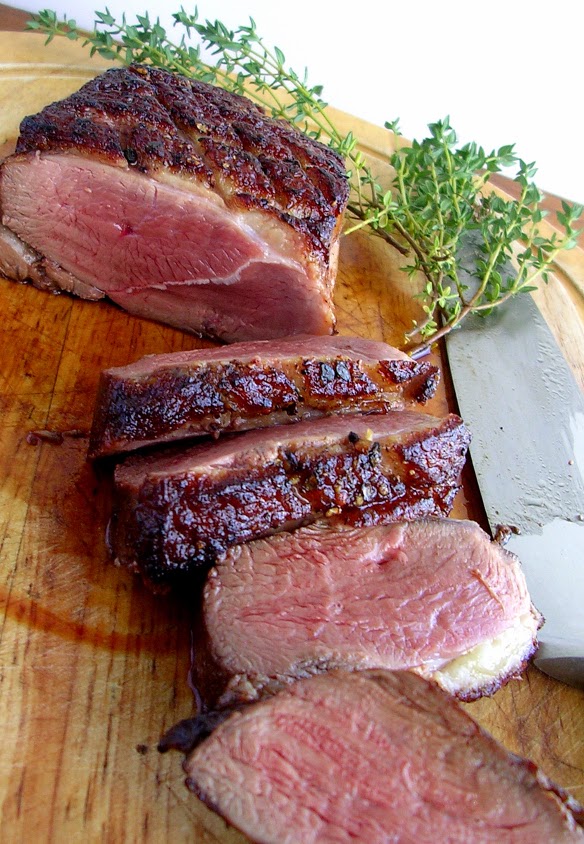
Scoring the layer of skin and fat helps to render out the fat while cooking, producing a nice crisp skin. Duck breast (also called magret) is usually served rare or medium rare, so it takes very little time to cook. It needs to rest 10 minutes before slicing. I served it with rice and sauteed pumpkin, a vegetable which goes very nicely with citrus. (Keep the reserved duck fat, refrigerated, to fry potatoes in on another day.)

Duck breast with clementine sauce--an elegant dinner.

Magret de Pato con Salsa de Clementinas
Duck Breast with Clementine Sauce


Serves 6

3 pounds boneless duck breast halves (3-4)
Salt and freshly ground black pepper
Sprigs of fresh thyme
1 tablespoon olive oil
3 shallots, finely chopped
½ cup PX wine
1 cup chicken stock
1 tablespoon Sherry vinegar
1 teaspoon anisette liqueur (optional)
5 clementines

With a sharp knife, score the skin and fat on the duck in a crosshatch, without cutting into the flesh. Sprinkle the duck breasts with salt, pepper and chopped thyme. Allow to come to room temperature.

Heat the oil in a saucepan and sauté the shallots until they are browned. Add the PX wine, stock, vinegar and anisette, if using. Season with ½ teaspoon salt, pepper and a sprig of thyme.

Remove the zest (peel without any white pith) from one of the clementines and add the zest to the saucepan with the juice of one clementine. Bring the sauce to a boil, then simmer until reduced by half, about 15 minutes. Taste for salt and add more, if needed. Discard the zest and sprig of thyme and set the sauce aside.

Peel the remaining clementines and divide into segments, removing as much of the membrane as possible.

Heat a heavy skillet and place the duck breasts, fat side down, in it. Cook them until fat is browned and crisped, about 5 minutes. Very carefully, pour or spoon off all the fat in the pan into a heatproof bowl.

Turn the duck breasts and cook the reverse side until browned, about 3 minutes for rare meat or longer for medium rare. Remove the breasts to a cutting board and allow to rest 10 minutes before slicing.

Reheat the sauce. Add 1 tablespoon of reserved duck fat to the sauce. Immediately before serving, add the clementines to the sauce.

Serve the sliced duck with sauce spooned over it.

Citrus and sweet wine make a delicious sauce for duck breast.

An elegant dish for a New Year's Eve dinner party.

HAPPY NEW YEAR TO ALL.