Showing posts with label low-carb. Show all posts

Saturday, August 7, 2021

IDEAS FOR LOW-CARB SUMMER MEALS


Grill some vegetables before putting the fish or meat on the grill. I got four different side dishes from these.


My aerobics group is on hiatus for the month of August. Good thing, too, as the thought of putting on socks and gym shoes is unbearable in this heat. While I’m hunkering down, it seems a good time to cut down on carbs such as bread, pasta, rice and other cereals and legumes. So, what’s to eat? Here are some ideas. 


  • Dorada a la espalda (butterflied bream) on the grill with roasted red pepper salad and olivada sauce.
  • Chicken breasts poached in olive oil with tomatoes and basil, a side of zoodles (zucchini noodles). .
  • Grilled leg of lamb with three sauces (Turkish walnut-red pepper sauce; olivada and baba ghanoush) with Belgian endive leaves and cauliflower dippers and pita chips for the bread eaters at the table.
  • Gazpacho for snacks, anytime of the day or night. 
These gilt-head bream (dorada) are opened up, a la espalda, so they grill in no time at all. Served with olivada sauce, sort of like tapenade, made with canned olives stuffed with anchovies, and a side of roasted pepper salad, using one of those red bell peppers, it was a lovely and quick meal for two.


One roasted pepper, peeled and dressed with extra virgin olive oil, salt and a few drops of Sherry vinegar made a side with the fish. The other three peppers I saved to make mujammara, a Turkish walnut and red pepper sauce, to go with another meal. 


No oven, no browning. Boneless chicken breasts are poached in a heavy, lidded pan with lots of olive oil and some cut-up tomatoes.  They're cooked in just 15 minutes. Sprigs of basil add a fresh flavor. Served with a side of zoodles (zucchini noodles) that cook in the microwave in 3 minutes.

No carbs, meat-centric--a boned leg of lamb on the grill. Sauces and dippers on the side. 


Three sauces to accompany the lamb or to serve with endive leaves and cauliflower florets for dipping. On the left is olivada, made to accompany the grilled fish, but pretty great with lamb, too. (Recipe for olivada is here ) At the top is baba ghanoush, made with the grilled eggplants and whole head of roasted garlic (recipe, with tahini, is from Claudia Roden's A Book of Middle Eastern Food.) On the right is mujammara, a Turkish sauce with walnuts and red peppers (mujammara recipe is here.)

Marinade for Grilled Lamb
Marinada para Cordero a la Parilla

This marinade is adapted from a recipe for Persian-style lamb kebabs. Grated onion in the marinade both tenderizes and flavors the meat. Add any combination of herbs and spices to the basic onion. Marinate the lamb up to 8 hours. Before grilling, bring it to room temperature and scrape off and discard the marinade. 

How long to grill the lamb will depend on type of grill (wood fire, charcoal or gas), thickness of the meat and preferred degree of doneness. At my house, son, Ben, is in charge of grilling—and he got it just right! 

1 large onion, chopped
2 cloves garlic
¼ cup loosely packed parsley
1 teaspoon oregano
Pinch of sumac (optional)
Salt
Freshly ground black pepper
3 pounds boned and butterflied leg of lamb


Finely chop the onion, garlic, parsley, oregano and sumac, if using, in a blender or food processor. Add 1 teaspoon salt and pepper. 

Spread open the piece of lamb. Trim off excess fat. Place in a rimmed sheet. Spread half the marinade on the skin side and turn the lamb, skin-side down. Spread remaining marinade on the meat’s surface. Cover with foil and refrigerate at least 2 hours and up to 8 hours.

To grill the lamb, scrape off excess marinade. 


No-Bread Gazpacho
Gazpacho Sin Pan

Gazpacho is a glass, perfect for sipping on a hot afternoon.


Or serve gazpacho in bowls as a starter. Drizle with additional olive oil. Add chopped serrano ham and, for bread eaters, crunchy croutons.


With a heap of tomatoes left from last week’s tasting of tomato varieties and soaring temperatures (38ºC/100ºF) I crave gazpacho. I love the traditional recipe for Andalusian gazpacho, in which a bread and olive oil emulsion gives body and smoothness to the tomatoes. But, cutting carbs, I’m eating no bread this month. Here’s an alternative version, with almonds in place of bread, that was every bit as satisfying as the traditional.

Blend chunked tomato.
The best way to prepare tomatoes for gazpacho is to chunk them up and blend them—skins, seeds and all—to a puree, then sieve the pulp to produce a silky-smooth tomato blend. 

The addition of green pepper, onion and cucumber is optional. Use  a piece, to taste, of each, for example, a 2-inch chunk of cucumber and a quarter of a green pepper and onion suit me about right. Use your best extra virgin olive oil; the flavor is important. Thin the gazpacho with water—from ¼ to 1 cup. A sipping gazpacho should be the consistency of light cream, but, if served in a bowl with a spoon, it can be thicker. 

Pour the finished gazpacho into a covered pitcher (or plastic water bottle) and chill in the fridge. Serve it in glasses for sipping or in bowls garnished with chopped serrano ham, grapes or melon, or, for those eating bread, crispy croutons.

Almonds replace bread in this gazpacho.
2 pounds ripe tomatoes
Piece of green pepper
Piece of sweet onion
Piece of peeled cucumber
2 cloves garlic
½ cup skinned almonds
¼ cup extra virgin olive oil
1 tablespoon Sherry vinegar
½ teaspoon salt or to taste
Water to thin the gazpacho

Cut the tomatoes, pepper, onion and cucumber into chunks and place in a large bowl. With an immersion blender, blend the vegetables until pureed. 

Sieve out seeds, skins.

Push the puree through a fine sieve, pressing on the solids to extract as much pulp as possible. Do this in two or three batches if necessary. Discard the solids left in the sieve.

Return about a quarter of the puree to the large bowl. Add the garlic and almonds and blend until they are finely ground. Blend in the oil, vinegar and salt. Beat in the remaining three-quarters of the tomato puree.  Thin the gazpacho with water. Chill the gazpacho.


Saturday, February 27, 2021

IT’S PUMPKIN BUTCHERING SEASON


So many possibilities with these pumpkins. The largest one is 22 inches long.

Big enough to be sentient beasts are these pumpkins, from the huerta of friends who live in the Granada highlands. The squashes have served as objets d’art on my kitchen shelf for awhile. But their time has come to submit to the knife. It’s pumpkin-butchering time. 


Knife to the heart. Not the best way to cut squash.
Hard-skinned varieties, known as winter squash, keep well during colder months. But, once broached, the flesh needs to be cooked off as soon as possible. I needed to come up with several pumpkin dishes in close succession. 

Before butternut and other small varieties of squash became widely available, my local village market sold only huge pumpkins, hacked off into pieces and sold by weight. Home cooks use the pumpkin with vegetables, legumes and sausages in stews such as berza (recipe here). 

Pumpkin guts.

    I cut the middle-sized pumpkin into thirds. (The best way to cut it is not to plunge the knife in, but to place the blade on the surface and, exerting some pressure, roll the squash against the blade.)

  Once emptied of seeds, the cavity of the thickest section seemed to beg to be stuffed. I once made a vegetarian version stuffed with grains, chickpeas and tofu (that recipe is here). This one would be stuffed with meat, without even bread crumbs, so it’s fairly low-carb.  

   Use ground meat of choice. I have ground chicken thighs, but turkey, pork, lamb or beef are equally good. The same mixture could be used to stuff peppers or baked like meatloaf, in a pan by itself. If you've got a bigger squash, increase the quantity of meat.


The squash is stuffed with meat and cheese. It bakes in a cazuela with tomatoes, which make the sauce.

Carve the pumpkin into wedges. Serve sauce alongside.


Pumpkin Stuffed with Meat
Calabaza Rellena con Carne

Serves 3 as a main dish.

2-pound whole pumpkin or squash
Salt
1 pound ground meat
3 tablespoons olive oil + additional for the baking dish
¼ cup pine nuts
¼ cup diced bacon (1 ounce)
1 cup chopped onion
½ cup diced red bell pepper
½ cup diced celery (2 stalks)
2 cloves garlic
½ teaspoon cumin
1 teaspoon sweet pimentón (paprika)
1 teaspoon oregano
Pinch of cayenne
Grating of nutmeg
Freshly ground black pepper
¼ cup chopped parsley
1 egg, lightly beaten
1 cup grated cheese (2 ½ ounces)
1 ½ cups canned crushed tomatoes

Cut the stem and top off the pumpkin. Scrape out and discard the seeds and stringy pulp in the center. Lightly salt the inside of the pumpkin and set it upside down in a colander to drain.

Heat the oil in a skillet and fry the pine nuts until they are golden. Skim them out and reserve them. Add the bacon, onion, red pepper, celery and garlic to the skillet and sauté them on moderate heat until onion is softened, 8 minutes. Season with 1 teaspoon salt, cumin, pimentón, oregano, cayenne, nutmeg, pepper and parsley. Stir in the pine nuts. Remove from the heat and allow to cool slightly.

Preheat oven to 400ºF.

Heap stuffing in shell.
Place the meat in a mixing bowl. Add the sautéed bacon and vegetables. Mix in the egg and cheese. Spoon the meat mixture into the cavity of the pumpkin. Don’t compact it. Set the stuffed pumpkin in an oiled baking dish. Pour the crushed tomatoes around it. Salt the tomatoes lightly. Drizzle additional oil over the pumpkin and tomatoes.

Bake the pumpkin 15 minutes. Lower oven temperature to 350ºF. Bake until the pumpkin is tender and meat is thoroughly cooked (it should register 150ºF on an instant-read thermometer), about 60 minutes. 

Squash baked with tomatoes.


     To serve, cut the pumpkin and stuffing in wedges or scoop the filling out of the shell. Accompany with the tomatoes and juices from the baking dish.


This piece of pumpkin roasted alongside the stuffed one. It makes a good side dish with roast chicken or pork chop. Or, perhaps to be pureed for pumpkin pie filling.


A third of the squash, cubed, in a vegetarian curry with tofu, coconut milk and peanuts.

Links to more pumpkin recipes here.

Another sort of meat loaf, Lamb Roll Wrapped in Chard.


Saturday, October 5, 2019

THE TALE OF A LONELY LITTLE SPAGHETTI SQUASH

We are bereft of pumpkins and squashes in the garden this year. Was the growing season too hot? Not enough water? No bees to pollinate the flowers? The lone survivor was a pretty, yellow spaghetti squash. 


An only squash--
Spaghetti squash is a variety not found in local markets, which is why I planted it. I make “zoodles,” thin strips of zucchini to substitute for pasta in order to keep my consumption of carbohydrates down. I figured spaghetti squash, whose flesh cooks up into skinny strands, or “spaghetti,” would be equally delicious with pesto, puttanesca or Asian peanut-sesame-chile sauce.

My singleton squash somehow deserved more elaborate fixing. How about fideuá, also known as “pasta paella,” a Valencian dish combining fideo noodles and seafood?

Shrimp, squid and mussels tossed in olive oil are pretty delicious, no matter whether you’re using real pasta or vegetable noodles. But, spaghetti squash makes noodles as thin as vermicelli, which turned out not so pretty in the finished dish. (Real fideos are more like spaghetti in thickness.) They did provide a good texture, however, with just a little crunch.

And, that’s the story of how my lonely little spaghetti squash was transformed into a Spanish dish. I´d happily ladle the whole mixture over a serving of pasta!


The beauty shot! Thin squash "spaghetti" tastes great, but doesn't have much visual presence.

Strands of squash are tangled with shrimp, squid and mussels. A sofrito gives flavour. The color comes from pimentón, not saffron.


Seafood with Spaghetti Squash “Noodles”
Fideuá con Fideos de Calabaza


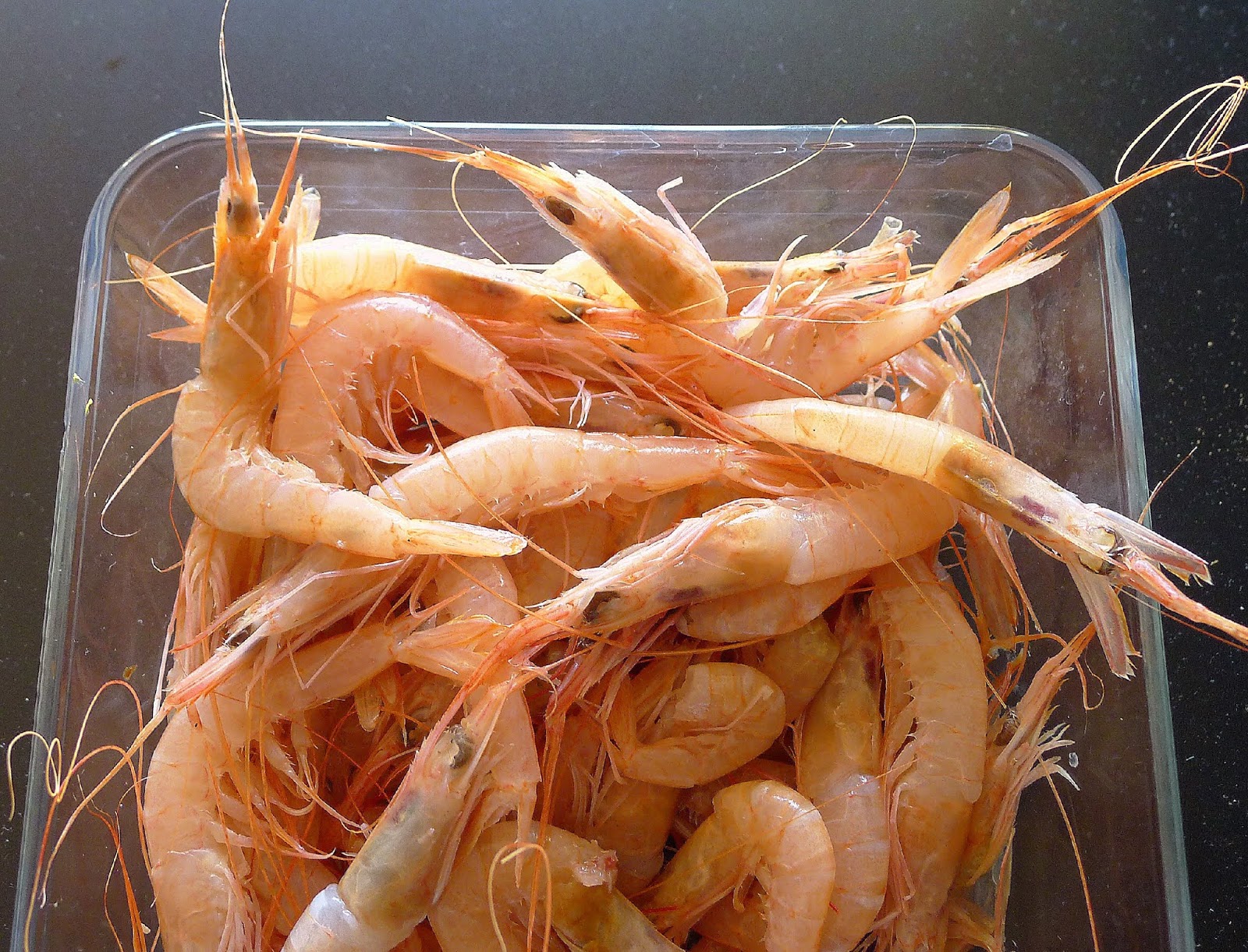
Fresh gambas blancas. Shells and heads can be used for stock or flavoring the cooking oil.

If you start with whole shrimp with heads and shells, the shells can be used to make a flavorful broth and/or to flavor the olive oil for making the sofrito. If this is not an option, use clam broth or fish stock.

You can vary the seafood in this dish. Use clams instead of mussels. Add chunks of a solid-fleshed fish such as rape (monkfish, angler) or (precooked) cuttlefish. I used thick pieces of a kind of squid called pota (flying squid). 

Serves 4.

1 (2-pound) spaghetti squash
1 pound whole small shrimp (or ½ pound peeled shrimp)
¼ cup olive oil
2 cloves chopped garlic
1 cup chopped red and green bell pepper
1 cup grated tomato pulp
6 ounces cleaned squid, in rings or chunks
¼ teaspoon smoked pimentón picante (hot paprika)
½ teaspoon sweet pimentón (paprika, not smoked)
1 cup shrimp or clam broth
Salt
8 mussels, steamed open and empty shells discarded
Chopped parsley to serve
Alioli (garlic mayonnaise) to accompany (optional)

After microwaving, squash makes strands.


Cut the spaghetti squash in half lengthwise. Scoop out and discard the seeds. Place one half, cut side down, in a microwave safe dish and add ¼ cup water. Microwave on high for 4 minutes. Turn the squash cut side up. Microwave 4 minutes more. Allow to set 5 minutes. Repeat with the other half of the squash.

When squash is cool enough to handle, use a fork to scrape the flesh lengthwise and scoop out the strands. Reserve them.

If you are starting with whole shrimp, peel them, reserving the heads and shells. Refrigerate the shrimp bodies. 


Fry the shrimp shells in olive oil, then discard the shells. Use the oil to make sofrito. Flavor!

Heat the oil in a paella pan or skillet. Add the heads and shells and fry them, stirring and crushing with a spatula, until they are completely cooked. Remove from heat. Tilt the pan so that the oil drains to one side. Use a skimmer to remove the shells from the pan. Discard them, saving the oil.

Return the oil to the heat. Add the garlic and peppers and sauté 3 minutes. Add the tomato pulp and continue frying until tomato liquid is cooked off and the sofrito begins to sizzle in the oil. Add the pieces of squid and the two kinds of pimentón. Sauté for 1 minute and add the shrimp or clam broth. Bring to a boil, reduce heat and cook gently for 10 minutes.

Add the reserved spaghetti squash to the pan. When the squash is very hot, add the shrimp. Stir to combine and cook 1 or 2 minutes. Remove from heat. Place mussels on top of the noodles. Sprinkle with parsley. If desired, serve with alioli (garlic mayonnaise) to accompany the dish.

Related recipes:


A few years ago--the pumpkin and squash yield was terrific.


Saturday, March 2, 2019

MEATBALLS, REJIGGERED

I’m crazy for meatballs. But I don’t relish the process of making them. I don’t mind rolling them, but flouring and frying a few dozen balls is a pain. I started out intending to try the oven-roasting method to cook the meatballs and wound up giving my favorite meatball recipe a complete re-make. 


Besides doing away with the frying, I eliminated the carbs (bread) from both the meatballs and the traditional almond sauce. And, I used ground chicken thighs instead of the usual pork-beef ground meat. I must say, I’m delighted with the results.

A remake of a traditional Spanish meatball recipe. The meatballs are made with ground chicken, there's no bread and they're not fried. The sauce is classic, though, with almonds and saffron.

Bread in meatball mix is not just filler. It actually keeps the meat from compacting, preventing dense, hard, dry balls.  So, I needed to replace the bread with something. Ground almonds were the perfect solution. They contributed moistness, richness and flavor. (Other gluten-free additions—although not low-carb—are chickpea flour, oat flakes, cooked rice or cornmeal.) Finely chopped mushrooms added meatiness and juiciness to the ground chicken.

In 10 minutes of roasting, the meatballs were done (no longer pink in the center), but they were browned only on the bottom. I tried turning some of them and placing them under the broiler for a few minutes, but I decided I liked the meatballs best juicy and pale, the better to show off the golden saffron sauce.

For the sauce, I eliminated the bread that usually thickens the sauce and increased the quantity of almonds.

Meatballs in almond sauce are favorite tapa bar fare.

A tapa-sized portion. In a tapas bar, meatballs are served with a few patatas fritas (fries) and chunks of bread. In keeping with the low-carb theme, I served them with neither potatoes nor bread.

Meatballs for dinner, with "zoodles"--low-carb zucchini noodles.


Meatballs in Almond-Saffron Sauce
Albóndigas en Salsa de Almendras


Makes 30 meatballs.

For the meatballs:
2 tablespoons olive oil
3 ounces mushrooms (1 cup finely chopped)
1 egg
½ cup ground almonds (unsweetened)
¼ cup finely chopped onions
2 cloves minced garlic
2 tablespoons chopped parsley
1 teaspoon salt
Freshly ground black pepper
Grating of fresh nutmeg
1 ½ pounds ground chicken thighs

Heat the oil in a small skillet and sauté the chopped mushrooms until they have lost their moisture and begin to sizzle in the oil (4 minutes). Remove from heat and let them cool slightly.

Beat the egg in a mixing bowl. Mix in the almonds, onions, garlic, parsley, salt, pepper and nutmeg. Stir in the sautéed mushrooms and oil from the skillet. 

Mix meat in very lightly.

Use a fork to fold the ground chicken into the mixture in the bowl.

Cook one meatball to taste.
(Fry one meatball in a small skillet to taste for seasoning.)


Line a rimmed baking sheet with baking parchment. 

Form the chicken mixture into walnut-sized balls. (If you like precision, that’s about 1 ounce per ball.) Place them as they are shaped on the baking sheet.

Preheat oven to 450ºF. 

Roast the meatballs until just done, 10-12 minutes. (If you want them to brown on two sides, turn them after 6 minutes.)

Roasted meatballs are browned only on the bottoms.
For the almond-saffron sauce:
3 tablespoons olive oil
¾ cup blanched and skinned almonds
3 cloves garlic, peeled
½ teaspoon saffron
10 peppercorns
1 clove
¼ cup hot water
½ cup white wine
1 cup chicken stock
Salt
Chopped parsley, to garnish

Fry almonds till golden and crisp.

Heat the oil in a skillet and fry the almonds and garlic until golden. Skim out the almonds and garlic and place them in a blender. Leave the oil in the skillet.

Crush the saffron, peppercorns and clove in a mortar. Add hot water and let the saffron infuse. 

Add the wine to the blender with almonds and garlic. Add the spices and water. Blend the mixture to make a smooth paste. 

Pour the almond mixture into the oil in the skillet. Stir in the chicken stock. Add salt to taste (about 1 teaspoon). Simmer the sauce, stirring, until it is smooth and thickened, about 8 minutes.

To serve, add the roasted meatballs to the sauce and reheat them. Serve the meatballs garnished with chopped parsley.

Ground almonds help to keep oven-roasted meatballs juicy and tender. The dark flecks in the meatballs are chopped mushrooms, which add to the meatiness.

More meatball recipes:

More recipes with almond-saffron sauce:

More low-carb recipes: