Saturday, October 26, 2024

THE TORTILLA: VARIATIONS ON A THEME

 
A classic potato tortilla with the addition of wakame seaweed.

Do you ever come across a recipe on Instagram that you’ve just got to try? Me, rarely. But a post for potato tortilla with wakame seaweed from Porto-Muiños (#portomuinos), Galician harvesters and distributors of algae products, grabbed me. An interesting variation on a classic and I just happened to have all the ingredients to hand.


I can buy several types of algae at my local market at the “health food” stall. Wakame is my favorite. It tastes like a sea breeze smells and is nicely chewy. I use wakame in salad with sesame to accompany sushi, poke and tuna tataki. But, seaweed with potatoes cooked in olive oil? Yes! Wakame adds an interesting flavor as well as texture.  

Shards of dry wakame.
Wakame comes layered in stiff sheets that have been pressed and dried.  After 10 minutes of soaking, it turns from black to dark green and softens to a chewy consistency. Once rehydrated it can be used raw or cooked.

I accompanied the seaweed tortilla with a mushroom sauté al ajillo which also was a variation on a traditional recipe. Instead of the usual champiñones I used white shimeji mushrooms, a product that recently turned up at my local grocery store. With some cherry tomatoes the tortilla and mushrooms made a delightful vegetarian lunch. 

Tortilla is perfect for a vegetarian lunch.

Variation on a theme: champiñones al ajillo made with shimeji mushrooms.


Potato Tortilla with Seaweed
Tortilla de Patatas con Alga

The Porto-Muiños recipe calls for patatas gallegas, Galician potatoes. Those with the PDO Indicación Xeográfica Protexida Pataca de Galicia—protected geographic indication, potato of Galicia, are the Kennebec variety. Not always available where I live, I used ordinary russet-type potatoes for this tortilla.

Potatoes for tortilla are best cooked slowly—not fried—in lots of olive oil. The potatoes absorb very little of the oil, which can be strained and used again. I like onions in tortilla, although the recipe from Porto-Muiños didn’t include them. Your choice.  

½ ounce dry wakame 
1 pound potatoes
½ cup olive oil
Salt
3 tablespoons chopped scallions (optional)
6 eggs
Freshly ground black pepper
Wakame after soaking.

Break the wakame into several pieces. Place them in a bowl and cover with warm water. Soak 5 minutes. With the fingers, prise apart the layers of wakame and soak 5 minutes more. Drain. Discard any clumps that have not softened. Cut any large pieces into shreds. (Makes approximately 1 cup of ready-to-serve seaweed.) 
Cook eggs and potatoes to set.

Peel the potatoes and slice them thinly. Heat the oil in a large skillet. Add the potatoes, lower heat and cook the potatoes, turning them frequently, without letting them brown. Sprinkle with ½ teaspoon salt. When potatoes are almost tender, about 15 minutes, add the scallions, if using. Cook another minute. Remove the potatoes and onions with a skimmer. Reserve the oil.

Beat the eggs in a bowl with 1 teaspoon of salt and pepper. Add the wakame and potatoes. Let the mixture stand 10 minutes.

Add 1 tablespoon of the reserved oil to a small (8-inch) no-stick skillet. When hot, pour in the egg-potato-wakame mixture. Stir it gently for 30 seconds, then allow to set on the bottom, 3-4 minutes. Adjust heat so that it doesn’t brown or scorch. 

Have ready a flat plate or pan lid. Place it on top of the skillet and hold it tightly while reversing the skillet so that the tortilla turns out onto the plate. Carefully slide it back into the skillet to cook on the reverse side, about 2 minutes. Lift the edge of the tortilla and slide it onto a serving dish.

Serve the tortilla hot or room temperature. 


Shimeji Mushroom Sauté
Setas Shimeji al Ajillo

White shimeji mushrooms, also called beech mushrooms, are a cultivated version of a wild fungi. They somewhat resemble enokitake mushrooms—shell-like caps with slender stems. Sauté them quickly for a slightly crunchy finish or add them to stews and soups to cook to chewiness. 

Chopped ham is often added to mushrooms al ajillo. If you’re cooking a vegetarian meal, just omit it. 

Slice root-end off shimeji mushrooms.

Serves 2-4.

1 bunch (about 6 ounces) shimeji mushrooms
3 tablespoons olive oil
2 cloves garlic, sliced
Red pepper flakes
½ ounce diced serrano ham (optional)
Salt
2 tablespoons dry Sherry
2 tablespoons chopped parsley

Fry with garlic.


Wash the whole bunch of mushrooms in a bowl of water. Drain. Cut off and discard the clump of root ends. Separate the mushrooms. Heat the oil in a skillet. Add the garlic and red pepper flakes and fry them 30 seconds. Add the mushrooms and sauté 1 to 2 minutes. Add the ham, if using, and Sherry. Cook 1 to 2 minutes until the alcohol is cooked off. Serve the mushrooms hot garnished with parsley.

Shimeji mushrooms sautéed with garlic, finished with Sherry.


Follow me on Instagram #mykitcheninspain

More recipes with seaweed:


More about Galician potatoes here.

More tortilla recipes:


Saturday, October 19, 2024

ORANGE SEASON BEGINS!

 
First of the season's oranges!

Early harvest oranges have begun to appear in local markets, reminding me of one of Spain’s gastronomic treasures—the orange, both sweet and bitter.


 “Valencia oranges” are famous, but Sevilla is equally well-known for citrus fruit and for the beautiful bitter orange trees that line the avenues of the Andalusian city.

The Sevilla orange is the protagonist of the 23rd annual Gastronomy Days (Jornadas Gastronómicas) sponsored by Hoteles de Sevilla. Oranges will be featured on the menus at 26 participating hotels until November 10 (see the list here ). As an example, Restaurant los Rincones del Marqués at the Hotel Palacio Villapanés offers Ibérico pork with bitter orange, wild mushrooms and braised artichokes; wild sea bass with orange; steak tartar in brioche with an orange-achiote emulsion; baby lamb with orange and rosemary honey. There’s even an orange wine to accompany the meal.

I’m not in Sevilla this month, but I am inspired to get creative with oranges. Here is a recipe for Sole with Orange Sauce as well as links to recipes with oranges that I have posted in the past. 

Fish with Orange-Caper Sauce
Pescado con Salsa de Naranja y Alcaparras

Pan-fried sole are sauced with orange-caper sauce. 

I was looking for gallineta, a rockfish that I thought would be especially good with orange sauce, but it was not available that day at my market.  I purchased two 8-ounce sole. I had them gutted, skinned and heads removed. This provided two 6-ounce ready-to-cook fish on the bone. Larger sole could be filleted or you could use fillets of any white fish such as sea bass, cod or grouper.

Serves 2.

2 (8-ounce) sole, cleaned and skinned
Salt
Flour
Olive Oil
¼ cup white wine
½ cup fish stock
¼ cup orange juice
1 tablespoon drained capers
1 tablespoon cold butter
Chopped parsley
Sliced oranges for garnish
Fried leeks to garnish (optional)


Sprinkle the fish with salt and allow them to come to room temperature. Dust them with flour on all sides. Add enough oil to cover the bottom of a skillet and place on medium-high heat. Add the fish and fry them until browned, about 2 minutes per side. Remove the fish and keep them warm.

Garnish with oranges and fried leeks.

Pour off all but 1 tablespoon of the oil. Add the wine and cook, stirring up any browned bits on the bottom of the pan. Let the wine reduce to 1 tablespoon. Add the stock and orange juice. Cook on medium heat until the sauce is reduced by half. Add the capers and heat thoroughly. Taste and add salt if needed.

Remove the pan from the heat and add the butter in small pieces, swirling it into the hot sauce. 

Place the fish on a platter or individual plates. Spoon over the orange-caper sauce. Sprinkle generously with parsley. Garnish the plates with sliced orange and fried leeks, if desired.

Shredded, fried leeks.
For the fried leeks: Wash the leek and remove outer layer. Cut the white part of the leek into 4-inch segments. Cut the segments in half lengthwise. With a sharp knife, slice the leek lengthwise into thin strips/threads. Soak them in ice water for 20 minutes. Drain well and pat dry on paper towels.

Fry the leeks in 2 inches of oil in a deep pan until they are golden-brown. (Use a deep pan as moisture in the leeks can cause the oil to bubble up.) Skim the leeks out and drain well on paper towels. Sprinkle them lightly with salt.


More recipes with oranges, sweet and bitter:

Orange-date salad.
Orange Gazpacho Cream (Porra).


Beer-battered fish, sour orange sauce.


Fish Soup with Sour Orange.


Orange-Saffron-Sherry Olive Oil Cake


Saturday, October 12, 2024

THE MEAT CHEAT


Pot-roasted beef chuck.

I have to confess that last week when I was making shredded beef for Venezuelan empanadas, I did not follow Juana’s recipe for carne mechada, which is essentially “boiled beef.” Instead I prepared beef chuck pot-roasted with wine to serve for a holiday dinner. We enjoyed the tender beef, rich gravy, roasted carrots and mashed potatoes one day. The leftovers were perfect for shredding and mixing with spicy sofrito for filling empanadas (or tacos) on another day. 


“Carne mechada” actually means “larded meat.” Larding is a technique of threading strips of fat, sometimes with garlic and herbs, through a piece of meat to keep it juicy during slow cooking. Chefs use a larding needle; home cooks just cut slits in the meat and insert the seasoning with the tip of a knife. 

Cutting corners, I simply mixed the garlic, spices and herbs and used them as a rub, spreading the mixture over the meat and into the crevices. Olive oil replaced larding fat.

I am still experimenting with Spanish beef cuts for pot roast. I intended to buy flank steak, which is the designated cut for making the shredded beef for empanadas. Flank may be labelled “vacío” or “falda” (which actually means the skirt, a different cut). But finding a nice hunk of aguja, which is chuck steak, I opted for that instead. I still haven’t found an equivalent to brisket. 

Let meat rest before slicing.

Pot Roast with Herbs
Carne Mechada con Hierbas

Vegetables can be added to the meat during the second hour of roasting. Carrots, parsnips, small onions, squash wedges, potatoes are all good. Personally, I like mashed potatoes alongside pot roast, the better to soak up the delicious onion gravy.

Roast vegetables with the beef.
Serves 6.

2 pounds chuck, skirt, flank or brisket
1 teaspoon salt
Freshly ground black pepper
½ teaspoon cumin
1 teaspoon oregano
½ teaspoon thyme
1 teaspoon smoked pimentón (paprika)
1 bay leaf, crumbled
3 cloves garlic, slivered
2 tablespoons olive oil
1 large onion, sliced
1 cup red wine
½ cup pureed fresh or canned tomatoes
½ beef bouillon cube (optional)
Carrots or other vegetables
Flour or cornstarch to thicken gravy (optional)

The piece of chuck can be left whole or divided into 3 or 4 chunks. In a small bowl combine the salt, pepper, cumin, oregano, thyme, pimentón and bay leaf. Rub this mixture on all sides of the meat, particularly into the deep crevices between muscles. Insert slivers of garlic where possible. Drizzle over the oil. Let the meat rest at room temperature for 40 minutes (or refrigerated up to 24 hours).

Preheat oven to 400ºF.

Lightly oil a roasting pan or cast iron skillet. Layer the onions on the bottom of the pan and place the meat on top. Roast the meat 20 minutes.

Lower oven temperature to 325ºF. Add wine and tomatoes to the pan. Crumble the bouillon cube, if using, and scatter it around and over the meat. Place lid on pan or cover the meat with a sheet of aluminum foil. Return the pan to the oven for 60 minutes.

Baste the meat with the liquid in the pan. Add carrots or other vegetables to the pan. Cover and return to the oven until the meat is fork tender, about 60 minutes. 

Pan juices for gravy.
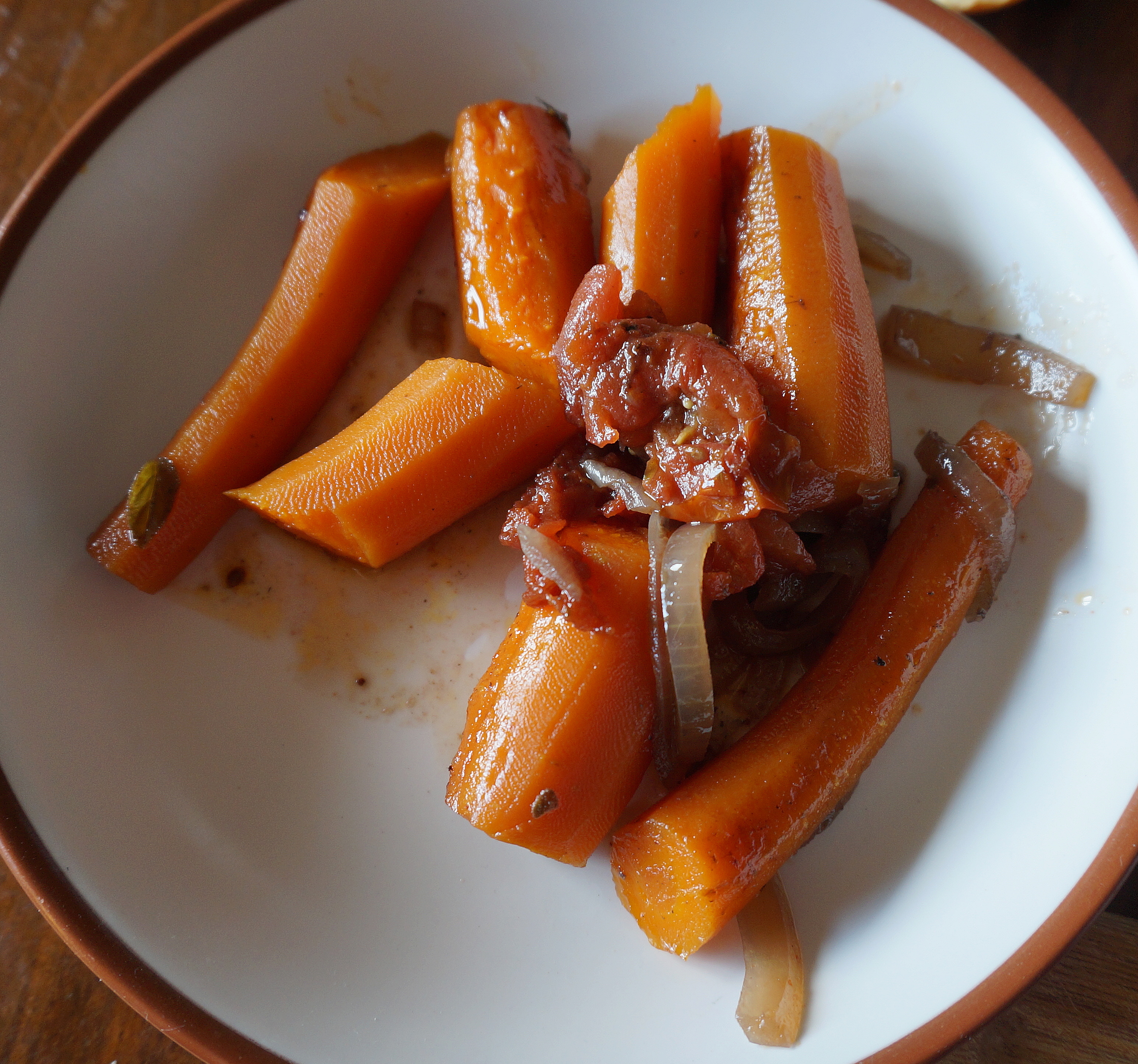
Carrots on the side.
Remove the vegetables from the pan to a serving bowl. 

Place the meat on a cutting board and allow it to stand 10 minutes before slicing.

The pan juices with onions can be reheated and served alongside the meat or the onions strained out and the liquid thickened with flour or cornstarch. If not serving immediately, cool the meat in the cooking liquid and refrigerate it.


More recipes for braised or stewed beef: