Showing posts with label bomba rice. Show all posts

Saturday, September 18, 2021

A WEEKDAY PAELLA


You can have this paella on the table in less than an hour--perfect for a weekday.


World Paella Day falls this year on an ordinary Monday (Sept. 20). So, instead of a grand, Sunday production for a crowd, I’m adjusting my recipe to make a weekday paella to serve only two.


What makes this a weekday paella? I’ve cut a few corners, making it fairly quick to prepare. Frozen fish fillets, a package of boneless chicken thighs, canned mussels. The sofrito gets short shrift, done in 5 minutes instead of 30. The small pieces of chicken don’t need slow browning. I’ve used canned, crushed tomatoes and reduced them on high heat. (For an authentic Valencia paella recipe, step by step, see The Secret to Great Paella.)

The recipe is for paella Parellada, “boneless” paella, supposedly invented in Barcelona in the 19th century for a finicky diner (his surname was Parellada) who didn’t want to mess with fish spines, shrimp shells and chicken bones. 

It’s a paella mixta, mixed paella, because it includes meat (chicken and sausage), fish (angler) and shellfish (shrimp, cuttlefish and mussels). You can use all of these ingredients or pick and choose among them, according to availability, tastes and prep time. 

Dinner for two, paella rice with fish, shellfish, chicken and vegetables.


Paella Parellada is a "boneless" paella--no shrimp or mussel shells, no fish bones, boneless chicken pieces. 


Boneless Paella
Paella Parellada

This recipe generously serves two, but, as a tapa, starter or light meal, it easily extends to serve four.

Use boneless, skinless chicken thigh or breast, cut into 1 ½-inch pieces. Firm-fleshed, boneless anglerfish is best because it’s so easy to cut bone-free chunks off the center spine. Boneless chunks of any white fish can be substituted. Use cuttlefish, if available. Pieces of squid or whole scallops could substitute. Use cooked and shelled clams or mussels, fresh or canned. Butifarra is a Catalan sausage. If not available, use any pork link sausage. Saffron is optional; pimentón colors the rice. Use grated fresh tomatoes or canned crushed (triturado) tomatoes. Bomba is the best rice for this paella, but any medium, round-grained rice is fine. If possible, use fish or shellfish stock for the liquid to cook the paella. Otherwise, use chicken stock or water.

Ingredients for the paella: in the center are medallions of anglerfish, peeled shrimp, and pieces of cuttlefish. Clockwise from top left: canned crushed tomatoes, Sherry, boneless chicken thighs, Bomba rice, frozen peas, romano green beans, pimentón, Butifarra sausage, canned mussels and diced red bell pepper.


3 tablespoons olive oil
4 peeled jumbo shrimp (2 ½ ounces)
4 medallions of angler fish (6 ounces)
6 ounces boneless chicken, cut in pieces
Salt
Freshly ground black pepper
4 slices butifarra or other sausage (1 ½ ounces)
¼ cup diced red bell pepper
¼ cup chopped onion
3 ounces cuttlefish, cut in pieces 
1 teaspoon pimentón (sweet paprika)
Saffron threads (optional)
½ cup crushed tomato
3 tablespoons Sherry
1 cup Bomba rice
2 ¼ cups fish broth
4 romano green beans, cut in 1-inch lengths (2 ounces)
¼ cup frozen peas, thawed
8 canned mussels, drained

For the picada:
2 tablespoons finely chopped parsley
1 clove garlic, minced
5 tablespoons extra virgin olive oil
Flaky salt

Heat 2 tablespoons of the oil in a paella pan on moderate heat. Add the shrimp and fish medallions and sauté, turning once, until they are lightly colored. The shrimp should be completely cooked; the angler, partially cooked. Remove them from the pan.

Add the chicken and slices of sausage to the pan and cook them until browned. Remove them.

dd the remaining 1 tablespoon of oil to the pan with the red pepper, onion and pieces of cuttlefish. Sauté 2 minutes until onion is softened. Stir in the pimentón and saffron, if using. Add the crushed tomato and raise the heat to cook off the liquid, 2 minutes. Add the Sherry and cook off the alcohol, 1 minute. Add the rice and stir for 1 minute. Add the broth and bring the liquid to a boil. Cook the paella on moderately high heat for 5 minutes.

Blanch the green beans in boiling water for 2 minutes and drain them. Add the beans to the pan with the reserved chicken and sausage. Stir to distribute all the ingredients, then don’t stir again. Reduce the heat to moderate and cook 10 minutes. 

Place the pieces of fish in the rice. Place the shrimp on top. Scatter the peas over the rice. Place the mussels around the edge. Cook until the rice is al dente and the liquid absorbed, about 4 minutes more.

Add parsley picada.


While the paella is cooking, make the picada. Combine the parsley, garlic, olive oil and salt. 

Remove the paella from the heat. Spoon some of the picada mixture over the top. Cover the pan with a cloth or sheet of foil and allow the paella to rest 5 minutes before serving. Accompany with remaining picada.


Allow paella to stand 5 minutes before serving.


Saturday, March 9, 2019

A RICE DISH FROM ANDALUSIA

A friend recently posted photos on Facebook of lunch with friends at a restaurant on the banks of the Guadalquivir River, south of Sevilla. One of the dishes pictured was arroz caldoso con pato—soupy rice with duck. 


When you think of Spain and rice, you probably don’t think of Andalusia.  But, not all Spanish rice is paella and not all rice comes from Valencia. In fact, more rice is produced in Las Marismas, the wetlands of the lower Guadalquivir River, than anywhere in Spain. Here, rice dishes are as indigenous as paella in Valencia.

Rice cooked with duck legs and mushrooms is caldoso, or soupy.

The Marismas, bordering the national park of Coto Doñana, are rich in wildlife. For centuries, this has been prime hunting territory, both for the rich and titled and for the poor who inhabit the region. Hunters might cook up a pot of rice with wild duck and seasonal wild mushrooms.

I didn’t have wild duck, nor even fresh duck. But I had several legs of duck in confit—cooked in duck fat and vacuum-sealed. No wild mushrooms either, so portobellos and shitakes would have to stand-in for the woodsy, wild fungii. (Typical in this region are gurumelos, amanita ponderosa; tanas, amanita caesarea, and senderuela, marasmius oreades or “Scotch bonnet.”)

Manzanilla is fino Sherry made in Sanlucar de Barrameda, the town where the Guadalquivir finally empties into the ocean. Use manzanilla to cook the rice and serve it with the meal too.

Bomba variety of rice absorbs less liquid. If you want the rice even soupier, add more cooking liquid.


Whole duck legs, conserved in confit, are already cooked, so add them to the rice near the end of cooking.


Pimentón (paprika) adds color and flavour. Saffron can be used as well.


Soupy Rice with Duck and Mushrooms
Arroz Caldoso con Pato y Setas

If you are using fresh, not confit, duck, cut it into small serving pieces, removing as much fat as possible. Use the back and wings to make stock. Add the pieces of duck to the pan with the liquid and cook until it is tender, 30-40 minutes, before adding rice.

Use medium-short grain rice, preferably the Bomba variety because it does not “flower,” or open up, when cooked in lots of liquid. Don’t wash the rice and don’t stir it once the duck has been returned to the pan.

Pimentón (paprika) both colors and flavors the rice. Use ordinary sweet pimentón, not smoked. Saffron can be used, if desired.

Duck legs in confit are already cooked. Scrape off all the fat before adding them to the rice.

Serves 4-6.

4 confit duck legs (about 10 ounces each)
3 tablespoons olive oil
1 cup chopped onions
½ cup chopped green pepper
¼ cup chopped red bell pepper
3 cloves garlic, chopped
5 ounces mushrooms, sliced or quartered
1 cup chopped tomatoes
1 teaspoon pimentón (paprika)
¼ teaspoon coarsely cracked black pepper
½ cup manzanilla or fino Sherry
5-6 cups chicken or duck stock or water
Sprig of thyme
Salt
1 ¼ cups medium-short-grain rice, preferably Bomba variety

Scrape fat from the duck legs. (Save it for another use.) Save any juices or gelatin clinging to the meat. 

Heat the oil in a cazuela or deep sauté pan. Brown the pieces of duck on both sides and remove. Add the onions, green and red peppers and garlic to the pan and sauté for 5 minutes. Add the mushrooms and continue sautéeing. Add the tomatoes and fry them until they lose their juice. 

Stir in the pimentón and pepper. Add the manzanilla. Cook off the alcohol, 3 minutes. Add any reserved juices or gelatin from the duck. Add 4 cups of the stock or water. Bring to a boil. Add the sprig of thyme and salt to taste. Stir in the rice. Let the rice cook, uncovered, on medium-high heat for 5 minutes. 

Rice starts with a sofrito, including mushrooms, then cooks in stock 5 minutes before duck is returned to the pan.

Return the pieces of duck to the pan. Add remaining 1 or 2 cups of stock or water to the pan and bring to a boil. Lower heat so the rice bubbles gently. Cook without stirring the rice until it is tender, 12 to 14 minutes more. 

Let the rice set 5 minutes before serving. 


Another "soupy" rice dish: Chicken with Soupy Rice and Vegetables.
Another rice dish from Andalusia: Córdoba Rice in a Skillet.

Web site for Gerry Dawes, the friend who posted the photo of duck with soupy rice that inspired this blog. Gerry knows lots about Spanish food and wines.

Saturday, October 24, 2015

RICE IN A SKILLET FOR SAN RAFAEL DAY

I once arrived in Córdoba on a fine day in October, to find it was a local holiday, the feast of San Rafael (October 24). The whole town closed up shop and headed for the hills for a midday cookout. The favorite dish for San Rafael day is perol de arroz, rice cooked, not in a flat paella pan, but in a deep two-handled frying pan, over a fire of thyme, rosemary, wild oak and olive. And, unlike paella, the perol contains no seafood, only meat such as rabbit, chicken, pork and sausage.

Family and friends gather round while the rice cooks, then everybody eats from the same pan—cucharón y paso atrás—spoonful and step back.

The ruins of Medina Azahara, a Moorish palace, outside of Córdoba.

In actuality, as urban areas have spread, the open campo, or countryside, is no longer an easy walk from town. When I visited the ruins of Medina Azahara, a fabulous Moorish palace outside of Córdoba, I was amused to see signs posted in the adjoining fields: prohibido los peroles--“prohibited to cook rice in perol here,” because it was private property.

Cook over a wood fire--or in the kitchen.

I decided this would be a fine dish to serve my family and neighbors for Sunday lunch in my campo. Actually, I cooked it in the kitchen, not outdoors. Everybody enjoyed it—except the 11-year-old, who refused to eat the rabbit. He had been cavorting with bunnies just the day before and eating them was beyond the pale.

Add any vegetables you like. Asparagus and mushrooms are usual ones. I used green beans as well as asparagus, because my garden is overrun with beans right now.

Spanish cooks don’t usually use real saffron for their rice dishes, but a powdered yellow coloring. I like real saffron plus I add some pimentón (paprika), not smoked, for added color.

A perol, made of rolled steel, is lightweight and easy to manage over a wood fire. In the kitchen, use a flat-bottomed wok or any deep skillet. The rice should stay meloso, juicy, rather than dry like paella. If possible, use Bomba variety of medium-short-grained rice, as it doesn’t “flower” and overcook as readily as ordinary paella rice.

Córdoba wine, fino from the D.O. region, Montilla-Moriles, goes into the rice. If not available, use dry Sherry or white wine. It’s perfectly acceptable to drink Montilla right through the meal. Or, with rabbit, serve red, white or rosé! It's a "white" meat, farm-raised, so it's not gamy.


Rice cooked in a deep skillet, with rabbit, pork, mushrooms, beans and asparagus.
Rice in a Skillet, Córdoba Style
Arroz en Perol, a la Cordobesa

Serves 6.

2 pounds rabbit or chicken, cut in 6 serving pieces
Salt and pepper
¼ cup olive oil
8 ounces pork, cut in 1-inch cubes
½ cup chopped onion
1 cup sliced mushrooms
1/3 cup chopped green pepper
3 cloves chopped garlic
Red pepper flakes (optional)
1 cup diced tomato
Sprig of fresh thyme or crumbled dry thyme
¼ cup chopped parsley
1 bay leaf
1 cup chopped asparagus
¼ cup fino Montilla-Moriles
5 cups chicken broth or water
2 cups Spanish medium-short grain rice
¼ teaspoon saffron threads, crushed, and/or yellow food coloring


Season the rabbit or chicken with salt and pepper. Heat the oil in a deep skillet and put in the meat. Brown it very slowly, then remove. (It may be necessary to do this in two batches.)

Add the pork cubes, onion, mushrooms, green pepper, garlic and red pepper flakes, if using. Continue stirring and browning the meat.

Add the tomato and continue cooking on a medium heat. Return the rabbit pieces to the pan. Add the herbs, asparagus and the fino wine. Bring to a boil, then add the broth or water. Bring to a boil and stir in the rice.

Mix the saffron and/or yellow food coloring into 3 tablespoons of water. Dribble it into the rice and stir to combine.

Cook on a high heat for 6-7 minutes. Then lower the heat and cook 14-15 minutes more, without stirring, until most of the liquid is absorbed and rice is done. Let set 5-10 minutes before serving.


Saturday, March 21, 2015

RICE "ON THE SIDE"

Last week, after filleting a whole corvina, I saved the head, bones and trimmings to make fish stock. Usually I stash stock in the freezer, ready for making one of my favorite Spanish fish soups. This time I decided to use that pot of concentrated flavor for a Spanish rice dish that’s not paella.


Flavorful rice and not much else.

Arroz abanda (in Alicante lingo, it’s arròs a banda) means rice “on the side.” It’s sort of like paella but without all the baroque trimmings. Originally it was a simple fisherman’s dish cooked on board a trawler. Some of the day’s catch was boiled in a pot, then skimmed out. Rice was added to cook in the tasty broth. The rice was served first, followed by the boiled fish.

The dish has since achieved near-cult status, especially in the provincial city of Alicante, where the rice is usually prepared in a paella pan instead of a fisherman’s kettle. It can be served in solitary splendor as a starter or as a side dish with fish cooked simply. A pungent alioli (garlic sauce) is the only accompaniment.

The success of arroz abanda depends on starting with a flavor-packed fish stock. You’ll find a basic recipe here. Use small, whole fish; trimmings from larger fish; crustacean shells; clam or mussel juices.

About Spanish rice. Spanish rice, the kind used for paella, is a round-grained, medium-short variety. Spanish rice has a white perla (pearl), where the starch is concentrated. Its great virtue is as a flavor conductor, soaking up the savory juices with which the rice cooks—olive oil sofrito, chicken, rabbit or seafood,  saffron. Spanish (often called “Valencian”) rice is similar to Italian varieties used for risotto. But the cooking method is totally different. Risotto is stirred to develop the creamy starch. Paella rice, cooked “dry,” is never stirred, as stirring would break up the starch kernel.

Bomba is one of several varieties of rice grown in Spain (it may be from the region called Calasparra). Bomba rice is especially esteemed for caldoso (soupy) and meloso, juicy, rice dishes because the kernel of starch doesn’t burst open and make the rice sticky. Bomba rice is absolutely not necessary for paella.

But, for this recipe, if possible use the bomba variety of rice because it will absorb more of that flavorful fish stock (use triple the volume of liquid to rice). If using varieties other than bomba, decrease the quantity of stock, using approximately double the volume of liquid to rice.

Ñoras are small dried peppers.
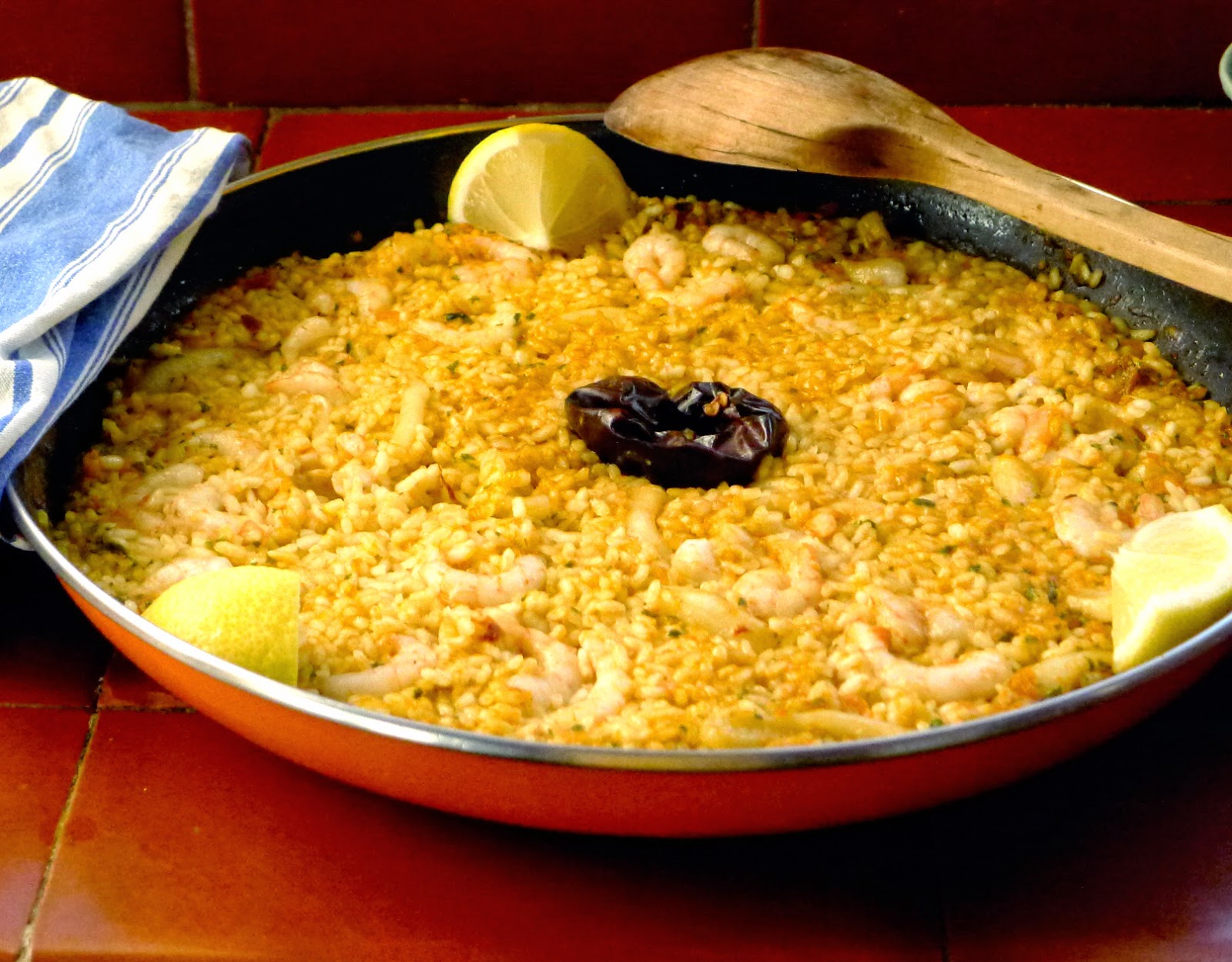
The traditional recipe calls for the pulp of a ñora, a bittersweet dried red pepper, the same pepper used to make pimentón (paprika). If not available, substitute a spoonful of sweet pimentón, stirred with a little water to make a paste. Saffron is optional; it adds that vibrant golden color.

Fry shrimp shells for flavor.
In addition to the fish stock, this recipe also calls for flavoring the cooking oil with shrimp shells and heads. If you haven’t got heads and shells, just omit this step. And, instead of a sofrito of chopped vegetables, it calls for a picada of tomatoes, ñora, garlic and parsley crushed in a mortar or blender.


Arroz Abanda
Rice on the Side

A few shrimp and pieces of squid for a tasty rice dish.

Serves 6 as a starter or side dish.

2 ñoras (or 2 teaspoons pimentón)
¼ cup boiling water
12 ounces small unpeeled shrimp (or 6 ounces peeled)
2 small tomatoes, peeled and chopped
3 cloves garlic
Small bunch of flat-leaf parsley, chopped
Salt
4 tablespoons olive oil
6 ounces squid, cut in rings
Pinch of saffron threads (optional)
2 cups medium-short rice, preferably bomba variety
5 ½-6 cups fish stock, heated
Alioli (garlic mayonnaise) to serve


Remove stem and seeds from the ñoras. Place one of them in a small bowl and add boiling water. Allow to soak 30 minutes.

Peel the shrimp, reserving both the bodies and the heads and shells.

Ingredients for a picada to flavor the rice.
Make the picada. Open the soaked ñora and, with the side of a spoon, scoop the pulp from the skin. Discard the skin and add the pulp to a mortar or blender. (Add the soaking liquid to the stock pot.) Add the tomatoes, garlic, parsley and ½ teaspoon salt to the pulp of the ñora. Crush or blend to make a smooth paste.

Heat 3 tablespoons of the oil in a paella pan, cazuela or skillet. Add the reserved shrimp heads and shells. Sautée until shells turn pink. Skim out the heads and shells and discard them, reserving the oil.

Add remaining 1 tablespoon oil to the pan. Add the remaining ñora and fry it on all sides. Remove the ñora and reserve. Add the tomato-garlic paste to the pan and sautée, stirring. Add the squid rings and the saffron threads.

Stir in the rice and let it sautée a few minutes. Add the hot stock. Cook the rice on a high heat for 8 minutes. Taste and add additional salt if needed. Stir in the reserved shrimp. Return the fried ñora to the pan, placing it in the center of the rice. Lower the heat and cook until rice is cooked, 15-18 minutes longer. Let the rice set 5 minutes before serving. Serve accompanied by alioli.

Serve rice with alioli--garlic mayonnaise.
Alioli
Garlic Mayonnaise

This is not a true alioli, which is an emulsion of crushed garlic and olive oil. But this simplified version is quick and delicious.

½ cup bottled mayonnaise
1-2 cloves garlic
3 tablespoons extra virgin olive oil
1 tablespoon fresh lemon juice
Salt, if needed


Place the mayonnaise, garlic, oil and lemon juice in a blender. Blend until smooth. Taste and add salt if necessary. Keeps, refrigerated, up to 1 week.