Showing posts with label anniversary. Show all posts

Saturday, November 30, 2024

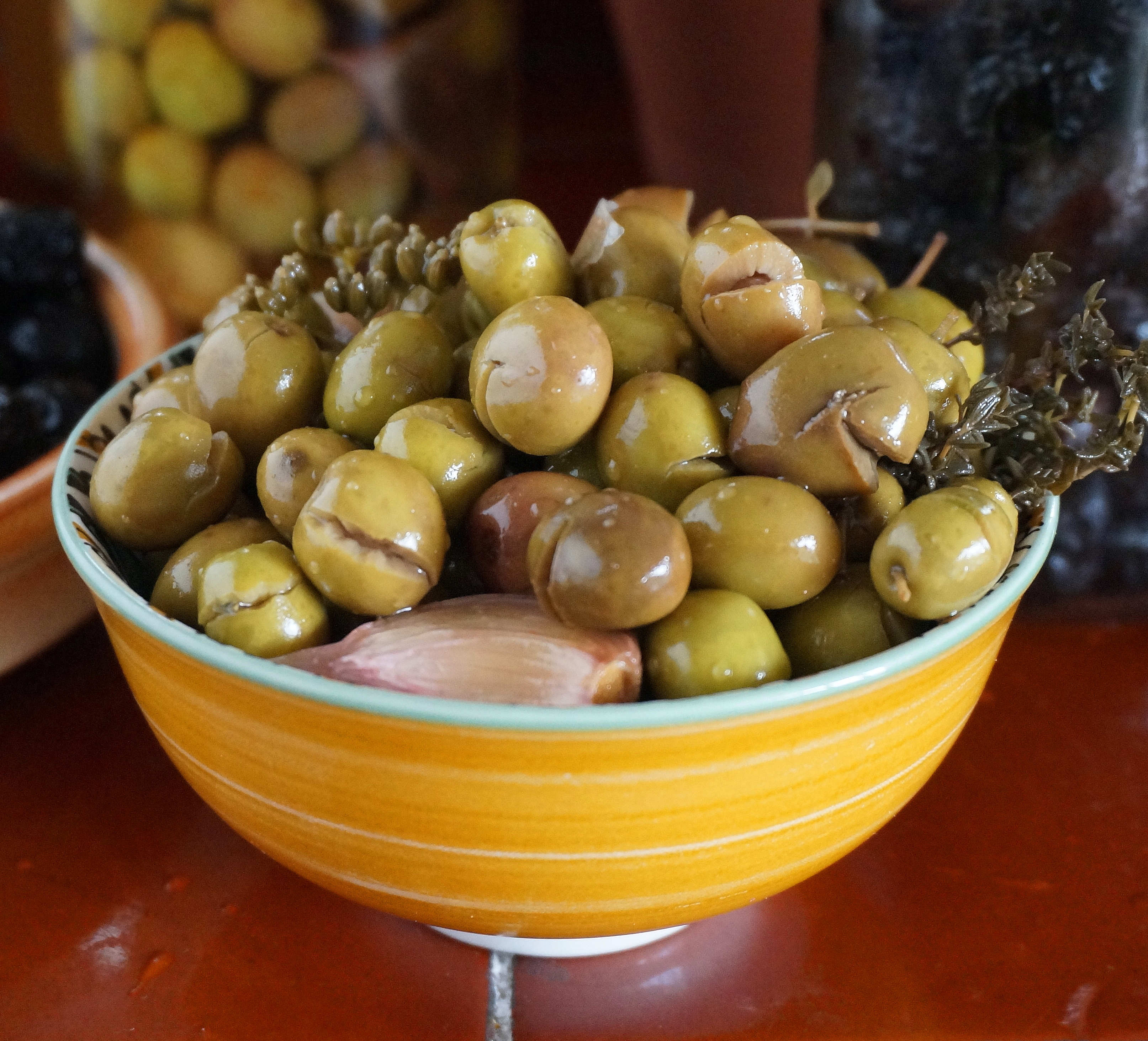
MY BIG FAT SPANISH OLIVES

 
Fat Manzanilla olives.

I’m celebrating an anniversary! This blog has been going, pretty much weekly, for 15 years! In honor of the occasion and of olive-picking season, I am posting that first blog with updates and a new recipe. 


(November 2009.) I like to tell my guests that the olives they are nibbling come from the tree they’re sitting under. No, don’t reach up and pluck one! Straight from the tree, they are impossibly bitter and astringent. Olives need a curing process to make them edible.

That’s what I’m doing this week, picking, sorting, cracking and soaking olives that will become table olives, eating olives. They are picked green—soon after the first fall rains soak the parched earth and plump up the olives. 

Nov. 2024. We picked more than a month ago and are now tasting the cured olives. 

Most of my olive trees are varieties usually pressed for oil. But I have several Manzanilla trees that produce big fat, fleshy olives, the same kind you usually find in jars at the supermarket. The home-cured ones are very different from commercial olives. Commercial olives are soaked in an alkaline solution (lye) to remove the bitterness. Home-cured ones require nothing more than water and salt, plus seasoning. 

I prepare my olives in the Andalusian style that I learned from local country people many years ago. 

Cracking olives before brining.
First, the olives must be cracked with a stone or mallet to split them open. This allows the soaking liquid to quickly penetrate to the pit. Uncracked olives require months to sweeten; split ones take about three weeks. 

I wear old clothes because smacking olives splatters oil everywhere. I’ve also tried the method from Extremadura, where olives are rayado, incised with a sharp blade. (I resisted buying a rough wooden tool that had both a clapper for splitting open the olives and a hole with blades for slitting them.) As an experiment this year, I used a little gizmo, like a hole-punch, to remove the pits from some of the olives. (I’ll report back on whether this was successful or not.)

I place the olives in small earthenware jugs, orsas.  I cover them with water. I use non-chlorinated well water. It’s extremely hard water (high in calcium, demonstrated by limescale on my kettle), which may help keep the olives crisp. I drain off the water and refresh it every two or three days until, when tasted, the olives are no longer bitter. 

Defining bitter is very subjective. I bought some cured olives at the market a few days ago that I would say were still really bitter. It’s a matter of taste. I let mine soak, changing the water every few days, until they are really sweet. That takes about three weeks. 

The olives are then immersed in brine, where they continue to cure, as well as take on flavor. Years ago, I learned that the brine should be strong enough to float an egg. That can vary depending on the freshness of the egg! Optimal measures: measure the water required to cover the olives. Use 7 tablespoons of kosher salt or any non-iodized salt for every 4 cups of water. (Basically, use a 10 percent brine for initial fermentation, then store the olives in a 12.5 percent brine.)

Now comes the flavoring. In my village, traditional flavoring for olives includes quartered lemons, unpeeled cloves of garlic, sprigs of thyme and flowering bracts of fennel. Elsewhere in Spain, I have sampled olives flavored with strips of red pepper, chile, oregano, vinegar. 

Although the olives are ready to eat in a few days, flavor develops as fermentation continues. After about a month, I pack the olives into clean jars and refrigerate them. Without conservatives, they last for months. That is, they last if I haven’t given them all away by Christmas.  

Four kinds of olives this year. Ben took charge of cracking, soaking, brining and seasoning the Moriscas in the clay jar and a small jar of whole ones. I doggedly had another go with whole, uncracked Manzanillas. The dry-salt cured black olives were a new experiment. 

Garlic, thyme, fennel to flavor.

(Nov. 2024) After years of experimenting, I have discovered that the fat Manzanilla olives do not keep well with the home-cure. They lose their crispness and the skins become leathery.  (Next year we may try the method with sosa caustica, lye, for the Manzanillas.) 

Years ago my friend Antonia told me that the only variety of the several on my land that are good para endulzar, to fix as table olives, is the Morisca. This olive is smaller than the Manzanilla but with a good ratio of flesh to pit and a thinner skin. After the fermentation process, the olives stay crisp in seasoned brine for months. Ben took charge of the cracking and seasoning this year. They are the best olives ever!
Salt-dried black olives.

We also experimented with dry-salt curing of ripe, black Manzanilla olives. Coated with coarse salt, the olives were left to drain and dry in a slotted container. The result is wrinkly black olives somewhat like Greek or Moroccan varieties, but very big and juicy. Will they keep?
Whole Manzanillas.

I put one jar of whole (not cracked), green Manzanillas in brine for about two months. They’re delicious, but already are becoming soft. Another jar of whole Moriscas is better.


You can add flavor to bottled, store-bought olives. Buy unpitted Seville olives (big Manzanillas). Drain them and rinse well. Marinate them for two days with slivered garlic, salt, sprigs of fresh or dried thyme, a sliced lemon and a little extra virgin olive oil. 

In Spain, olives are enjoyed as a tapa and alongside meals. They top typical salads, from mixed greens to exotic orange, onion and salt cod. They are used rarely in cooking, although duck with olives is a Sevilla classic. Olivada is an olive pâté, sensational spread on toasts. 

The olive blog was originally published Nov. 7, 2009. A month later (Dec. 10) I posted a follow-up, The Taste Test, and deleted the original blog. Check the blog archives for more entries about olives. You can search for recipes or product information in the little window that appears in the upper-left hand side of the screen. (To see the search window on a mobile phone screen, scroll to the end of the blog and switch to “view web version.” The (tiny) search window appears in the upper left corner.)

Cooks love feedback! If you enjoy reading these reports and recipes from My Kitchen in Spain, let me know in the Comments. I’ve been sharing these (copyrighted) recipes for free for 15 years. Do you think it’s high time I added advertising? Or switched to a subscription newsletter? Any opinions?

Pork Stew with Olives (2024)
Estofado de Cerdo con Aceitunas

Strips of pork are braised with Sherry, olives added at the end of cooking.

Serves 4. 

1 pound pork shoulder
Salt
Freshly ground black pepper
Flour
3 tablespoons olive oil
1 cup chopped onion
3 cloves garlic
1/3 cup dry Sherry
½ cup grated tomato pulp or canned crushed tomatoes
2 cups meat stock or water
Carrots (optional)
Pinch of winter savory or thyme
4 medium potatoes, cut in small pieces
1 cup pitted olives
Chopped parsley

Slice and cut the pork into 3-inch strips. Sprinkle with salt and pepper and let them come to room temperature. Dredge the pork in flour and pat off excess. Heat the oil in a heavy skillet. Brown the pork strips and remove them.

Add the onions and garlic to the skillet and sauté them until softened and beginning to brown, 5 minutes. Add the Sherry and cook 2 minutes. Add the tomatoes, stock and carrots, if using. Return the pork to the pan. Season with salt, pepper and savory or thyme. When the liquid is bubbling, regulate the heat so the stew cooks gently. Cover and cook 15 minutes. Add the potatoes and cook 15 minutes longer or until potatoes are done and meat is tender. Add the olives and heat thoroughly. Serve the stew sprinkled with parsley.

Add a pop of color to olive-drab stew with a sprinkling of cranberries or pomegranate kernels.

More recipes with olives:


Saturday, November 11, 2017

LIVE IT UP!


Celebration! Chocolate birthday cake, bubbly cava and friends.

With a major birthday this week, a date that also marks the anniversary of the day I quit smoking (32 years ago), plus the eighth anniversary of starting this blog, I was all set to live it up. I would bake myself a sugar-free chocolate birthday cake, regale myself with flowers, invite some friends over and pop open a bottle of bubbly cava.


Birthday bouquet.


Not enough candles for my cake.

The taste test--- (Cake is topped with whipped cream sweetened with stevia.)

The gala event went sort of according to plan. The cake, which I photographed earlier in the day, looked gorgeous. But I noticed that the friends politely pushed the cake aside. I tasted. The cake was awful! A disaster.

My idea was to use pureed prunes to stand in for sugar and to use dark (85%) chocolate sweetened with malitol and stevia plus unsweetened cocoa in the cake batter. Oh, and also to sub olive oil for butter. Prunes would point up the fruitiness of chocolate. A hint of coffee would also deepen the chocolate. A shot of Sherry vinegar, conversely, to emphasize the sweetness of prunes and stevia. (The recipe was based on one for Chocolate Prune Cake in Joy of Cooking.)

The cake didn’t rise. It tasted great--a deep, bittersweet chocolate. But it was dense and heavy as lead. Inedible. The cava went down nicely. The friends were fun, the pressies nice.

I couldn’t give up on the cake. A couple days later I made a second one, using more liquid to make a lighter batter. It rose nicely. Full of optimism, I spread a chocolate ganache on the top.

The second cake, topped with ganache.

Alas! The texture was horrid, dense, sort of like steamed pudding. “Throw it out,” said my son Ben. “Too chocolate-y,” said grandson Leo.

I know that sugar in baking does more than just sweeten. It gives texture and volume as well. And I know that creaming butter with sugar creates a cakey texture that olive oil can’t match.

I’m just now googling sugar-free cake entries. Perhaps I’ll have another try for the next celebration. But, this week you get no blog recipe, just some pretty pictures.

It's my party and I'll cry if I want to! Just pour me another cava, please.


Other (successful) recipes for sugar-free desserts:
Sugar-Free Almond Torte.
Date Bars.
Apricot Mousse.

More recipes for baking with olive oil:
Apple-Almond Crumble.
Olive Oil Carrot Cake.
Fig Pudding.
Zucchini Chocolate Cake.

Saturday, February 20, 2016

FIFTY YEARS AND COUNTING!

Fifty years ago this month I arrived in the village of Mijas. A rickety-old taxi deposited us in the plaza where we unloaded bags and a steamer trunk packed with typewriter and books. We (my then-husband and I) had come to southern Spain to spend a year, exploring, writing, reading. Fifty years later I am still here.

We stayed in a small pension while we searched for a place to live. At midday we usually ate at a local bar, where I became acquainted with the glories of Mediterranean fish. We soon met a Canadian couple, also house-hunting. They were staying at a family-run hostal on the central plaza that also had a restaurant. We joined them there for lunch one day.

Restaurant Mirlo Blanco in the 1960s.
Over the years, that restaurant, the Mirlo Blanco—“white blackbird"—became our favorite place for any special occasion—birthdays, anniversaries, visitors from abroad. The menu featured traditional Basque cuisine, as the family that ran the restaurant was from the Basque Country.

The service was impeccable—my ex and the Canadian writer, channeling  Hemingway, called the maître d’ “el gran maestro.” On one of my first meals there, the maître brought to the table for inspection a whole, glistening-fresh hake, about 1 ½ feet long, before returning it to the kitchen to be cooked a la vasca, Basque style, with white wine, asparagus, clams and parsley.

I hadn’t been back to the Mirlo Blanco in quite a few years—I rarely eat out except when I am travelling. But this week, what with that 50th anniversary and some friends visiting, it seemed like a good occasion.

Mirlo Blanco today. The restaurant is located in the central plaza of the village.
The Mirlo Blanco has changed very little in all those years. The matriarch, Doña Pía (from whom I cajoled recipes many years ago) is gone, as is el gran maestro. The second and third generations of the Auzmendi family run the establishment. The current maître, who, besides serving our lunch, kept a cozy fire burning nicely in the hearth, has been with the family for 38 years.

With some seasonal additions, the menu, too, was basically the same! The wonderful Basque fish soup (perfect on a chilly February day), merluza a la vasca, squid in black ink sauce, braised ox-tail, soufflé Gran Marnier, and, one of my favorite dishes, txangurro, a crab gratin served in the crab shell.


Crab meat with brandy-inflected sauce is baked in the crab shell.


Crab Gratin, Basque Style
Txangurro a la Vasca

Txangurro is the Basque name for spider crab (centolla in Spanish). It’s a good-sized crab whose shell is covered with knobby protuberances. One crab doesn’t really provide a lot of meat. So I use frozen or canned crab to extend the quantities. The recipe is my adaptation of the one I got from Doña Pía of the Mirlo Blanco. It’s baked in the crab shells (you can recycle shells). If you have not got shells, bake in individual ramekins.

Serves 4

¼ cup olive oil
2 ½ cups chopped onions (2 medium onions)
1 carrot, diced
2 cloves garlic, chopped
3 cups diced tomatoes
¼ cup brandy
½ cup dry Sherry
¼ cup crab broth
½ teaspoon pimentón (paprika)
Pinch of cayenne
½ teaspoon salt
2 tablespoons chopped parsley
1 bay leaf
2 cups drained, flaked crab meat
1 ½ cups day-old bread crumbs
1 tablespoon butter

Heat the oil in a deep skillet and sauté the onion, carrot and garlic for 5 minutes. Add the tomatoes and cook at a high heat 5 minutes more.

 Add 3 tablespoons of the brandy, Sherry, liquid drained from the crabs, pimentón, salt, parsley and bay leaf. Bring to a boil, then simmer the sauce for 40 minutes.

Discard the bay leaf. Purée the sauce in a blender, then sieve it. Return the sauce to the pan and stir in the crab meat. Add remaining brandy. Cook 5 minutes.

Preheat oven to 400º.

Spoon the mixture into the crab shells or oiled ramekins. Sprinkle the tops with bread crumbs and dot with butter. Bake until the top is lightly golden, about 20 minutes.


Chef Lars Kronmark samples Orange and Cod Salad, an Andalusian entree on the menu.


Mirlo Blanco web page here.

Other recipes:
Basque-style hake: http://mykitcheninspain.blogspot.com.es/2012/12/tis-season-for-cookbooks.html
Basque fish soup: http://mykitcheninspain.blogspot.com.es/2011/02/five-star-seafood-soup.html
Squid in its own ink: http://mykitcheninspain.blogspot.com.es/2014/09/the-tentacle-adventure-continues.html
Orange-cod salad:http://mykitcheninspain.blogspot.com.es/2014/10/two-chefs-come-to-lunch.html


Saturday, December 8, 2012

TIS THE SEASON--FOR COOKBOOKS

This cookbook's a classic!
It’s that time of year again, when newspapers, magazines, websites and opinionated bloggers publish their lists, Best Cookbooks of 2012. Cookbooks are big for the holiday season, both for gift-giving and for consulting recipes for holiday parties. So, let me tell you about a special cookbook, a real keeper.

2012 marks the 25th anniversary of the publication of my first-ever cookbook, COOKING IN SPAIN, still going strong after all these years!

COOKING IN SPAIN was published in 1987 by Lookout Publications. The book and recipes grew out of a monthly cooking column that I wrote for Lookout, an English-language magazine published in Spain. (I wrote food and other features for 30 years, until the magazine eventually folded.) Lookout Publications morphed into Santana Books, the current publisher.

I wrote COOKING IN SPAIN with expats like myself in mind, for people who needed to find their way around Spanish markets—what is that weird fruit? how do you cook that kind of fish? what are all these cheeses? sausages?—and, having tasted Spanish food in restaurants and tapa bars, wanted to try some of the dishes in their own kitchens. A Spanish-English glossary of ingredients, a cook’s tour of regional cuisines, shopping tips and more than 400 recipes made this the “bible” of Spanish cooking.

Years back, COOKING IN SPAIN was one of the very few books about this, at the time, almost unknown cuisine. Although the book was never distributed in the US, American tourists in Spain bought it to take home. It's a real pleasure to meet people, both here and in the US, who tell me how much they love the book and to talk to Spaniards who marvel that a "foreigner" could possibly know so much about authentic Spanish cuisine.

New edition, new look.

The new edition, which came out in 2006, has all the market and kitchen info of the original edition, but with a fresh format and new color photographs by Jean Dominique Dallet and Jerónimo Alba. You can order the new edition of this book, shipped direct from the publisher, Santana Books.

People frequently ask me, “what is your favorite recipe?” I couldn’t possibly pick just one! But, over many years of sampling Spain’s regional cooking, I have several recipes that I return to over and over.

Berza--vegetable pot (Photo by JD Dallet)

Quite a few of these have already appeared in previous blogs: berza (Andalusian vegetable and sausage stew); gazpachuelo (Mediterranean seafood chowder); meatballs in almond sauce ;  Fideuá (seafood pasta paella). Here’s another of my favorites, Basque-style hake. I love the simplicity of the dish—garlic, olive oil and wine complement the delicate fresh fish.


Merluza a la Vasca, Hake, Basque Style
Merluza a la Vasca
Hake, Basque Style


Hake is a wonderful fish, flaky and delicate in flavor. (Restaurant critic Jeffrey Steingarten once called it “rich-man’s cod.”) For this dish it’s important to use fresh, not frozen, fish. Fresh cod or haddock might be substituted if hake is not available.

Serves 6.

Hake steaks.
3 pounds hake, cut into 6 crosswise steaks 1 ½ inch thick
Salt
2 tablespoons flour
1/3 cup olive oil
6 cloves garlic, sliced crosswise
2/3 cup white wine
1 dozen clams (Manila or littlenecks)
1 dozen small peeled shrimp
3 tablespoons chopped parsley
6 cooked or canned spears of asparagus


Salt the fresh fish steaks and let them sit for 15 minutes. Pat them dry and dust with the flour.

Heat the oil in a cazuela or skillet. Add the garlic and the pieces of fish. Let them cook, without browning for 2 minutes on each side. Sprinkle with any remaining flour. Then add the wine, ½ teaspoon salt, clams and shrimp.

Cook the fish, shaking and rocking the casserole, until the fish is just flaky and clam shells opened, 10 to 12 minutes. The sauce should be slightly thickened.

Add the parsley and asparagus. Serve in the same cazuela.

Saturday, November 10, 2012

BLOG BIRTHDAY AND A LOOK AT THE STATS

Favorite blog is about cooking in cazuela.

Raise a glass of cava (Spanish bubbly) with me to toast an anniversary—it’s three years since I started this blog, MY KITCHEN IN SPAIN.

My first couple of posts were experimental, as I learned how to use the Blogger template and wrestled with uploading photos. My “official” “Welcome to My Kitchen in Spain” blog appeared November 28, 2009.

Finding a voice, choosing subjects that interest first me, then you, the readers; testing and formatting recipes, and, especially, learning to take photos of food all continue to challenge me, engross me every week.

The fun part is doing what I’ve always enjoyed about food writing—cooking and tasting and talking to people about what they eat and how they cook it. I’m a reporter at heart and blogging is a great way to keep a hand in.

After years of writing about Spanish food, I’ve gathered a lot of information and thousands of recipes. Here’s where I can share that knowledge with many more people than those who read my cookbooks or magazine articles.

Traffic to MY KITCHEN IN SPAIN has grown steadily over three years. Google.com, Google UK, Google Canada, Google Australia and Google España account for far and away most of the referrals. Top links were from Stumbleupon, the Los Angeles Times after my stories appeared in the food pages of the paper (thanks Russ Parsons), and LeitesCulinaria.

Where are you, the audience? The US leads readership by a lot, Spain is second. After that it’s other English-speaking countries—UK, Canada and Australia. But, then, Russia. I cannot fathom why I have such wide readership in Russia! Then Germany, France, India and the Philippines.

I am fascinated by the “search keywords” category on the stats page. Here are the all-time most searched: “Spanish cocktails,” “avocado tree,” “grelos” (use “Search” at the upper left of the blog if you want to know what grelos are), “pimentón,” “white watermelon” (yes, I wrote about white watermelon here, but why so many searches?), “cazuela,” “piquillo pepper seeds” and “Spain seafood.”

And now for the top five blog posts: in fifth place, Bitter Oranges--Mouth-Puckeringly Delicious ; fourth,  This Gazpacho Is Hot; third, How to Lower Your Cholesterol WithoutMedication, which doesn’t really have much to do with Spanish cooking; second, Five Star Seafood Soup; and, drum roll, please, número uno, Clay Pot Cooking, Cazuela Edition. My welcome page also gets a lot of traffic (link to it by clicking on the photo of me at the left).


I welcome your comments and questions. I'm fascinated to know what you, the readers, want to know about cooking in Spain.

To celebrate this anniversary, here’s another post on clay pot cooking, cazuela edition. Refer to the original post for everything you need to know about cooking in earthenware.


Rice, pork, seafood and vegetables cooked in a cazuela.


Cazuela de Arroz a la Malagueña
Rice with Pork and Seafood, Málaga style

It’s a paella if you cook it outdoors in a metal paella pan. It’s un arroz, merely a rice dish, if you cook it in the kitchen in a cazuela.

If possible buy unshelled shrimp, as the shells and, especially, heads add flavor. Use Spanish round-grain rice for this dish. If not available, Italian arborio is a possible substitute.

Serves 4 to 6.

Saffron and pimentón flavor the rice.

½ pound small clams (such as Manila clams)
¾ pound large shrimp in their shells (or ½ pound shelled shrimp)
4 tablespoons olive oil
½ pound pork, cut in cubes
1 small onion, finely chopped
1 green bell pepper, cut in strips
2 cloves garlic, chopped
1 teaspoon sweet pimentón (paprika), not smoked pimentón
1 tomato, peeled and chopped
Pinch of saffron, crushed
Salt and freshly ground black pepper
10 ounces asparagus stalks
1 small artichoke
½ pound monkfish fillets, cut in cubes
4 cups water or stock
2 cups round-grain rice


Wash the clams in several changes of water. Put them in a pan with ½ cup of water. Cover and cook the clams just until shells open. Remove from heat. Reserve clams. Strain the broth and reserve it.

Shell the shrimp, reserving the shells. You can use the shells to make a stock, along with any fish trimmings. Or else sauté them in hot oil to flavor the oil.

Heat the oil in a 12-inch cazuela. Add the shrimp shells and sauté them until they turn color. The shells flavor the oil. Scoop them out with a skimmer and discard the shells. Now sauté the shrimp in the same oil. Remove them when they are pink and reserve them.

Add the pork to the pan and fry it until browned on all sides. Stir in the onion, green pepper and garlic. Sauté 5 minutes. Stir in the pimentón, then add the tomato. Mix the crushed saffron in ¼ cup hot water. Pour into the cazuela. Add salt (about 2 teaspoons, unless you have heavily salted the stock) and pepper.

Trim ends off asparagus, cut stalks into 1-inch pieces and add to the cazuela. Remove outer leaves from the artichoke and cut it into quarters immediately before adding to the pan. Add the pieces of monkfish.

Combine the reserved clam broth with water or stock to make 4 cups liquid. Add to the cazuela and bring to a boil. Stir in the rice. Bring again to a boil, then reduce heat so liquid bubbles gently until rice is al dente tender, about 18 minutes. Arrange the clams and shrimp on top.

Remove cazuela from heat and allow to set for 5 minutes before serving.