Showing posts with label Mijas. Show all posts

Saturday, March 12, 2022

TRADITIONAL VILLAGE COOKING

 A traditional pueblo salad, salmorejo, with oranges, onions, olives and cod, looked so colorful when she placed it on the table that Remedios Valenzuela decided to photograph the plate. “That´s how I started,” said Remedios, 59, whose collection of recipes and village lore has been published by the Museo Histórico Etnológico de Mijas. “Every day I took a picture of what I cooked, downloaded it in the computer with the recipe.” As the project grew, she dug deeper into the local culture, talking to her parents and other older villagers, to dig out recipes for traditional dishes.


Collection of 63 traditional recipes.
She entered her collection of recipes, history, family reminiscences and photos in the Mijas bi-annual awards for research in ethnography and history. Her project won the ethnography award and the result is a book, Gastronomía Tradicional Mijeña (Traditional Mijas Cooking), published 2022 by Colección Osunillas, Museo Histórico Etnológico de Mijas. 

I was so excited to get my hands on this book! I learned Spanish cooking in the kitchens of Mijas, where I have lived for more than 50 years. My neighbors were delighted to talk about food. One kitchen led to another. An inquiry about new dishes got me sent off to a friend, a tía, the abuela, who could show me how to make them. I filled notebooks with local recipes, often dozens of versions of the same dish. My first cookbook, Cooking in Spain, is dedicated to “the women of Mijas who took me into their kitchens.” Most of those dishes and holiday sweets as well are included in Gastronomía Tradicional Mijeña.

Remedios (she is known as Reme) said she grew up eating traditional food and continues to cook it in her own kitchen. She said she fears the old dishes and the traditional Mediterranean diet are being lost, as younger generations turn more and more to ready-made foods. 

Mainly, she explains, she wanted to preserve the old dishes, in all their variety and richness, “to respect and protect our simple and humble roots”. The book, she writes in the dedication, is in memory of those who came before, in homage to those yet among us and as a legacy for those who might come after. 

Reme´s parents’ generation came of age in the “tiempo de hambre,” the “time of hunger” that followed the civil war. “In those times,” she writes, “food was so scarce that they sometimes had to resort to the picaresque and audacity just to be able to take home a crust of bread or handful of figs.” People who had a plot of land to grow food could manage to fill the olla with hot soup, but those with no land had to resort to begging, or scavenge for firewood to carry to the panadería for a few coins or a loaf of bread. 

Many people, even in the village, kept laying hens. The eggs were not for family consumption, but were collected by the recovera, a woman who peddled them in Málaga city and brought back in exchange products not available in the pueblo. Subsistence living.  

“Because of that,” she writes, “many of our typical dishes are made up of simple ingredients related to the land and the sea, such as potatoes and sweet potatoes, figs, chickpeas, olive oil, flour, fish, milk.” 

“Today we should be grateful for the richness and variety of typical Mijas dishes,” she writes. Many are still daily fare. “We should feel proud to be able to present, enjoy, and continue to preserve them.” 

Remedios Valenzuela
I got together with Reme in her modern kitchen to make one of the recipes from her book. Reme seemed pleased with the recipe I chose, Cazuela de Patatas con Pollo, a potato-chicken stew. It´s a basic recipe, she said, that “admite de todo,” to which anything can be added. In fact, she has three more versions of it, one with broad beans and pork, one with cazón (an inexpensive fish), potatoes and zucchini, and another with cuttlefish. To the basic stew, she said any seasonal vegetable can be added—carrots, chard, peas, artichokes, asparagus. And, to serve more people, just add more potatoes!


Potato and Chicken Stew
Cazuela de Patatas con Pollo

“Cazuela” refers to an earthenware cooking vessel, once used right in the coals of the hearth, as well as to the stew that cooks in it. Nowadays, the pan or stewpot is metal. A Dutch oven or deep sauté pan would be perfect for making this stew. 

This is one of those dishes that can be stretched to serve more people—just add potatoes. At its most frugal, it makes a filling meal with no meat or fish at all. (In my first cookbook, I have the identical recipe, but with no meat, chicken or fish.)

This one-pot meal would be the main dish for a family meal. Reme said that, typically, it would be served into a large bowl and placed in the center of the table. Family members would eat right out of the bowl. 

In past times, the “saffron” called for in the recipe was not real saffron, but colorante, a powdered yellow coloring. Today, Reme uses real saffron. While it doesn’t contribute such an intense golden hue as colorante, saffron gives the dish a subtle aroma and color. She calls for three whole cloves pounded in the mortar with the saffron, peppercorns and garlic. That’s more cloves than I am accustomed to, but I liked their spicy flavor with the potatoes. Interesting, how such small tweaks make so much difference in how a dish turns out.

Crush spices in mortar

Traditionally, the spices, herbs, garlic and almonds were crushed in the almirez or mortero, a brass or wooden mortar. A mortar is the most effective way to grind the hard spices, but the garlics and almonds are easier in a blender (add a little water if necessary).

“Start by cutting the potatoes in irregular pieces, so that when they are cooked, they break up and thicken the broth.” Use mealy potatoes for this cazuela. Their starchiness helps thicken the stew. 
Serves 4.

1 ½ pounds boneless chicken
2 pounds potatoes
3 tablespoons olive oil
1 onion, chopped
1 red bell pepper, chopped
1 green pepper, chopped
2 plum tomatoes, chopped
8 peppercorns
3 cloves
½ teaspoon saffron threads
1 teaspoon oregano
2 cloves garlic
15 almonds (blanched and skinned)
½ teaspoon pimentón (sweet paprika, not smoked)
1 bay leaf
Salt
Water

Cut the chicken into 2-inch pieces. Peel the potatoes and cut them into 1 ½-inch pieces. 

Reme stirs the cazuela.

Heat the oil in a cazuela or sauté pan. Add the onion and two kinds of peppers. Sauté on moderate until onions are softened. Add the tomatoes and sauté until they release their juice. Add the pieces of chicken and sauté, turning, until golden. 

In a mortar, crush the peppercorns, cloves and saffron. Add the oregano and grind it. Add the garlic and crush them to a paste. Add the almonds and gradually crush them until fairly smooth. Add a little water to the mortar to make a paste. Stir the spice-garlic-almond mixture into the chicken and vegetables in the pan. Add the pimentón and bay leaf. Season with 1 teaspoon salt. 

Add the potatoes to the pan and distribute all the ingredients evenly. Add enough water to cover. Bring to a boil, then reduce heat and cover the pan. Simmer gently, stirring occasionally, until potatoes are very tender, about 50 minutes. Let the cazuela settle 5 minutes before serving.

The cazuela is ready to serve. Potatoes thicken the cooking liquid. 


Accompanied by bread, the cazuela is a one-dish meal.


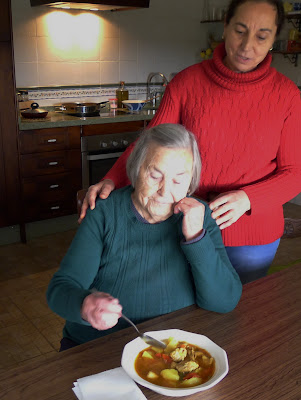
Reme serves a bowl of the cazuela to her mother, Francisca (Paca) Rey, 82, the source of many of the village recipes that Reme collected for her book. 


In her well-tended garden, Reme picks a bunch of acelgas (chard) for me to take home.
 
Sautéed Chard
Acelgas Rehogadas

Chopped chard is par-boiled then sautéed with garlic. 


Back in my kitchen with the bunch of chard from Reme´s garden, I found a recipe in her book for tortilla with sautéed chard.
 
Reme´s recipe notes that chard can be added to potajes (stews with legumes) in the same way as spinach. It’s also good simply sautéed with garlic, as a side dish with meat, chicken or fish or combined with eggs for a tortilla.


Serves 2-3 as a side.

1 bunch chard (½ pound)
2 cloves garlic, sliced
1 ½ tablespoons olive oil
Salt
Freshly ground black pepper

Wash the chard. Chop stems and leaves separately. Cook the stems in boiling salted water about 4 minutes. Add the leaves and cook until they are tender (about 4 minutes longer). Drain the chard well.

Heat the oil in a skillet. Add the garlic. When it begins to turn golden, add the chard. Season with salt and pepper. Sauté the chard on moderate heat until it is very tender and thoroughly heated. 

Chard Tortilla
Tortilla de Acelgas

Tortilla of chopped chard and eggs.

I added some diced cooked potato to this recipe. 

Serves 2.

Sautéed chard (above)
1 cooked potato, diced (optional)
3 eggs, beaten
Salt 
1 tablespoon olive oil

Mix chard and eggs.
In a bowl combine the cooked chard and potato, if using, with eggs. Season with salt. Heat the oil in a small non-stick skillet on moderate heat. Pour in the chard-egg mixture. Stir it a few times, then allow to cook until the eggs are almost set. Loosen the sides of the tortilla with a spatula. Place a flat plate on top of the skillet. Holding the plate tight with one hand, very carefully turn the skillet upside down, turning the tortilla out onto the plate. Slide the tortilla back into the pan to cook on the reverse side.

Lift an edge of the tortilla with a spatula and slide it out onto a serving plate. Serve the tortilla hot or cold.


Here are more traditional village recipes similar to the ones in Gastronomía Tradicional Mijeña:


Orange and Cod Salad (Salmorejo). This is the colorful salad that started Remedios on her recipe search. (Her version has green peppers too, even more colorful.) Elsewhere, the salad is called remojón or ensalada malagueña, but in our village it´s salmorejo--not the Córdoba salmorejo, which is a thick gazpacho cream.


Saturday, August 28, 2021

TAPAS—THEY'RE NOT LIKE THE OLD DAYS

Where are the tapas of yesteryear? The meatballs, croquettes and boquerones al natural? Even that old favorite, ensaladilla rusa? Traditional tapas, the ones I learned to love when I first came to live in Mijas pueblo, were nowhere to be found on a recent tapas excursion in the same town. 


With a friend visiting from the U.S., I made the rounds on the Ruta de la Tapa, the “tapa route,” of 11 participating bars (and a couple of ice cream shops), each offering a tapa and a glass of wine for €2.50 (about $2.95). Each bar served a fixed tapa—no choices.  

We managed to try five bars, enjoying the stroll through village streets and meeting up with others out for the occasion (Tuesdays and Thursdays through August). Of the five tapas sampled, only two somewhat resembled traditional tapas. 

Potato tortilla filled with peppers and mackerel.

Our first stop was Bóveda del Flamenco and the tapa Tortillada de Caballa. It was a not-quite-traditional potato tortilla that was split in half and filled with a mixture of sautéed red peppers and mackerel. Pretty good and the Verdejo white wine, totally quaffable. Good value for €2.50.


Pastry with shrimp.

The bar Tapintxo is a bright, modern establishment, white and glass walls hardly separating the (air-conditioned) interior from the tables outside. The tapa: Pastela de Marisco con Fideos, a brik pastry, dusted with powdered sugar, filled with shrimp and rice noodles in a slightly spicy sauce with a sprinkling of dill. Once the sugar was brushed off, it was tasty, but nothing about it was Andalusian.


Brochette chicken curry.

We doubled back to the Bar Porras, on the Plaza de la Libertad in the center of Mijas pueblo. The Porras is one of only two bars on the plaza (there once were five) that existed when I first set foot in the village (1966). It’s where I cut my teeth on tapas, at the bar and in the kitchen, collecting recipes from the women who prepared the tapas. To its credit, the bar still serves traditional dishes such as pescaito frito, a platter of fried fish. 

The tapa on the ruta: Pincho de Pollo al Curry, a brochette of chicken bites with curry sauce. The chicken was grilled to order and was delicious. But, curry sauce? The white wine was not quaffable. The waiter said, in effect, what did we expect for €2.50? (To its credit, the Bar Porras has some excellent wines, including Viña Tamisa, made in Mijas.


Mijas burro-taxis, heading home.


Wrap with chili con carne.
At Chema’s Terrace we sat at a table outdoors and watched the train of Mijas Burro-Taxis head home for the night after a day of carrying tourists around the village. The tapa here was Wrap de Chili con Carne, a flour tortilla enclosing a mixture of red kidney beans and meat, not unlike canned chili. It was nicely presented, but had absolutely no connection to anything typical of Mijas. (Tortilla wraps and chile are not Spanish.) Switching to chilled rosado (rosé) was a good move. (Footnote: this bar-restaurant is located on the entrance plaza to Mijas in an old building that once was La Malagueña, a pensión where I stayed for a couple weeks when I first arrived in Mijas in 1966.)


Lars tries chicken "Popeye."

Our tapas route finished at Bar Fiesta where the tapa presented was Cilindro de Pollo Popeye, a roll with chicken “Popeye.” Sure enough, spinach was the main ingredient!

My friend, Lars Kronmark, who is a chef-instructor at the Culinary Institute of America in St. Helena, CA., said it was the best tapa of the evening, multi-dimensional and the most integrated. I agreed. It was based on a very traditional dish, espinacas a la catalana, spinach with raisins and pine nuts. The spinach was mounded on a base of potato puree. Hidden beneath the spinach was a chicken cutlet. The spinach was topped with crisp bacon. José Moreno, owner of Bar Fiesta, said tapas have “evolucionado,” evolved, over the years. 


I suppose that, for the Ruta de la Tapa, each bar tries to be as original as possible to distinguish it from all the others. Same old, same old, meatballs just wouldn't cut it. (Participants who get their “tapaporte” stamped by all 11 establishments can vote for their favorite tapa.) Still, I was nostalgic for the tapas of yesteryear!

Spinach with Raisins and Pine Nuts, Potato Puree and Pork Cutlet
Espinacas con Pasas y Piñones, Puré de Patatas y Filete de Lomo

Potato puree on the bottom, a pork cutlet topped with spinach with raisins and pine nuts.

A garnish of crisp bacon and cooked quail's eggs.

This is my adaptation of the tapa served at Bar Fiesta. I used pork loin cutlets instead of chicken. A vegetarian version could be made using quail eggs. (To hard-boil quail eggs, cover them with water, bring to a boil and cook 3 minutes. Drain the eggs and cover them in cold water.)

The classic rendition of this dish is with Málaga muscatel raisins, which need to be seeded. You can use sultanas or any seedless raisin. 

Mediterranean pine nuts.

I’ve got a handful of pine nuts gathered from the tree beside my patio. They are difficult to crack and extract. And, apparently, this year they are scarce, because the ones in the market are a different variety, imported from China. 
Local pine nuts (left) and Chinese.

Makes 4 tapa servings.


For the potatoes:
1 pound potatoes
Salt
1 tablespoon olive oil
½ cup milk
Freshly ground black pepper
1/8 teaspoon smoked pimentón (paprika)

For the pork:
Olive oil
4 thick-cut slices of bacon
4 thinly sliced cutlets of pork loin
Salt and pepper
Pinch of oregano
Few drops of Vinegar

For the spinach:
14 ounces fresh spinach, stems trimmed
3 tablespoons olive oil
2 tablespoons pine nuts
1 clove garlic, chopped
2 tablespoons raisins
Salt and pepper

Garnishes
Hard-cooked quail eggs
Bread sticks or crisps

Peel the potatoes, cut them in chunks and cook in salted boiling water until they are very tender. Drain, saving about ½ cup of potato water (to use in thinning the puree).

Mash the potatoes with the oil. Stir in the milk, salt to taste, pepper and pimentón. Thin the mashed potatoes with enough potato water to make a smooth puree that can be easily spread. 

Put a few drops of oil in a small skillet and fry the bacon until browned on both sides. Remove. Season the pork cutlets with salt, pepper, oregano and vinegar. Brown them in the fat remaining in the skillet. They need only 1 minute per side. Remove

Sauté pine nuts, garlic and raisins.

Wash the spinach, if necessary, and chop it. In a large pan heat the oil and add the pine nuts on medium-high heat. When they begin to brown, add the garlic and raisins. Stir until garlic begins to turn golden. Add the spinach and, if spinach is very dry, 1 or 2 tablespoons of water. Season with salt and pepper. Cook, stirring to mix in the pine nuts and garlic, until the spinach is wilted and tender. 

Potato puree, pork cutlet.


To assemble: Place a large spoonful of potato puree on each plate and spread it to make a base. Place a cooked pork cutlet on top of the potato. (If making a vegetarian plate, omit the pork and imbed a cooked and peeled quail’s egg in the center of the puree.) Mound the spinach on top of the pork and potatoes. Garnish the plate with halved quails’ eggs and bread sticks.


More about tapas:
Tapa-Hopping Round Town  (The Ruta de la Tapa 11 years ago!)


Saturday, April 4, 2015

CON LAS MANOS EN LA MASA

Adding flour to the levadura madre, the starter dough for making bread. We are preparing dough for hornazos, bread rolls with eggs, a traditional Easter snack.
we
Con las manos en la masa-- Hands kneading dough to make traditional Easter breads, hornazos.      
Once the dough is kneaded until it is no longer sticky, Antonio Garcia shows the particpants how to pinch off pieces and shape them into small balls to enclose a raw egg.

Each person gets to shape the hornazos. Most are simple little rolls; others are boats, baskets, turtles. In my village, the hornozos are made of basic bread dough with a little matalahúga, aniseed. In other towns, they may have oil or lard, sugar or honey added. 

Many hands roll out the dough.

The rolls are covered and left in a warm place to rise. Here, an electric heater underneath is the heat source.

Antonio puts the first tray of hornazos into the wood-fired oven. This oven is similar to the traditional bread ovens.

Fresh out of the oven--a tray of hornazos, bread rolls with eggs.


The Mijas village tourism department gives away bags of hornazos to visitors on Palm Sunday and Easter Sunday.

Grist for the political mill. The current mayor of Mijas, Angel Nozal (Partido Popular), who is running for re-election next month, dumps wheat in the mill for grinding and gets his manos en la masa as well.

Freshly-ground wheat flour.

Hornazos, a typical Easter bread, with egg baked in the dough.

HAPPY EASTER!

Saturday, December 14, 2013

TIME OUT FOR TAPAS

Just when I was supposed to be slaving over a hot stove, preparing a recipe for this week’s blog, I got a phone call from Shawn Hennessey, “tapas queen,” my guide to tapas in Sevilla  (see her web site http://sevillatapastours.com/ and also my recent  blog post from Sevilla). She has been visiting Málaga and revisiting her favorite tapa bars there.

“I’m coming to Mijas! Can we meet at lunch for tapas?” I’m so excited that Shawn is meeting me on my own turf! (I live in Mijas.) So, of course, I drop everything.

Mijas is a small hill town overlooking the Mediterranean on Spain’s southern coast. It once had a dozen tapa bars in the casco antiguo, the old center. Of those, only two remain. But it has a dozen new bars, some mainly serving the day tourists, but others with ambitious wine lists and menus.

Bar Porras in the central plaza of Mijas.
We meet at the Bar Porras, on the Plaza de la Libertad, smack-dab in the center of town. Bar Porras is one of the original bars, where I learned Spanish cooking some 40 years ago.This is where I have coffee and read the newspaper most mornings after my aerobics class.

Shawn arrives with Victor Garrido, an independent tour guide who does in Málaga what Shawn does in Sevilla (http://www.welovemalaga.com/ ).

A plate of ham to begin our tapas lunch tour.
Having learned the tapa-tour-guide plan from Shawn, I immediately order a plate of ibérico ham and glasses of Manzanilla (fino Sherry). We are off to a good start.

We continue on to the Museo del Vino, just a short stroll up Calle San Sebastian. A historic village house was converted to be an enoteca, a wine museum, shop and bar with wine tastings. Seated at a big wooden tasting table, we are cozy on a nippy December day. In summertime, the little enclosed patio is the cool place for sipping. (http://www.museovinomalaga.org )

Cheese and a glass of Botani.

Shawn is delighted to find here her favorite white wine, the light and floral Botani, from Bodegas Jorge Ordoñez. The Museo del Vino specializes in wines from Málaga province. The wine pairs perfectly with a nutty, semi-cured cheese. We are served bread rolls and bread sticks and a dish of organic olive oil for dipping.

Grilled scallops and cherry tomatoes.


We share a tapa of grilled scallop brochettes with cherry tomatoes. A sprinkling of pimentón (paprika) and olive oil complements the sweetness of the shellfish. Likely the scallops are frozen—but they are, nevertheless, delicious.

A last stop before Shawn returns to Málaga to catch her train back to Sevilla. We perch on stools (not very comfortable) at Bodega El Placer, just off the central plaza. Touted as a “wine bar,” it seems to specialize in red wines and does not have Shawn’s favorite whites. 


Black squid croquette.

We sample several tapas here. I love the squid croquettes with a squid-ink alioli sauce. They are black and crispy on the outside, creamy on the inside. Think I will try this recipe myself one of these days.

Solomillo (pork tenderloin) is—in my opinion—too sweet with a fruit compote. The crispy langostinos tempura—jumbo shrimp, crisply fried—are divine, but again, a little too sweet in the saucing. Morcilla (blood sausage) doesn’t show any evidence of the raisins and pine nuts that  supposedly accompany it. The bacalao—salt cod—gratin is, uh, interesting, with its dusting of curry and turmeric, but again, with a layer of sweet compote that overwhelms the other flavors. What's with all the sweet sauces? They are not really traditional in Spanish cooking.

Ham, egg and crispy fried potatoes. Terrific!
The best dish of all? A perfect—perfect—fried egg. Estrellado—crispy around the edges, with straw potatoes, hot and crispy, and some meltingly tender scraps of fine ham. How to share this amongst three? Shawn, with enormous experience, proceeds to mix the egg, ham and potatoes all together.

Oh my god, that is so good. Thanks Shawn. Come back soon.

And, here's "tapas in Mijas" from Shawn's angle: http://azahar.me/2013/12/14/mijas-at-last/


Starting the tapas tour (photo by Shawn Hennessey)