Saturday, December 28, 2024

A MERRY LITTLE CHRISTMAS


Christmas morning. My grandson, Leo Searl, home from university, is spending a few days at my house. He makes breakfast on Christmas morning--smoked salmon on toast with cream cheese and scrambled eggs. What a pleasure to catch up with what's going on in his life.


What's in this strangely-shaped present under the tree for Ben?


Oh, wow! Look what's in my Christmas box! It's a sampler of ibérico ham, a selection of sliced ham, shoulder-ham, chorizo and cured fat from Dehesa Monteros, made from ibérico pigs of the Rubio Dorado breed. They start out eating chestnuts in the forests of Ronda and are finished on bellotas, wild acorns. 


Christmas lunch for three. On a sunny afternoon we started with sopa de galets, a rich chicken broth with giant pasta shells stuffed with pâté. Marinated "standing rib roast" of ibérico pork centered the main course, accompanied by potatoes and squash roasted with onions and apples. 

The pork loin has been boned to facilitate carving, but the rack of ribs tied back on for roasting to keep the meat moist. Ibérico pork with its marbling of fat is especially juicy. Ibérico pork is usually cooked medium-rare to medium--still pink in the center. (The recipe for the pork marinade is here.)


A side dish of chard sautéd with garlic, raisins and pine nuts was served in a colorful hand-made ceramic bowl by Tara Chapman, Leo's mum. 


I bought a kilo of locally-grown pecans, called nueces americanas, from a chica in my aerobics class. The pecans, which I adore, inspired me to make a nut torte just for me! It was sugar-free and gluten free as well. (I used this recipe for walnut torte, swapping King Arthur baking sugar substitute and gluten-free bread crumbs.) For the guys there were also fig brownies with real sugar, sweet figs and lots of nuts. Both desserts are good served with a dollop of rich Greek yogurt or whipped cream.
Pecan torte with a dollop of rich Greek yogurt.


From my kitchen to yours, MERRY CHRISTMAS TO ALL.

Saturday, December 21, 2024

PESTIÑOS, A SWEET FOR DUAL HOLIDAYS


For whatever holiday you're celebrating: pestiños are honey-glazed fried pastries.

This year both Christmas Eve and the first night of Hanukkah fall on December 24. This recipe for pestiños, honey-glazed fried pastries, is perfect for both holidays. 


In Spain, where nowadays most Christmas sweets are store-bought, pestiños are one of the few that are still homemade. Family and neighbors might gather on a chilly evening to roll, shape and fry pieces of a simple dough. Children can help with the dough, though frying is left to the grownups. 

Ready for 1st night of Hanukkah.
Hanukkah, the "festival of lights," is a Jewish holiday that marks the victory in the 2nd Century BCE of the Maccabees over an occupying force and the rededication of the Temple in Jerusalem and the re-lighting of the menorah. Miraculously, the olive oil for the menorah, enough for a single day, lasted for eight days and nights. For that reason the holiday is also a celebration of olive oil when it’s traditional to serve fried foods, both sweet and savory. 
Serve pestiños for a tree-trimming party.

How to serve pestiños? For a Hanukkah party serve the pestiños with pomegranate or grape juice (with or without vodka); mulled wine or hot apple cider. They're equally good for a Christmas tree-trimming party with eggnog.

In Spanish homes, when friends come to visit during the holidays, it’s typical to serve a platter of homemade sweets such as pestiños as well as store-bought mantecados and roscos, accompanied by sweet Málaga wine, aguardiente (anise liqueur) and Spanish brandy de Jerez. 

It's an occasion to catch up on family news and marvel at how much the children have grown, to view the Belén, Nativity scene, and compare recipes for for Noche Buena, the  Christmas Eve festive dinner.

Pestiños are also good for breakfast or afternoon snacks with coffee, hot chocolate, tea or herbal infusions. For dessert, serve pestiños alongside a winter compote of apples and pears stewed with raisins and figs. 

Honey-Glazed Fritters
Pestiños

Serve pestiños for breakfast, snacks, dessert, parties.

These little pastries are fried in oil then dipped in warmed honey to glaze them. Olive oil in the pastry dough is traditional and adds flavor. Olive oil also is best for frying but less expensive sunflower oil (aceite de girasol) can be used instead. 

After dipping the fritters in honey let them dry on a rack for 30 minutes. They will soak up some of the honey but will still be somewhat sticky. If you prefer not to finish them with honey, instead dredge them in sugar while they are still hot. Place the fritters on a rack to cool. 

The dough can be made several days before using and kept refrigerated. Once fried, the fritters are best soon after they are made but can be stored in an air-tight tin up to five days. 

Makes 40 fritters.

¼ cup extra virgin olive oil
1 strip of orange peel
1 teaspoon aniseeds
2 ¼ cups all-purpose flour plus additional for rolling out the dough
¾ teaspoon salt
¼ cup orange juice
¼ cup white wine
Oil for frying (olive or sunflower)
½ cup honey
2 tablespoons water
1-2 teaspoons toasted sesame seeds
Granulated sugar (optional)

Place the olive oil in a small saucepan with the strip of orange peel. Heat it until it begins to sizzle. Add the aniseeds and remove the pan from the heat. Let the oil stand 5 minutes. Skim out and discard the orange peel.

Cut dough in diamond shapes.


Place the flour in a mixing bowl and stir in the salt. Make a well in the center and pour in the oil with aniseeds. Stir some of the flour into the oil. Add the orange juice and wine and mix them into the flour.  

Turn the dough out onto a work surface and knead it until smooth. The oil in the dough keeps it from sticking, so additional flour probably is not needed. Divide the dough in half and wrap each half in plastic wrap. Refrigerate 1 hour or up to 2 days.

Pinch dough firmly.

Cover a sheet pan with baking parchment. Lightly flour work surface. Unwrap one of the balls of dough and pat to flatten it. Roll it out into more or less a rectangular shape 8 to 10 inches wide and as thin as a penny. Use a knife or pastry wheel to cut strips about 2 inches wide. Cut again on the diagonal, making diamond (rhomboid) shapes of dough. 

Pick up a piece and pinch together the two points that are closest together. Pinch firmly so the dough does not open when fried. Place each folded piece of dough on the sheet pan. Gather up any scraps and roll out again. Save a small bit of dough to use to test the oil temperature. (If desired the sheet of shaped dough can be refrigerated for several hours before continuing with the frying.)

Roll, cut and shape the second ball of dough in the same manner.

Put oil in a pan to a depth of 1 inch. Heat on medium-high. Drop a small ball of dough into the oil. When it begins to sizzle, the oil is hot enough (360ºF). Add the pieces of dough without crowding the pan. When golden-brown on the bottom, carefully flip them to brown the reverse sides. Skim out the fritters and drain on paper towels. Continue frying remaining pieces of dough.

Dip in warmed honey.

 Place the honey in a pan with the water. Bring it to a boil and remove from the heat. Set a rack over a sheet pan to catch drips. One by one dip the fritters into the warm honey. Place them on the rack. Sprinkle with sesame seeds. Allow the fritters to dry. They will soak up some of the honey but will still be somewhat sticky. Sprinkle with sugar if desired.


Recipes for winter compotes to serve with pestiños:


More fried pastries:


Saturday, December 14, 2024

VEGETARIAN CHORIZO

 When clouds and a winter chill descended on us this week, a pot of black beans seemed like a good idea. Usually I would throw a few links of chorizo in the pot along with vegetables. Chorizo is a powerful flavor pack. But because I was expecting a vegetarian guest for dinner, I decided to make vegetarian chorizo.
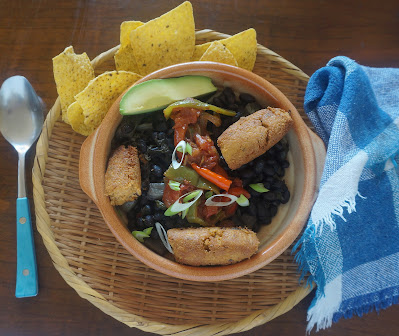

Black beans served with sautéed peppers and vegetarian chorizo sausages.


Garlic and pimentón give the vegetarian chorizo a taste a lot like the porky version.

I used tofu plus bread crumbs (gluten-free is fine) for the “meat” of the chorizo and olive oil instead of fatty panceta (belly bacon) for unctuousness. The seasoning was traditional—lots of smoked pimentón, garlic and a few other spices. And, plenty of salt. 

The vegetarian mixture could be stuffed into non-animal sausage casings, if available, making the resulting links more like real chorizo. Another alternative is to roll the mixture in cheesecloth or parchment.

Adding beaten egg to the sausage mixture helps to bind the ingredients so they don’t disintegrate in cooking. If you prefer a vegan sausage, eliminate the egg and, instead of rolling the mixture into sausage links, fry it “loose” or in small patties. 

My no-meat chorizo had good flavor and complemented the black beans nicely. But the texture was nowhere near the real thing. Tofu just doesn’t have much chew to it. I recently tasted some morcilla (blood sausage) that had finely chopped almonds in it. I think that would be good in the vegetarian chorizo, adding a little crunchiness to a sausage lacking in texture. 

Vegetarian Chorizo
Chorizo Vegetariano
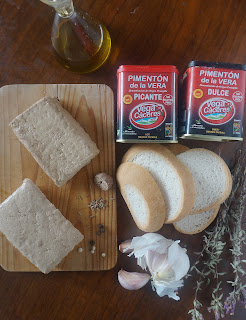
Tofu, bread, oil, garlic and spices.
Serves 4.

8 ounces firm tofu
2 cloves
1/8 teaspoon cumin seeds
¼ teaspoon black peppercorns
½ teaspoon coarse salt
1 clove garlic, coarsely chopped
2 teaspoons sweet (dulce) smoked pimentón (paprika)
½ teaspoon hot (picante) smoked pimentón
½ teaspoon oregano
2 slices day-old bread (1 ½ ounces)
½ cup coarsely chopped walnuts or almonds (optional)
3 tablespoons olive oil + additional to fry the chorizo
1 teaspoon soy sauce or miso paste
1 tablespoon lemon juice
Salt to taste
1 egg, beaten (optional)

Cut the block of tofu into 8 pieces. Place them on paper towels and cover with additional paper towels. Place a weight (such as a cutting board) on top and let the tofu drain 10 minutes.

In a mortar crush the cloves, cumin and peppercorns with the salt. Add the garlic and mash it. Add the two kinds of pimentón and oregano.
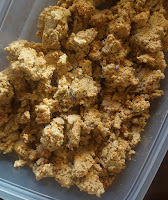
Grind tofu in food processor
Break up the tofu into a food processor. Break the bread into pieces and add to the processor with the mixture in the mortar, oil, soy and lemon juice. Grind these ingredients until well combined. Taste the mixture and add salt as needed (½ teaspoon or more).  If using egg, mix it in.
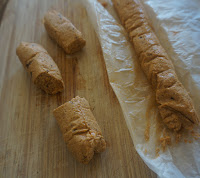
Roll sausages in parchment.

Shape the mixture into two logs approximately 8 inches long and 1 inch thick. Place each one on a strip of parchment. Roll the chorizo log up using the parchment to compact it. Twist the ends of the parchment to make a sausage roll. Chill the chorizo logs 24 hours.

Cut each sausage into four “links.” Poach them in boiling salted water 5 minutes and drain well. When ready to serve, pat the chorizos dry and fry them in hot oil to brown on all sides.  


Recipe for homemade pork chorizo is here.

If you need to refresh your knowledge about pimentón.