Showing posts with label spices. Show all posts

Saturday, December 20, 2025

SEASONED GREETINGS WITH VEGETABLES

 
Power to the beans! They are dressed with horseradish cream sauce.

Making a Christmas dinner for vegetarian friends one year, perhaps inspired by the thought of roast beef with accoutrements, I came up with the brilliant combination of green beans with horseradish cream. 


Seasoning vegetables with unexpected flavors is a good ploy for any special meal, whether vegetarian or meat-based. It gives them presence next to the turkey, roast beef, glazed ham or, why not, a vegetarian mushroom-rice loaf. Here are some of the ways I spice up the vegetables.

Wild fennel stems and seeds.
Spices and herbs. Use the familiar ones in new ways. Or use triple the quantity. For example, instead of a “grating of nutmeg,” try a whole spoonful of the warm spice with squash or in a béchamel sauce; instead of a sprinkle of "paprika" for garnish, use a heaping tablespoon of pimentón (paprika) mixed into a vegetable. Try out the spices that have been languishing on your shelf—poppy seeds, cardamom, coriander, fennel.

Spice and herb blends are especially good for punching-up the flavor of plain veggies. Try especia para pinchitos, a blend made for marinating the little brochettes you get in tapas bars. It’s similar to Moroccan ras el hanout, a blend of cumin, coriander, turmeric, ginger, and cayenne. Other blends to experiment with are Madras curry powder, Palestinian za’atar, American chile powder, Old Bay (celery, mustard, bay, pepper), and herbes de Provence (thyme, rosemary, savory).  

Dip into condiments to season vegetables—mustard, vinegar, pickles, Worcestershire sauce, soy sauce, miso, olives, capers, Tabasco, chile crisp. Use grated lemon or orange peel to add zest. Mashed anchovies or crisp bacon add oomph to bland vegetables. 

Green beans. Cooks have been trying to fancy-up beans ever since haricots amandine (with toasted slivered almonds). Horseradish (rábano picante) may seem exotic, but it really gives them zing! Stir 1-2 tablespoons prepared horseradish with 2 tablespoons cream, salt, and pepper. Either spoon the horseradish cream over cooked green beans or mix it with the cooked beans and reheat them together. Serve with grated lemon peel on top. Good alongside roast beef. Use skinny haricots or wide, flat beans (pictured at right), strings peeled and beans slivered.

Spinach with cumin and crumbs.
Spinach. I used to make little spinach timbales for holiday dinners, unmolded around the centerpiece roast. But my cooking has simplified over the years. Now I want a pop of flavor and no complications. Cumin is a spice that appears in many traditional Andalusian dishes, a flavor remnant from Moorish Spain. It's a very forward spice; if preferred, use ground cumin for a more subtle flavor. 

Here I have used it in a refrito, a quick-fried sauce. Heat 2 tablespoons extra virgin olive oil with ½ teaspoon cumin seeds and 1 clove crushed garlic until the seeds begin to darken. Remove from heat and add ½ teaspoon Sherry vinegar. Discard the garlic. Spoon the oil and seeds over cooked spinach and top with fried bread crumbs. Spinach with cumin is especially good as a side with roast lamb.

Broccoli is dressed with herbed vinaigrette.
Broccoli. The sauce for the broccoli is essentially a herb-inflected vinaigrette, but it can be served room temperature or heated. Cook broccoli florets until crisp-tender, about 4 minutes. Drain and refresh in ice water. Place 1 teaspoon herbes de Provence in a jar and add 1 tablespoon boiling water. Let sit 10 minutes. Add ½ teaspoon salt, 1 teaspoon Dijon mustard, 1 tablespoon Sherry vinegar, 1 clove crushed garlic, and ¼ cup extra virgin olive oil. Cap the jar and shake well until sauce is emulsified. Pour over cooked broccoli or combine with the broccoli and reheat briefly. Tip: Vinegar will leach out the bright green of cooked vegetables, so combine sauce and broccoli immediately before serving. (Makes enough sauce for 8 ounces of florets.) Broccoli with herbs would complement roast pork.

Cauliflower escabeche can be served hot or cold.
Cauliflower. Escabeche is a very old method of conserving fish, meat, or vegetables in a vinegar marinade. Nowdays escabeche is prepared for flavor rather than as a preservative. This marinated cauliflower with fennel can serve as a cold dish with salad greens or be reheated in the marinade. Be sure to drizzle the cauliflower with additional olive oil before serving. Marinated cauliflower goes nicely with whole roasted salmon. I've used stems and seeds from wild fennel, but you can use sliced fennel bulb instead.
Marinate cauliflower.
Place ¼ cup of olive oil in a large pan. Spread ½ cup julienned onions, ½ cup red bell pepper cut in strips, and 1 sliced carrot in the pan. Cook on medium heat 5 minutes. Do not let the vegetables brown. Add 4 cups cauliflower florets (about 18 ounces). Sprinkle with 1 ½ teaspoons salt, 2 cloves slivered garlic, sprigs of wild fennel or sliced fennel bulb, peppercorns, and coriander seeds. Tuck lemon slices and bay leaf in the cauliflower. Pour over ½ cup white wine vinegar and 1 cup boiling water. Bring the mixture to a boil, reduce heat, cover the pan, and cook until cauliflower can be easily piereced with a knife, about 15 minutes. Let the cauliflower cool in the pan. Place cauliflower, vegetables, and marinade in a jar and allow to sit overnight. Serve hot or cold. (Tip; don't use red onion in the marinade, as the vinegar will leach out the color, turning the cauliflower slightly pink. The red peppers are not affected by the vinegar.)

Spiced rutabaga with pumpkin seeds.
Rutabaga. Root vegetables—rutabaga (also known as "Swede" and "neep," nabo sueco in Spanish); parsnips (chirivia); turnips (nabo), carrots (zanahorias), sweet potatoes (boniatos)—are enhanced with sweet spices such as cinnamon or are complemented with herbal flavors such as sage. (Although not root vegetables, pumpkin and squashes fit nicely into this category of sweet, earthy vegetables.) I’ve used two of my favorite spices—ginger and cardamom. The cooked rutabaga is crushed, not pureed, then mixed with spices, olive oil, and Greek yogurt. It can be reheated in the oven or microwave. Spiced rutabaga is a good side with roast chicken or duck or with pot roast. 

Peel and cut into cubes 20 ounces of rutabaga (about half of a big one—you may need an axe to split it!) Cook the cubed vegetable in boiling salted water with a 3-inch strip of orange peel until it is soft enough to mash, about 20 minutes. In a mortar crush ½ teaspoon coarse salt, 12 peppercorns, 6 cardamon pods with husks removed, and 1 teaspoon chopped fresh ginger. Drain the rutabaga, discarding the orange peel. Use a potato-masher to crush the rutabaga, adding 2 tablespoons extra virgin olive oil and ¼ cup Greek yogurt. Stir in the spices and combine well. Add salt to taste. Reheat before serving garnished with pumpkin seeds.

Brussels sprouts with Moroccan spices.
Brussels sprouts. Why are sprouts always part of a holiday dinner? I’m guessing it’s because they are so seasonable (pun intended), coming into the market at exactly this time. Sprouts sautéed with diced bacon may be the absolute best way to season them, but if bacon isn’t part of your meal plan, here’s a spicy alternative. The sprouts can be roasted in the oven (30 minutes at 400ºF) or cooked in boiling, salted water and drained. The spiced Brussels sprouts would sparkle next to roast turkey.

Heat 2 tablespoons olive oil in a skillet. Add 2 sliced shallots, 1 tablespoon slivered almonds, and (optional) ½ cup peeled and diced apple and sauté until shallots are softened, 5 minutes. Do not let them brown. Stir in 1 teaspoon ras el hanout spice blend or pinchito spice and 1 tablespoon chopped preserved lemon (Moroccan salted lemon). Add the cooked Brussels sprouts. Add a spoonful of water if needed so the sprouts don’t scorch. Heat well before serving. 

Potato latkes with pimentón.
Potatoes. How many ways are there to make roast or mashed potatoes? A spoonful of pimentón de la Vera, smoked Spanish paprika, which comes sweet, bittersweet, and picante-hot, will transform potatoes—roasted or mashed. Pimentón, probably the most popular spice in Spanish cooking, is also a brilliant addition to potato latkes. 

Double-mashed potatoes.


Here's a link to a recipe for Double-Mashed Potatoes with Pimentón (patatas revolconas) and 10 more ways to season the sides for Christmas dinner. 


HAPPY HOLIDAYS


There's much more about spices and herbs and how to season vegetables in my new cookbook, FLAVORS OF AL-ANDALUS, The Culinary Legacy of Spain. 

FLAVORS OF AL-ANDALUS 
The Culinary Legacy of Spain

Here's the ideal gift for the cooks in your life--FLAVORS OF AL-ANDALUS, The Culinary Legacy of Spain. This is a fresh angle on the traditional cooking of Spain, with 120 recipes that can trace their roots to Moorish Spain. See below for where to order. 

This cookbook explores the fascinating story of the deep and lasting influences that Islamic culture has left on modern Spanish cooking. 
Author and Spanish cooking expert Janet Mendel tells the story of the Moorish influence on Spanish cooking through 120 recipes and photographs for modern-day dishes, from salads and vegetables to fish, poultry and meat to sweets and pastries, that trace their heritage to foods served in medieval times. Dishes from this era include exotic spices such as saffron, the use of fruits and almonds with savory dishes, and honeyed sweets and pastries. The flavors of al-Andalus live on in modern Spanish cooking and are what makes Spain’s cuisine distinctive from the rest of Europe. (Hippocrene Books)    


 Order on IndiePubs (USA) 

Use PROMO CODE HIPPOCRENE40 for 40% off on all Hippocrene titles at IndiePubs online bookstore.


Saturday, October 28, 2017

THE SPICE THAT’S CUMIN IN


On a Moroccan table, not salt and pepper, but salt and cumin.

“Pass the salt and pepper, please” said one of my tablemates at our first meal in Morocco. I passed him two small ramekins, one a salt cellar and the other, presumably, containing pepper.


“Not pepper!” he exclaimed. “What is it? Sort of like curry.” I tasted. Cumin, comino, in Spanish. After salt, cumin is the most prevalent seasoning in Moroccan food. It’s added to many dishes during cooking and it’s placed on the table for each person to add according to taste.


Whole cumin seeds and ground cumin. Toast the whole seeds and add, sparingly, to potatoes, beans, legumes.
Cumin is the whole or ground seeds of a plant belonging to the same family as parsley, dill and caraway. Its aroma is pungent, nutty. Its taste, slightly bitter, warm and earthy. A native of south Asia and the Middle East, the spice has found its way into cuisines right around the world, especially in spice blends such as Moroccan ras el hanout; Indian garum masala and curry; Tex-Mex chili powder, and Latin American adobo. It’s often a cohort of hot chile.

I’m always exploring connections between cooking styles and cultures. So, of course I noted that cumin is a spice also used in Andalusia, the region of Spain just across the Mediterranean from Morocco. (So close that, on a clear day, I can see the mountains of North Africa from my kitchen window.)

For instance, the tapa bar favorite, pinchitos, spicy mini-kebabs, is spiced almost identically to the brochettes grilled by street vendors in Morocco, heavy on the cumin, with a little heat from chile. In Málaga and Cádiz, pinchitos are usually made with pork, while in Tangier, just across the narrow Straits of Gibraltar, they are made with lamb or beef.

Cumin even turns up in some versions of gazpacho. It’s used in that favorite Sevilla dish, espinacas con garbanzos, spinach with chickpeas, as well as with lentils and black-eyed peas. Surprisingly, a hint of cumin appears in Andalusian braised vegetables, such as asparagus, artichokes, fava beans and pumpkin.

The Andalusia-North Africa connection is more than just proximity. The “Moors” who ruled Al-Andaluz for seven centuries were Arabs and Berbers from North Africa. They left an indelible mark on the cuisine, customs and language of southern Spain. (Spanish words such as almendras, almonds; albóndigas, meatballs, and aceite, oil, all derive from Arabic.)


This Andalusian vegetable dish seasoned with cumin is a little like Moroccan tagine.

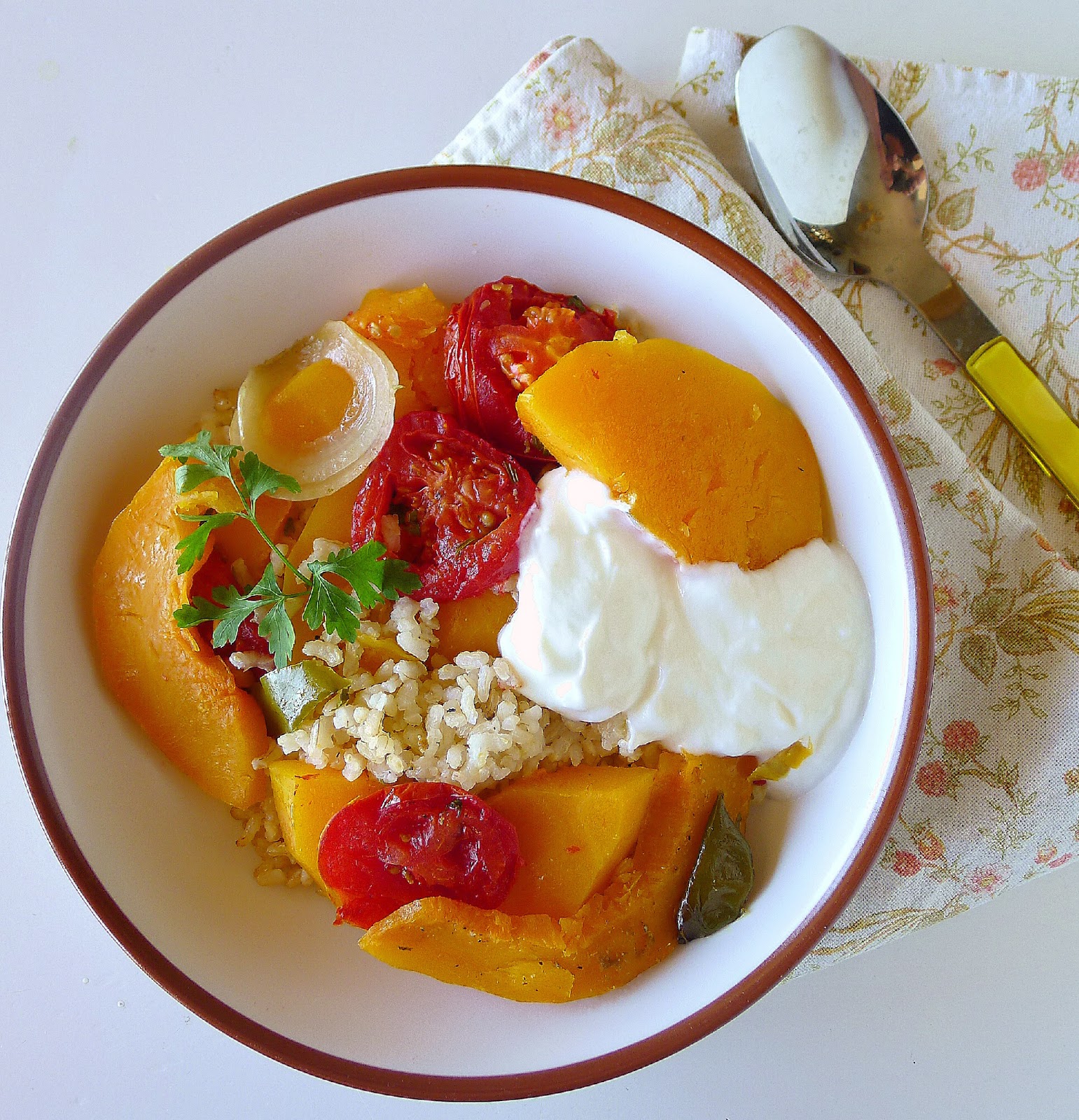
I’ve been cooking a lot of Moroccan food since I returned from a week’s travels there (see the previous four blog posts for recipes). But this week I’m looking for cumin connections in Andalusian food. This is a village recipe—calabaza guisada, or stewed pumpkin—that reminds me a little of tagine, the Moroccan stew of vegetables and meat.

Brown rice makes this vegetable melange a vegetarian main dish.

A dollop of yogurt is a good addition to rice with butternut squash.


Butternut squash in my garden.
The Spanish recipe calls for pumpkin, peppers, onion and tomatoes to be layered in a pan and simmered or baked until tender. I’ve turned the dish into a vegetarian main course, by baking all the veggies on top of a layer of brown rice. I’ve used butternut squash from the garden instead of the more traditional pumpkin.


Baked Squash with Rice
Calabaza Guisada con Arroz


1 ½ cups brown rice
6 cups water
Salt
2 pounds butternut squash
3 plum tomatoes, sliced
1 onion, sliced
2 green peppers, cut in strips
3 cloves garlic, chopped
1 bay leaf
1 tablespoon chopped parsley
½ teaspoon cumin
Freshly ground black pepper
1 tablespoon Sherry vinegar
¼ cup olive oil
1 cup boiling water
Greek yogurt to serve (optional)

Cook the rice in 6 cups of boiling water with 1 teaspoon salt for 8 minutes. Drain. (Rice can be par-boiled in advance of assembling the casserole.)

Preheat oven to 375ºF. 

Cut the squash in half, remove seeds and peel. Slice it crosswise ½ inch thick. Spread the drained rice in the bottom of a lightly oiled cazuela or oven casserole. Layer the sliced squash, tomatoes, onion, green peppers and garlic on top of the rice. Break the bay leaf into pieces and tuck them among the vegetables. Sprinkle with parsley, cumin, salt to taste and pepper. Drizzle over the vinegar and oil. Pour over the boiling water.

Cover the casserole with a lid or foil and bake until squash is tender, about 75 minutes.

Serve hot or room temperature with a dollop of yogurt, if desired.


Some more Andalusian dishes spiced with cumin:

Saturday, April 25, 2015

RABBIT COOKED IN THE MEDIEVAL STYLE

A couple weeks ago I was cooking Chicken Marbella in which the chicken roasts with prunes. I commented then that chicken cooked with fruit is an unusual combination in Spanish cuisine--except for dishes in the medieval style. That inspired me to go searching through my recipe files for an example and I found this gorgeous way to cook rabbit in a sweet and sour sauce with figs and lots of spices. (The recipe appears in my book COOKING FROM THE HEART OF SPAIN—FOOD OF LA MANCHA, published by Wm. Morrow in 2006.)

Rabbit cooked, Mudéjar style, with figs and medieval spices.
Now that the Easter bunny season is behind us, it’s a good time to cook rabbit. Almost all rabbit is farm-raised and available year-round. It’s a lean, white meat with a delicate flavor.

This recipe comes from Toledo, a city in La Mancha (central Spain). Still enclosed by ancient walls and monumental gates, the old town of narrow, cobbled streets preserves much of its medieval character. Inhabited over the centuries by Romans (the ruins of a Roman circus, one of the largest of the Empire, lies just outside the walls); Visigoths (at least one church originally was Visigothic); Sephardic Jews (two synagogues remain in the old Jewish quarter); Arabs and Berbers (a 10th century mosque is preserved), and Christians, who built an astonishing cathedral and dozens of convents and monasteries, Toledo is at once monumental and intimate.

Toledo cathedral.
The Muslim Arabs (Moors) took Toledo in 712. When King Alfonso VI wrested control of the city in 1085, many of the Moors opted to stay under Christian dominion. Called Mudéjars—meaning “permitted to remain”—they had an enormous influence on architecture, building churches, synagogues and civic buildings in the graceful Mudéjar style, with its low towers, horseshoe arches, plaster, tile, and wood decorations.

The Toledo School of Translators flourished, bringing together Arab, Hebrew, and Latin scholars who translated Greek philosophy, Persian literature, Arabic medicine into Latin and Spanish.

The Mudéjar influence permeated the style of cooking as well, bringing exotic spices from eastern lands into Spanish cooking. This rabbit dish, perfumed with cinnamon, clove, aniseed and saffron, is a delicious example.


Seasonings used in medieval cooking. Clockwise from bottom left: thyme with flowers, mint, pine nuts, shelled and unshelled; almonds; green almonds; figs; nutmeg; ginger root, cinnamon sticks; bay leaves; rosemary, and parsley. On the tray in the center: top row from left: peppercorns, caraway seeds, cumin seeds and aniseeds. In the center, saffron. Bottom row, from left, coriander seeds, black mustard seeds and cloves.
Steep the whole spices and figs in the cooking liquid, then strain the liquid and add to the rabbit. Don’t overcook rabbit; as it is very lean, it easily becomes dry. If rabbit comes with the liver, sauté it and mash to a paste to thicken the sauce. If liver is not available, the sauce can be thickened with a little flour, if desired.

If rabbit is not an option, make this recipe with bone-in half chicken breasts. Serve the rabbit with rice or cous cous and minted carrots.


Rabbit with Figs and Mudéjar Spices
Conejo con Higos al Estilo Mudéjar

A subtle sweet and sour sauce complements delicate rabbit, here served with rice and minted carrots.
Serves 4.

1-2 tablespoons honey (preferably rosemary honey)
¼ cup Sherry vinegar
1-inch piece fresh ginger, cut in half
¼ teaspoon black peppercorns
¼ teaspoon coriander seeds
¼ teaspoon mustard seeds
1/8 teaspoon aniseeds
1-inch piece of cinnamon
3 cloves
2 cups water
12 dried figs, stems removed
Sprigs of mint, thyme and parsley
¼ teaspoon saffron threads, crushed
¼ cup hot water
¼ cup olive oil
1/3 cup blanched almonds
3 cloves garlic
1 rabbit, 2 ½ to 3 pounds, cut into 8 pieces
Rabbit liver, cut up (optional)
Salt
Freshly ground black pepper
½ cup finely chopped onion
½ cup white wine


Combine the honey, vinegar, ginger, peppercorns, coriander, mustard, aniseeds, cinnamon, and clove in a saucepan with 2 cups water. Bring to a boil and simmer 5 minutes. Remove from heat and add the sprigs of herbs and the figs. Cover and let them macerate at least 2 hours.

Crush the saffron in a mortar. Add ¼ cup of hot water and let it steep at least 15 minutes.

In a cazuela or large sauté pan heat the oil and fry the almonds and garlic until they are lightly golden. Skim them out and reserve.

Add the rabbit pieces and liver, if using, to the hot oil and sauté on medium heat until they are lightly browned on all sides. (Remove the liver pieces, if using.) Add the chopped onion and continue sautéing.

Put the fried almonds, garlic and liver, if using, in a blender with the wine and process to make a smooth paste.

With a slotted spoon, remove the figs from the spiced liquid and reserve them. (Don’t worry if some spices cling to the figs.) Strain the liquid and reserve it. Discard the spices and herbs. Add 1 ½ cups of the spice liquid to the rabbit with the saffron. Stir in the almond paste. Season with salt and pepper. Cover and simmer 20 minutes. Add the figs to the rabbit and cook until rabbit is tender, another 15 to 20 minutes.

Rabbit--the other white meat. 

More rabbit recipes here:
Rabbit in Wine Marinade (Conejo al Salmorejo), http://mykitcheninspain.blogspot.com.es/2012/10/hunting-season-opens-at-supermarket.html

Rabbit, Sierra-Style (Conejo a la Serrana), http://mykitcheninspain.blogspot.com.es/2014/03/rabbit-other-white-meat.html

Rabbit with Beans and Pasta (Conejo con Gurullos) http://mykitcheninspain.blogspot.com.es/2010/07/thyme-on-my-hands.html http://mykitcheninspain.blogspot.com.es/2010/07/thyme-on-my-hands.html