Showing posts with label ñora. Show all posts

Saturday, April 1, 2023

THE ITERATIONS OF A COD SALAD

 
A Catalan springtime salad with salt cod, tuna, olives and a romesco dressing.

And, suddenly, it is spring! I’ve moved from soup to salad in the space of a week. Because it’s also the start of Semana Santa, Holy Week leading to the Easter festival, I am having my annual bacalao fest. 


Bacalao is dry salt cod. This year I have simplified prep by purchasing a package of bacalao desalado y desmigado—salt cod that has already been desalted and separated into small pieces. (See below for how-to proceed if you’re starting out with whole pieces of salt cod.) I looked to Catalonia for the salad inspiration.

Following are three salad recipes that all include cod. You can make each one separately or you can make a double portion of the first, simple, iteration and morph it into the more complex salads. 

The first iteration: esqueixada is shredded cod with chopped tomatoes and spring onions, studded with olives, dressed with extra virgin olive oil.


Ringing the changes: this is empedrat, meaning "cobblestones," so called because the salad is studded with cobbles of beans, olives, diced cod. 

Add chunks of tuna and strips of anchovies to the basic cod salad and serve it on a bed of escarole with a dressing of romesco sauce. This is xató, the same salad pictured at the top of the page.


Shredded Cod Salad
Esqueixada de Bacalao

Esqueixada looks a little like “exquisite,” but in fact means “shredded”—what you do to the salt cod after it has been desalted by soaking. 

Scraps of desalted cod for salad.
In theory, desalted cod does not need cooking, but I prefer to simmer it briefly to soften it and to eliminate any off-flavors. Add the desalted cod to simmering water for 1 minute. After draining well, pick through the scraps of cod to make sure there are no bits of bones remaining. 

If good salad tomatoes are not available this early in the season, try using cherry tomatoes in this salad. 

To emphasize the Catalan flavor, use Catalan Arbequina olive oil and olives and a Penedès (or cava) white wine vinegar.

Serves 4 as a starter.

1 (packed) cup pieces of desalted cod (8 ounces)
1 large tomato
1 or 2 spring onions or several scallions (½ cup chopped)
3 tablespoons extra virgin olive oil
½ tablespoon white wine vinegar
Salt to taste
½ cup pitted black olives

First variation:
¼ cup diced green bell pepper
¼ cup diced red bell pepper

Bring a pan of water to a boil. Reduce heat to a simmer. Add the cod and simmer 1 minute. Drain the cod, refresh in cold water and let it drain well in a colander. Pick through the pieces of cod, removing any bits of skin or bone and pull the flesh into bite-size pieces.

Peel tomatoes for salad.
Peel the tomato and cut it into small dice. Place the tomato in a bowl. Slice or dice the onions or scallions and add to the tomatoes. Add the shredded cod, saving a few larger pieces to garnish the salad. Add the oil, vinegar and salt to taste. Mix in the olives. Chill the salad.

To serve, spread the salad on a platter. Place a few larger pieces of cod on top. 

Same salad with added green and red peppers.


The first variation of the salad calls for the addition of diced green and red pepper to the tomatoes and spring onion mix. They add color and crunch.


“Cobblestone” Salad with Cod and Beans
Empedrat

Add cooked white beans and hard-cooked eggs to the original cod salad for a substantial lunch dish.

In Catalonia, this would be made with small white beans called mongetes. Any white beans or black-eyed peas can be used. If using canned beans, drain and rinse them before dressing with oil and vinegar. Make the esqueixada salad, above, with the olives. Add it to the beans and garnish with hard-boiled eggs. A new iteration. This would make a good lunch salad.

Serves 4.

2 cups cooked and drained white beans
1 clove garlic, minced
3 tablespoons extra virgin olive oil
1 tablespoon white wine vinegar
Salt
Freshly ground black pepper
Finely chopped parsley
2 cups of esqueixada cod and tomato salad (recipe above)
2 hard-boiled eggs

Place the beans in a bowl. Add the garlic, oil and vinegar. Season to taste with salt and pepper. 

Immediately before serving, add 1 tablespoon parsley to the beans. Spread the beans on a platter. Spoon the esqueixada (cod, tomatoes, onions, olives) over the beans. Cut the eggs in half and garnish the platter. Sprinkle with additional parsley.

Cod and Tuna Salad with Romesco Dressing
Xató


This salad includes some of the same ingredients as the original esqueixada—cod, tomatoes, olives—with the addition of tuna and anchovies. They are spread on a bed of escarole and dressed with romesco sauce. 

Romesco dressing for the xató salad.
For the romesco dressing:
Make this sauce with all almonds or, if you like hazelnuts, use part almonds, part hazelnuts. It’s customary to toast them lightly, giving them depth of flavor and making them easier to grind in a mortar. (I quit on the mortar and switched to the food processor.) 

The basic recipe makes a thick, heavy sauce. To make it easier to mix with salad ingredients, thin the romesco with water. (The un-thinned sauce makes a sensational dip, for chips or celery sticks.)

Ñoras are a dried, bittersweet pepper (not hot). Reconstitute them by cooking/soaking, then scraping the pulp from inside the peppers. If ñoras aren’t available, use a heaping tablespoon of pimentón (sweet paprika) stirred to a paste in 2 tablespoons of water. 

The romesco dressing can be made in advance and kept at room temperature for 1 day. If to be stored longer, refrigerate, covered, but bring to room temperature before using.

Almonds and ñora peppers.

2 ñoras (see above for substitution)
½ cup almonds and hazelnuts
1 slice baguette
2 tablespoons white wine vinegar
2 cloves garlic
½ teaspoon salt
Pinch of cayenne
Pinch of dried mint
1/3 cup extra virgin olive oil
¼ to ½ cup ñora liquid or water, to thin the sauce

Scrape pulp from ñoras.
Remove stems and seeds from the ñoras. Place them in a small pan with water, bring to a boil and simmer 5 minutes. Remove the pan from the heat and allow the ñoras to soak 1 hour.

Skim the ñoras out, saving the liquid. Spread the ñoras open on a cutting board. Scrape the pulp from the shells. Discard the skins. Chop the pulp.

Lightly toast the almonds and hazelnuts in a small skillet. Place the slice of bread in a small bowl and add the vinegar. Soak the bread until it is softened. Squeeze it out and discard the vinegar.

Grind the almonds/hazelnuts in a mortar or food processor. Add the pulp from the ñoras (or the pimentón paste), the garlic, salt, cayenne and mint. Process until smooth. Add the oil and process until emulsified. Add enough liquid to thin the sauce to the consistency of heavy cream.

For the xató salad:
You can use the Esqueixada salad (recipe above) with its cod, tomatoes and olives. Use a slotted spoon to add it to the greens so the excess dressing doesn’t thin the romesco.Otherwise, start with pieces of cod and add tomatoes and olives.

Escarole or other salad greens
1 cup esqueixada or pieces of desalted cod
½ cup drained chunks of light tuna
Anchovy fillets
Black olives
Sliced tomatoes
Romesco dressing

Spread the escarole on a platter. Scatter the pieces of cod and tuna on top. Add strips of anchovies, olives and tomatoes.  Top with spoonfuls of romesco dressing or serve the dressing separately for each person to mix with the salad.

Mix the romesco dressing with the greens and pieces of fish.
---     ---     ---     ---     ---     ---     ---     ---     ---     ---     ---     ---     ---     ---     ---    

A whole split of bacalao--dry salt cod.

To prepare bacalao from scratch:
Start desalting the salt cod one to three days before you intend to use it (less time for smaller pieces). Scrape off surface salt and wash the fish in running water. Put it in a bowl and cover with water. Soak the bacalao, covered and refrigerated, 24 to 48 hours, changing the water three times a day. Each time you change the water, wash the fish under running water, squeeze it gently and wash out the container.

After soaking, place the pieces of bacalao on a clean towel and cover with another to soak up excess water. Remove scales and bones. The skin may be required for some dishes, as its gelatinous quality thickens the sauce. Big chunks are usually cooked whole, but scraps can be cooked, de-boned and used in fritters, fish balls and salads.

More recipes with romesco:


Another "cobblestones" recipe (plus links to eight more bacalao recipes):

Another salad with salt cod:

Sunday, February 19, 2012

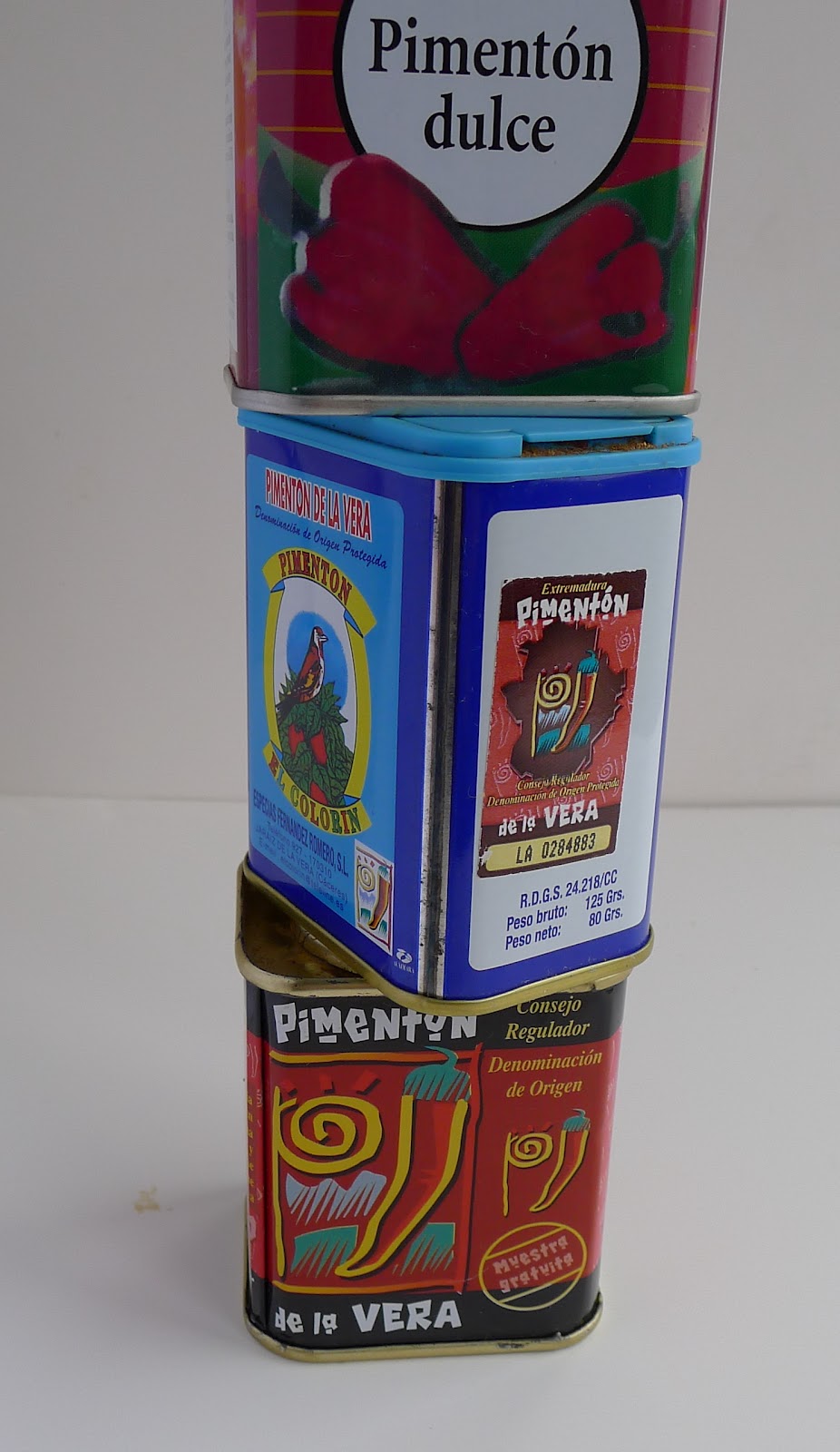
PIMENTÓN, IN TRANSLATION

Pimentón is an ingredient that pops up over and over in Spanish recipes. (See last week’s post about chorizo.) Pimentón is, simply, Spanish for “paprika”.

So why don’t I just call it paprika? Because the Spanish word is so much closer to the origin of this spice than is paprika—a word of Serbian origin. Here’s the pimentón creation story.

Pimentón is produced from the capsicum annuum pepper, the chile, discovered by Columbus on his first trip to the New World. He was looking for the “Indies,” the source of “pepper,” pimienta in Spanish. When he found the hot-tasting capsicum, Columbus called it pimiento, from which derives “pimentón”.

Columbus carried peppers and other New World fruits back to Spain, where they were cultivated by monks in various abbeys. The Hieronymite monks at the Yuste monastery in La Vera (Extremadura) were the first to dry the peppers and use the powder as a flavoring and food preservative. They shared with brother-monks at the monastery in La Ñora (Murcia).

Supposedly Emperor Charles V, when he abdicated the Spanish throne in 1555 and retired to the Yuste monastery, got to like the spice (he was a notorious gourmand) and recommended it to his sister, Queen Mary of Hungary (which roped in parts of Serbia). That’s where it became known as “paprika,” the Serbo-Croatian word for “pepper”.

 Which still doesn’t explain why the English-speaking world calls it “paprika” rather than “pimentón.” More Hungarian immigrants to US shores? You can see why I stick to the word “pimentón.”

Pimentón is made from choricero peppers (left) and ñoras.
So, how is it produced? Pimentón is made from dried red peppers which, depending on the cultivar, can be sweet, bittersweet or hot (picante). After drying, the peppers are milled—ground—to a fine powder. The most used peppers are the choricero, elongated, and the ñora or bola, a sort of mini bell pepper, about the size of a plum. Both are sweet to bittersweet.

Pimentón is produced both in Murcia, in eastern Spain, and in the La Vera region of Extremadura in western Spain.

In Murcia, in eastern Spain, the hot, dry Mediterranean climate allows the peppers to be sun-dried (or, industrially, dried with hot air).

In autumn when the peppers ripen in La Vera, early rains in the Atlantic climate of Extremadura make sun-drying impossible. So, the peppers are smoke-dried 10 to15 days over smouldering chunks of wild holm oak. From the smoking sheds they’re carried to the milling factory where they are stone-ground to red powder. The slow smoking fixes the natural carotenoid pigments of the peppers, producing an intensely red spice. It also adds an ineffable natural smokiness that complements many foods.

So, pimentón de la Vera (which has DO, denominación de origen) is smoked paprika. Pimentón de Murcia (which has DOP, denominación de origen protegida) is not smoked. They are both “pimentón.” Both come as dulce, sweet; agridulce, bittersweet, and picante, spicy-hot.

Dulce—sweet pimentón—is, by far, the most widely used spice in Spanish cooking. Sweet pimentón, smoked or unsmoked, is the most versatile, while the bittersweet adds complexity to a dish. The spicy-hot is piquant and flavorful, but not as fiery as cayenne.

In Spain, the lion’s share of pimentón goes to the sausage-making industry. The most emblematic Spanish sausage, garlicky chorizo, is colored and flavored with it.

Pimentón is widely used in home cooking too and not just a sprinkle for color. Heaping tablespoons of it go into sauces where it provides richness of flavour. In Extremadura, La Vera pimentón is the preferred type. Elsewhere in Spain, unsmoked pimentón is used lavishly, even in paella and other rice dishes.

Use Spanish pimentón, smoked or unsmoked, in any recipe calling for paprika. It gives a little flamenco flounce to Hungarian goulash. Use the La Vera spice, with its earthy, smoky aroma, in barbecue sauces, marinades and spice rubs. The spicy-hot version adds pizzazz to beans and lentils, gratin dishes, seafood cocktail sauces. The hot stuff is a wake-up call for humble devilled eggs or potato salad.

Scrape pulp from choricero peppers.
In cooking with pimentón, stir it into a little water and blend smooth before adding to a sauce. Or stir it into hot oil—off the heat—before incorporating liquid ingredients. Take care not to scorch pimentón, else it becomes bitter. If using pimentón on barbecued food, add it during the last few minutes of grilling, so that it doesn’t burn.

Store pimentón tightly covered and protected from light.

To use dried choricero or ñora peppers instead of pimentón, remove stems and seeds from the peppers, then soak them in boiling water until softened. Open the peppers and scrape the pulp from the inside.

Monkfish in pimentón sauce.
Fish in Pimentón Sauce
Pescado al Pimentón


This can be made with any solid-fleshed fish, such as monkfish or skate. The sour juice of bitter oranges gives punch to the sauce.

Serves 4.

1 ½ pounds fish fillets
salt
3 slices bread, crusts removed
4 cloves garlic
2 tablespoons sweet or bittersweet pimentón (not smoked)
1 teaspoon oregano
½ cup white wine
1 ½  cups fish stock or water
3 tablespoons olive oil
4 medium potatoes, thickly sliced
2 teaspoons Sherry vinegar or sour orange juice
12 mussels, steamed open
chopped flat-leaf parsley to garnish


Cut the fish fillets into 3-inch pieces. Sprinkle with salt and let set for 30 minutes, then pat the fish dry.

Soak the bread in water to cover until softened. Squeeze it out and put in a blender with the garlic, pimentón, oregano and wine. Blend until smooth.

Heat the oil in a cazuela or skillet. Sauté the pieces of fish about 1 minute on each side. The fish does not need to brown. Remove. Add the potatoes to the cazuela and turn them in the oil for 3 minutes.

 Pour over the blended pimentón sauce. Add the fish stock or water. Simmer until the potatoes are almost tender, 20 minutes. Add the fish to the pan and cook in the sauce for 10 minutes, or until fish flakes easily. If sauce thickens too much, add additional broth or water.

Add the vinegar or orange juice and cook 2 minutes more. Garnish with the steamed mussels. Sprinkle with chopped parsley and serve in the same cazuela in which the fish cooked.

Friday, September 17, 2010

A GOOD SAUCE HALLOWS ANY CAUSE


ROMESCO SAUCE

A simple baked potato, a heap of green beans, cooked artichoke, chicken breast or succulent grilled shrimp—a good sauce will improve any one of those easy-to-prepare foods.

And, from the repertoire of Spanish sauces, there is none more hallowed than romesco, a Catalan sauce of toasted nuts, dried red peppers, garlic and olive oil.

Although originally a sauce from Tarragona (Catalonia’s second city after Barcelona, having nothing to do with the herb tarragon), romesco is popular everywhere in Catalonia. It accompanies calçotada, grilled spring onions with butifarra sausage. It also makes a cook-in sauce for fish and shellfish stew or chicken.

The principal ingredient is the ñora pepper, a plum-shaped, bittersweet dried pepper with crinkly skin. Traditionally the sauce was confected by grinding the all the ingredients in a marble mortar. Now it’s quickly made in a blender or food processor.

Ñora peppers are used to make pimentón (paprika). So, if you have not got peppers to confect this sauce, substitute pimentón/paprika (but, not smoked pimentón). You can use almonds and/or hazelnuts—I like both. Fry them until crisp so that they grind up better. Often a not-too-sweet cookie, called galleta María, is used along with the nuts to thicken the sauce. If not available, use fried bread.

Every Catalan claims to have some secret touch to making a perfect romesco—a few drops of anisette or brandy, dried mint, roasted tomato. The essential ingredient is extra virgin olive oil, preferably a fine Catalan arbequina oil.

Romesco is an all-purpose sauce that can accompany hot or cold foods. Serve it with boiled vegetables, grilled shellfish, poached fish or charcoal-grilled spring onions. If you are serving it with seafood, use fish stock to thin the sauce. Otherwise, add just enough water to make a sauce the consistency of pouring cream. Unthinned, use it as a dip with raw vegetable dippers.The sauce keeps, refrigerated, for several days.

Romesco
Catalan Red Pepper Sauce


Makes 1 ¼ cups.

2 tablespoons pimentón (paprika)
4 tablespoons red wine
2/3 cup extra virgin olive oil
12 skinned almonds
12 skinned hazelnuts
1 slice bread, crusts removed, or 3 María cookies
3 cloves garlic
Pinch of dried mint
2 tablespoons wine vinegar
Pinch crushed red chile flakes
Salt
Water or fish stock (about ¼ cup)


Stir the pimentón and red wine together to make a paste.

In a small skillet, heat 2 tablespoons of the oil and fry the almonds, hazelnuts, bread and garlic until bread is toasted. Remove and transfer them to a blender or food processor with the pimentón paste, mint, vinegar, chile and salt. Blend to a smooth paste. Gradually blend in the remaining oil. Add enough water to thin the sauce to the consistency of thick cream.